Genesis 46
Brenton Septuagint Translation · Tap a verse to see its cross-references.
Jacob’s Journey to Egypt
1And Israel departed, he and all that he had, and came to the well of the oath; and he offered sacrifice to the God of his father Isaac. 2And God spoke to Israel in a night vision, saying, Jacob, Jacob; and he said, What is it? 3And he says to him, I am the God of thy fathers; fear not to go down into Egypt, for I will make thee there a great nation. 4And I will go down with thee into Egypt, and I will bring thee up at the end; and Joseph shall put his hands on thine eyes. 5And Jacob rose up from the well of the oath; and the sons of Israel took up their father, and the baggage, and their wives on the waggons, which Joseph sent to take them. 6And they took up their goods, and all their property, which they had gotten in the land of Chanaan; they came into the land of Egypt, Jacob, and all his seed with him.
Those Who Went to Egypt
7The sons, and the sons of his sons with him; his daughters, and the daughters of his daughters; and he brought all his seed into Egypt.
The Children of Leah
8And these are the names of the sons of Israel that went into Egypt with their father Jacob—Jacob and his sons. The first-born of Jacob, Ruben. 9And the sons of Ruben; Enoch, and Phallus, Asron, and Charmi. 10And the sons of Symeon; Jemuel, and Jamin, and Aod, and Achin, and Saar, and Saul, the son of a Chananitish woman. 11And the sons of Levi; Gerson, Cath, and Merari. 12And the sons of Judas; Er, and Aunan, and Selom, and Phares, and Zara: and Er and Aunan died in the land of Chanaan. 13And the sons of Phares were Esron, and Jemuel. And the sons of Issachar; Thola, and Phua, and Asum, and Sambran. 14And the sons of Zabulun, Sered, and Allon, and Achoel. 15These are the sons of Lea, which she bore to Jacob in Mesopotamia of Syria, and Dina his daughter; all the souls, sons and daughters, thirty-three.
The Children of Zilpah
16And the sons of Gad; Saphon, and Angis, and Sannis, and Thasoban, and Aedis, and Aroedis, and Areelis. 17And the sons of Aser; Jemna, Jessua, and Jeul, and Baria, and Sara their sister. And the sons of Baria; Chobor, and Melchiil. 18These are the sons of Zelpha, which Laban gave to his daughter Lea, who bore these to Jacob, sixteen souls.
The Children of Rachel
19And the sons of Rachel, the wife of Jacob; Joseph, and Benjamin. 20And there were sons born to Joseph in the land of Egypt, whom Aseneth, the daughter of Petephres, priest of Heliopolis, bore to him, even Manasses and Ephraim. And there were sons born to Manasses, which the Syrian concubine bore to him, even Machir. And Machir begot Galaad. And the sons of Ephraim, the brother of Manasses; Sutalaam, and Taam. And the sons of Sutalaam; Edom. 21And the sons of Benjamin; Bala, and Bochor, and Asbel. And the sons of Bala were Gera, and Noeman, and Anchis, and Ros, and Mamphim. And Gera begot Arad. 22These are the sons of Rachel, which she bore to Jacob; all the souls eighteen.
The Children of Bilhah
23And the sons of Dan; Asom. 24And the sons of Nephthalim; Asiel, and Goni, and Issaar, and Sollem. 25These are the sons of Balla, whom Laban gave to his daughter Rachel, who bore these to Jacob; all the souls, seven. 26And all the souls that came with Jacob into Egypt, who came out of his loins, besides the wives of the sons of Jacob, even all the souls were sixty-six. 27And the sons of Joseph, who were born to him in the land of Egypt, were nine souls; all the souls of the house of Jacob who came with Joseph into Egypt, were seventy-five souls.
Jacob Arrives in Egypt
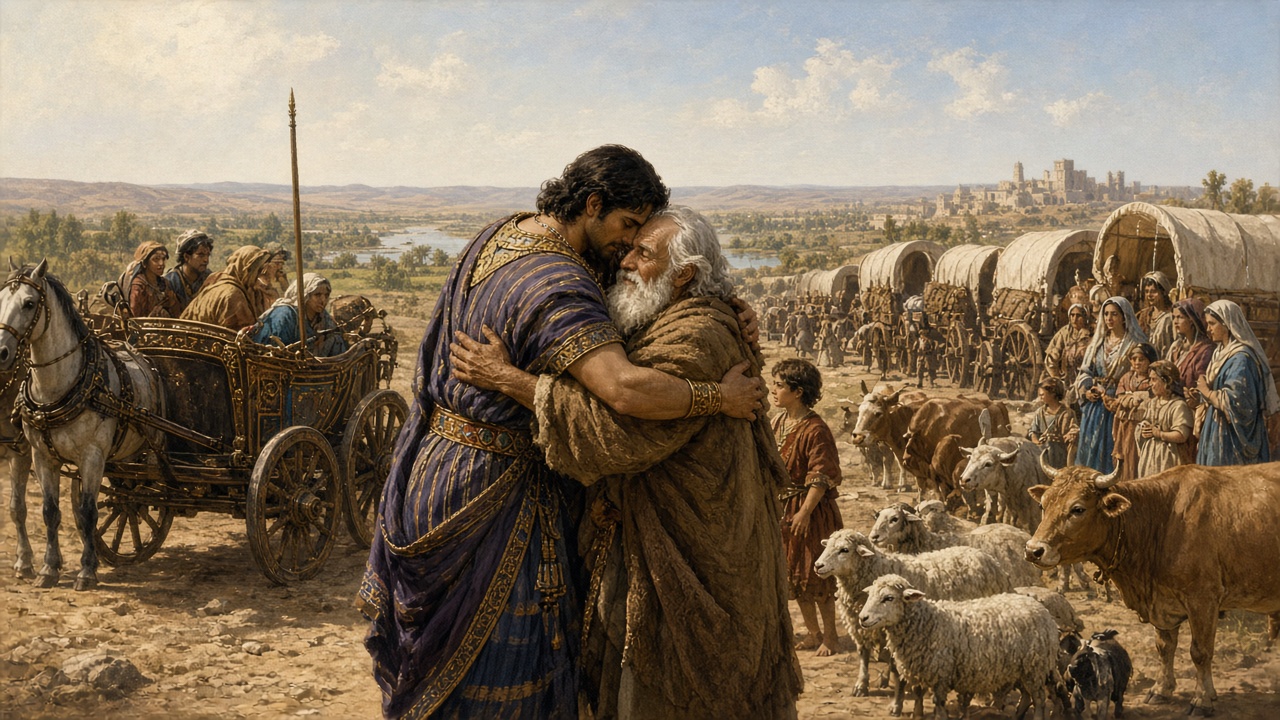
28And he sent Judas before him to Joseph, to meet him to the city of Heroes, into the land of Ramesses. 29And Joseph having made ready his chariots, went up to meet Israel his father, at the city of Heroes; and having appeared to him, fell on his neck, and wept with abundant weeping. 30And Israel said to Joseph, After this I will gladly die, since I have seen thy face, for thou art yet living. 31And Joseph said to his brethren, I will go up and tell Pharao, and will say to him, My brethren, and my father's house, who were in the land of Chanaan, are come to me. 32And the men are shepherds; for they have been feeders of cattle, and they have brought with them their cattle, and their kine, and all their property. 33If then Pharao call you, and say to you, What is your occupation? 34Ye shall say, We thy servants are herdsmen from our youth until now, both we and our fathers: that ye may dwell in the land of Gesem of Arabia, for every shepherd is an abomination to the Egyptians.
Did you know?
Israel Goes Down to Egypt
- As Israel set out for Egypt with all that he had, he stopped at Beersheba and offered sacrifices to the God of his father Isaac. Beersheba, meaning well of the oath or well of seven, was a well Abraham dug and named after a compact with Abimelech; when Isaac reopened it, he gave it the same name. It was a favorite dwelling of both patriarchs, and there that night God spoke to Jacob in a vision, telling him not to fear going down to Egypt, for he would make him a great nation there.Sources: the Bible text itself · Beersheba
- Jacob sent Judah ahead to Joseph for directions to Goshen, an Egyptian district east of the Nile, apparently near the royal residence, where the family remained until the Exodus. Easton's Bible Dictionary (1897) calls it the best of the land, now a desert, and also the land of Rameses. Joseph told his brothers to say they had raised livestock from youth, so they might settle there, because shepherds were detestable to the Egyptians; that dictionary suggests Pharaoh was probably Apopi, last of the Hyksos, who welcomed these Asiatic shepherds, while native Egyptians abhorred them, though some argue Joseph arrived later, under Thothmes III, after the Hyksos were expelled.Sources: the Bible text itself · Goshen · Pharaoh (of Joseph)
- The chapter counts sixty-six of Jacob's direct descendants who came to Egypt, not counting the wives of his sons, and seventy when Joseph's two sons already born in Egypt are included. Leah's sons and her daughter Dinah are named in that tally, although Easton's Bible Dictionary (1897) says Leah herself had died in Canaan before the journey and was buried in the cave of Machpelah; Rachel had died earlier giving birth to Benjamin and was buried on the way to Ephrath, that is, Bethlehem. Manasseh and Ephraim were born to Joseph in Egypt by Asenath, daughter of Potiphera, priest of On, a center of sun-worship that the Septuagint and Vulgate call Heliopolis.Sources: the Bible text itself · Leah · Rachel · On
Notes written with AI assistance from open sources (Theographic Bible Metadata, CC BY-SA 4.0; Easton’s Bible Dictionary, public domain) and reviewed before publishing.
Places in this chapter
- Egypt · 30.129, 31.308 · verses 1, 3, 4, 5, 6, 7, 8, 20, 26, 27
- Canaan · 32.767, 35.333 · verses 6, 12, 31
- Heliopolis · Today: Ain Shams · 30.129, 31.308 · verse 20
- Goshen · Today: Goshen 1 · 30.799, 31.834 · verses 28, 29, 34
Only places identified with high confidence are shown (90% or more according to the scholarly sources compiled by OpenBible). Period map: DARE (Digital Atlas of the Roman Empire), CC BY 4.0; modern map: © OpenStreetMap contributors; places: OpenBible.info (CC BY 4.0).
Credits and license for this translation
Translation of the Greek Septuagint into English by Sir Lancelot Charles Lee Brenton
Published in 1851, and now in the Public Domain.
If you find errors in the text, please report them so that we can correct them.
Section headings adapted from the Berean Standard Bible (public domain); they are not part of this translation’s text.
Source: http://ebible.org/eng-Brenton/ · eBible.org