Genesis 39
Brenton Septuagint Translation · Tap a verse to see its cross-references.
Joseph and Potiphar’s Wife
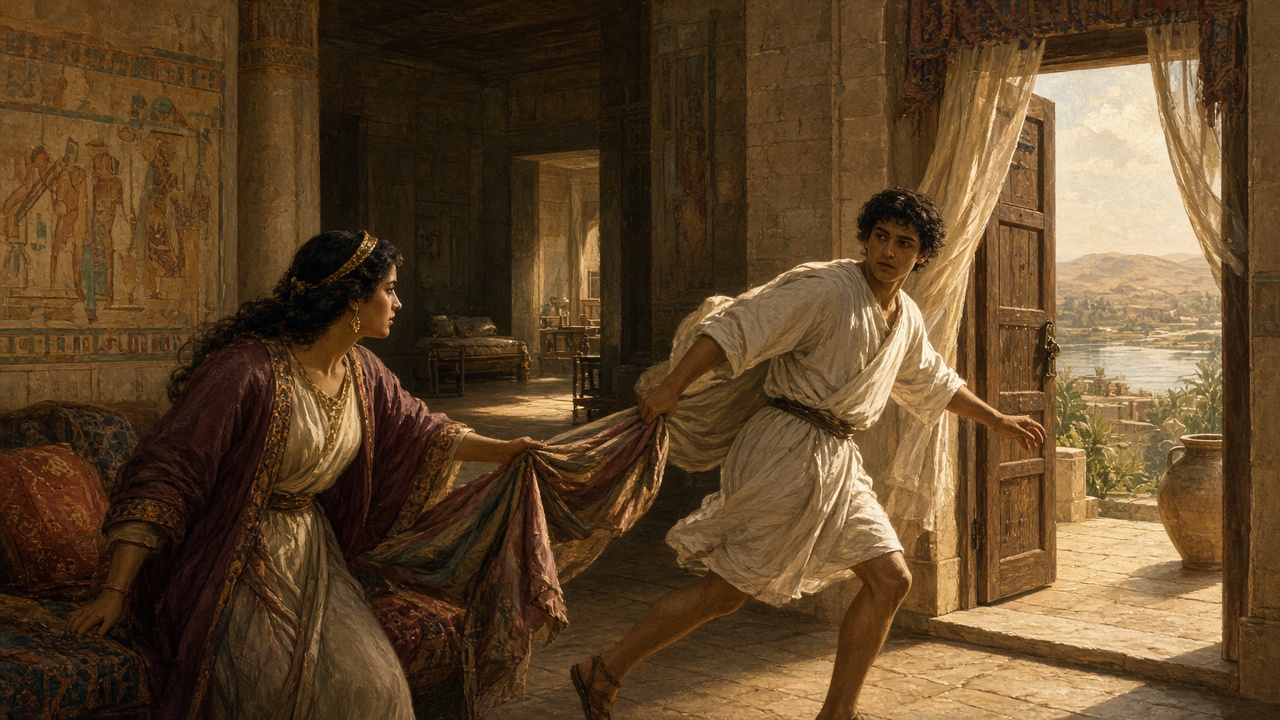
1And Joseph was brought down to Egypt; and Petephres the eunuch of Pharao, the captain of the guard, an Egyptian, bought him of the hands of the Ismaelites, who brought him down thither. 2And the Lord was with Joseph, and he was a prosperous man; and he was in the house with his lord the Egyptian. 3And his master knew that the Lord was with him, and the Lord prospers in his hands whatsoever he happens to do. 4And Joseph found grace in the presence of his lord, and was well-pleasing to him; and he set him over his house, and all that he had he gave into the hand of Joseph. 5And it came to pass after that he was set over his house, and over all that he had, that the Lord blessed the house of the Egyptian for Joseph's sake; and the blessing of the Lord was on all his possessions in the house, and in his field. 6And he committed all that he had into the hands of Joseph; and he knew not of anything that belonged to him, save the bread which he himself ate. And Joseph was handsome in form, and exceedingly beautiful in countenance. 7And it came to pass after these things, that his master's wife cast her eyes upon Joseph, and said, Lie with me. 8But he would not; but said to his master's wife, If because of me my master knows nothing in his house, and has given into my hands all things that belong to him: 9and in this house there is nothing above me, nor has anything been kept back from me, but thou, because thou art his wife—how then shall I do this wicked thing, and sin against God? 10And when she talked with Joseph day by day, and he hearkened not to her to sleep with her, so as to be with her, 11it came to pass on a certain day, that Joseph went into the house to do his business, and there was no one of the household within. 12And she caught hold of him by his clothes, and said, Lie with me; and having left his clothes in her hands, he fled, and went forth.
Joseph Falsely Imprisoned
13And it came to pass, when she saw that he had left his clothes in her hands, and fled, and gone forth, 14that she called those that were in the house, and spoke to them, saying, See, he has brought in to us a Hebrew servant to mock us—he came in to me, saying, Lie with me, and I cried with a loud voice. 15And when he heard that I lifted up my voice and cried, having left his clothes with me, he fled, and went forth out. 16So she leaves the clothes by her, until the master came to his house. 17And she spoke to him according to these words, saying, The Hebrew servant, whom thou broughtest in to us, came in to me to mock me, and said to me, I will lie with thee. 18And when he heard that I lifted up my voice and cried, having left his clothes with me, he fled and departed forth. 19And it came to pass, when his master heard all the words of his wife, that she spoke to him, saying, Thus did thy servant to me, that he was very angry.
20And his master took Joseph, and cast him into the prison, into the place where the king's prisoners are kept, there in the prison. 21And the Lord was with Joseph, and poured down mercy upon him; and he gave him favour in the sight of the chief keeper of the prison. 22And the chief keeper of the prison gave the prison into the hand of Joseph, and all the prisoners as many as were in the prison; and all things whatsoever they do there, he did them. 23Because of him the chief keeper of the prison knew nothing, for all things were in the hand of Joseph, because the Lord was with him; and whatever things he did, the Lord made them to prosper in his hands.
Did you know?
Joseph in Potiphar's House
- Potiphar, the Egyptian who bought Joseph from the Ishmaelites, has a name explained as “dedicated to Ra,” the sun-god. He was an officer of Pharaoh and captain of the guard—probably chief of the state police, who formed part of the army but were also largely employed in civil duties. A marginal note on Genesis 37:36 calls that same office “chief of the executioners.”Sources: Potiphar · the Bible text itself
- Believing his wife’s accusation, Potiphar had Joseph thrown into the prison where the king’s prisoners were confined. One reference says he remained there for some years, and a chronology dates the start of that imprisonment to 1717 BC, with a duration of three years.Sources: Potiphar · Joseph imprisoned · the Bible text itself
- The Pharaoh whom Potiphar served is not named in this chapter. One reference holds that the Pharaoh of Joseph’s days was probably Apopi, or Apopis, the last of the Hyksos kings, while some argue that Joseph came to Egypt in the reign of Thothmes III, long after the Hyksos had been expelled.Sources: Pharaoh (of Joseph) · the Bible text itself
Notes written with AI assistance from open sources (Theographic Bible Metadata, CC BY-SA 4.0; Easton’s Bible Dictionary, public domain) and reviewed before publishing.
Places in this chapter
- Egypt · 30.129, 31.308 · verse 1
Only places identified with high confidence are shown (90% or more according to the scholarly sources compiled by OpenBible). Period map: DARE (Digital Atlas of the Roman Empire), CC BY 4.0; modern map: © OpenStreetMap contributors; places: OpenBible.info (CC BY 4.0).
Credits and license for this translation
Translation of the Greek Septuagint into English by Sir Lancelot Charles Lee Brenton
Published in 1851, and now in the Public Domain.
If you find errors in the text, please report them so that we can correct them.
Section headings adapted from the Berean Standard Bible (public domain); they are not part of this translation’s text.
Source: http://ebible.org/eng-Brenton/ · eBible.org