Ezekiel 2
Brenton Septuagint Translation · Tap a verse to see its cross-references.
Ezekiel’s Call
1This was the appearance of the likeness of the glory of the Lord. And I saw and fell upon my face, and heard the voice of one speaking: and he said to me, Son of man, stand upon thy feet, and I will speak to thee.
2And the Spirit came upon me, and took me up, and raised me, and set me on my feet: and I heard him speaking to me. 3And he said to me, Son of man, I send thee forth to the house of Israel, them that provoke me; who have provoked me, they and their fathers, to this day. 4And thou shalt say to them, Thus saith the Lord. 5Whether then indeed they shall hear or fear, (for it is a provoking house,) yet they shall know that thou art a prophet in the midst of them.
6And thou, son of man, fear them not, nor be dismayed at their face; (for they will madden and will rise up against thee round about, and thou dwellest in the midst of scorpions): be not afraid of their words, nor be dismayed at their countenance, for it is a provoking house. 7And thou shalt speak my words to them, whether they will hear or fear: for it is a provoking house.
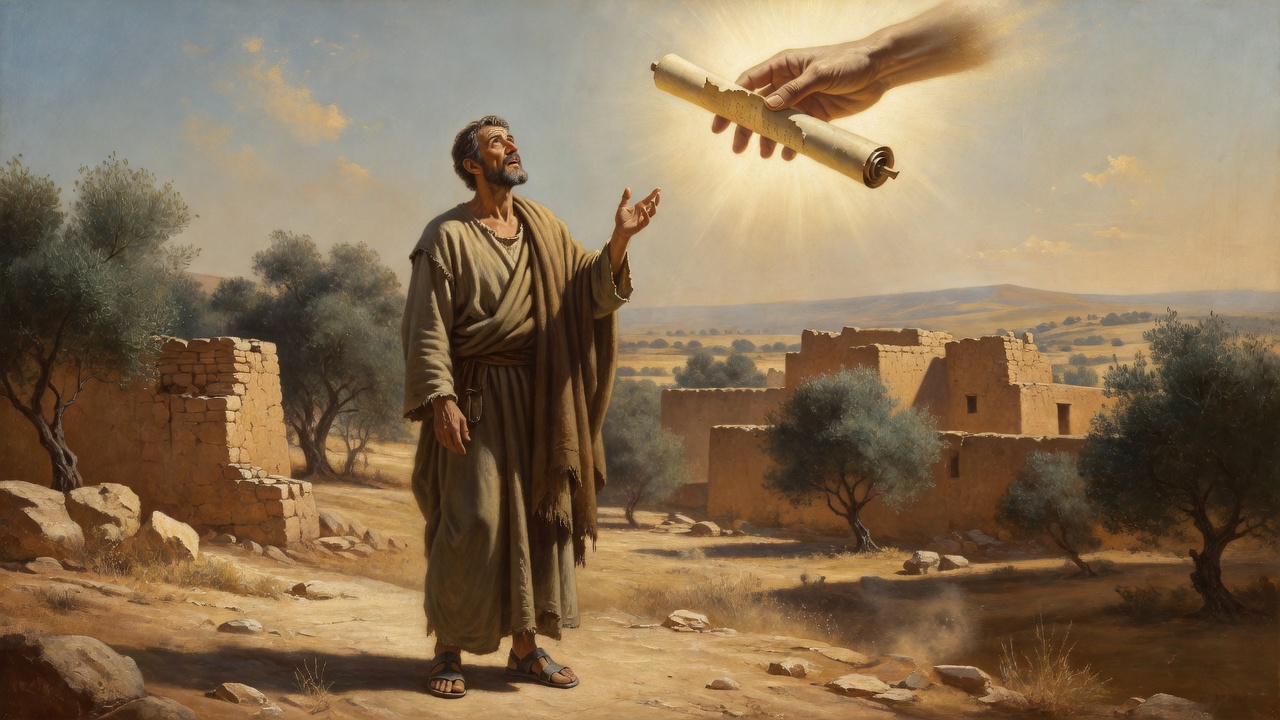
8And thou, son of man, hear him that speaks to thee; be not thou provoking, as the provoking house: open thy mouth, and eat what I give thee. 9And I looked, and behold, a hand stretched out to me, and in it a volume of a book. 10And he unrolled it before me: and in it the front and the back were written upon: and there was written in it Lamentation, and mournful song, and woe.
Did you know?
Ezekiel's Commission and the Written Scroll
- In this vision, Ezekiel is repeatedly addressed by the title 'son of man' and is empowered by the Spirit to stand and receive a divine commission to speak to the rebellious house of Israel.Sources: the Bible text itself
- Ezekiel's recorded prophetic ministry began in approximately 592 BC and extended over a period of about 23 years.Sources: Prophecies of Ezekiel
- The scroll presented to the prophet was written on both the front and the back, filled completely with words of lamentation, mourning, and woe.Sources: the Bible text itself
Notes written with AI assistance from open sources (Theographic Bible Metadata, CC BY-SA 4.0; Easton’s Bible Dictionary, public domain) and reviewed before publishing.
Credits and license for this translation
Translation of the Greek Septuagint into English by Sir Lancelot Charles Lee Brenton
Published in 1851, and now in the Public Domain.
If you find errors in the text, please report them so that we can correct them.
Section headings adapted from the Berean Standard Bible (public domain); they are not part of this translation’s text.
Source: http://ebible.org/eng-Brenton/ · eBible.org