Deuteronomy 9
Brenton Septuagint Translation · Tap a verse to see its cross-references.
Assurance of Victory
1Hear, O Israel: Thou goest this day across Jordan to inherit nations greater and stronger than yourselves, cities great and walled up to heaven; 2a people great and many and tall, the sons of Enac, whom thou knowest, and concerning whom thou hast heard say, Who can stand before the children of Enac? 3And thou shalt know to-day, that the Lord thy God he shall go before thy face: he is a consuming fire; he shall destroy them, and he shall turn them back before thee, and shall destroy them quickly, as the Lord said to thee. 4Speak not in thine heart, when the Lord thy God has destroyed these nations before thy face, saying, For my righteousness the Lord brought me in to inherit this good land. 5Not for thy righteousness, nor for the holiness of thy heart, dost thou go in to inherit their land, but because of the wickedness of these nations the Lord will destroy them from before thee, and that he may establish the covenant, which the Lord sware to our fathers, to Abraam, and to Isaac, and to Jacob.
6And thou shalt know to-day, that it is not for thy righteousnesses the Lord thy God gives thee this good land to inherit, for thou art a stiff-necked people.
The Golden Calf
7Remember, forget not, how much thou provokedst the Lord thy God in the wilderness: from the day that ye came forth out of Egypt, even till ye came into this place, ye continued to be disobedient toward the Lord.
8Also in Choreb ye provoked the Lord, and the Lord was angry with you to destroy you; 9when I went up into the mountain to receive the tables of stone, the tables of the covenant, which the Lord made with you, and I was in the mountain forty days and forty nights, I ate no bread and drank no water. 10And the Lord gave me the two tables of stone written with the finger of God, and on them there had been written all the words which the Lord spoke to you in the mountain in the day of the assembly. 11And it came to pass after forty days and forty nights, the Lord gave me the two tables of stone, the tables of the covenant. 12And the Lord said to me, Arise, go down quickly from hence, for thy people whom thou broughtest out of the land of Egypt have transgressed; they have gone aside quickly out of the way which I commanded them, and have made themselves a molten image.
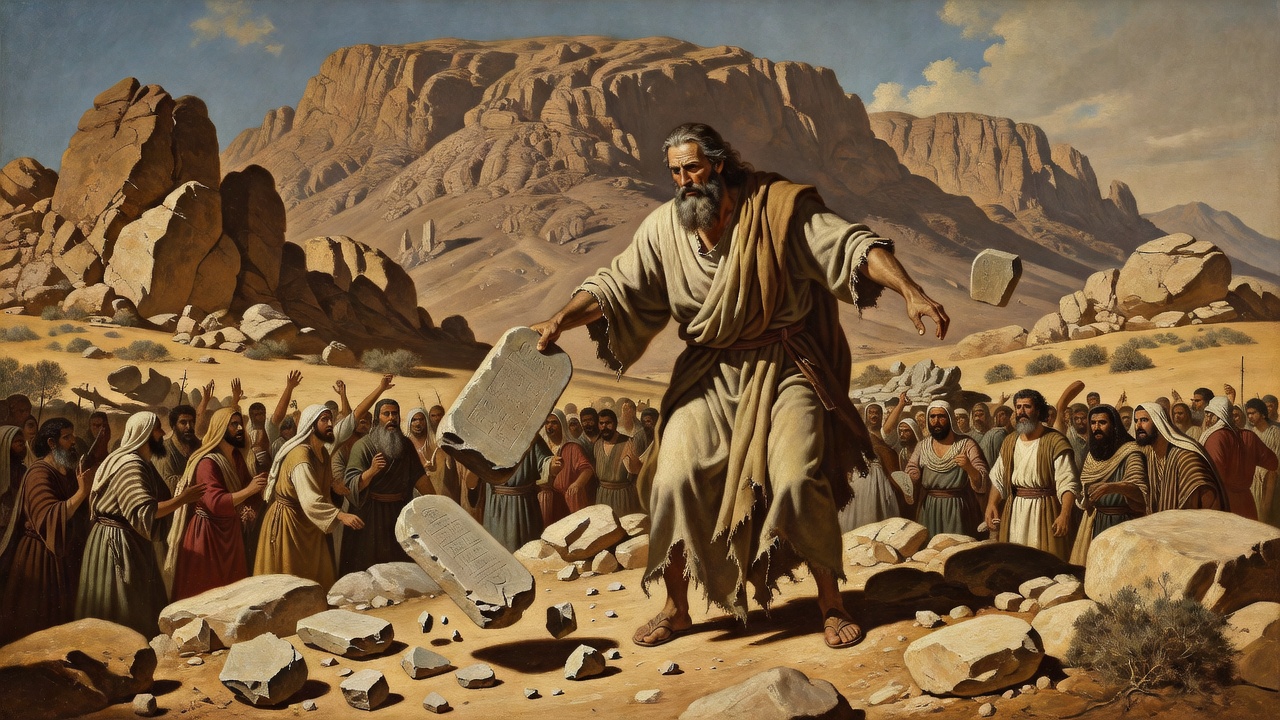
13And the Lord spoke to me, saying, I have spoken to thee once and again, saying, I have seen this people, and, behold, it is a stiff-necked people. 14And now suffer me utterly to destroy them, and I will blot out their name from under heaven, and will make of thee a nation great and strong, and more numerous than this. 15And I turned and went down from the mountain; and the mountain burned with fire to heaven; and the two tables of the testimonies were in my two hands. 16And when I saw that ye had sinned against the Lord your God, and had made to yourselves a molten image, and had gone astray out of the way, which the Lord commanded you to keep; 17then I took hold of the two tables, and cast them out of my two hands, and broke them before you. 18And I made my petition before the Lord as also at the first forty days and forty nights: I ate no bread and drank no water, on account of all your sins which ye sinned in doing evil before the Lord God to provoke him. 19And I was greatly terrified because of the wrath and anger, because the Lord was provoked with you utterly to destroy you; yet the Lord hearkened to me at this time also. 20And he was angry with Aaron to destroy him utterly, and I prayed for Aaron also at that time. 21And your sin which ye had made, even the calf, I took, and burnt it with fire, and pounded it and ground it down till it became fine; and it became like dust, and I cast the dust into the brook that descended from the mountain.
22Also in the burning, and in the temptation, and at the graves of lust, ye provoked the Lord. 23And when the Lord sent you forth from Cades Barne, saying, Go up and inherit the land which I give to you, then ye disobeyed the word of the Lord your God, and believed him not, and hearkened not to his voice. 24Ye were disobedient in the things relating to the Lord from the day in which he became known to you. 25And I prayed before the Lord forty days and forty nights, the number that I prayed before, for the Lord said that he would utterly destroy you. 26And I prayed to God, and said, O Lord, King of gods, destroy not thy people and thine inheritance, whom thou didst redeem, whom thou broughtest out of the land of Egypt with thy great power, and with thy strong hand, and with thy high arm. 27Remember Abraam, and Isaac, and Jacob thy servants, to whom thou swarest by thyself: look not upon the hardness of heart of this people, and their impieties, and their sins. 28Lest the inhabitants of the land whence thou broughtest us out speak, saying, Because the Lord could not bring them into the land of which he spoke to them, and because he hated them, has he brought them forth to slay them in the wilderness. 29And these are thy people and thy portion, whom thou broughtest out of the land of Egypt with thy great strength, and with thy mighty hand, and with thy high arm.
Did you know?
Not by Israel's Righteousness
- Moses warns Israel that their entry into Canaan is not earned through moral uprightness, directly calling them a stubborn or stiff-necked people. Instead, their conquest is attributed to the moral corruption of the resident nations and God's faithfulness to the covenant sworn to Abraham, Isaac, and Jacob.Sources: the Bible text itself · Abraham · Isaac · Jacob (Israel)
- The passage refers to the Anakim, descendants of Anak renowned for their great height and strength, who occupied heavily fortified cities in Canaan. Their reputation had previously intimidated the Israelites from attempting to enter the land.Sources: the Bible text itself · Anak
- To emphasize Israel's history of rebellion, Moses recounts the golden calf at Horeb where he shattered the two stone tablets and interceded for the people and Aaron. He also highlights repeated crises during the wilderness journey, including incidents at Taberah, Massah, and Kibroth-hattaavah.Sources: the Bible text itself · Horeb · Aaron · Taberah
Notes written with AI assistance from open sources (Theographic Bible Metadata, CC BY-SA 4.0; Easton’s Bible Dictionary, public domain) and reviewed before publishing.
Places in this chapter
- Jordan · Today: Jordan River · 31.761, 35.558 · verse 1
- Egypt · 30.129, 31.308 · verses 7, 12, 26, 29
- Mount Horeb · Today: Jebel Musa · 28.540, 33.973 · verse 8
Only places identified with high confidence are shown (90% or more according to the scholarly sources compiled by OpenBible). Period map: DARE (Digital Atlas of the Roman Empire), CC BY 4.0; modern map: © OpenStreetMap contributors; places: OpenBible.info (CC BY 4.0).
Credits and license for this translation
Translation of the Greek Septuagint into English by Sir Lancelot Charles Lee Brenton
Published in 1851, and now in the Public Domain.
If you find errors in the text, please report them so that we can correct them.
Section headings adapted from the Berean Standard Bible (public domain); they are not part of this translation’s text.
Source: http://ebible.org/eng-Brenton/ · eBible.org