Deuteronomy 14
Brenton Septuagint Translation · Tap a verse to see its cross-references.
Clean and Unclean Animals
1Ye are the children of the Lord your God: ye shall not make any baldness between your eyes for the dead. 2For thou art a holy people to the Lord thy God, and the Lord thy God has chosen thee to be a peculiar people to himself of all the nations on the face of the earth. 3Ye shall not eat any abominable thing. 4These are the beasts which ye shall eat; the calf of the herd, and lamb of the sheep, and kid of the goats; 5the stag, and doe, and pygarg, and wild goat, and camelopard. 6Every beast that divides the hoofs, and makes claws of two divisions, and that chews the cud among beasts, these ye shall eat. 7And these ye shall not eat of them that chew the cud, and of those that divide the hoofs, and make distinct claws; the camel, and the hare, and the rabbit; because they chew the cud, and do not divide the hoof, these are unclean to you. 8And as for the swine, because he divides the hoof, and makes claws of the hoof, yet he chews not the cud, he is unclean to you; ye shall not eat of their flesh, ye shall not touch their dead bodies.
9And these ye shall eat of all that are in the water, ye shall eat all that have fins and scales. 10And all that have not fins and scales ye shall not eat; they are unclean to you. 11Ye shall eat every clean bird. 12And these of them ye shall not eat; the eagle, and the ossifrage, and the sea-eagle, 13and the vulture, and the kite and the like to it, 15and the sparrow, and the owl, and the sea-mew, 16and the heron, and the swan, and the stork, 17and the cormorant, and the hawk, and its like, and the hoopoe, and the raven, 18and the pelican, and the diver and the like to it, and the red-bill and the bat. 19All winged animals that creep are unclean to you; ye shall not eat of them. 20Ye shall eat every clean bird. 21Ye shall eat nothing that dies of itself; it shall be given to the sojourner in thy cities and he shall eat it, or thou shalt sell it to a stranger, because thou art a holy people to the Lord thy God. Thou shalt not boil a lamb in his mother's milk.
Giving Tithes
22Thou shalt tithe a tenth of all the produce of thy seed, the fruit of thy field year by year. 23And thou shalt eat it in the place which the Lord thy God shall choose to have his name called there; ye shall bring the tithe of thy corn and of thy wine, and of thine oil, the first-born of thy herd and of thy flock, that thou mayest learn to fear the Lord thy God always. 24And if the journey be too far for thee, and thou art not able to bring them, because the place is far from thee which the Lord thy God shall choose to have his name called there, because the Lord thy God will bless thee; 25then thou shalt sell them for money, and thou shalt take the money in thy hands, and thou shalt go to the place which the Lord thy God shall choose. 26And thou shalt give the money for whatsoever thy soul shall desire, for oxen or for sheep, or for wine, or thou shalt lay it out on strong drink, or on whatsoever thy soul may desire, and thou shalt eat there before the Lord thy God, and thou shalt rejoice and thy house, 27and the Levite that is in thy cities, because he has not a portion or inheritance with thee.
28After three years thou shalt bring out all the tithes of thy fruits, in that year thou shalt lay it up in thy cities. 29And the Levite shall come, because he has no part or lot with thee, and the stranger, and the orphan, and the widow which is in thy cities; and they shall eat and be filled, that the Lord thy God may bless thee in all the works which thou shalt do.
Did you know?
Dietary Regulations and Tithe Provisions
- The dietary laws in Deuteronomy 14 distinguish clean from unclean land animals based on two physical criteria: having completely divided hooves and chewing the cud. Aquatic creatures were considered clean for consumption only if they possessed both fins and scales.Sources: the Bible text itself
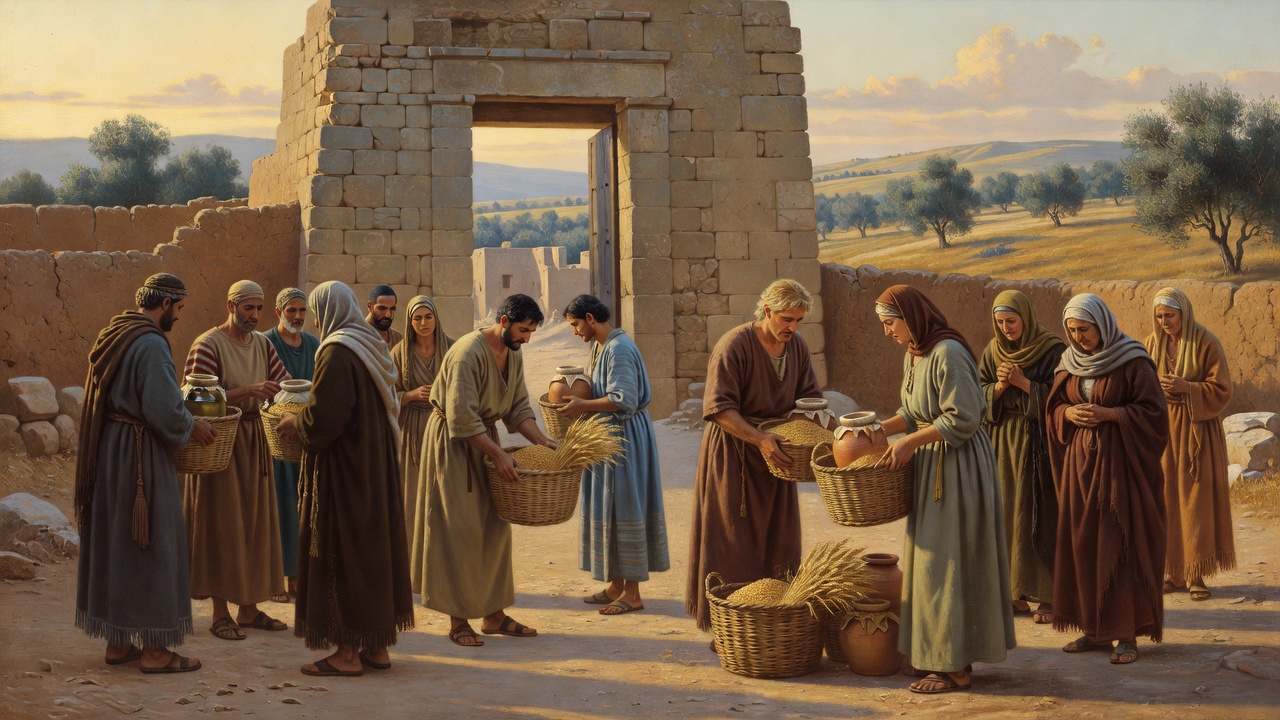
- To accommodate families who lived far from the designated sanctuary, the law allowed agricultural tithes to be converted into silver for travel. Upon arriving at the central sanctuary, worshippers could use the money to purchase festive food and drink to celebrate with their households.Sources: the Bible text itself
- Every third year, the annual tithe was gathered and stored within local towns rather than taken to the central sanctuary. This food was set aside to support community members without land inheritances, specifically Levites, resident foreigners, orphans, and widows.Sources: the Bible text itself
Notes written with AI assistance from open sources (Theographic Bible Metadata, CC BY-SA 4.0; Easton’s Bible Dictionary, public domain) and reviewed before publishing.
Credits and license for this translation
Translation of the Greek Septuagint into English by Sir Lancelot Charles Lee Brenton
Published in 1851, and now in the Public Domain.
If you find errors in the text, please report them so that we can correct them.
Section headings adapted from the Berean Standard Bible (public domain); they are not part of this translation’s text.
Source: http://ebible.org/eng-Brenton/ · eBible.org