2 Samuel 4
Brenton Septuagint Translation · Tap a verse to see its cross-references.
The Murder of Ish-bosheth
1And Jebosthe the son of Saul heard that Abenner the son of Ner had died in Chebron; and his hands were paralysed, and all the men of Israel grew faint. 2And Jebosthe the son of Saul had two men that were captains of bands: the name of the one was Baana, and the name of the other Rechab, sons of Remmon the Berothite of the children of Benjamin; for Beroth was reckoned to the children of Benjamin. 3And the Berothites ran away to Gethaim, and were sojourners there until this day.
4And Jonathan Saul's son had a son lame of his feet, five years old, and he was in the way when the news of Saul and Jonathan his son came from Jezrael, and his nurse took him up, and fled; and it came to pass as he hasted and retreated, that he fell, and was lamed. And his name was Memphibosthe.
5And Rechab and Baana the sons of Remmon the Berothite went, and they came in the heat of the day into the house of Jebosthe; and he was sleeping on a bed at noon. 6And, behold, the porter of the house winnowed wheat, and he slumbered and slept: and the brothers Rechab and Baana went privily into the house: 7and Jebosthe was sleeping on his bed in his chamber: and they smite him, and slay him, and take off his head: and they took his head, and went all the night by the western road.
8And they brought the head of Jebosthe to David to Chebron, and they said to the king, Behold the head of Jebosthe the son of Saul thy enemy, who sought thy life; and the Lord has executed for my lord the king vengeance on his enemies, as it is this day: even on Saul thy enemy, and on his seed.
The Execution of Rechab and Baanah
9And David answered Rechab and Baana his brother, the sons of Remmon the Berothite, and said to them, As the Lord lives, who has redeemed my soul out of all affliction; 10he that reported to me that Saul was dead, even he was as one bringing glad tidings before me: but I seized him and slew him in Sekelac, to whom I ought, as he thought, to have given a reward for his tidings. 11And now evil men have slain a righteous man in his house on his bed: now then I will require his blood of your hand, and I will destroy you from off the earth. 12And David commanded his young men, and they slay them, and cut off their hands and their feet; and they hung them up at the fountain in Chebron: and they buried the head of Jebosthe in the tomb of Abenner the son of Ner.
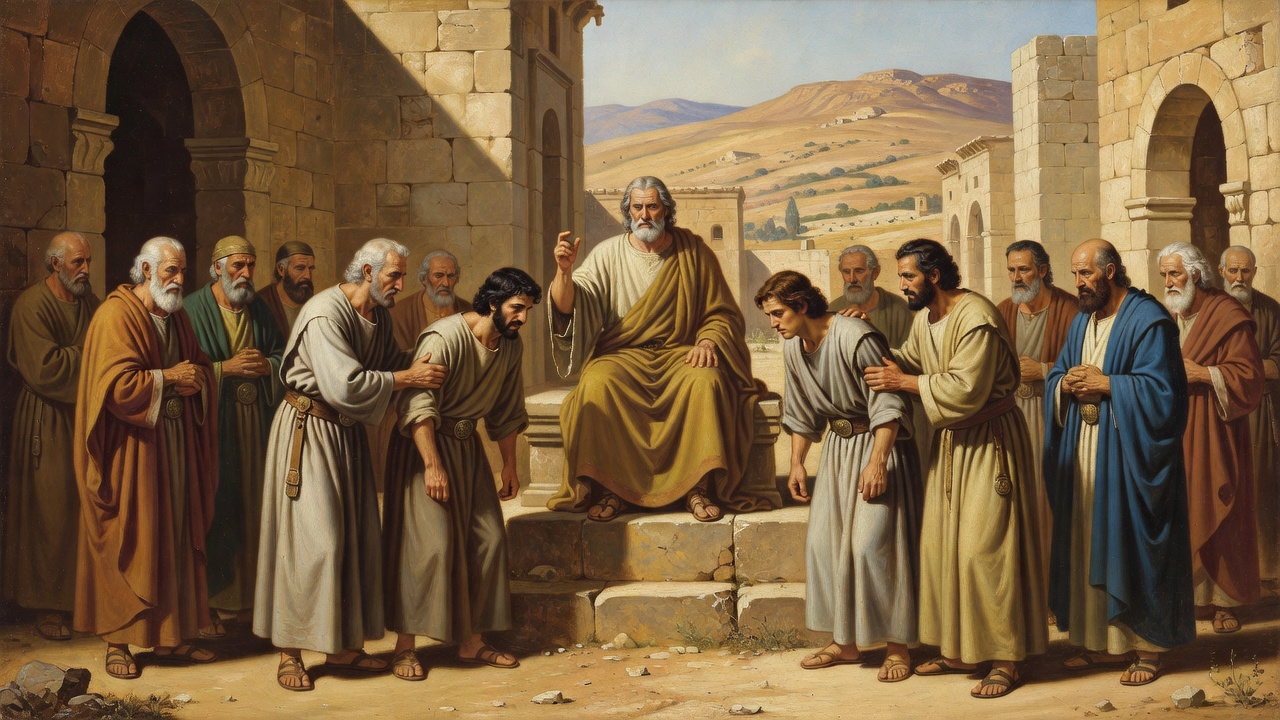
Did you know?
The Assassination of Ish-bosheth
- The assassins Baanah and Rechab were from Beeroth, an ancient Gibeonite town assigned to the territory of Benjamin. The biblical text notes that the Beerothites had previously fled to Gittaim, where they resided as foreigners.Sources: the Bible text itself · Beeroth · Gittaim · Rimmon
- The chapter introduces Mephibosheth, the surviving son of Jonathan and grandson of Saul. When news of the royal family's defeat arrived from Jezreel, the five-year-old child was dropped by his fleeing nurse, leaving him permanently lame in both feet.Sources: the Bible text itself · Mephibosheth
- When Rechab and Baanah brought Ish-bosheth's severed head to Hebron expecting praise, David recalled his earlier execution of the Amalekite messenger at Ziklag. David condemned the murder of an innocent man in his own bed, ordering the conspirators executed and burying Ish-bosheth's head in Abner's tomb.Sources: the Bible text itself · Baanah · Ziklag · Abner
Notes written with AI assistance from open sources (Theographic Bible Metadata, CC BY-SA 4.0; Easton’s Bible Dictionary, public domain) and reviewed before publishing.
Places in this chapter
Only places identified with high confidence are shown (90% or more according to the scholarly sources compiled by OpenBible). Period map: DARE (Digital Atlas of the Roman Empire), CC BY 4.0; modern map: © OpenStreetMap contributors; places: OpenBible.info (CC BY 4.0).
Credits and license for this translation
Translation of the Greek Septuagint into English by Sir Lancelot Charles Lee Brenton
Published in 1851, and now in the Public Domain.
If you find errors in the text, please report them so that we can correct them.
Section headings adapted from the Berean Standard Bible (public domain); they are not part of this translation’s text.
Source: http://ebible.org/eng-Brenton/ · eBible.org