1 Kings 10
Ãcõrẽ Bed̶ea · Tap a verse to see its cross-references.

About this book
About 1 Kings
- Easton's Bible Dictionary (1897) treats the authorship of the books of Kings as uncertain. A tradition that Jeremiah wrote them is, in Easton's view, supported by passages almost identical with parts of Jeremiah and by events Jeremiah knew personally, yet Easton thinks it more probable that Ezra, after the Captivity, compiled the books from earlier documents, perhaps written by David, Solomon, Nathan, Gad, and Iddo. Easton dates the composition between 561 B.C., when Jehoiachin was released from captivity by Evil-merodach, and 538 B.C., the decree of Cyrus.Sources: Easton: Kings, The Books of
- Easton says these books contain the annals of the kingdom from Solomon's accession until Nebuchadnezzar and the Babylonians subdued it, a period he estimates at about 453 years. 1 Kings opens while David is dying: Adonijah, his fourth son, who had become heir-apparent to the throne after the deaths of Amnon and Absalom, has himself proclaimed king, but Nathan and Bathsheba persuade David to enthrone Solomon at once. Solomon, David's son by Bathsheba, whose history is recorded in 1 Kings 1-11, came to the throne, Easton suggests, at about sixteen or eighteen.Sources: Easton: Kings, The Books of · Adonijah · Solomon
- In the Hebrew Scriptures the two books of Kings originally formed one book; the Septuagint first divided them and, with the Vulgate, numbers them as the third and fourth books of Kings, the books of Samuel being the first and second. Easton notes that Chronicles gives greater prominence to the priestly or Levitical office, while Kings gives greater prominence to the royal office, and that in the threefold division of the Scriptures by the Jews these books are ranked among the Prophets. The narrative points to earlier sources: the book of the acts of Solomon and the chronicles of the kings of Judah and of Israel.Sources: Easton: Kings, The Books of
- After Solomon's death the ten tribes revolted and invited Jeroboam, son of Nebat, to be their king; Easton calls him the first king of those tribes and dates his reign from 976 to 945 B.C. He had fled to Egypt under the protection of Shishak I, and later moved his residence from Shechem, his first capital, to Tirzah, which remained the chief residence of Israel's kings until Omri bought the hill of Shomeron from Shemer for two talents of silver and built Samaria. The later narrative includes Ahab, Omri's son and the seventh king of Israel, whose wife was Jezebel: to the calf worship introduced by Jeroboam he added the worship of Baal, and he was severely admonished by the prophet Elijah.Sources: Jeroboam · Tirzah · Samaria · Ahab
Notes written with AI assistance from open sources (Theographic Bible Metadata, CC BY-SA 4.0; Easton’s Bible Dictionary, public domain) and reviewed before publishing.
Sabá druad̶ebema boroba Salomoʌ̃ acʌd̶e wãna
1Wẽrãda Sabá druad̶ebema boro basía. Maʌ̃ wẽrãba ũrĩsia Salomoʌ̃ra Ãcõrẽneba trʌ̃ b̶ʌga b̶ʌda. Maʌ̃ carea idjia Salomoʌ̃a ne cawaiẽ́ b̶eada iwid̶id̶e wãsia poya panui cawaya. 2Idji ume zocãrã wãsid̶aa. Cameyo zocãrãne quera b̶eada, mõgara biya qued̶ea nẽbʌa b̶ea sid̶a edesia. Idjab̶a oroda waib̶ʌa edesia. Jerusaleʌ̃ne jũẽped̶a Salomoʌ̃ ume bed̶ead̶e wãsia. Maʌ̃ne idjia iwid̶i quĩrĩã b̶ad̶ara jũma iwid̶isia. 3Idjia iwid̶id̶ara Salomoʌ̃ba jũma arid̶e panusia. Idjia poya panuẽ́ra neẽ́ basía. 4Mãwã Sabád̶ebema boro wẽrãba cawasia Salomoʌ̃ra wãrãda bio ne cawa b̶ʌda. Maʌ̃ awara Salomoʌ̃ de dromada, idjia coi carea erob̶ʌda, idjiare b̶ea chũmebadada, idji nezocarãda ãdji djio bara, idji nezocarã dji dromarãda, idjia Ãcõrẽ de dromane animarã babue diabari sid̶a unuped̶a cawa crĩchaẽ́ basía. 6Maʌ̃ne idjia Salomoʌ̃a nãwã jarasia:
–Bʌ necawaad̶ebemada, bʌa od̶ad̶ebema sid̶a mʌ̃ druad̶e ũrĩsia. Id̶ibʌrʌ cawasia maʌ̃ra wãrãda. 7Zei naẽna mʌ̃a ĩjãẽ́ b̶asia. Baribʌrʌ ara mʌ̃dji dauba ununa bẽrã ĩjãsia. Wãrãda bʌd̶ebema jaraped̶ad̶ara ni ẽsidra bid̶a mʌ̃́a jarad̶aẽ́ basía. Mʌ̃a ũrĩna cãyãbara bʌra ne cawaara b̶ʌa idjab̶a baraara b̶ʌa. 8¡Bʌ ẽberãrãra bio b̶ʌsrid̶a b̶ead̶ida panʌa! Bʌare b̶ea sid̶a bio b̶ʌsrid̶a b̶ead̶ida panʌa ewariza bʌ quĩrãpita panʌne bʌ necawaada ũrĩ panʌ bẽrã. 9Bʌ Ãcõrẽra bio bia b̶ʌa. Idjia bʌra bia unuped̶a israelerã boroda b̶ʌsia. Idjia israelerãra ewariza bio quĩrĩã b̶ʌ bẽrã, bʌda ãdjirã boroda b̶ʌsia bia pe erob̶amãrẽã idjab̶a jipa cawa o b̶amãrẽã.–
10Sabád̶ebema boro wẽrãba Salomoʌ̃a oroda nueve mil libra diasia. Maʌ̃ awara quera quĩrãtanoa b̶eada, mõgara biya qued̶ea nẽbʌa b̶ea sid̶a zocãrã diasia. Maʌ̃ wẽrãba Salomoʌ̃a quera waib̶ʌa diad̶a quĩrãca ni ab̶aʌba Israel druad̶aa enenacaa.
11Maʌ̃be Israeld̶ebema boro Salomoʌ̃ba erob̶ʌd̶ebemada Sabád̶ebema boro wẽrãa waib̶ʌa diasia. Maʌ̃ awara ne jũma maʌ̃ wẽrãba iwid̶id̶a sid̶a diasia. Maʌ̃be Sabád̶ebema boro wẽrãra, idji ume zeped̶ad̶arã sid̶a idji druad̶aa jẽda wãsid̶aa.
Salomoʌ̃ ne bara b̶ad̶a
Tiro purud̶ebema boro Hiraʌ̃ba barcoda zocãrã erob̶asia. Maʌ̃ barcoba oroda, sándalo bacuruda, idjab̶a mõgara biya qued̶ea nẽbʌa b̶ea sid̶a Opir druad̶eba Israel druad̶aa waib̶ʌa enebadjid̶aa. Maʌ̃ sándalo bacuruba Salomoʌ̃ba dumene ʌ̃taa jida wãbadada Ãcõrẽ de dromane, idji de dromane bid̶a obisia. Maʌ̃ awara arpada, salterio sid̶a dji zá cawa b̶ea itea obisia. Sándalo bacuru maʌ̃ ewarid̶e waib̶ʌa enena quĩrãca maʌ̃ naẽna ni maʌ̃are bid̶a enenacaa. 14Poaza Salomoʌ̃ba oroda cincuenta mil libra edabadjia. 15Maʌ̃ awara Arabia druad̶ebema bororãa, Israeld̶ebema dji dromarãa bid̶a oroda diabibadjia. Ne nẽdobuebadarãa bid̶a oroda diabibadjia Israel druad̶e ne nẽdobued̶amãrẽã.
16Israeld̶ebema boro Salomoʌ̃ba djõi careabema jũãtrʌbada waib̶ʌa b̶eada dosciento berrachi obisia. Maʌ̃za quince libra oro od̶a basía. 17Idjab̶a dji caibeada tresciento berrachi obisia. Maʌ̃za libra ũbea aud̶u oro od̶a basía. Jũma maʌ̃ djõi careabema jũãtrʌbadara idji de dromane waga b̶ʌsia. Maʌ̃ dera trʌ̃ jarabadjid̶aa “Libanonebema oi.”
18Maʌ̃ awara Salomoʌ̃ba bugue waib̶ʌada jʌwa tʌd̶ʌcabari bara obisia. Maʌ̃ra elepante quid̶a od̶a basía. Maʌ̃ buguera oro idji awa quiruba jũma bʌrasia. Dji ẽcarra chũ chũmebarira borogoa b̶asia. Jʌwa acʌare, jʌwa araare bid̶a orrocawa imama zaca b̶eada panasid̶aa. Bugued̶e chũmene wãi carea dumeda b̶asia. Maʌ̃ dumera sei quid̶a b̶asia. 20Dume quid̶ad̶e iquid̶aza imama zaca panʌda b̶easia. Mãwã imama zaca b̶eara doce panasid̶aa. Maʌ̃ bugue quĩrãca ni ab̶aʌ dewara druad̶ebema boro itea od̶aca basía.
21Salomoʌ̃ taza b̶eara, eped̶eco b̶ea sid̶a oro idji awa quiru od̶a basía. Maʌ̃gʌra idji de droma “Libanonebema oi” abadad̶e erob̶asia. Parata od̶ara neẽ́ basía. Salomoʌ̃ ewarid̶e parata od̶ara israelerãmaarã mãcuaẽ́ b̶asia oroda barcod̶e waib̶ʌa enebadji bẽrã.
22Salomoʌ̃ba ne nẽdobada barcoda pe erob̶asia. Maʌ̃ barcora Tiro purud̶ebema boro Hiraʌ̃ barco b̶ea ume ne nẽdod̶e wãbadjid̶aa. Poa ũbead̶e b̶arima ab̶a jẽda zebadjid̶aa. Maʌ̃ne oroda, paratada, elepante quid̶ada, yarreca b̶eada, idjab̶a ĩbana biya qued̶ea sid̶a enebadjid̶aa.
23Israeld̶ebema boro Salomoʌ̃ra baraara b̶asia idjab̶a ne cawaara b̶asia jũma naʌ̃ ẽjũãnebema bororã cãyãbara. 24Jũma naʌ̃ ẽjũãnebemarãba Salomoʌ̃ra acʌd̶e ze quĩrĩã panasid̶aa Ãcõrẽba idjía diad̶a necawaada ũrĩni carea. 25Poa zebʌrʌza dji acʌd̶e ze panʌba Salomoʌ̃ itea ne enebadjid̶aa: oro od̶ada, parata od̶ada, wua biya qued̶eada, djõi careabemada, quera tũãpa b̶eada, cawayoda, mula sid̶a.
Salomoʌ̃ba cawayo, carreta sid̶a nẽdod̶a
26Salomoʌ̃ba djõbada carretada, cawayo sid̶a zocãrã edasia. Carretara 1,400 edasia idjab̶a cawayoda doce mil edasia. Maʌ̃gʌra idji sordaorã panabada puruza idjab̶a Jerusaleʌ̃ne idji b̶abarima bid̶a b̶ʌcuasia. 27Salomoʌ̃ dji boro basid̶e paratada Jerusaleʌ̃ne ad̶uba erob̶asia mõgara quĩrãca. Idjab̶a dji biara b̶ʌ bacuru Libanonebema enenada ad̶uba erob̶asia mẽãbema higojõ eya carrad̶e bara quĩrãca. 28Salomoʌ̃ itea ne nẽdobadarãba Egiptod̶e idjab̶a Ciliciad̶e cawayoda nẽdobadjid̶aa. 29Cawayo ab̶a cuatro libra paratabari nẽdobadjid̶aa. Egiptod̶e carreta ab̶a quince libra paratabari nẽdobadjid̶aa. Maʌ̃be ãdjirãba hititarã bororãa, Siriad̶ebema bororãa bid̶a cawayoda, carreta sid̶a nẽdobuebadjid̶aa.
Did you know?
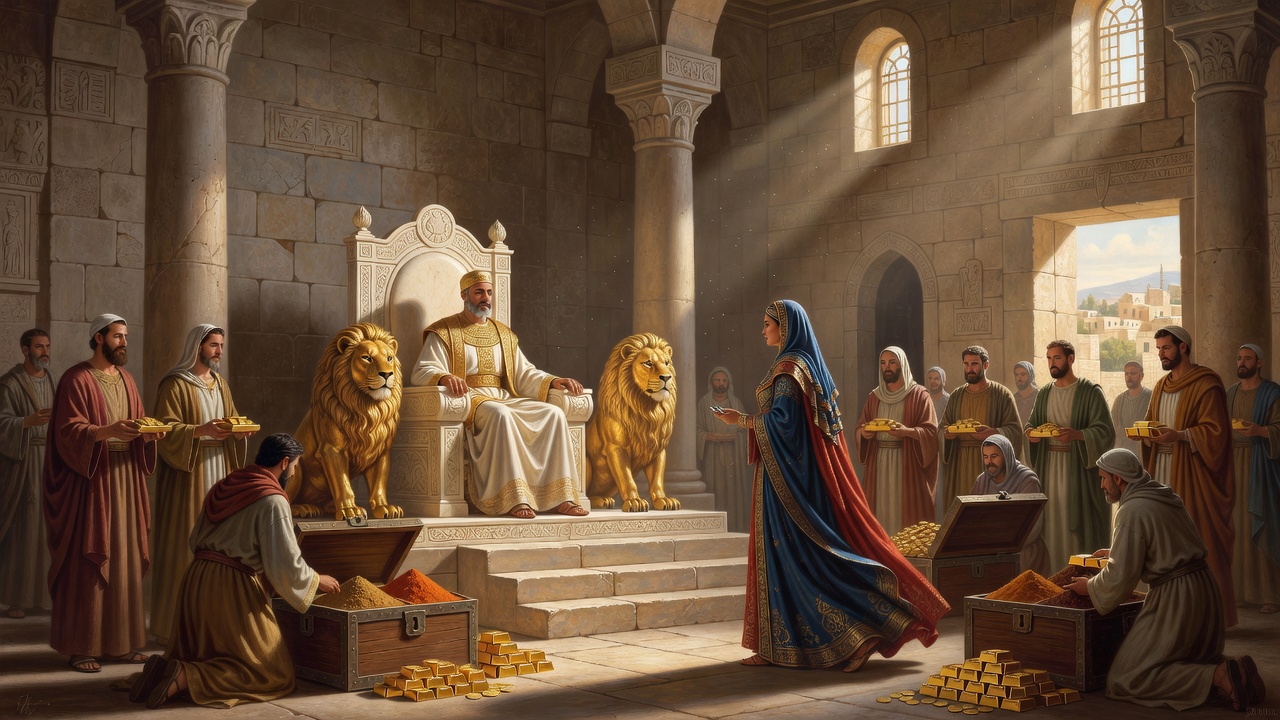
Solomon's Splendor and the Queen of Sheba
- Sheba is identified with Saba in Southern Arabia, a kingdom renowned in the ancient world for its lucrative trade in aromatics and spices. The queen's visit with a vast camel train carrying spices, gold, and precious stones reflected both diplomatic interests and the region's commercial wealth.Sources: Sheba · the Bible text itself
- Solomon allied with King Hiram of Tyre to conduct maritime expeditions to distant locations like Ophir and Tarshish. These fleets returned with rare goods, including almug wood, ivory, precious stones, and gold, further enriching the royal court in Jerusalem.Sources: Hiram · Ophir · Tarshish · the Bible text itself
- The biblical text describes Solomon's elaborate ivory throne overlaid with fine gold, which stood on six steps flanked by twelve sculpted lions. Such extravagant furnishings and gold drinking vessels highlighted the unprecedented prosperity of his reign.Sources: the Bible text itself
Notes written with AI assistance from open sources (Theographic Bible Metadata, CC BY-SA 4.0; Easton’s Bible Dictionary, public domain) and reviewed before publishing.
Places in this chapter
- Sheba · 15.348, 44.206 · verses 1, 4, 10, 13
- Jerusalem · 31.777, 35.234 · verses 2, 26, 27
- Arabia · Today: Arabian Peninsula · 23.000, 46.000 · verse 15
- House of the Forest of Lebanon · Today: in Jerusalem · 31.777, 35.234 · verses 17, 21
- Shephelah · 31.692, 34.875 · verse 27
- Egypt · 30.129, 31.308 · verses 28, 29
- Syria · Today: Aram · 33.511, 36.306 · verse 29
Only places identified with high confidence are shown (90% or more according to the scholarly sources compiled by OpenBible). Period map: DARE (Digital Atlas of the Roman Empire), CC BY 4.0; modern map: © OpenStreetMap contributors; places: OpenBible.info (CC BY 4.0).
Credits and license for this translation
Ãcõrẽ Bed̶ea
New Testament in Emberá, Northern (PM:emp:Emberá, Northern)
copyright © 2011 Wycliffe Bible Translators, Inc.
Language: Emberá, Northern
Translation by: Wycliffe Bible Translators, Inc.
Copyright Information
© 2011, Wycliffe Bible Translators, Inc. All rights reserved.
This translation text is made available to you under the
terms of the Creative Commons License: Attribution-Noncommercial-No Derivative Works.
( http://creativecommons.org/licenses/by-nc-nd/3.0/ )
In addition, you have permission to port the text to different file formats, as long as you
do not change any of the text or punctuation of the Bible.
You may share, copy, distribute, transmit, and extract portions
or quotations from this work, provided that you include the above copyright
information:
You must give Attribution to the work.
You do not sell this work for a profit.
You do not make any derivative works that change any of the actual words or punctuation of the Scriptures.
Permissions beyond the scope of this license may be
available if you contact
us with your request.
The New Testament
in Emberá, Northern
© 2011, Wycliffe Bible Translators, Inc. All rights reserved.
This translation is made available to you under the terms of the
Creative Commons Attribution-Noncommercial-No Derivatives license 4.0.
You may share and redistribute this Bible translation or extracts from it in any format, provided that:
You include the above copyright and source information.
You do not sell this work for a profit.
You do not change any of the words or punctuation of the Scriptures.
Pictures included with Scriptures and other documents on this site are licensed just for use with those Scriptures and documents.
For other uses, please contact the respective copyright owners.
2014-04-24
Source: http://ebible.org/empNTpo/ · eBible.org