Genesis 46
Ekajuk Scriptures Bible Portions · Tap a verse to see its cross-references.
Ana Jekob mehle tahm go Ijib
1Owo Isreel kehm mehle tahm a nsol a nsol enye kpee, eji á rehnge go Beer-seba a kehm limi ajom ka Esowo bi nde Aisik. 2Esowo kehm bungu tong Isreel atv, jolo elfoongo nlem re, <<Jekob! Jekob!>> Á kehm faange re, <<Nyehn me ga.>> 3Esowo kehm bungu re, <<Me wo li Esowo, Esowo bio bi nso, ka fahl eljeke go Ijib, tibre m bahk-a koko lim egburu ejahbe o. 4M bahke jeke a na go Ijib, etingitingi m bahke tiki feere a na. Josef wo a bahke naange kake go ebo.>> 5Owo Jekob kehm mehle o Beer-seba, abon Isreel ba nlum kehm soro rod Jekob ndea bo, a abon ebo, a akal ebo, kak go amvtv nya Fero tumu tv re ba sol bo. 6Fvfo bo tob rodo atohkondi ebo a nsol kpee nyi bo bele go Kenan. Jekob a abon ebe kpee mehle tahm go Ijib. 7Jekob rodo abon ebe ba nlum, a abon abon ebe ba nlum, a tob rodo abon ebe ba nkal, a abon abon ebe ba nkal, etˈtohngo eje kpee tahm a bo go Ijib. 8A wo li abing abon ba nlum ba Isreel ba tahme go Ijib: Ruben wo Jekob gbo mbang jel-e. 9Abon ba nlum ba Ruben ba a: Hanok, Palu, Hejiron a Karmi. 10Abon ba nlum ba Simion ba a: Jamuel, Jamin, Ohad, Jakin, Johar, a Sawul ji nnenkala Kenan wo jele ka-e. 11Abon ba nlum ba Levi ba a: Gerson, Kohad a Merari. 12Abon ba nlum ba Judah ba a: Er, Onan, Sela, Pereji a Jerah, (Er, a Onan bo kpo go ndi nyi Kenan) Abon ba nlum ba Pereji: ba a, Hejiron a Hamul. 13Abon ba nlum ba Isaka ba a: Tola, Pua, Jasub a Simron. 14Abon ba nlum ba Jebulun ba a: Sered, Elon a Jaleel. 15Abon ba nlum baa, ba Lia jele ka Jekob go Padan Aram, a lˈyehke Dayina mmon ewe no nkal. Abon ba nlum, a ba nkal ebe kpee jolo eltahl ane awubu ane ara. 16Abon ba nlum ba Gad ba a: Jefon, Hagi, Suni, Ejibon, Eri, Arodi a Areli. 17Abon ba nlum ba Aser ba a: Imna, Isva, Isvi, a Beria, mmonannyehn ebo no nkal no bo jo lung-e re Sera. Abon ba nlum ba Beria ba a: Heber a Malkiyel. 18Abon kpee ba Jilpa jele no ka Jekob ba a, Jilpa ji Laban rod-e no ka Lia mmon ewe no nkal, bo kpee jolo elku a nne awohng. 19Abon ba nlum ba Rasel nkala Jekob jele no ba a: Josef a Bejamin. 20Gona Ijib wo Asenad mmon no nkal no Potifera ji jolo nlimajom no On, jele Manase, a Efriim ka Josef. 21Abon ba nlum ba Benjamin ba a: Bela, Beker, Asbel, Gera, Naaman, Ehi, Ros, Mupim, Hupim, a Ard. 22Bo ba jolo abon ba nlum ba Rasel jele no ka Jekob, bo kpee jolo ewubu ane ani. 23Mmon no nlum no Dan wo a: Husim. 24Abon ba nlum ba Naftali ba a: Jajiyel, Guni, Jejer a Silem. 25Abon ba nlum ba Bilha jele ka Jekob ba a, Bilha ji Laban rod-e no ka Rasel mmon ewe no nkal, bo kpee jolo ane asehma. 26Ane ba toono Jekob je go Ijib, bo jolo ane atahl ara, ane arakera, bo kpee jolo etˈtohngo eje, a lˈyehke akal abon ebe bum nkpe. 27A lˈbudu abon ba nlum abal ba Josef jele go Ijib, etˈtohngo Jekob, jolo ane atahl ara ane awubu kpe kpe. 28Jekob tumu Judah á gbo-e mbang, song goji Josef, eji á lˈsong kahn ana bo bahke sehnge song rehng go Gosen. Eji bo rehnge go ejang bio bi Gosen, 29Josef toobo mmvtv akuungu enye tahm go Gosen song wane Isreel nde go mbang. Ana Josef nyehne nde, á kehm song bingi nde, bahk emel kun-e go ekpakebahk, soro kehme ellingi ekidi tete. 30Isreel kehm tongo Josef re, <<Anv wo fuumu re me n kpo, eji m ma ba nyehn antahng re wo noa kpeke li go elkpin.>> 31Owo Josef kehm tongo abonanyehn a anebe etahk nde kpee re, <<M bahke tahme song bung a Fero, m bahk-e tongo re, <Abonanee, a anebe etahk nsoo kpee, bo ji lene go ndi nyi Kenan, bob ba, ba tob-m. 32Aneblum baa, abaabebul ba, bo kpo le enyam, bob ko efong, ejoro, a ebul baange ebo ba a bi, a ejum ajehng ajehng ji bo kpi no.> 33Fero lˈlung-n fere bahb re, <Eltum anii ń kpo lim?> 34Li re wahn faang-e re, <Alokeltum eba kpo le atohkondi bomo ese ese tete ba rehng anv, ana babnsoo ejahre jo lim. Á bahk-n yake re wahn song jol go ejang bi Gosen, tibre eltum ebul abaabe li ebi eltum ka anebe Ijib.>>
Did you know?
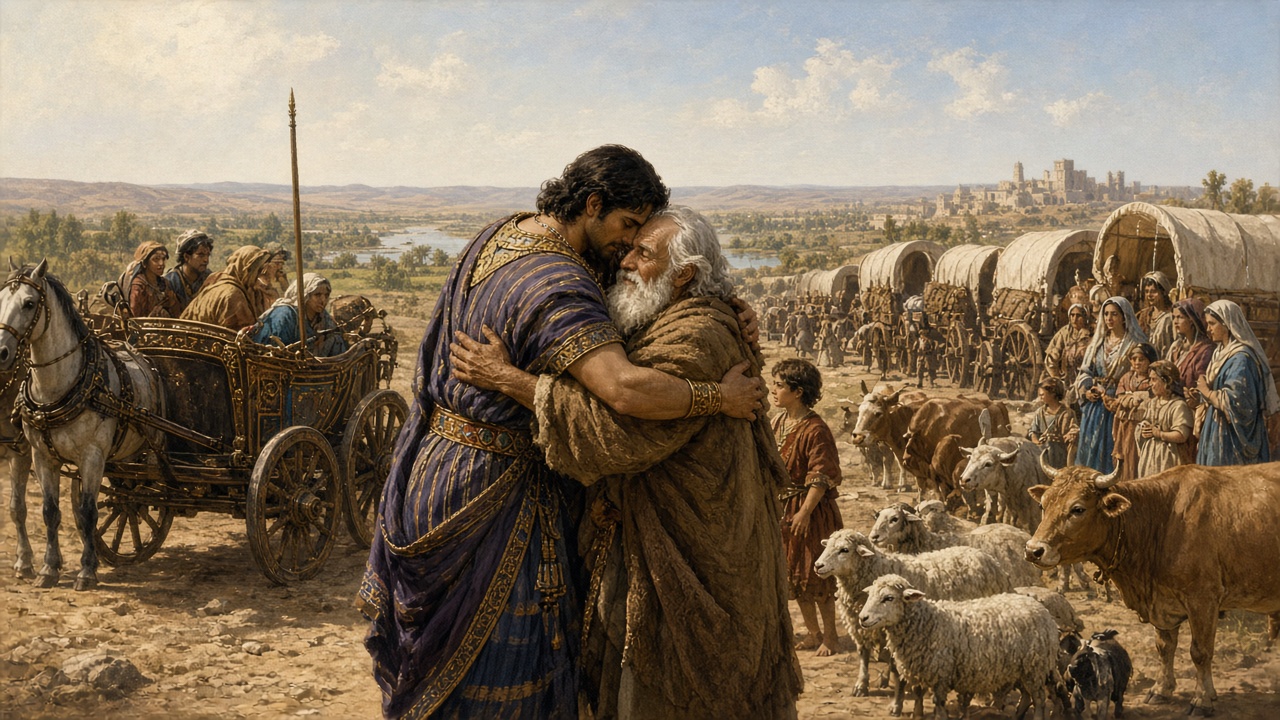
Israel Goes Down to Egypt
- As Israel set out for Egypt with all that he had, he stopped at Beersheba and offered sacrifices to the God of his father Isaac. Beersheba, meaning well of the oath or well of seven, was a well Abraham dug and named after a compact with Abimelech; when Isaac reopened it, he gave it the same name. It was a favorite dwelling of both patriarchs, and there that night God spoke to Jacob in a vision, telling him not to fear going down to Egypt, for he would make him a great nation there.Sources: the Bible text itself · Beersheba
- Jacob sent Judah ahead to Joseph for directions to Goshen, an Egyptian district east of the Nile, apparently near the royal residence, where the family remained until the Exodus. Easton's Bible Dictionary (1897) calls it the best of the land, now a desert, and also the land of Rameses. Joseph told his brothers to say they had raised livestock from youth, so they might settle there, because shepherds were detestable to the Egyptians; that dictionary suggests Pharaoh was probably Apopi, last of the Hyksos, who welcomed these Asiatic shepherds, while native Egyptians abhorred them, though some argue Joseph arrived later, under Thothmes III, after the Hyksos were expelled.Sources: the Bible text itself · Goshen · Pharaoh (of Joseph)
- The chapter counts sixty-six of Jacob's direct descendants who came to Egypt, not counting the wives of his sons, and seventy when Joseph's two sons already born in Egypt are included. Leah's sons and her daughter Dinah are named in that tally, although Easton's Bible Dictionary (1897) says Leah herself had died in Canaan before the journey and was buried in the cave of Machpelah; Rachel had died earlier giving birth to Benjamin and was buried on the way to Ephrath, that is, Bethlehem. Manasseh and Ephraim were born to Joseph in Egypt by Asenath, daughter of Potiphera, priest of On, a center of sun-worship that the Septuagint and Vulgate call Heliopolis.Sources: the Bible text itself · Leah · Rachel · On
Notes written with AI assistance from open sources (Theographic Bible Metadata, CC BY-SA 4.0; Easton’s Bible Dictionary, public domain) and reviewed before publishing.
Places in this chapter
- Egypt · 30.129, 31.308 · verses 1, 3, 4, 5, 6, 7, 8, 20, 26, 27
- Canaan · 32.767, 35.333 · verses 6, 12, 31
- Heliopolis · Today: Ain Shams · 30.129, 31.308 · verse 20
- Goshen · Today: Goshen 1 · 30.799, 31.834 · verses 28, 29, 34
Only places identified with high confidence are shown (90% or more according to the scholarly sources compiled by OpenBible). Period map: DARE (Digital Atlas of the Roman Empire), CC BY 4.0; modern map: © OpenStreetMap contributors; places: OpenBible.info (CC BY 4.0).
Credits and license for this translation
Ekajuk Scriptures Bible Portions
Ekajuk: Ekajuk Scriptures Bible Portions (Bible)
copyright © 2024 Luke Initiative for Scripture Translation and The Seed Company
Language: Ekajuk
Contributor: Luke Initiative for Scripture Translation
This translation is made available to you under the terms of the
Creative Commons Attribution Share-Alike license 4.0.
You have permission to share and redistribute this Bible translation in any format and to make reasonable revisions and adaptations of this translation, provided that:
You include the above copyright and source information.
If you make any changes to the text, you must indicate that you did so in a way that makes it clear that the original licensor is not necessarily endorsing your changes.
If you redistribute this text, you must distribute your contributions under the same license as the original.
Pictures included with Scriptures and other documents on this site are licensed just for use with those Scriptures and documents.
For other uses, please contact the respective copyright owners.
Note that in addition to the rules above, revising and adapting God's Word involves a great responsibility to be true to God's Word. See Revelation 22:18-19.
2025-07-02
Source: http://ebible.org/eka/ · eBible.org