Genesis 32
Ekajuk Scriptures Bible Portions · Tap a verse to see its cross-references.
Jekob toobo ebjing bi a bahke song wane Eso
1Jekob kehm tob tahm eje, babenjel nya Esowo kehm-e kpiri go mbang. 2Eji Jekob nyehne bo, á kehm bungu re, <<A wo li ebehre ji Esowo.>> Á kehm lungu edi jio re Mahanayim.
3Jekob tumu atiingi etib re bo gbo-e mbang tv Eso mmonannyehn, go ndi nyi Seir ji li ejahbe ji Edom. 4Á tubu bo elle re, ana wo ḿ bahke tongo nsoo ewame Eso: <Jekob nlokeltum ewa re, me n jol a Leban, fere sa a ne tete rehng anv. 5Me n bel efong, ebvankang, ejoro, ebul, alokeltum ba nlum, a ba nkal. Anv n kpˈtumu etib tv wo ntubesi ewame, re me lub fil-a ndon go ega esamahr.
6Eji atiingi etib feere no ba kpiri Jekob, bo tong-e re, <<Wahr ebje goji Eso mmonanne, anv á kpˈbake ba kpir-a, a aneblum atahltahl ba kp-e toono.>> 7Jekob bele egburu elfahle gbalee,eko fere jo tane, owo á kehm yabe ane ba jolo a ne go nlong na ebal, á tob yabe ebul ebe, akamel, a ebvankang. 8Á tiri re, <<Eso lˈfere ba nok a ellong anehng, ellong ni lˈsa, bo lub be for.
9Owo Jekob kehm kake ero re, <<O Esowo bi nsoo Ebraham, Esowo bi nsoo Aisik, O Jehova, wo ji tong-m re, <Feere song go ega ejahbe, go ega ebangenahb, m bahke limi nob a na.> 10Me n tohkem fˈfuumu go nnoobo eljini, a ekakesehk ji a ma tib me nlokeltum ewa, m bele ebti efilebo bi bi, eji n siiri aya ma Jodan maa, wo anv me n jol nlong ebal. 11N kpˈkake ero re, wo tahr-m go abo nya mmonanee Eso, tibre n kpˈfahle re á bahke ba nok aname, tob nok a bab nnyehn, a abon abon. 12Wo wo ma bung re, <Etingitingi m bahke limi nob a na, m bahke fere lim etˈtohngo eja jol ana erikehndi aya bi nnene lˈkˈma fange.>>>
13Jekob kange o atv mao, nsol enye nyi á bele no, á yehke o re á song yare mmonannyehn Eso: 14ebul baange atahl awubu, efahmbul eltahl, ejoro atahlawubu, ekom eltahl, 15eltahl ekamel ebwubu bi jolo akal budu abon, edahmagbudu atahl abal, nfong ewubu, akal ebvankang jolo eltahl, alum jolo ewubu. 16Jekob yake bo kpee kak alokeltum ebe go ebo re bo jo kpur bo, nne awohng awohng no jo jen a bo, bele ellong nˈne, á kehm tongo alokeltum ebe re, <<Gbo-m wahn mbang, jo jenen wahn jo ka ane baa, a enyam eyake.>>
17Á tubu nne no gbo bo mbang elle re, <<Mmonanee Eso lˈkpir-a fere bahb re, <Wo li ka nne awoo, fvfo gan wo a kpˈtahme? Nne awoo kpi enyam bi li-a go mbuksong o?> 18Á bahk-e tongo re, <<Enyam bio bi Jekob nlokeltum ewa bi, ayare nya á ma tum tv ntubesi ewe Eso nya a. Yefono kpˈbake go njahm. 19Jekob tob tubu etoono ane abal, a etoono ane ara elle, a ane bako kpee ba kpˈtoono ane ba kpo jen a enyam re, <<Wahn ane kpee bungen nnyo nnyo amehng tong Eso ń lˈwan-e go mbang. 20Jo kunen ekpu wahn bung re, <Yefono Jekob nlokeltum ewa kpˈbake toon-r go njahm. Jekob jo tiri re, <<M bahk-e gono go ayare nya n kpˈtumu tv-e, n lˈnyehne, fundiki á bahk-m koko.>> 21Owo Jekob kehm tumu ayare nyao bo gbo mbang a nya, yefono sa kang o ebo ebehre.
Elrahng bi Jekob noko a Esowo
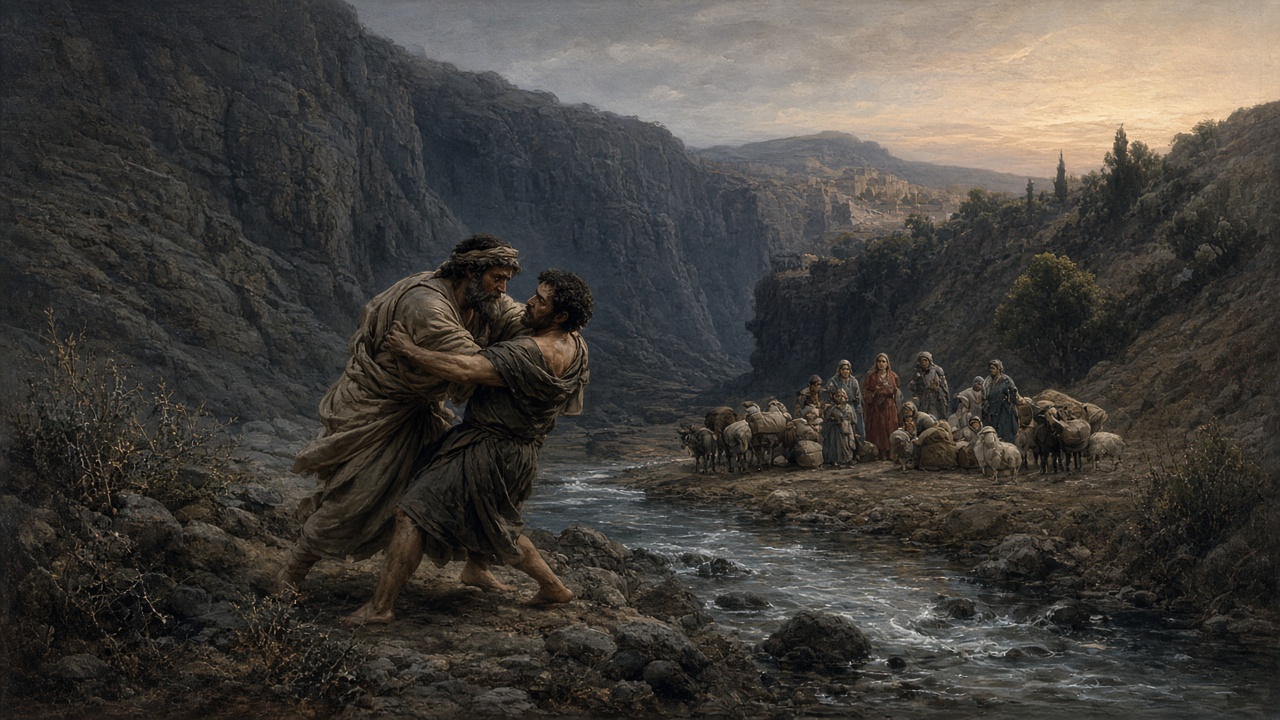
22Atv mao Jekob kehm mehle rod akal ebe na abal, a alokeltum ba nkal abal, go abon ebe, ewubu a mmon awohng, kpee ba nlum bo song siiri ebgba bi bo jo lung re Jabok. 23Ngare nyi á ma tum bo siiri ebgba, á tob tumu nsol enye kpee. 24Jekob sa ntahngtahng, owo nnenlum kehm ba gong ebrahng a ne tete efungfu se. 25Eji nnenlum noo nyehne re á nehme mal a ne, á kehm kooro Jekob go ebrudu, ebrudu soro radde, eji á jo gong ebrahng a ne. 26Nnenlum noo tong-e re, <<Nong me n song tibre efungfu yahke se.>>
Jekob kehm faange re, <<Me wa-a nehm yake á song tete á fuul-m.
27Nnenlum noo kehm-e bahbe re, <<Mbing enya mee?>>
Á kehm-e faange re, <<Me Jekob wo,>>
28Nnenlum noo kehm bungu re, <<Bo wa-a nehm kpe jo lung re Jekob, bo bahke fere jo lung-a re Isreel, tibre wob nok a Esowo, tob nok a ane fere ga bo.>>
29Jekob kehm bungu re, <<Titi tong-m mbing enya.>> Nnenlum noo kehm bungu re, <<Jenji wahnge a kehm bahbe mbing enyame? Nnenlum noo kehm-e fuulu o.
30Owo Jekob kehm lungu edi jio re Peniel. Á kehm bungu re, <<Tibre me n nyehn Esowo gbul gbul gbuul, tvtv o yebkpe kuuru elkpin aname.>>
31Njul rehnge ero tv-e o ana á sehnge Peniel, á fere jo feebe na tibre ebrudu ebradde. 32Owo wahnge anebe Isreel kˈlˈli njahb nyi li kohlo ebrudu, tibre ebrudu bi Jekob rˈradde eji nnenlum noo koor-e kohlo o njahb ebrudu.
Did you know?
At the Jabbok, on the Way to Esau
- Mahanaim means “two camps.” Jacob gave that name to the place near the Jabbok, beyond the Jordan, when the angels of God met him and he said, “This is the camp of God.” There he also divided his people, flocks, herds, and camels into two camps, hoping one might escape if Esau attacked the other.Sources: Mahanaim · the Bible text itself
- The Jabbok, whose name is explained as “a pouring out, or a wrestling,” is a stream east of the Jordan. It joins the Jordan about midway between the Sea of Galilee and the Dead Sea, after a course of about 65 miles through a wild, deep ravine. At its ford Jacob sent his two wives, two maidservants, eleven sons, and all he owned across, then remained alone and wrestled with a man until daybreak.Sources: Jabbok · the Bible text itself
- Jacob sent messengers to Esau in the land of Seir, the country of Edom, calling him lord and himself a servant. Seir is a mountainous region along the east side of the Arabah, from the southeastern end of the Dead Sea toward Akabah, the eastern branch of the Red Sea; the Edomites occupied it, and it was allotted to Esau’s descendants. Esau, the firstborn twin and a hunter, had sold his birthright for red lentil stew and was also called Edom, “red,” while Jacob—whose name means “one who follows on another’s heels,” or “supplanter”—had conspired with his mother to deceive Isaac.Sources: the Bible text itself · Seir · Esau (Edom) · Jacob (Israel)
Notes written with AI assistance from open sources (Theographic Bible Metadata, CC BY-SA 4.0; Easton’s Bible Dictionary, public domain) and reviewed before publishing.
Places in this chapter
- Edom · 30.746, 35.604 · verse 3
- Jordan · Today: Jordan River · 31.761, 35.558 · verse 10
- Jabbok · Today: Zarqa River · 32.115, 35.543 · verse 22
Only places identified with high confidence are shown (90% or more according to the scholarly sources compiled by OpenBible). Period map: DARE (Digital Atlas of the Roman Empire), CC BY 4.0; modern map: © OpenStreetMap contributors; places: OpenBible.info (CC BY 4.0).
Credits and license for this translation
Ekajuk Scriptures Bible Portions
Ekajuk: Ekajuk Scriptures Bible Portions (Bible)
copyright © 2024 Luke Initiative for Scripture Translation and The Seed Company
Language: Ekajuk
Contributor: Luke Initiative for Scripture Translation
This translation is made available to you under the terms of the
Creative Commons Attribution Share-Alike license 4.0.
You have permission to share and redistribute this Bible translation in any format and to make reasonable revisions and adaptations of this translation, provided that:
You include the above copyright and source information.
If you make any changes to the text, you must indicate that you did so in a way that makes it clear that the original licensor is not necessarily endorsing your changes.
If you redistribute this text, you must distribute your contributions under the same license as the original.
Pictures included with Scriptures and other documents on this site are licensed just for use with those Scriptures and documents.
For other uses, please contact the respective copyright owners.
Note that in addition to the rules above, revising and adapting God's Word involves a great responsibility to be true to God's Word. See Revelation 22:18-19.
2025-07-02
Source: http://ebible.org/eka/ · eBible.org