Habakkuk 3
Geeshsha Mas'aafaa · Tap a verse to see its cross-references.
Imbbaak'ooma Woosaa
1Timbbitiyaa odiyaa Imbbaak'oomi mazimuriyaadan yes's'iidde, woosseedda woosay hawaa:
2Abeet Med'ina Godaw, neeni kase ootseeddawaa taani sisaade yayaad. Abeet Med'ina Godaw, nu wodiyaankka he oosotuwaa zaaretsaade ootsa; unttunttu nu wodiyaankka erettino. Neeni hank'k'etsiyaa wode ne maarotaa k'oppa.
3S'oossay Temaana giyaa sa'aappe yee; He Geeshshay Paaraana Deriyaappe yee. Aa bonchchuu saluwaa kammeedda; Aa galataykka sa'aa kumeedda. 4Aa p'ooletsaykka aawaa poo'uwaa mala; Aa wolk'k'ay k'osetti utteedda Aa kushiyaappe pozhzhu giyaa poo'uu kesee. 5S'oossay iita harggiyaa bareppe sintsaw kiittee; hayk'k'uwaakka bare geeduwaa kaaletsee. 6I ek'k'iide biittaa k'aatseedda. K'ay I s'eelliide kawutetsatuwaa kokkorsseedda. Med'inaadeppe de'eedda deretuu me"eretteeddino; k'ay I unttunttu bollan hamettiyaa beniideppe de'eedda deretuukka laaletteeddino. 7Taani Toop'p'iyaa Asay tuggatishin be'aad; Midiyaama biittaa asaykka kokkorishiina be'aad.
8Abeet Med'ina Godaw, neeni ayaw hank'k'ettaadii? Shaafatuu neena hank'k'etsisseeddino? Woy abbaa bolla hank'k'uwaa ees's'a kesaadii? Tuytti, neeni ne paratuwaanne ne paraa gaaretuwaa toggeeddawe ne asaw s'oonuwaa immanaassa. 9Neeni ne wonddaafiyaa giigissaadda; pootsatuwaa dukkanaw dafaadda. Biittaa p'alk'k'aade haatsaa kessaadda. 10Deretuu neena be'iide, yashshaw kokkoreeddino; haatsaa kis'aykka aad'd'eedda. K'ay haatsaa c'iimmatuukka waassiino; waassiidde barenttu dambbalaa haa haa darisseeddino. 11I s'onggiide yeddeedda pootsatuu poo'uwaaninne ne tooratuwaa p'ooletsan awaynne aginay barenttu de'iyaa saan de'iyaa saan ek'k'eeddino.
12Neeni hank'k'ettaade biittaa ubbaan yuuyyaadda; kawutetsatuwaakka hank'k'uwaan yed'd'aadda. 13Neeni ne asaa ashshanawunne ne oketteeddawaa ashshanaw kesaadda; iitatuwaa kaappuwaa shoc'aadda; Aa mayuwaa k'aaraade Aa kallo s'iira ashshaada. 14Aa olanchchatuwaa gadaawaa neeni Aa tooraan Aa c'addaadda. Unttunttu nuuna laalanaw gotiyaadan yiino; metootanchchaakka geeman mittanaw dosiino. 15Neeni ne paratuwaan abbaa yed'd'aade aad'd'iyaa wode, daro haatsay hoommuwaa goppu gee.
16Taani hawaa ubbaa sisina, ta bollay gaji gajeedda; ta mettershshay kokkoreedda; ta mek'etsaykka wook'k'eedda; ta gedetuukka k'ay gunddeeddino. Nuuna tuggayiyaawantta S'oossay murana gakkanaw, metuwaa gallassaa taani danddayan naagana.
17Balasiyaa giyaa mitsay ayifana d'ayooppekka, woyniyaa turaan ayifii d'ayooppekka, wogaray ayifenan is's'ooppekka, gadii katsaa mokkennan is's'ooppekka, sikkuwan dorssi d'ayooppekka, k'ay ak'uwaan mehii d'ayooppekka, 18hewe ubbay d'ayooppekka, taani Med'ina Godaan nashettana; taana ashshiyaa Med'ina Godaan taani nashshechchaa pooc'u gaana. 19Ubbaa Mooddiyaa Med'ina Goday taw wolk'k'aa; ta gediyaa gaaraa gediyaadan minisee; taani d'ok'k'a sa'atuwaan hemettanaw taana danddayissee.
(Yes's'iyaawantta kaaletsiyaawaa hassayissiyaawaa: ha mazamurii diis's'iyaawaa diis's'iidde yes's'iyaa mazimuriyaa.)
Did you know?
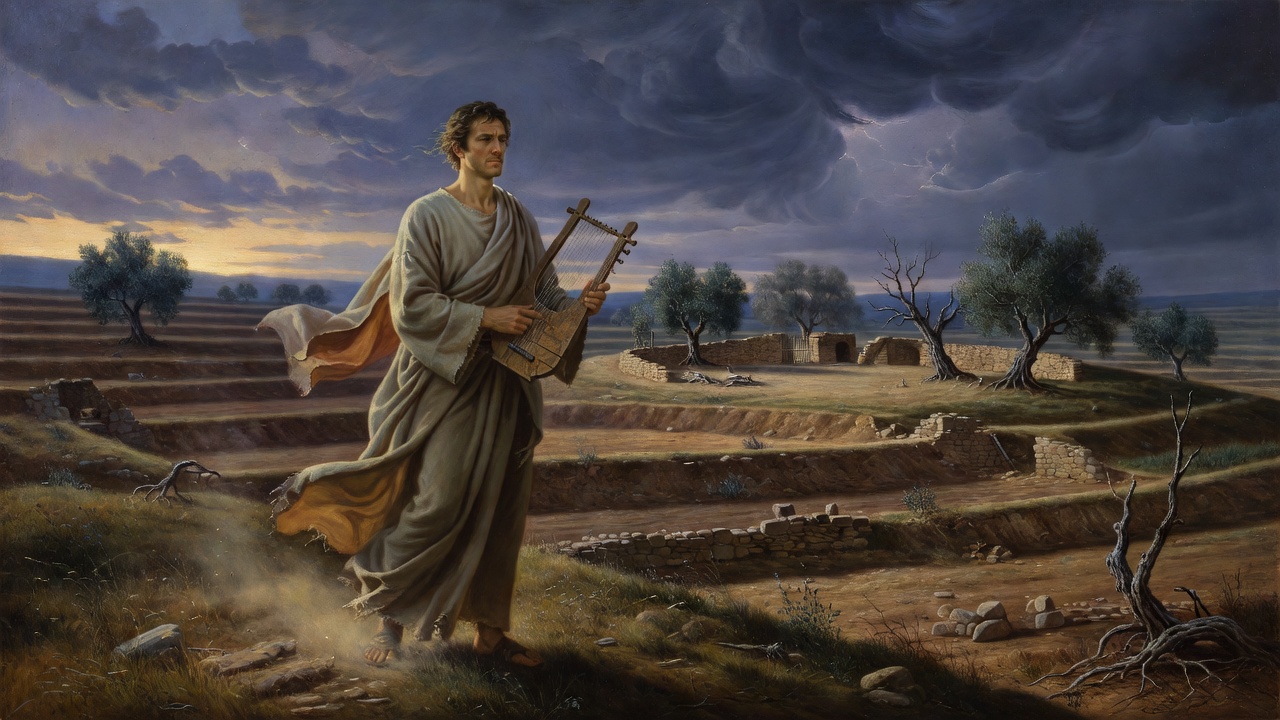
Habakkuk's Prayer and Song of Faith
- The poem depicts God appearing from the southern wilderness, mentioning Teman in southern Idumea and Mount Paran on the desert boundary of the Promised Land. These geographic references echo ancient poetic descriptions of the Lord marching in majesty from the south.Sources: Teman · Mount Paran · the Bible text itself
- Cushan and Midian are portrayed trembling before the divine advance. The Midianites were nomadic Arabian tribes dwelling in tents across the desert regions and pasturelands of Sinai and northern Arabia.Sources: Cushan · Midian · the Bible text itself
- The chapter is structured as a liturgical psalm, complete with musical terms such as 'Shigionoth', 'Selah', and a closing dedication to the choirmaster for performance with stringed instruments.Sources: the Bible text itself
Notes written with AI assistance from open sources (Theographic Bible Metadata, CC BY-SA 4.0; Easton’s Bible Dictionary, public domain) and reviewed before publishing.
Places in this chapter
- Midian · 28.495, 35.012 · verse 7
Only places identified with high confidence are shown (90% or more according to the scholarly sources compiled by OpenBible). Period map: DARE (Digital Atlas of the Roman Empire), CC BY 4.0; modern map: © OpenStreetMap contributors; places: OpenBible.info (CC BY 4.0).
Credits and license for this translation
Geeshsha Mas'aafaa
The Holy Bible in the Dawuro language of Ethiopia, Latin script
copyright © 2024 The Word for the World International
Language: (Dawro)
Contributor: The Word for the World International
This translation is made available to you under the terms of the
Creative Commons Attribution Share-Alike license 4.0.
You have permission to share and redistribute this Bible translation in any format and to make reasonable revisions and adaptations of this translation, provided that:
You include the above copyright and source information.
If you make any changes to the text, you must indicate that you did so in a way that makes it clear that the original licensor is not necessarily endorsing your changes.
If you redistribute this text, you must distribute your contributions under the same license as the original.
Pictures included with Scriptures and other documents on this site are licensed just for use with those Scriptures and documents.
For other uses, please contact the respective copyright owners.
Note that in addition to the rules above, revising and adapting God's Word involves a great responsibility to be true to God's Word. See Revelation 22:18-19.
2025-05-01
Source: http://ebible.org/dwrl/ · eBible.org