Luke 5
Beibel: okanisi tongo · Tap a verse to see its cross-references.
Masaa Gadu soi den fosi bakaman // fu Masaa Jesesi wan sani
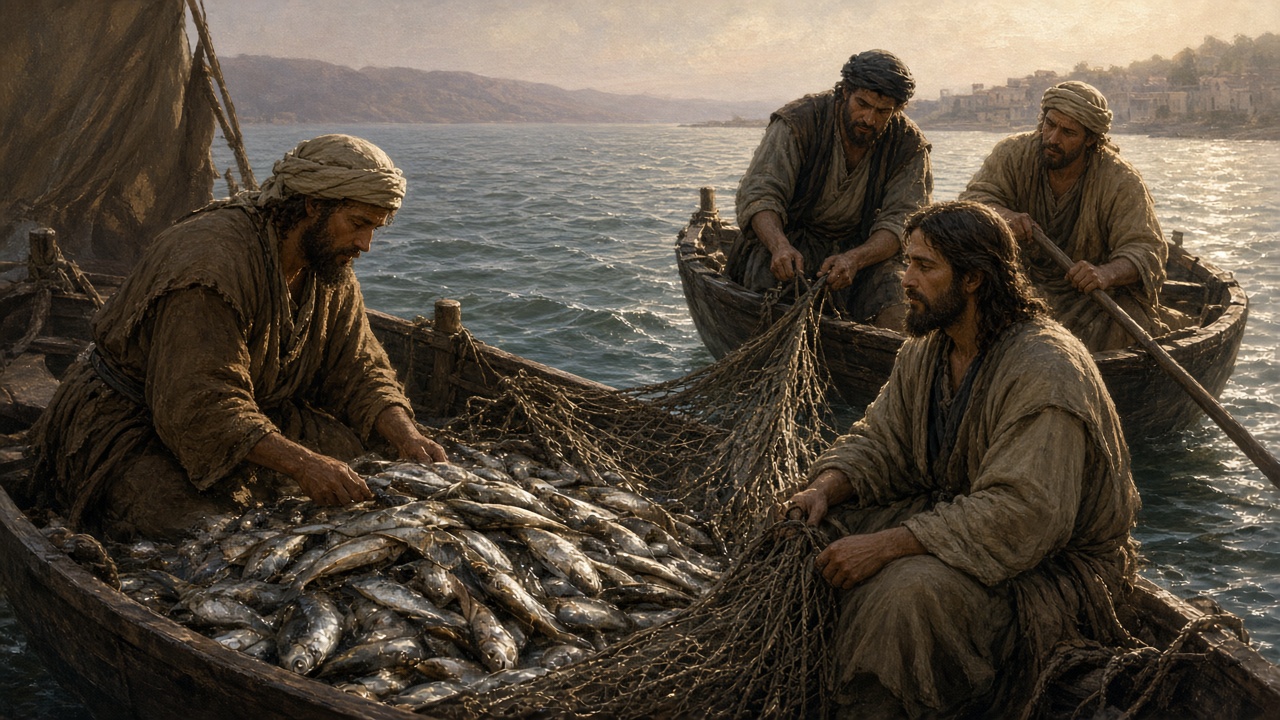
1Ma namo, da wan dei, da Masaa Jesesi be de a wataa mofu, fu a ze fu Genesaleti. Da somen sama ali kon ne en te a ipi, fu yee Masaa Gadu wowtu. 2Ne Masaa Jesesi si tu boto a lampeesi de. Den boto ya na be fu wanlo fisiman di be komoto a peesi kon e losi den seepi e seeka. 3Wan fu den fisiman ya na be Simon. Ne a subi go a ini a boto fu Simon. Ne a taigi Simon fu a toosi a boto go a wataa afu, fu a sa taki anga den sama.
4Ne Masaa Jesesi sidon a ini a boto taki anga den sama te a kaba. Ne a taigi Simon taki: “So, we Simon! Wai a boto go a mindii wataa! Da i towe i seepi kisi fisi!”
5Ne Simon piki taki: “Mesiti! A di na yu taki, meke mi o towe a seepi baka. Ma ofuso, mi á be o towe en moo. Bika na hii neti u towe seepi suku fisi kaba sondee fu kisi wan siiba. Ma toku, di na yu taki so, da u sa iti luku baka.” 6Ne den iti den seepi a wataa. Ne den kisi fisi te, a seepi e suku fu piiti. 7Ne den bali kai den taa sama di den anga den be e fisi makandii, fu kon yeepi den anga den fisi. Ne den kon a den. Ne den e kisi den fisi poti a ini den tu boto te, a fika pikinso moo fu den tu boto sungu.
8Da di Peitilisi si den somen fisi di den kisi, ne a foondoo te, a kai anga kini a doti, a Masaa Jesesi fesi, bali taki: “Masaa! Komoto a mi se ya, baa! Bika mi a ná wan bun libisama. Mi á waiti sai fi i kon a mi se.” 10Soseefi a sani ya foondoo Johanisi anga Jakowbesi, den tu manpikin fu Da Sebedi di be e wooko anga Simon Peitilisi.
Ne Masaa Jesesi taigi Simon taki: “Simon! Ná feele moo! I be e kisi fisi. Ma fanafu now, mi o meke i toon sama di e kisi libisama enke fisi tyai kon biibi a mi.” 11Ne den tyai den boto go poti baka. Ne den komoto a soo, fika ala den sani fu den de, go e waka a Masaa Jesesi baka.
Masaa Jesesi deesi wan gwasiman
12Da bakadati, ne Masaa Jesesi go a wan kondee. Ma namo, da wan gwasiman be de ape. Da di a gwasiman si Masaa Jesesi, ne a lon kon sutu kini a doti kai tapu fesi a doti e begi en taki: “Masaa, baa! Mi sabi taki efi i wani, i poi fu deesi mi puu a gwasi siki ya, baa!”
13Ne Masaa Jesesi langa ana oli en. Ne a taki: “Mi wani! Kon bun baka!” Ne wanten di Masaa Jesesi taki so, ne a man kon bun kelle baka. 14Ne Masaa Jesesi bali en taki: “Ná taigi ná wan sama san mi du gi yu. Ma go na apaiti begiman fu a Mama Keliki, meke den si taki i kon bun. Da du san a weiti fu Mosesi e taigi yu fu du, te i kon bun fu gwasi siki. Bika Masaa Gadu be gi Mosesi wan weiti a sikiifi taki: ‘Wan Islayeli sama di kon bun fu gwasi siki mu tyai wan paiman go gi Masaa Gadu, fu sama sa si taki, a kon bun tuu.’ ” 15Ma anga ala fa Masaa Jesesi bali a man de, toku sama yee sani fu Masaa Jesesi na a hii peesi de. Ne ala sama e kon a Masaa Jesesi, fu a deesi den fu den siki di den abi. 16Ma Masaa Jesesi be lobi go a ini a gaan sabana go begi en wawan. Na so a fika den sama de, ne a go a ini a sabana ini go begi.
Masaa Jesesi deesi wan lanman
17We, ne wan taa dei, ne Masaa Jesesi e leli den sama Masaa Gadu wowtu baka. Da den Faliseiman anga den leliman fu Dyuweiti seefi be de ape tu. Den be komoto na a hii Galileya anga hii Judeja pisiwataa, anga soseefi Jelusalem Foto. Ma namo, da a taanga fu Masaa Gadu be de a Masaa Jesesi tapu fu deesi siki. 18Da di Masaa Jesesi leli den sama te wan pisi, ne wantu man tyai wan lanman a wan daagi tapu kon a Masaa Jesesi. 19Ma den á be poi pasa go doo a Masaa Jesesi a ini a osu. Bika sama be ipi seefi. Ne den subi go na a osu tapu, ne den puu wantu fu den siton na a osu tapu. Ne den pasa a man anga a daagi na a olo saka go leti a Masaa Jesesi fesi. 20Da di Masaa Jesesi si fa den man di tyai a mati fu den kon ya e biibi taanga, ne a taigi a lanman taki: “Mi mati! I kisi paadon fu den takuudu anga ogii fi yu.”
21Da di den Faliseiman anga den leliman fu Dyuweiti yee fa Masaa Jesesi taki, ne den kuutu a ini denseefi taki: “Fa wan libisama sa taki so wan sani? Ai oli Gadu a sipowtu! Bika ná wan sama di man fu gi libisama paadon fu takuudu anga ogii, boiti Masaa Gadu wawan.”
22Ma Masaa Jesesi be sabi san de a ini den. Ne a taigi den taki: “Saide meke u e denki so du? 23Fu taigi wan sama taki, a kisi paadon fi en takuudu anga ogii, efu fu taigi en taki: ‘Opo taampu waka!’ on di moo taanga? 24Ma u mu sabi taki, a Manpikin di saka kon toon libisama ya abi makiti a goontapu, fu gi sama paadon fu takuudu anga ogii.” Ne a daai, ne a taigi a lanman taki: “Opo taampu! Teke i daagi waka go a osu!” 25Ne dyandyalan, a man dyombo opo na ala den sama fesi. Ne ai waka e gafa Masaa Gadu e gwe a osu. 26Ala sama fiya foondoo. A gei enke den á be wani biibi den ain. Ne den gafa Masaa Gadu taki: “Ai, Masaa Gadu bigi! U si gaan foondoo sani tide.”
Masaa Jesesi kai Leifi fu waka // ne en baka
27Ne bakadati, ne Masaa Jesesi komoto de e gwe. Ne di ai gwe, ne a si wan man den e kai Leifi*f8*, sidon ne en kantoo doo mofu e piki lantimoni. Ne Masaa Jesesi kai en fu a kon toon wan bakaman fi en. 28Ne a man opo, ne a fika ala den sani fi en de, ne a waka go fu go waka a Masaa Jesesi baka.
29Da di den de te wan dei, ne Leifi oli wan gaan fesa ne en osu gi Masaa Jesesi. Somen taa mati fu Leifi di be e piki lantimoni anga wantu taa sama be de na a piisii ya tu. 30Da di den de na a fesa te wan pisi, ne wan duupu Faliseiman anga leliman fu Dyuweiti si Masaa Jesesi sidon e nyan anga den man di e piki lantimoni anga den taa takuu libi man fu a kondee de. Da a sani ya á bun gi den. Ne den akisi den bakaman fu Masaa Jesesi taki: “Fu saide meke u sidon e nyan anga den man di e piki lantimoni anga den taa takuulibi sama de?”
31Ma Masaa Jesesi yee den. Ne a piki den anga wan ageisi toli taki: “ ‘Na sama di e siki, na dati abi dataa fanowdu. Ma sama di á siki, ná abi dataa fanowdu. Dataa de gi sikiman anga malengiiman.’ 32Mi á kon kai den bunbun sama, ma mi kon fu kai den sama di sabi taki, den libi á bun, fu den daai den libi.”
Saide den bakaman fu Masaa // Jesesi nái tan anga angii fu begi?
33Ma namo, wan dei, ne wan duupu Faliseiman anga leliman fu weiti akisi Masaa Jesesi taki: “Mesiti! Saide meke den bakaman fi yu ná abi ten, di den e tan sondee nyan fu begi enke wi anga den bakaman fu wi? Den bakaman fu Johanisi a Dopuman seefi, abi ten di den e tan sondee nyan fu Gadu tu.”
34Ne Masaa Jesesi gi den wan toli taki: “Fa mi anga den bakaman fu mi de ya, da a de leti enke te wan man toow anga wan uman. Di a man toow, ne a kai somen sama fu kon meke piisii anga en. We, solanga a toowman de na a fesa anga den, da na soso nyan meke piisii namo den o de. 35Ma te di a dei o doo, te a toowman ná o de moo, da den sa abi ten di den o go e de sondee nyan fu begi.”
36Ne a gi den ete wan ageisi toli. A taki: “A o taanga gi u, fu teke san mi e taki. Bika, te wan gaandi koosi fi i piiti, da anga san yu o lapu en? Ná anga wan gaandi pisi koosi, no? Bika efi i lapu a gaandi koosi anga wan nyunyun pisi, da te i wasi en, da a nyunyun pisi koosi o ali piiti komoto na a gaandi koosi. Da a gaandi koosi o piiti moo bigi.
37“Na soseefi, a á fiti fu u poti nyun meke win go a ini gaandi saka di meke anga meti buba. Bika a dee taanga kaba. Da di a win o kuku, da a o soopu a gaandi saka basi towe a win poli. Da a kon, i lasi win, i lasi saka. 38Nyunyun win meke fu poti a ini nyunyun saka, di á poi basi lasi en.
39“Ma efu wan sama diingi gaandi win, da a ná o wani diingi nyunyun meke win moo. Bika, da a o si enke a gaandi win di a diingi switi moo a nyun meke win.”
Did you know?
Calls, Healings, and New Wine
- Jesus taught the people from Simon’s boat on the Lake of Gennesaret while the crowd pressed in along the shore. The name comes from a town of Naphtali on the western shore, earlier called Chinnereth; the plain beside the lake, noted for its fertility and beauty, was called “the Paradise of Galilee.”Sources: Gennesaret · the Bible text itself
- Simon, also called Peter, grew up in Bethsaida, on the western coast of the Sea of Galilee, and was trained as a fisherman. James and John, his partners in the other boat, were sons of Zebedee, a Galilean fisherman; Easton's Bible Dictionary (1897) infers that Zebedee had some position in Capernaum, because he had two boats and hired servants.Sources: Simon Peter · James (Son of Zebedee) · Zebedee · the Bible text itself
- The man Jesus called from the tax booth is named Levi in this chapter; in other accounts he is Matthew, son of Alphaeus, a tax collector at Capernaum. Easton's Bible Dictionary (1897) suggests that he may have taken the name Matthew in grateful memory of his call, and describes the great banquet he gave that same day as a farewell feast.Sources: Matthew · the Bible text itself
Notes written with AI assistance from open sources (Theographic Bible Metadata, CC BY-SA 4.0; Easton’s Bible Dictionary, public domain) and reviewed before publishing.
Places in this chapter
- Gennesaret · Today: El Ghuweir · 32.861, 35.507 · verse 1
- Galilee · 32.760, 35.527 · verse 17
- Jerusalem · 31.777, 35.234 · verse 17
- Judea · Today: Judea 1 · 31.777, 35.234 · verse 17
Only places identified with high confidence are shown (90% or more according to the scholarly sources compiled by OpenBible). Period map: DARE (Digital Atlas of the Roman Empire), CC BY 4.0; modern map: © OpenStreetMap contributors; places: OpenBible.info (CC BY 4.0).
Credits and license for this translation
Beibel: okanisi tongo
New Testament in Eastern Maroon Creole (NS:djk:Eastern Maroon Creole)
copyright © 2009 Wycliffe Bible Translators, Inc.
Language: Eastern Maroon Creole
Translation by: Wycliffe Bible Translators, Inc.
Eastern Maroon Creole
djk
Suriname
Copyright Information
© 2009, Wycliffe Bible Translators, Inc. All rights reserved.
This translation text is made available to you under the
terms of the Creative Commons License: Attribution-Noncommercial-No Derivative Works.
( http://creativecommons.org/licenses/by-nc-nd/3.0/ )
In addition, you have permission to port the text to different file formats, as long as you
do not change any of the text or punctuation of the Bible.
You may share, copy, distribute, transmit, and extract portions
or quotations from this work, provided that you include the above copyright
information:
You must give Attribution to the work.
You do not sell this work for a profit.
You do not make any derivative works that change any of the actual words or punctuation of the Scriptures.
Permissions beyond the scope of this license may be
available if you contact
us with your request.
The New Testament
in Eastern Maroon Creole
© 2009, Wycliffe Bible Translators, Inc. All rights reserved.
This translation is made available to you under the terms of the
Creative Commons Attribution-Noncommercial-No Derivatives license 4.0.
You may share and redistribute this Bible translation or extracts from it in any format, provided that:
You include the above copyright and source information.
You do not sell this work for a profit.
You do not change any of the words or punctuation of the Scriptures.
Pictures included with Scriptures and other documents on this site are licensed just for use with those Scriptures and documents.
For other uses, please contact the respective copyright owners.
2014-04-22
Source: http://ebible.org/djkNT/ · eBible.org