John 4
Beibel: okanisi tongo · Tap a verse to see its cross-references.
Masaa Jesesi sa gi sama wataa di e gi libi
1We, ne a seefi yuu ten de, ne den Faliseiman yee taki somen sama e kon a Masaa Jesesi te a ipi fu a dopu de. Da den sama e fika anga Masaa Jesesi e toon bakaman fi en. Da na so Masaa Jesesi be abi moo ipi bakaman moo Johanisi. 2Wansi a ná enseefi be e dopu den sama seefi, ma na den bakaman fi en. 3We, ne di Masaa yee taki den Faliseiman kon sabi so kaba, ne a komoto fika Judeja go a Galileya.
4Ma a be musu fu waka pasa na a pisi kondee di en e kai Samaliya fosi a be doo Galileya. 5Ne ai go te a go doo a wan foto fu Samaliya den e kai Sikali. Da Sikali de koosube anga wan pisi doti di a gaansama fu den Dyu den kai Jakopu be gi wan fu den pikin fi den kai Jowsef. 6We, na ape Jakopu be abi wan peti wataa fi en di de a pe te enke tide. We, di Masaa Jesesi be doo de, da a be weli fu waka. Ne a go koosube na peti. Da a be sa de wan sani fu twalufu yuu mindii dei so.
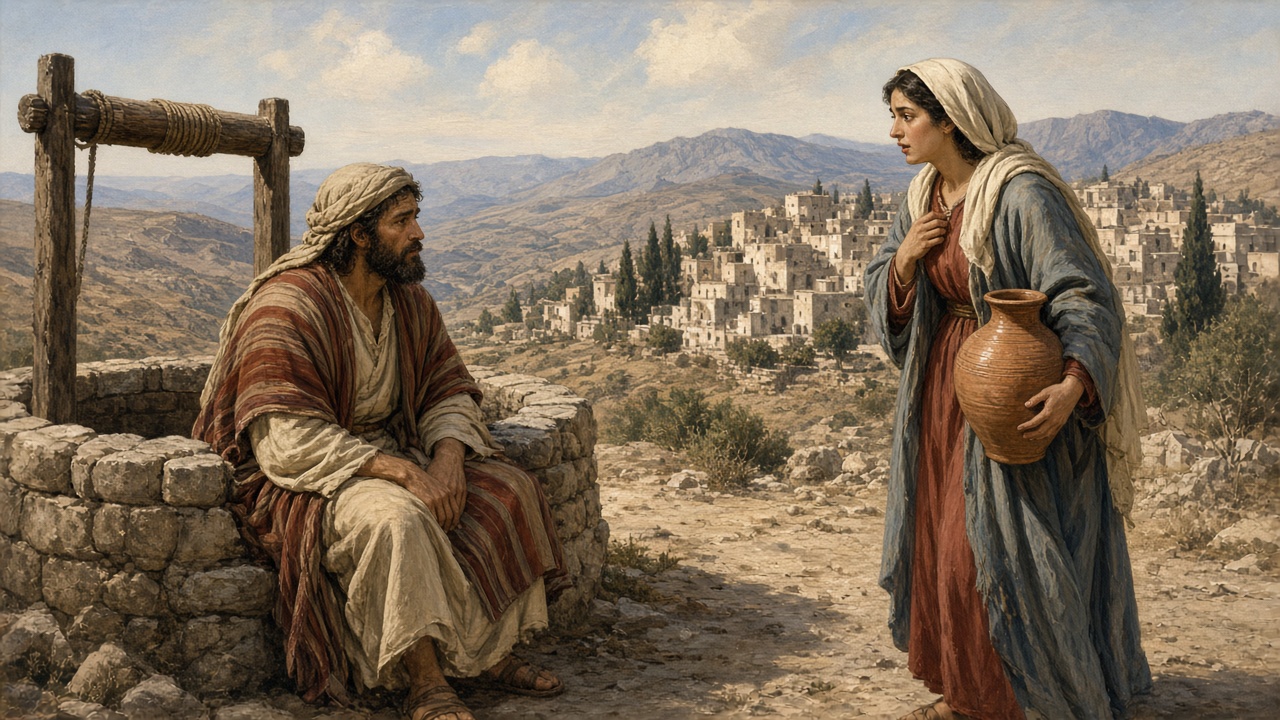
7Di Masaa Jesesi sidon de te wan pisi, ne wan uman fu a kondee de kon fu kisi wataa na a peti. Ne Masaa Jesesi akisi en taki: “Gi mi wan pikinso wataa fi yu mi diingi, baa?” 8Da a yuu de, da den bakaman fi en be go a foto fu bai sani fu den nyan.
9Ne a uman akisi en taki: “Fa yu enke wan Dyusama sa begi mi wataa fu diingi?” Den Dyu anga den Samaliya sama á be e koti.
10Ne Masaa Jesesi piki en taki: “Efi i be sabi a gaan bun di Masaa Gadu be wani gi yu, anga efi i be sabi a sama di e begi i wataa fu diingi ya, da i be o begi en wataa, da a be o gi yu a wataa di e gi sama libi.”
11Ne a uman piki en taki: “We, Masaa, yu ná abi ná wan sani fu kisi a wataa. Da soseefi a peti dipi tu. Da pe yu o fende libi wataa fu gi mi? 12I bigi moo u tata Jakopu di be gi wi a peti ya? Bika enseefi anga den pikin fi en anga den meti fi en be diingi a wataa fu a peti ya.”
13Ne Jesesi piki en taki: “A sama di e diingi a wataa ya, te wan pisiten, da dee wataa o kisi en baka. 14Ma a sama di o diingi a wataa di mi o gi en, da ná wanten moo di dee wataa o kisi en. Ma a wataa di mi o gi en o toon gaan liba e lon komoto ne en ini huu enke gaan sula. Da sowan sama abi a libi fu tego kaba.”
15Ne a uman taigi en taki: “Masaa oo! Gi mi a wataa de, meke dee wataa á kisi mi moo, baa? Da a ná o de fu mi kon kisi wataa dise moo.”
16Ne Masaa Jesesi taigi en taki: “Go kai i man, da u kon.”
17Ne a uman taigi en taki: “Mi ná abi man.”
Ne Jesesi taigi en taki: “Na tuu san i taki, taki i ná abi man. 18Bika na feifi man i libi anga den paati kaba. Da a wan di i abi ya seefi a ná yu man tu. Da san yu taki ya na tuu.”
19Ne a uman piki en taki: “Masaa, mi e si taki yu na wan apaiti takiman fu Masaa Gadu. 20We, bika den gaansama fu u den Samaliya sama be e begi Masaa Gadu na a mongo tapu ya. Ma u den Dyusama taki, na Jelusalem na a moo bun peesi fu begi.”
21Ne Jesesi piki en taki: “Uman, biibi mi. A ten e kon, di a ná a mongo tapu ya efu Jelusalem u o go fu go begi a Tata moo. 22U á sabi san u e begi. Ma wi sabi san wi e begi. Bika na den Dyu a tuutuu yeepi fu Masaa Gadu e komoto go a den taa sama. 23Ma a ten e kon, da meke u taki, a de kaba, di den sama di e libi wan letiopu fasi o begi anga den hii ati a ini jeje anga tuu. Bika na den sowtu sama ya Gadu Tata e suku fu begi en na a sowtu fasi ya. 24Ma Gadu na jeje. Da den sama di e begi en mu begi en, e opo en nen a hei a wan tuutuu fasi anga a Jeje fu Masaa Gadu leti enke fa enseefi de tuutuu.”
25Ne a uman taigi en taki: “Mi sabi taki a Mesiyasi*f7* o kon. Da te a kon, da a o tyai ala sani fiya kon a kiin gi wi.”
26Ne Masaa Jesesi piki en taki: “We, uman, a sama di i kai de, ne en i si e taki anga yu ya.”
27We, a seefi yuu de, ne den bakaman fu Masaa Jesesi kon doo a pe a be de. Ne den foondoo fu si taki a be e taki anga wan uman sama. Ma toku seefi ná wan fu den di taki wan sani fu akisi en taki, san yu akisi en, efu san yu anga en be e taki. 28Ne a uman fika a bungu fi en de, ne a lon go a ini a foto go kai sama taki: 29“U kon go luku wan sama di taigi mi, mi hii libi. Da u kon u go luku. Kande sama na a Kelestesi.” 30Ne den sama komoto a ini a foto booko gwullu go a Masaa Jesesi.
31We, a yuu de, da den bakaman be e begi Masaa Jesesi fu a go nyan.
32Ma Masaa Jesesi piki den taki: “Mi abi wan nyanyan fu nyan di u á sabi.”
33Ne den bakaman fi en taigi den seefi taki: “Tan! A sa de taki wan sama be tyai nyanyan kon gi en fu a nyan?”
34Ma Jesesi taigi den taki: “A nyanyan fu mi, na fu du a wani fu mi Tata di sende mi kon, fu a wooko fi en go doo. 35Na u seefi e taki, ete fo mun, da koti alisi yuu doo, no? We, u opo u ain luku den goon. Alisi lepi kaba. 36We, sama di e koti e fende en paiman. Da soseefi ai kibii nyanyan fu a libi fu bakaten. Da sama di e paandi anga sama di e koti o piisii makandii. 37Bika na ya wi e si taki a nongo e kon tuu di taki: ‘Taawan e paandi, taawan e koti.’ 38Bika, we mi be sende u go fu u koti san taa sama be paandi. Na taa sama be sete a wooko de, ma u kon fu kaba en.”
39Da somen sama fu Samaliya kon biibi ne en fu a sani di a uman be taigi den. Bika a be taigi den taki: “A taigi mi ala san mi be du.” 40Ne den Samaliya sama di be kon ne en, begi en fu a tan anga den ape. Ne a tan tu dei anga den. 41Ma somen sama be daai kon e biibi ne en fu den wowtu di enseefi be e taki.
42Ne den sama taigi a uman taki: “Now u nái biibi moo fu san i taigi wi. Ma wi e biibi fu di wi eigi yesi yee. Da wi sabi tuutuu taki, a Yeepiman di Masaa Gadu sende kon gi goontapu, ne en de ya.”
Masaa Jesesi deesi a pikin fu wan edeman
43Ne tu dei a baka, ne Masaa Jesesi komoto de e go a Galileya. 44We, Masaa Jesesi seefi be taki kiinkiin taki: “Wan apaiti takiman fu Masaa Gadu ná abi nen ne en eigi kondee.” 45We, di a doo Galileya, ne ala den sama di be si den sani di a be du a Jelusalem, teke en anga gaan piisii. Bika somen fu den be de a Jelusalem na a Pasika Piisii tu.
46Ne Masaa Jesesi doo a peesi di den e kai Kaana, na a pisiwataa fu Galileya, pe a be meke a wataa toon win. Ne di a go doo de, ne wan bigiman di be e wooko a kownu paleisi yee taki a komoto a Judeja kon a Galileya de. Ne a go a Masaa Jesesi fu a kon deesi wan manpikin fi en gi en. Bika a pikin ya be siki swaki te na fu dede namo.
48Ne Masaa Jesesi piki en taki: “Solanga u á si gaan foondoo sani anga gaan maiki, u nái biibi.”
49Ne a man piki en taki: “Masaa, gaantangi kon yeepi mi, baa. Deesi a pikin fu mi gi mi fosi a dede, baa.”
50Ne Masaa Jesesi piki en taki: “Go! A pikin fi yu e libi.”
We, a man biibi enke fa Masaa Jesesi taki. Ne a go fi en a osu baka. 51Ne di a de a pasi e gwe te wan pisi, ne a miti den futuboi fi en a pasi. Ne den taigi en taki: “A pikin fi yu e libi!” 52Ne di a akisi den on ten fu a dei a pikin be kon betee, ne den taigi en taki: “Eside bakadina, wan ten fu wan yuu, ne a feba gwe.” 53Ne a man si taki na a seefi yuu di Masaa Jesesi be taigi en taki: “Go! A pikin fi yu e libi.” We, ne a man ya anga en hii osu daai kon a biibi.
54Da a sani di Masaa Jesesi du ya, ne meke di fu tu gaan foondoo sani di a du, di a daai komoto a Judeja kon a Galileya baka.
Did you know?
Living Water in Samaria
- Jesus left Judea to return to Galilee, and the Gospel says he had to pass through Samaria. Under the Romans in Jesus' time, Judea was the southernmost of Palestine's three divisions, distinguished from Samaria and Galilee, and the narrative notes that Jews did not associate with Samaritans.Sources: the Bible text itself · Judea
- He came to Sychar, near the plot of ground that Jacob had given his son Joseph, and, weary from the journey, sat down by Jacob's well. Easton's Bible Dictionary (1897) records that from the time of the Crusaders Sychar was usually identified with Shechem, but that explorations had identified it with 'Askar, a small Samaritan town on the southern base of Ebal, about a mile north of the well.Sources: the Bible text itself · Sychar
- The woman contrasted worship on this mountain with the Jewish claim that one must worship in Jerusalem, and she spoke of a coming Messiah, called Christ. When the disciples returned from buying food in the town, they were surprised that Jesus was speaking with a woman.Sources: the Bible text itself
Notes written with AI assistance from open sources (Theographic Bible Metadata, CC BY-SA 4.0; Easton’s Bible Dictionary, public domain) and reviewed before publishing.
Places in this chapter
- Galilee · 32.760, 35.527 · verses 3, 43, 45, 46, 47, 54
- Judea · Today: Judea 1 · 31.777, 35.234 · verses 3, 47, 54
- Samaria · Today: Samaria 2 · 32.276, 35.195 · verses 4, 5, 7, 9
- Jerusalem · 31.777, 35.234 · verses 20, 21, 45
- Mount Gerizim · 32.199, 35.273 · verse 20
Only places identified with high confidence are shown (90% or more according to the scholarly sources compiled by OpenBible). Period map: DARE (Digital Atlas of the Roman Empire), CC BY 4.0; modern map: © OpenStreetMap contributors; places: OpenBible.info (CC BY 4.0).
Credits and license for this translation
Beibel: okanisi tongo
New Testament in Eastern Maroon Creole (NS:djk:Eastern Maroon Creole)
copyright © 2009 Wycliffe Bible Translators, Inc.
Language: Eastern Maroon Creole
Translation by: Wycliffe Bible Translators, Inc.
Eastern Maroon Creole
djk
Suriname
Copyright Information
© 2009, Wycliffe Bible Translators, Inc. All rights reserved.
This translation text is made available to you under the
terms of the Creative Commons License: Attribution-Noncommercial-No Derivative Works.
( http://creativecommons.org/licenses/by-nc-nd/3.0/ )
In addition, you have permission to port the text to different file formats, as long as you
do not change any of the text or punctuation of the Bible.
You may share, copy, distribute, transmit, and extract portions
or quotations from this work, provided that you include the above copyright
information:
You must give Attribution to the work.
You do not sell this work for a profit.
You do not make any derivative works that change any of the actual words or punctuation of the Scriptures.
Permissions beyond the scope of this license may be
available if you contact
us with your request.
The New Testament
in Eastern Maroon Creole
© 2009, Wycliffe Bible Translators, Inc. All rights reserved.
This translation is made available to you under the terms of the
Creative Commons Attribution-Noncommercial-No Derivatives license 4.0.
You may share and redistribute this Bible translation or extracts from it in any format, provided that:
You include the above copyright and source information.
You do not sell this work for a profit.
You do not change any of the words or punctuation of the Scriptures.
Pictures included with Scriptures and other documents on this site are licensed just for use with those Scriptures and documents.
For other uses, please contact the respective copyright owners.
2014-04-22
Source: http://ebible.org/djkNT/ · eBible.org