Acts 27
Beibel: okanisi tongo · Tap a verse to see its cross-references.
Gaaman Festesi e sende Pawlesi gwe a Loma Foto
1Namo a yuu doo fu Gaaman Festesi sende Pawlesi anga taa sitaafuman anga boto gwe a Italiya Kondee. A poti a waka gi wan apaiti kulu suudati fu a moo gaan kownu a Loma Foto. Ofisii Yuliyusu abi a faantiwowtu. Mi ya seefi anga taa biibiwan teke fu go tu. 2U teke wan seili boto be komoto na Adamitiyeni Foto kon a Sesaleya Foto ya. A be o pasa den foto na a hii sikin liba fu Asiya pisiwataa. Alestakesi, wan biibiwan fu Tesalonika Foto a Masadoniya pisiwataa be de na a waka ya tu.
3Namo a taa dei di u sete a waka, ne u doo Sidon Foto. U komoto a soo, Pawlesi abi mati de. A ofisii gi en pasi, fu go a den osu. Den solugu en bun. A ofisii ya be e libi bun anga Pawlesi. 4Di u wai a mindii de, ne u poti boto ede langa langa, fu gwe a fesi. Ma wan gaan winta kon muliki u. U á poi go anga fesi. Ne u wai na a winta pasi, koti lontu a bakase fu a gaan tabiki kondee den e kai Sipolosi. Dati tapu a winta gi u. 5Namo u subi langa langa komoto ape a pisiwataa fu Silisiya anga a pisiwataa fu Pamfiliya kon kaasi abaa anga denseefi. Ne u abaa leti ape gwe a ini a gaanbigi ze ini seefi. Ne u go kai na abaase a Mila Foto a Lisiye pisiwataa.
6Namo Yuliyusu enke ofisii fu a waka suku wan taa boto de di e gwe na a se fu Italiya Kondee. A fende wan taa seili boto di be komoto na Alekisandiya Foto a Egepte Kondee. 7Den dei baka dati, da gaan winta muliki u te. A gei u nái waka seefi. Anga taanga u go doo a foto den e kai Kinidosi. U komoto de baka, fu koti abaa go kai na a gaan tabiki kondee Keleita. A gaan winta á fika u. U kai na a tyontyon mofu fu a Keleita Tabiki ya a Salmona Foto. Ne u koti lontu bakase fu a tabiki ya fu kibii gi a winta ya tu. 8Ma toku anga taanga u e waka ete, te enke u go doo a lampeesi den e kai Bun Kibii Lampeesi, na a seefi gaan tabiki kondee ya. Pe u doo ya á de faawe fu Laseya Foto. 9Ma u be daai tumisi langa na a Bun Kibii Lampeesi de. A gaan Paadon Dei pe Dyusama e begi paadon be kai pasa kaba. Namo Pawlesi gi den taawan wan wasikoi.
10A taki: “Meke u tapu a waka ya fosi! Mi e si taki, efu u go moo faawe, a waka o poli. Boto anga lai, kande sama libi sa lasi tu.” 11Ma a ofisii á poti yesi a Pawlesi wowtu. Bika a aliki a sitiiman fu a sipi anga a basi fu a boto, di taki sani ná o waka so. 12Moo gaanse sama a ini a sipi wani a waka go doo. Den taki, a Bun Kibii Lampeesi ya á meke fu pasa a koo ten fu a yali di e kon. Efu a kan, a moo bun, fu go moo faawe na a gaan tabiki ya a Feinikisi Foto. Ape sa moo kibii u gi a takuu winta di e wai komoto a kukutuse fu san dongo anga letise fu san dongo e gwe a san dongo seefi.
Gaan takuu winta tyai a boto gwe a mindii fu a ze
13Namo wan pikin winta wai komoto a kukutuse fu san dongo. Ne den ali sipi ankaa poti a boto. Den denki taki, a winta ya o toto u waka nama nama anga a tabiki fu gwe moo faawe. 14Ma wanboo so, ne a winta komoto a letise fu san dongo. Dati na a gaan takuu winta di ala sama e feele taki, ogii! 15Namo a wai a sipi anga taanga tyai gwe a mindii fu a ze. U meke moiti te u weli, u á poi tii en go baka a pe u be komoto. Ne ai wai wi te a mindii fu a gaanbigi ze ya.
16A winta ya tyai wi go kai a Kalawda, wan pikin tabiki. Baka fu a tabiki ya tapu a winta gi u pikinso. Ne u pina poti a pikin boto di e puu sungu sama a wataa a boto, fu a á sa naki booko a ini a ze. 17U teke koodei lolo a hii boto, fu oli den paanga di a boto meke. U feele enke a sa naki panya a den santi bangi, den e kai Siite. U saka den koosi di winta e wai tyai a boto, fu winta á kisi en taanga moo. Na so u e diipi gwe.
18A ze be takuu! Winta e wai te, ala a wataa e seke enke toko. A ini tuutuu takuu weli u de. Taa dei seefi, u towe wantu lai a wataa, fu a boto moo opo feke. 19Di fu dii dei fu a takuu winta ya, ne den wookoman fu a boto losi wantu wooko sani di a boto meke towe a wataa seefi, fu a sa kon moo opo feke baka.
20Wantu dei a baka, da a hii sani e takuu moo anga moo. U nái si san anga sitali a neti moo seefi. A se e seke enke toko. Ala sama be si dede de kaba. Fu komoto libilibi denki á be de ape moo. 21Somen dei den tan de sondee nyan, den nái fii fu nyan. Namo Pawlesi go taampu a den fesi taki: “Den man ya! San e miti u ya, na di u á be teke mi taki. Di u be de a Keleita Tabiki lampeesi, mi be wasikoi fu u á toosi komoto de! Efu u be yee, a hii poli waka ya pe lai anga boto anga sama libi de fu lasi ya á be o miti wi! 22Ma toku ete, mi taampu ya e gi u taanga sikin ete taki, u á lasi ati! U ala o komoto libilibi a ini a gaan ogii ya. Wan enkii libi ya ná o lasi, na a sipi wawan. 23Bika a neti di pasa ya, da mi Masaa Gadu di mi e dini sende wan Masaa Gadu Kondee Basiya fi en*f15*, kon a mi. A kon taampu a mi fesi taki anga mi. 24A gi mi a bosikopu taki: ‘Ná feele! I mu go doo namo namo, a pe yu e go na a moo gaan kownu a Loma Foto, fu kuutu yu! Masaa Gadu o kibii yu, fu sani á sa du yu ya! Ibiiwan taawan di de na a waka ya tapu anga yu seefi o kibii tu. Na so a sa teke gaan bun ati fasi namo luku yu.’ 25U tei ati fu oli doo! Mi e fitoow Masaa Gadu, fu san a sende en Basiya kon taigi mi ya. 26San namo u mu du, na fu tan luku a winta fu tyai wi go nama a wan tabiki.”
Wookoman fu a sipi sabi a // ze wooko bun
27Namo tin na fo dei kaba, di u e diipi lontu a ini a Adiya Ze ya. Da wan pisi yuu fu mindii neti, ne den wookoman fu a seili boto kon kisi fu sabi taki, u koosube wan lampeesi. 28Ne den teke wan sowtu maiki tetei iti a wataa, fu maiki a dipi fu a ze pe u de. Namo den si fotenti meiti namo. Pikinso moo lati, den maiki baka, a kon de diitenti meiti namo. 29Namo den pantan taki, kande a sipi o naki booko a siton a ini a ze. Ne den towe hii fo sipi ankaa a lasi boto a wataa, fu oli a boto, meke a á sa waka esi. Namo den sutu kini begi, fu dei mu booko, meke u si pe u e go.
30Wan pisiten doo de seefi, pikinmoo den botoman lowe gwe fika wi taawan wawan a ini ogii. Den poti a pikin boto fu puu sungu sama a wataa go a wataa kaba. Da den e koli wi taki, na sipi ankaa den de a edese fu a sipi anda e towe. 31Ma Pawlesi sabi, namo a piki a ofisii fu suudati taki: “Efu den botoman lowe gwe fika wi anga a sipi, da yuseefi o lasi yu libi.”
32Namo a ofisii meke suudati go koti a tetei di be tei a pikin boto na a sipi losi, meke a lowe gwe.
33Namo peesi e kiin, ne Pawlesi taigi den sama ape taki: “U mu nyan wan pikin sani poti a bee. Tin na fo dei langa u de anga booko ede, sondee nyan. 34A nyan ya o meke u kisi a kaakiti di u fanowdu na a moiti di u mu meke go komoto a soo. Bika fa u de ya, sama á de ya di libi o lasi. U ala o go komoto libilibi.” 35Fa ai taki de, na so ai booko beele kaba fu nyan. Ne a begi leti a den taawan fesi de, ne a bigin nyan. 36Namo den taawan kisi taanga sikin, ne den seefi teke nyanyan wai kon nyan tu. 37Ala anga ala na tu ondoo seibintenti a sigisi (276) sama be de a ini a boto ya. 38Di den nyan te den kaba, ne den puu moo sani a ini a boto towe a wataa. Somen saka di be lai anga sani di den e meke bolon.
Fa ala sama doo libilibi a soo
39Di peesi kaba kiin, ne den si wan sani a faawe. Den á be sabi on pe na a peesi de. Den luku te, ne den si wan peesi meke enke tabiki oli koti gwe a soo. A abi wan moi santi bangi. Ne den fende fu go sutu boto de. 40Ne den koti sipi ankaa di den be towe ibi a boto puu gwe a wataa, fu winta moo diipi a boto. Den losi den banti di e oli a sitii fu a boto. A fesi se koosi di winta e wai tyai a boto dati den opo fu kisi winta. Na so a boto fika fu tii go doo lampeesi. Namo den botoman kiki fu go na a lampeesi di den be si. 41Ma fosi den doo seisei, namo a ede boto sutu fasi kinkin a wan santi bangi a mindii wataa anda. Ne a seke wataa booko a lasi boto puu.
42Namo den suudati sete fu go kii sitaafuman di den be mu oli wakiti de. Den denki den o suwen lowe gwe. 43Ma a ofisii tapu den. Bika a be wani kibii Pawlesi. Ne a taki, fu ibii sama di sabi suwen fosi dyombo suwen go komoto a soo. 44Den di á sabi suwen mu teke paanga ofu taa pisi udu fu a sipi di nái go a ondoo, fu oli suwen go komoto. Na so ibiiwan go komoto libilibi a soo.
Did you know?
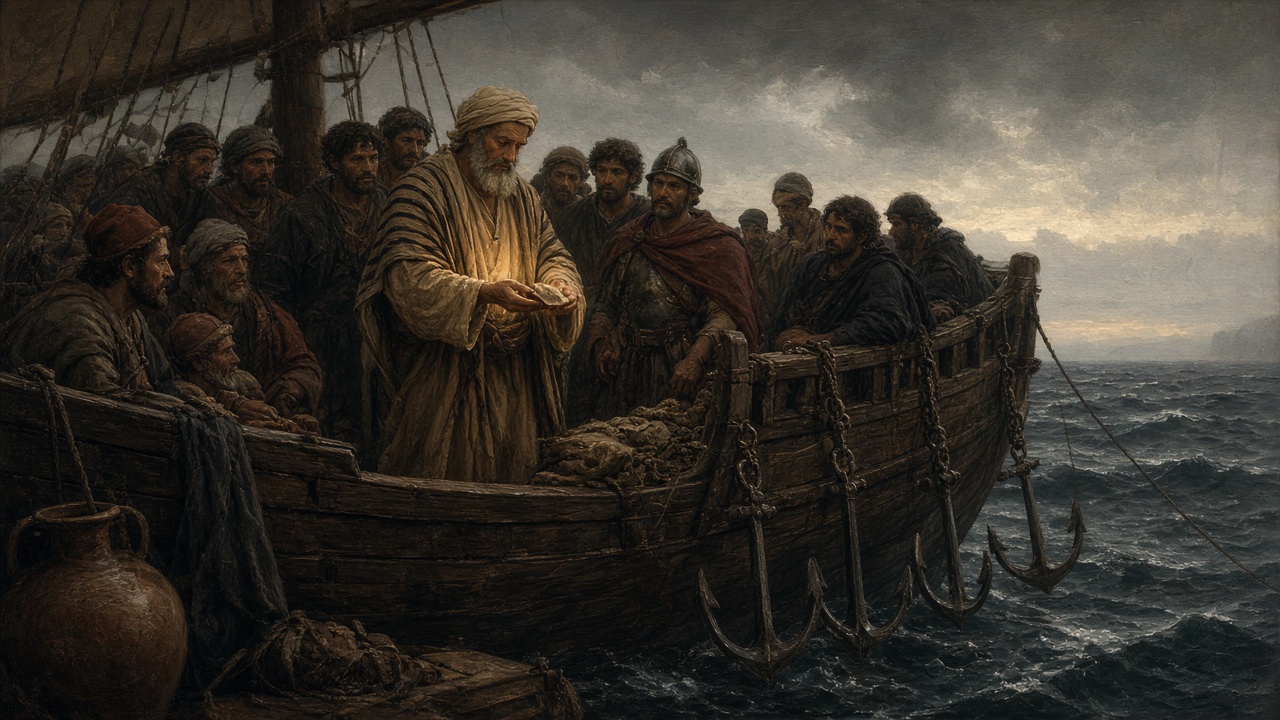
Storm and Shipwreck on the Way to Rome
- Paul and the other prisoners did not sail straight to Italy. At Caesarea they boarded a ship of Adramyttium, a city on the coast of Mysia in Asia Minor, bound for ports along the coast of Asia, a name Easton's Bible Dictionary takes in this verse as probably Asia Minor, and that ship carried them only as far as Myra in Lycia. There the centurion put them aboard an Alexandrian ship sailing for Italy; the dictionary notes that it was rare for a ship to sail from any port of Palestine direct to Italy.Sources: Adramyttium · Asia · the Bible text itself
- The prisoners were handed over to Julius, a centurion of the Imperial Regiment. Easton's Bible Dictionary identifies him as centurion of the Augustan cohort, or the emperor's body-guard, and describes his courteous regard for Paul. At Sidon, about twenty-five miles north of Tyre, he let Paul visit friends and receive care; later he blocked the soldiers' plan to kill the prisoners so that Paul's life would be spared.Sources: Julius · Sidon · the Bible text itself
- After Cnidus the ship worked along Crete, one of the largest islands in the Mediterranean, about 140 miles long and 35 broad, which Paul visited on this voyage to Rome. The account says the voyage had already become dangerous because it was after the Fast, and Fair Havens was unsuitable for wintering. One chronology dates the start of the journey to Rome to AD 56 and the shipwreck in the storm to AD 57.Sources: Crete · Journey to Rome begins · Paul is shipwrecked by a storm · the Bible text itself
Notes written with AI assistance from open sources (Theographic Bible Metadata, CC BY-SA 4.0; Easton’s Bible Dictionary, public domain) and reviewed before publishing.
Places in this chapter
- Italy · 41.892, 12.485 · verses 1, 6
- Adramyttium · Today: Oren · 39.501, 26.933 · verse 2
- Asia · 38.400, 28.300 · verse 2
- Thessalonica · Today: Thessaloniki · 40.638, 22.946 · verse 2
- Sidon · Today: Sandikli archaeological site in Sidon · 33.561, 35.372 · verse 3
- Cyprus · 35.000, 33.000 · verse 4
- Cilicia · 36.913, 34.892 · verse 5
- Lycia · 36.733, 29.900 · verse 5
- Myra · 36.259, 29.985 · verse 5
- Pamphylia · 37.000, 31.000 · verse 5
- Alexandria · 31.183, 29.896 · verse 6
- Cnidus · 36.686, 27.375 · verse 7
- Crete · 35.310, 24.893 · verses 7, 8, 12, 13, 14, 21
- Salmone · Today: Cape Sideros · 35.316, 26.312 · verse 7
- Fair Havens · Today: Kaloi Limenes · 34.930, 24.800 · verses 8, 12
- Lasea · Today: Lasaea · 34.941, 24.811 · verse 8
- Cauda · Today: Gavdos · 34.833, 24.083 · verse 16
- Syrtis · Today: Sidra · 31.500, 18.000 · verse 17
- Adriatic Sea · Today: Adriatic and Ionian Seas · 38.000, 19.000 · verse 27
Only places identified with high confidence are shown (90% or more according to the scholarly sources compiled by OpenBible). Period map: DARE (Digital Atlas of the Roman Empire), CC BY 4.0; modern map: © OpenStreetMap contributors; places: OpenBible.info (CC BY 4.0).
Credits and license for this translation
Beibel: okanisi tongo
New Testament in Eastern Maroon Creole (NS:djk:Eastern Maroon Creole)
copyright © 2009 Wycliffe Bible Translators, Inc.
Language: Eastern Maroon Creole
Translation by: Wycliffe Bible Translators, Inc.
Eastern Maroon Creole
djk
Suriname
Copyright Information
© 2009, Wycliffe Bible Translators, Inc. All rights reserved.
This translation text is made available to you under the
terms of the Creative Commons License: Attribution-Noncommercial-No Derivative Works.
( http://creativecommons.org/licenses/by-nc-nd/3.0/ )
In addition, you have permission to port the text to different file formats, as long as you
do not change any of the text or punctuation of the Bible.
You may share, copy, distribute, transmit, and extract portions
or quotations from this work, provided that you include the above copyright
information:
You must give Attribution to the work.
You do not sell this work for a profit.
You do not make any derivative works that change any of the actual words or punctuation of the Scriptures.
Permissions beyond the scope of this license may be
available if you contact
us with your request.
The New Testament
in Eastern Maroon Creole
© 2009, Wycliffe Bible Translators, Inc. All rights reserved.
This translation is made available to you under the terms of the
Creative Commons Attribution-Noncommercial-No Derivatives license 4.0.
You may share and redistribute this Bible translation or extracts from it in any format, provided that:
You include the above copyright and source information.
You do not sell this work for a profit.
You do not change any of the words or punctuation of the Scriptures.
Pictures included with Scriptures and other documents on this site are licensed just for use with those Scriptures and documents.
For other uses, please contact the respective copyright owners.
2014-04-22
Source: http://ebible.org/djkNT/ · eBible.org