Genesis 50
Nǫ̀htsı̨̨ Nı̨̨htł'è · Tap a verse to see its cross-references.
1Joseph sıì wegha dìì t'à edetà k'e ts'ǫ̀ edeèghà, yeghǫ etse xè yets'į̀. 2Eyı tł'axǫǫ̀ Joseph weyatıì k'è nàèdı-k'èezǫǫ Israel wekw'ǫǫ̀ k'e yìk'eetł'òo agį̀į̀là gà sınìgı̨ı̨htı̨. 3Gınàowoò k'ę̀ę̀ dı̨ènǫ dzęę̀ ts'ǫ̀ yìk'eetł'òo t'à dǫkw'ǫǫ̀ sıìgehɂı̨. Hazǫǫ̀ t'à Egypt got'ı̨į̀ łǫ̀hdı̨ènǫ dzęę̀ ts'ǫ̀ gıghǫ ts'ǫǫ̀gı̨ı̨wǫ.
4Ts'ǫǫ̀gı̨ı̨wǫǫ wetehoòwo tł'axǫǫ̀ Joseph k'àowocho Faraoh wecheekeèdeè gots'ǫ̀ hadı, “Eteseahɂı̨ nı̨dè segha k'àowocho Faraoh ts'ǫ̀ goahde, dıı hawèahdı: 5‘Setà eładaawı ekò wexè yatı nàtsoo whıhtsı̨į̀ asį̀į̀là ı̨lè, sets'ǫ̀ hadı, “Kanan nèk'e edegha dǫkw'ǫǫ̀ k'è gòɂǫǫ whıhtsı̨ ı̨lèe sìı ekǫ sekw'ǫǫ̀ whetǫ ha,” sèhdı ı̨lè. Eyıt'à ekǫ ası̨ı̨le, ekǫ setà wekw'ǫǫ̀ nèehtį̀ ha, eyı tł'axǫǫ̀-ı̨dè jǫ nǫǫ̀ehtła ha,’ hawèahdı,” Joseph gòhdı.
6K'àowocho Faraoh yets'ǫ̀ hadı, “Netà wexè yatı nàtsoo wheęhtsı̨ k'ę̀ę̀ ekǫ wekw'ǫǫ̀ whetǫ anele,” yèhdı.
7Eyıt'à Joseph edetà wekw'ǫǫ̀ nìtį̀ ha ekǫ ehtła. K'àowocho Faraoh wecheekeèdeè eyıts'ǫ Egypt gots'ǫ k'aodèe hazǫǫ̀ wexè agejà. 8Joseph wekǫ̀ gots'ǫ wèot'ı̨, wı̨ı̨de, eyıts'ǫ wetà wekǫ̀ ts'ǫ dǫ gıxè agejà. Gıza eyıts'ǫ gıts'ǫ tıts'aàdìı zǫ Goshen nèk'e ageèhkw'e. 9Tłı̨cho-behchı̨į̀ łǫ eyıts'ǫ dǫ tłı̨cho t'à k'egedèe goxè agejà. Sıì dǫ łǫ gok'ègeède.
10Deh Jordan gà dǫ Atad wìyeh wedèè k'e tł'olà sıìgehɂı̨ı̨ k'è nègı̨ı̨de. Eyı nègı̨ı̨de ekò hòtł'ò getse. Joseph, łǫ̀hdı̨ dzęę̀ ts'ǫ̀ wetà ghǫ ts'ǫǫ̀gı̨ı̨wǫ gha dzęę̀ wheɂǫǫ̀ ayį̀į̀là. 11Kanan got'ı̨į̀ eyı nàgedèe sìı Atad wedèè k'e tł'olà sıìgehɂı̨ı̨ k'è dǫ getse gogıaɂı̨ ekò hagedı, “Egypt got'ı̨į̀ gınàowoò k'ę̀ę̀ dǫ ełaı̨wo gha ts'ǫǫ̀gı̨ı̨wǫ,” gedı. Eyıt'à deh Jordan gà eyı nèk'e Abel-Mızram gòyeh hǫt'e.
12Eyıt'à Jacob weyatıì k'ę̀ę̀ weza eghàlagı̨ı̨dà. 13Kanan nèk'e ts'ǫ̀ wekw'ǫǫ̀ geèhchì. Mamer nèk'e gà dèè Makpelah k'e kwe-yìı-gòɂǫǫ yìı wekw'ǫǫ̀ nègı̨į̀tǫ. Abraham eyı kwe-yìı-gòɂǫǫ dèè xè Het got'ı̨į̀ Efron ghǫnàyeèhdì ı̨lè. 14Joseph edetà wekw'ǫǫ̀ nìı̨htǫ tł'axǫǫ̀ Egypt nèk'e ts'ǫ̀ anajà. Wı̨ı̨de eyıts'ǫ dǫ łǫ wetà wekw'ǫǫ̀ nìtį̀ ha goxè aget'ı̨ı̨ sìı gıxè naèhde.
Joseph edı̨ı̨de ts'ǫ̀ nezı̨į̀ gode
15Gıtà ełaı̨wo tł'axǫǫ̀ Joseph wı̨ı̨de hagedı, “Joseph gots'ǫ̀ wınì-le nı̨dè wets'ǫ̀ hoìla eghàlats'ı̨ı̨dà k'èxa ek'èt'à gots'ǫ̀ hoìla eghàlaeda ha sǫnı,” gedı. 16Eyıt'à Joseph danatıgı̨ı̨ɂǫ, hagıìhdı, “Gotà ełaàwı kwe dıı hagòhdı ı̨lè: 17‘Joseph wets'ǫ̀ dıı haahdı nǫǫ̀, gòhdı ı̨lè: Nı̨ı̨de dànì nets'ǫ̀ hoìla eghàlagı̨ı̨dàa sìı gıhołı̨į̀ gıghǫ nahoı̨le,’ hanèts'edı ha gòhdı ı̨lè. Eyıt'à goxı̨ netà Wenǫ̀htsı̨ wecheekeè ats'ı̨ı̨t'ee sìı gohołı̨į̀ goghǫ nahoı̨le gha neghǫnàdats'eetì,” gıìhdı. Yatı hanıı Joseph danègı̨ı̨ɂǫ ekò Joseph wegha dìì agòjà t'à ı̨ı̨tsè.
18Wı̨ı̨de Joseph ts'ǫ̀ nègı̨ı̨de ekò wets'ǫ̀ nàgògı̨ı̨hgè xè hagedı, “T'aats'ǫǫ̀ negha eghàlats'eedaa-dǫǫ̀ ts'ı̨ı̨lı̨ ha,” gıìhdı.
19Hanìkò Joseph gots'ǫ̀ hadı, “Sets'àahjı̨-le. Nǫ̀htsı̨ wetł'axǫǫ̀ whıhda nıìle. 20Sets'ǫ̀ hoìla eghàlaahda gha aaht'ı̨ ı̨lè, hanìkò wet'à gogha nezı̨į̀ hòɂǫ gha Nǫ̀htsı̨ ayį̀į̀là, dǫ łǫ edaxàgole gha ayį̀į̀là. 21Eyıt'à t'asìı ghǫ dahjı̨-le. Naxık'èhdì ha eyıts'ǫ naxıza sı gık'èhdì ha,” gòhdı. Joseph hanì yatı nezı̨ı̨ t'à gıdzeè nàtsoò agǫ̀ǫ̀là.
Joseph ełaı̨wo
22Joseph, wetà wèot'ı̨ xè Egypt nèk'e nàgı̨ı̨dè. Įłèakw'eènǫ-daats'ǫ̀-hoònǫ xo ts'ǫ̀ ı̨ı̨dà. 23Efrayım wets'ıhɂǫ̀ǫ-dǫǫ̀ taı ts'ǫ̀ ełek'èdaà gı̨ı̨de goaɂı̨. Eyıts'ǫ Manaseh weza Makır weza gıgǫ̀hłı̨ ekò eyı sı dagoehte ı̨lè.
24Eyı tł'axǫǫ̀ Joseph edı̨ı̨de gots'ǫ̀ hadı, “Hòt'a ełaehwhı ha nìkw'o. Hanìkò Nǫ̀htsı̨ naxıts'àdı ha hǫt'e. Jǫ nèk'e ts'ǫ xànaxeewa ha, Kanan nèk'e ts'ǫ̀ anaxele ha. Abraham, Isaac eyıts'ǫ Jacob xè yatı nàtsoo whehtsı̨ı̨ sìı k'ę̀ę̀ eghàlaeda ha,” gòhdı. 25Joseph, Israel weza yatı nàtsoo gèhtsı̨į̀ agǫ̀ǫ̀là, hadı, “Nǫ̀htsı̨ ekǫ nèk'e ts'ǫ̀ xànaxeèwa nı̨dè sekw'ǫǫ̀ jǫ nèk'e gots'ǫ edexè ahłe gha naxıyatıì seghàahɂà,” gòhdı.
26Eyıt'à Joseph ı̨łèakw'eènǫ-daats'ǫ̀-hoònǫ (110) weghoò ekò ełaı̨wo. Yìk'eetł'òo t'à wekw'ǫǫ̀ segı̨į̀la gà Egypt nèk'e wekw'ǫǫ̀ whetǫ agı̨į̀là.
Did you know?
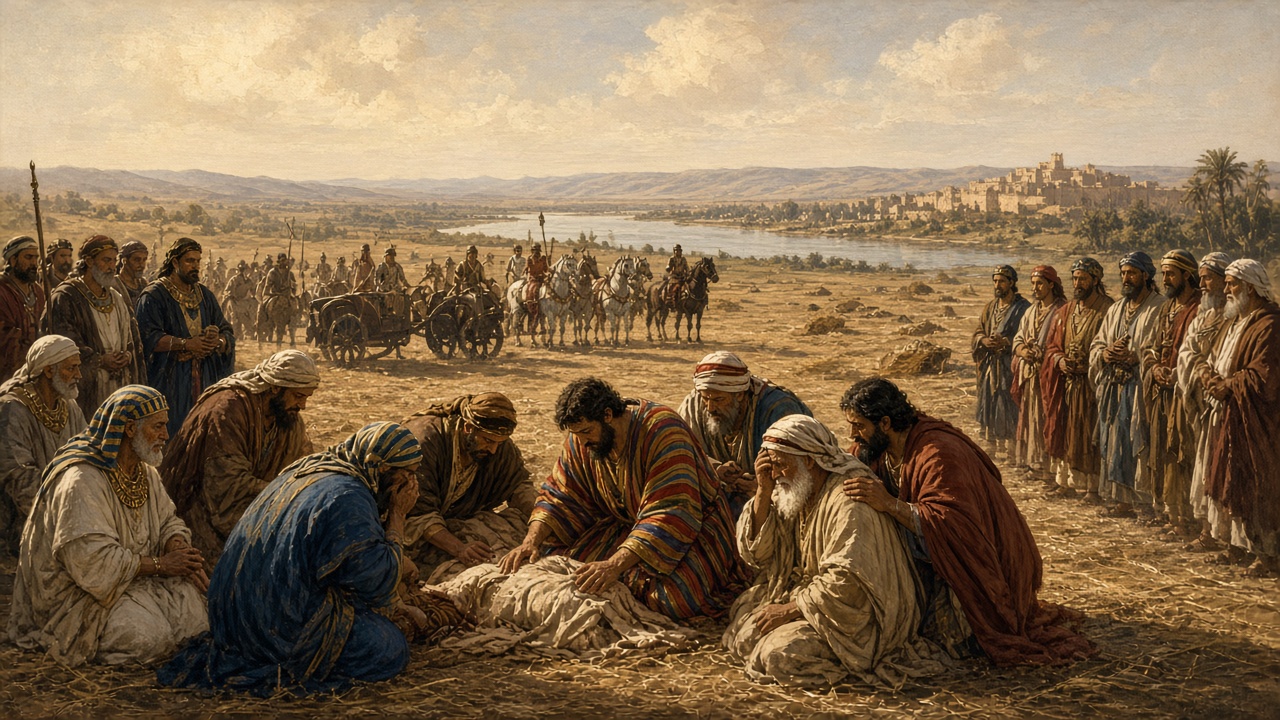
The Burial of Jacob and the Death of Joseph
- The threshing floor of Atad, where the company wailed loudly for seven days across the Jordan, takes its name from a word meaning buckthorn. The Canaanites who saw the mourning called the place Abel-mizraim, 'meadow of Egypt' or 'mourning of Egypt.' Easton's Bible Dictionary places Abel-mizraim west of the Jordan and says its site is unknown, while describing Atad as probably near Hebron.Sources: the Bible text itself
- Jacob's sons buried him in the cave of Machpelah, in the field near Mamre, the burial site Abraham had bought from Ephron the Hittite. Easton's Bible Dictionary identifies Ephron as the son of Zohar and records the price as four hundred shekels of silver.Sources: the Bible text itself
- Joseph remained in Egypt and lived to the age of one hundred and ten, long enough to see Ephraim's sons to the third generation. The sons of Machir, son of Manasseh, were brought up on Joseph's knees—a phrase the Revised Version renders 'born upon Joseph's knees,' which Easton's Bible Dictionary explains as adoption from birth. He told his brothers that God would bring them up to the land promised to Abraham, Isaac, and Jacob, and he made the sons of Israel swear to carry his bones up from Egypt; when he died, they embalmed him and placed him in a coffin there.Sources: the Bible text itself
Notes written with AI assistance from open sources (Theographic Bible Metadata, CC BY-SA 4.0; Easton’s Bible Dictionary, public domain) and reviewed before publishing.
Places in this chapter
- Canaan · 32.767, 35.333 · verses 5, 13
- Egypt · 30.129, 31.308 · verses 7, 14, 22, 24, 26
- Goshen · Today: Goshen 1 · 30.799, 31.834 · verse 8
- Atad · Today: near the mouth of the Jordan River · 31.915, 35.530 · verses 10, 11
- Jordan · Today: Jordan River · 31.761, 35.558 · verses 10, 11
- Machpelah · Today: Cave of the Patriarchs · 31.525, 35.111 · verse 13
Only places identified with high confidence are shown (90% or more according to the scholarly sources compiled by OpenBible). Period map: DARE (Digital Atlas of the Roman Empire), CC BY 4.0; modern map: © OpenStreetMap contributors; places: OpenBible.info (CC BY 4.0).
Credits and license for this translation
Nǫ̀htsı̨̨ Nı̨̨htł'è
Dogrib: Dogrib Genesis & New Testament New Testament & Portions of Old Testament
copyright © 2009 Canadian Bible Society
Language: Dogrib
Translation by: Canadian Bible Society
Tłı̨chǫ Genesis and New Testament
About Tłı̨chǫ
Tłı̨chǫ (Dogrib) is a Na-Dene (Athabaskan) language. It is spoken by the First Nations Tłı̨chǫ people in the Northwest Territories in Canada. It has the largest number of speakers of any of the Aboriginal language communities in the NWT, and is one of the official languages of the Northwest Territories.
About This Translation
This translation includes the book of Genesis and the New Testament in Tłı̨chǫ. The first edition of the Tłı̨chǫ New Testament was published in 2003. It was a historic event, as it was the first time in more than a hundred years that a complete New Testament was published for one of the Dene First Nations in the Territories. The first edition was well received and quickly sold out. In the meantime the book of Genesis had been completed. Consequently, the 2008 reprint of the Tłı̨chǫ New Testament included Genesis.
Though this translation of the New Testament and Genesis took a total of ten years, the people who worked on it built on years of labor invested by the Tłı̨chǫ people, elders, priests and missionaries, translators, educators, and linguists. The material contained in this book was checked and approved by consultants from Wycliffe Bible Translators and the Canadian Bible Society.
If you are interested in obtaining a printed copy of this Bible, please contact the Canadian Bible Society at http://www.biblescanada.com .
Copyright Information
Dogrib Genesis and New Testament © 2003, 2008 Canadian Bible Society
The text of the Bible in Tłı̨chǫ that appears in this electronic format or website is for personal use only.
Up to five hundred (500) verses of the Bible text in any form (written, visual, electronic or audio) may be quoted without permission. The quoted verses may not be more than 50% of a complete book of the Bible, or more than 25% of the total text of the work in which they are quoted. Prior written permission must be obtained for any other use of the text. Copyright acknowledgement must in all cases appear on the title or copyright page.
For more information on copyright conditions or to apply, visit http://www.biblesociety.ca/copyright .
This translation is made available to you under the terms of the
Creative Commons Attribution-Noncommercial-No Derivatives license 4.0.
You may share and redistribute this Bible translation or extracts from it in any format, provided that:
You include the above copyright and source information.
You do not sell this work for a profit.
You do not change any of the words or punctuation of the Scriptures.
Pictures included with Scriptures and other documents on this site are licensed just for use with those Scriptures and documents.
For other uses, please contact the respective copyright owners.
2014-04-22
Source: http://ebible.org/dgrDOGNT/ · eBible.org