Genesis 31
Nǫ̀htsı̨̨ Nı̨̨htł'è · Tap a verse to see its cross-references.
Jacob weɂeh Laban ch'à kwı̨èhsa
1Jacob, Laban weza dıı hagedı yeghǫ ıìkw'o, “Jacob, gotà wets'ǫ tıts'aàdìı hazǫǫ̀ neyı̨į̀wa. Gotà wets'ǫ t'asìı t'à dǫ ahxee whelı̨,” gedı. 2Eyıts'ǫ Jacob weɂeh Laban yets'ǫ̀ wınì ładı̨į̀ ajà yek'èhoèhzà, ı̨nę̀ę lanì yets'ǫ̀ naɂa-le t'à.
3Eyı tł'axǫǫ̀ gots'ǫ̀ K'àowo Jacob ts'ǫ̀ hadı, “Necho gınèk'e nèot'ı̨ gıts'ǫ̀ anaąde, nexè aht'ı̨ ha,” yèhdı.
4Eyıt'à Jacob edets'èkeè Rachel eyıts'ǫ Leah gokàwhehɂà, edı̨į̀ tıts'aàdìı k'èdìı sìı ts'ǫ̀ gokàwhehɂà. 5Gots'ǫ̀ hadı, “Naxıtà sets'ǫ̀ wınì ładı̨į̀ ajà, ı̨nę̀ę lanì sets'ǫ̀ naɂa-le, hanìkò setà Wenǫ̀htsı̨ sìı sexè at'ı̨ hǫt'e. 6Naxıtà wegha hòtł'ò eghàlaıhdà wek'èahsǫ hǫt'e, 7hanìkò t'aats'ǫǫ̀ seghǫyaeɂà eyıts'ǫ sets'àɂeedìı sìı dek'aɂį̀ ayehɂı̨. Hanìkò naxıtà sets'ǫ̀ hoìla eghàlaeda ch'à Nǫ̀htsı̨ ayį̀į̀hwhǫ. 8‘Tıts'aàdìı weta goèhzǫǫ sìı nets'àɂeedìı gı̨ı̨lı̨ ha,’ naxıtà sèhdı nı̨dè tıts'aàdìı gıza gıta goèhzǫǫ̀ nègele. Eyıts'ǫ, ‘Tıts'aàdìı dezǫ gık'e nawhet'ıı sìı nets'àɂeedìı gı̨ı̨lı̨ ha,’ sèhdı nı̨dè tıts'aàdìı gıza dezǫ gık'e nawhet'ıı nègele. 9Eyıt'à Nǫ̀htsı̨ naxıtà wets'ǫ tıts'aàdìı yeghǫ neyı̨į̀waa sìı seghàyı̨ı̨la hǫt'e.
10“Įłàà tıts'aàdìı ełek'aàdèe ekò k'e nàwhıhtı̨ ı̨lè. K'eeht'į̀ là ejıetsoa werezhıì hazǫǫ̀ dezǫ gık'e nawhet'ıı eyıts'ǫ gıta goèhzǫǫ sìı ejıetsoa xè ełek'aàgedè ghǫ nàwhıhtı̨ ı̨lè. 11Nǫ̀htsı̨ weyak'eet'ı̨į̀ sets'ǫ̀ gode hǫt'e, ‘Jacob,’ sèhdı. ‘Hęɂę, neèhkw'ǫ,’ dehsı̨. 12‘Įdaà k'eı̨t'į̀,’ sèhdı, ‘Ejıetsoa werezhıì ejıetsoa xè ełek'aàgedèe sìı hazǫǫ̀ gıta dezǫǫ nawhet'ı, hanì-le-ı̨dè gıta goèhzǫǫ sìı dets'è xè ehk'aàdè. Laban dànì nets'ǫ̀ eghàlaı̨dàa sìı wek'èehsǫ t'à tıts'aàdìı hanì ełek'aàgedè agèhłà. 13Bethel ekǫ Nǫ̀htsı̨ nets'ǫ̀ wègoèht'į̀ı̨ sìı eyı aht'e. Ekǫ kwe nàı̨ɂa k'e tłeh anelà ı̨lè eyıts'ǫ ekǫ sets'ǫ̀ yatı nàtsoo wheęhtsı̨ ı̨lè. Jǫ nèè gots'ǫǫ̀ aąde, nenèè dǫ nelı̨ı̨ sìı ts'ǫ̀ anaąde,’ sèhdı ı̨lè,” Jacob edets'èkeè gòhdı.
14Eyıt'à Rachel eyıts'ǫ Leah hagedı, “Gotà ełaı̨wo-ı̨dè wets'ǫ t'asìı wı̨ı̨zìı gots'ǫ̀ ade ha nıìle. 15Hòt'a wegha dǫ eładı̨ı̨ lats'ı̨ı̨t'e. La k'èxa dǫ ghàgòı̨la hǫt'e hanìkò eyı hazǫǫ̀ edets'ǫ̀ yek'ehǫǫhwho. 16Ehkw'ı ha nı̨dè Nǫ̀htsı̨ sìı gotà wets'ǫ t'asìı hazǫǫ̀ yeghǫ nı̨į̀waa sìı gots'ǫ hǫt'e eyıts'ǫ goza sı gıts'ǫ hǫt'e. Eyıt'à Nǫ̀htsı̨ dànèhdıı sìı hanele,” gıìhdı.
17Eyıt'à Jacob, Kanan nèk'e edetà ts'ǫ̀ anade ha sınìtła. Edeza eyıts'ǫ edets'èkeè tıts'aàdìıcho k'e nègòı̨wa. Wets'ǫ tıts'aàdìı hazǫǫ̀ edenakweè k'eɂà agǫ̀ǫ̀là, eyıts'ǫ Padan-Aram nèk'e gots'ǫ t'asìı hazǫǫ̀ ełèyı̨ı̨laa sìı hazǫǫ̀ edexè ayį̀į̀là.
19Nageedè kwe Laban t'asį̀ı̨ nıwà edesahzǫ̀ą k'e xagot'à ekò k'e Rachel edetà ts'ǫ nǫ̀htsı̨ą hòèlı̨ı̨ dèɂı̨. 20Eyıts'ǫ Jacob, Aram got'ı̨į̀ Laban naàhtǫ naèhtła t'à yetł'ahk'e hòèhtsı̨. 21Eyıt'à t'asìı hazǫǫ̀ xè nakwı̨èhsa. Deh te naèhtła, eyıts'ǫ shìhta Gılad nèk'e ts'ǫ̀ ajà.
Laban Jacob deèzhì
22Taı dzęę̀ tł'axǫǫ̀ Jacob nakwı̨èhsa gedı Laban yeghǫ ıìkw'o. 23Laban edèot'ı̨ edexè ayį̀į̀là gà łǫ̀hdı̨ dzęę̀ ts'ǫ̀ Jacob k'è k'egıadè tł'axǫǫ̀ shìhta Gılad nèk'e gıghàı̨de. 24Hanìkò eyı toò k'e Laban nàwhetı̨ t'à Nǫ̀htsı̨ yets'ǫ̀ gode, hayèhdı, “Edexonehdı, Jacob wets'ǫ̀ hoìla xàyanehtı-le,” yèhdı.
25Laban, Jacob ghǫnììtła ekò, Jacob shìhta Gılad nèk'e nı̨hbàa nàı̨hgè ı̨lè. Eyıt'à Laban ededı̨ sı edèot'ı̨ xè eyı nı̨hbàa nàı̨hgè. 26Ełegà nègı̨ı̨de ekò Laban Jacob ts'ǫ̀ hadı, “Dànìghǫ hanì senaàhtǫ k'ehoı̨ɂa? Eyıts'ǫ ełets'egǫ k'ę̀ę̀ setì seghǫ naneewa. 27Dànìghǫ senaàhtǫ kwı̨èhsa xè sets'ǫ̀ ekǫ-le eghàlaneedà? Sets'ǫ̀ haı̨dı nı̨dè naı̨tła kwe negha goınà xè eyeh eyıts'ǫ tł'ık'eetı̨ı̨ t'à negha sǫnàts'edè ha ı̨lè. 28Sekwı gık'èts'eehdlı̨-le eyıts'ǫ setì t'asagèehsı̨-le et'ıì naątła. Sıì gonezǫ-le k'ę̀ę̀ eghàlaneedà. 29Nenahk'e ts'ı̨ı̨lı̨ ne t'à naxıts'ǫ̀ hoìla eghàlaehda ha dìì-le hǫt'e. Hanìkò ı̨dìı toò k'e netà Wenǫ̀htsı̨ sets'ǫ̀ goı̨de, hadı, ‘Edexonehdı, Jacob wets'ǫ̀ hoìla xàyanehtı-le,’ sèhdı. 30Netà wekǫ̀ ts'ǫ̀ anaąde ha neewǫ t'à anejà, wek'èehsǫ. Hanìkò dànìghǫ senǫ̀htsı̨ą seghǫneeɂı̨?” Laban yèhdı.
31Jacob, Laban ts'ǫ̀ hadı, “Dehjı̨ ts'ıhɂǫ̀ hanì nenaàhtǫ nats'eède ı̨lè. Sets'ǫ̀ nek'èch'a xè netì seghǫ nagı̨ı̨wa ha sǫnı dehwhǫ ı̨lè. 32Hanìkò gota gots'ǫ amìı nenǫ̀htsı̨ą dèɂı̨ı̨ wegòt'ǫǫ nı̨dè ełaàwı ha. Gòet'ı̨ gıdaà t'asìı nets'ǫ goxè wheɂǫǫ wegòahɂǫ nı̨dè neàhchı,” Jacob yèhdı. Ekò k'e, wets'èkeè Rachel nǫ̀htsı̨ą dèɂı̨ı̨ yek'èezǫ-le ı̨lè.
33Eyıt'à Laban Jacob wenı̨hbàa yìı k'eeta, eyıts'ǫ Leah wenı̨hbàa yìı eyıts'ǫ ts'èko nàke gogha eghàlageeda gını̨hbàa sı yìı k'eeta hanìkò edenǫ̀htsı̨ą gòhɂǫ-le. Eyı tł'axǫǫ̀ Rachel wenı̨hbàa yìı k'eeta. 34Rachel edetà ts'ǫ nǫ̀htsı̨ą dèɂı̨ ı̨lèe sìı wet'à tıts'aàdìıcho k'e ts'edaa weyìı yı̨ı̨wa gà yeka wheda. Laban t'asìı hazǫǫ̀ Rachel wets'ǫ sìı ta k'eeta hanìkò edenǫ̀htsı̨ą gòı̨la-le.
35Rachel edetà ts'ǫ̀ hadı, “Età sets'ǫ̀ nek'èch'a welè-le. Ts'èko ehłı̨ t'à nenadąą̀ nàhwho ha dìì,” edetà èhdı. Laban t'asìı hazǫǫ̀ ta k'eeta kò edenǫ̀htsı̨ą gòhɂǫ-le.
36Eyıt'à Jacob, Laban ts'ǫ̀ wınì-le, hayèhdı, “Hot'eè, ayìı sek'enìdahoǫɂà ha? Nek'èch'a ayìı hòwhıhtsı̨ t'à hanì k'esı̨ı̨zo nǫǫ̀? 37Segoht'ǫǫ̀ ta hazǫǫ̀ k'eı̨ta t'à nekǫ̀ ts'ǫ t'asìı gòneehɂǫ nì? Hot'eè jǫ nìı̨chı, nèot'ı̨ hazǫǫ̀ eyıts'ǫ sèot'ı̨ hazǫǫ̀ gınadąą̀ nìı̨chı, ededı̨ gosınìyagıhtı welì.
38“Dıì xè naènǫ xo nexè aeht'è hǫt'e. Nets'ǫ sahzǫ̀a eyıts'ǫ ejıetsoa gıza gǫ̀hłı̨ t'à t'asagejà whìle, eyıts'ǫ nets'ǫ ejıetsoa k'èhdì t'à gıkwǫ̀ ghǫ shèhtı̨ whìle. Jacob Laban wets'ǫ sahzǫ̀ą eyıts'ǫ ejıetsoa k'èdì ı̨lè.|src="HK00009B.TIF" size="span" ref="31.38" 39Tıts'aàdìıcho ekìı-ka k'eɂàa t'à nets'ǫ sahzǫ̀ą ełaı̨wo nı̨dè wetł'axǫǫ̀ sets'ǫ sahzǫ̀ą nìehtè. Dzęh hanì-le-ı̨dè to nets'ǫ tıts'aàdìı neghǫ geeɂį̀ nı̨dè sı̨ èhłı̨ wek'èxa nàehdì ası̨ı̨hɂı̨. 40Dıı hanì sexè hòı̨ɂà hǫt'e: Dzę-ı̨dè edı t'à daıhɂà eyıts'ǫ to-ı̨dè edza t'à daıhɂà, eyıts'ǫ nezı̨į̀ ıhtèe whìle. 41Hanì naènǫ xo ts'ǫ̀ nexè aeht'è. Netì nàke k'èxa hoònǫ-daats'ǫ̀-dı̨ xo negha eghàlaıhdà hǫt'e, eyıts'ǫ dıı tıts'aàdìı seghàneela k'èxa ek'ètaı xo ts'ǫ̀ negha eghàlaıhdà hǫt'e. Eyı weɂǫ̀ǫ̀ sets'àɂeedì gha nı̨dè sexè ekǫ-le k'ehoı̨ɂa. 42Abraham Wenǫ̀htsı̨ eyıts'ǫ setà Nǫ̀htsı̨ ghàtsį̀edìı sìı sexè at'ı̨-le nı̨dè hotıì t'asìı dę nası̨ı̨hɂà ha ı̨lè. Hanìkò Nǫ̀htsı̨ dàhòtł'ò daıhɂàa eyıts'ǫ dànì hòtł'ò eghàlaıhdàa sìı saɂı̨ t'à ı̨dìı toò nets'ǫ̀ goı̨de hǫt'e,” Jacob yèhdı.
43Laban, Jacob ts'ǫ̀ hadı, “Eyı ts'èko sìı setì agı̨ı̨t'e, chekoa nègı̨ı̨laa sìı sekwı agı̨ı̨t'e, eyıts'ǫ eyı tıts'aàdìı hazǫǫ̀ sets'ǫ agı̨ı̨t'e. Ehkw'ı t'à t'asìı hazǫǫ̀ nenadąą̀ whelaa sìı sets'ǫ zǫ hǫt'e. Hanìkò dıì sìı setì eyıts'ǫ gıza dàgeèhłà lì? 44Eyıt'à dıì ełexè yatı nàtsoo wììtsı̨, wet'à ełexè ts'èwhı̨į̀ ts'eeda ha,” Laban yèhdı.
45Eyıt'à Jacob kwe nechàa dèè k'e nàı̨ɂaà ayį̀į̀là. 46Edèot'ı̨ ts'ǫ̀ hadı, “Kwe nıàhwha,” gòhdı. Eyıt'à kwe negı̨į̀wa gà łą̀ą ełeka whelaà agį̀į̀là. Eyı tł'axǫǫ̀ eyı dèè k'e ełexè shègıazhe. 47Laban eyı kwe nègı̨ı̨waa sìı Jegar-Saduta wìyeh ayį̀į̀là, eyıts'ǫ Jacob Galed wìyeh ayį̀į̀là.
48Laban hadı, “Jǫ kwe whelaa sìı ełexè yatı nàtsoo wììtsı̨ı̨ wenats'edì ha eyı gha hǫt'e,” hadı. Eyıt'à eyı nèk'e Galed gòyeh hǫt'e. 49Eyı nèk'e Mızpah sı gòyeh adlà, Laban dıı hadı t'à, “Ełets'ǫǫ̀ ats'ejà nı̨dè goyatıì nàts'eezhì ha-le gha gots'ǫ̀ K'àowo goxoehdı welè. 50Setì gıts'ǫ̀ hoìla eghàlaı̨da, hanì-le-ı̨dè gıgà ts'èko eyıì-le nèehchì nı̨dè, neghàehda-le kò Nǫ̀htsı̨ goghàeda hǫt'e, wenaądì nǫǫ̀,” yèhdı.
51Eyıts'ǫ Laban, Jacob ts'ǫ̀ hadı, “Yatı nàtsoo wììtsı̨ wek'èhoedzǫ gha jǫ kwe whela hǫt'e, eyıts'ǫ eyı gha jǫ kwe nàı̨ɂa hǫt'e. 52Jǫ kwe whelaa sìı eyıts'ǫ jǫ kwe nàı̨ɂaa sìı wet'à goyatıì nats'edì ha hǫt'e. Nets'ǫ̀ hoìla hohtsı̨ ha jǫ kwe whelaa sìı wete ehtła ha nıìle, eyıts'ǫ nı̨ sets'ǫ̀ hoìla hoı̨htsı̨ ha jǫ kwe whelaa eyıts'ǫ jǫ kwe nàı̨ɂaa sìı wete aąde ha nıìle. 53Abraham Wenǫ̀htsı̨, Nahor Wenǫ̀htsı̨ eyıts'ǫ gıtà Wenǫ̀htsı̨ ehkw'ı gosınìyaehtı welè,” Laban hadı.
Eyıt'à Jacob, wetà Isaac Nǫ̀htsı̨ ghàtsį̀edìı sìı wıızì t'à yatı nàtsoo whehtsı̨. 54Jacob eyı shìhta nèk'e tıts'aàdìı ełaı̨hwho gà Nǫ̀htsı̨ ts'ǫ̀ yek'ı̨ı̨hk'ǫ. Eyı tł'axǫǫ̀ ełèot'ı̨ ełexè shègıazheè agǫ̀ǫ̀là. Shègıazhe tł'axǫǫ̀, to eyı geète.
55Satsǫ k'omǫǫ̀dǫǫ̀ et'ıì Laban naetła kwe edekwı eyıts'ǫ edetì gok'èts'adlı̨ eyıts'ǫ yatı nezı̨ı̨ t'à gok'eèyaı̨htı. Eyı tł'axǫǫ̀ edenèk'e ts'ǫ̀ anajà.
Did you know?
Parting at the Heap of Witness
- Laban called the stone heap Jegar-sahadutha, an Aramaic name, and Jacob called it Galeed, Hebrew for “heap of witness.” A Bible dictionary suggests that Nahor’s family originally spoke Aramaic, while Abraham and his descendants learned Hebrew, a kindred dialect, in Canaan.Sources: Galeed · the Bible text itself
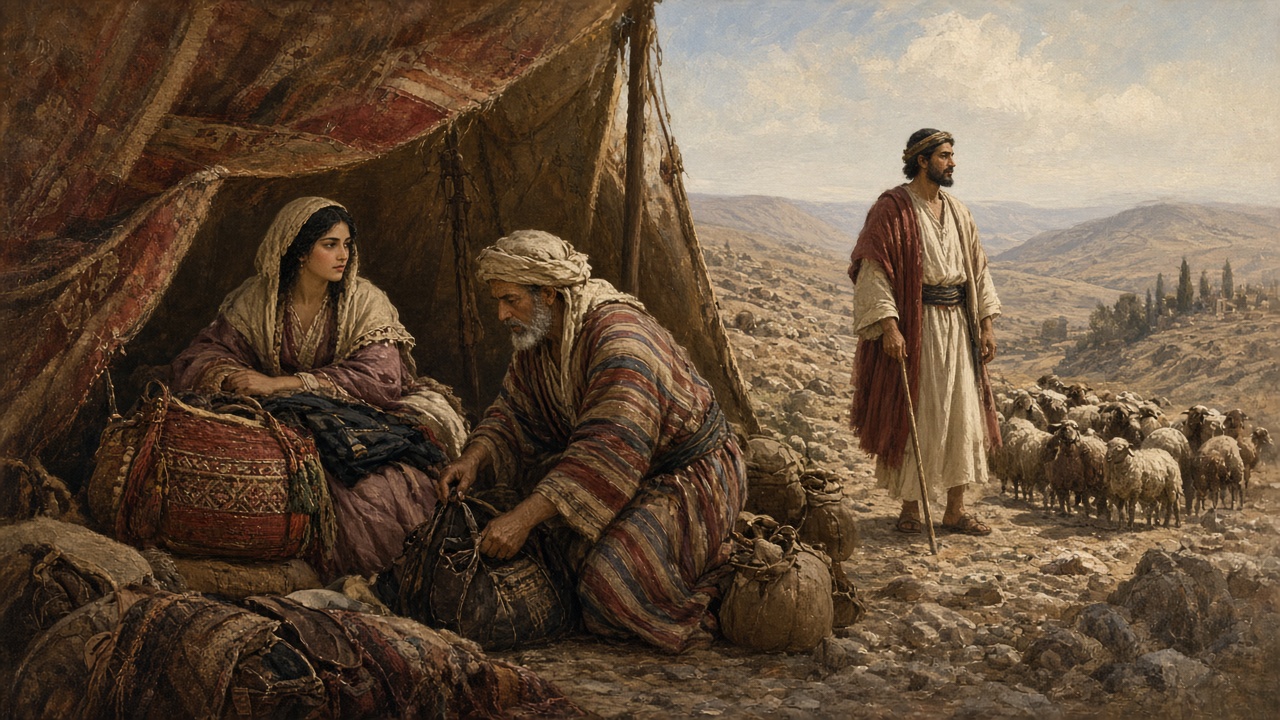
- As they left, Rachel took her father’s household idols, the teraphim, hid them in her camel’s saddlebag, and sat on them while Laban searched the tents. Jacob did not know she had stolen them, though he had declared that anyone found with the idols would not live.Sources: Rachel · the Bible text itself
- Jacob left Paddan-aram, the plain of Aram, commonly regarded as the Mesopotamian district around Haran, crossed the Euphrates, and was overtaken in the hill country of Gilead after a pursuit of seven days. Gilead is described as a “hill of testimony,” a mountainous region east of the Jordan. A dictionary notes that, when Jacob fled from Haran, contact between Abraham’s family in Canaan and the relatives who had remained there came to an end.Sources: Paddan-aram · Gilead · Nahor (brother of Abraham) · the Bible text itself
Notes written with AI assistance from open sources (Theographic Bible Metadata, CC BY-SA 4.0; Easton’s Bible Dictionary, public domain) and reviewed before publishing.
Places in this chapter
- Canaan · 32.767, 35.333 · verse 18
- Euphrates · Today: Euphrates River · 31.004, 47.442 · verse 21
- Gilead · Today: Gilead 1 · 32.187, 35.692 · verses 21, 23, 25
Only places identified with high confidence are shown (90% or more according to the scholarly sources compiled by OpenBible). Period map: DARE (Digital Atlas of the Roman Empire), CC BY 4.0; modern map: © OpenStreetMap contributors; places: OpenBible.info (CC BY 4.0).
Credits and license for this translation
Nǫ̀htsı̨̨ Nı̨̨htł'è
Dogrib: Dogrib Genesis & New Testament New Testament & Portions of Old Testament
copyright © 2009 Canadian Bible Society
Language: Dogrib
Translation by: Canadian Bible Society
Tłı̨chǫ Genesis and New Testament
About Tłı̨chǫ
Tłı̨chǫ (Dogrib) is a Na-Dene (Athabaskan) language. It is spoken by the First Nations Tłı̨chǫ people in the Northwest Territories in Canada. It has the largest number of speakers of any of the Aboriginal language communities in the NWT, and is one of the official languages of the Northwest Territories.
About This Translation
This translation includes the book of Genesis and the New Testament in Tłı̨chǫ. The first edition of the Tłı̨chǫ New Testament was published in 2003. It was a historic event, as it was the first time in more than a hundred years that a complete New Testament was published for one of the Dene First Nations in the Territories. The first edition was well received and quickly sold out. In the meantime the book of Genesis had been completed. Consequently, the 2008 reprint of the Tłı̨chǫ New Testament included Genesis.
Though this translation of the New Testament and Genesis took a total of ten years, the people who worked on it built on years of labor invested by the Tłı̨chǫ people, elders, priests and missionaries, translators, educators, and linguists. The material contained in this book was checked and approved by consultants from Wycliffe Bible Translators and the Canadian Bible Society.
If you are interested in obtaining a printed copy of this Bible, please contact the Canadian Bible Society at http://www.biblescanada.com .
Copyright Information
Dogrib Genesis and New Testament © 2003, 2008 Canadian Bible Society
The text of the Bible in Tłı̨chǫ that appears in this electronic format or website is for personal use only.
Up to five hundred (500) verses of the Bible text in any form (written, visual, electronic or audio) may be quoted without permission. The quoted verses may not be more than 50% of a complete book of the Bible, or more than 25% of the total text of the work in which they are quoted. Prior written permission must be obtained for any other use of the text. Copyright acknowledgement must in all cases appear on the title or copyright page.
For more information on copyright conditions or to apply, visit http://www.biblesociety.ca/copyright .
This translation is made available to you under the terms of the
Creative Commons Attribution-Noncommercial-No Derivatives license 4.0.
You may share and redistribute this Bible translation or extracts from it in any format, provided that:
You include the above copyright and source information.
You do not sell this work for a profit.
You do not change any of the words or punctuation of the Scriptures.
Pictures included with Scriptures and other documents on this site are licensed just for use with those Scriptures and documents.
For other uses, please contact the respective copyright owners.
2014-04-22
Source: http://ebible.org/dgrDOGNT/ · eBible.org