Acts 20
Bigu a tipan: I mahusay a baheta para ta panahun tam · Tap a verse to see its cross-references.
Ti Pablo Ta Masedonia
1Nadid, kélipas na éya a ligalig, éy pinauwet ni Pablo du méniwala, sakay hinatulan na side. Ey kétapos na éya, éy hinumektat siya, a tinumamo ta Masedonia. 2Tinumulos sa siya, a pinatibay na du méniwala ta éya. Ey kédemét na ta Gresia, 3éy tinumulos sa siya a étélo a bulan. Ey to pégayak na pabi a umange ta Siria, éy nabaheta na a ahayukén siya du Judeo a bunon. Kanya nagsoli siya ta Masedonia. 4Tu kakaguman na nadid éy ti Sopater a taga Berea, a anak ni Piro, sakay ti Aristarko, sakay ti Segundu, a taga Tesalonika side. Kaguman na be ti Gayo a taga Derbe, sakay ti Timoteo, sakay ti Tikoko éy ti Tropimo a taga Asia, 5sakay sakén a ti Lukas. Nagdetol side, a naguhay side dikame ta Troas. 6Kélipas no piyesta, éy nénegipo kame dide, a sinumakay kame to paraw ta Pilipos. Lima a aldew i linakad me, éy pinumundu kame ta Troas, a inabut me sa du kakaguman me a minégdetol. Ey esa simba kame sa a tinumulos.
Tu Ulito a Natépduk
7To simba, éy napisan kame dén a étanan, a monda umaheg kame to katapusan a péngapon na Panginoon. Ey ti Pablo éy nagdamag siya a mégkagi du napisan sa, da méglakad siya to gagabi. 8Edsa kame to ontok no bile, sakay te meadu kame a simbu. 9To hatinggabi éy te ulito a te eknud to bintana, a ti Otiko i ngahen naa. Ta tongka na éy minagtongkog siya a hanggan da nakatidug; tulos bigla siya a minatépduk to sidung no melangkaw a bile. Ey to péngégkat de, éy pate bale dén. 10Ey inumogsad ti Pablo a yinapus na. “Diyan kam méligalig,” kagi na, “buhay pabi siya.” 11Ey sinumangkay man dén siya a minéngan side. Sakay négkagi man dén ti Pablo dide a hanggan to késikat no bilag. Ey to gagabi dén, éy hinumektat kame dén. 12Ey mésahat side to ulito, da niange de siya to bile a buhay dén.
13Nagsakay kame to paraw a tamo ta Asos. Pero ti Pablo éy ginumisot. I nibilin naa dikame éy isakay me siya ta éya. 14To pégtagbu me ta Asos, éy nisakay me siya, a nagtulos kame ta Mitilene. 15Kétulak me ta éya, éy dinumemét kame to kagagabian na to tapat no puduk na Kiyo. Ey to kasunud a aldew, éy linumampas kame ta Samos; éy to kahuway man dén a aldew éy dinumemét kame ta Mileto. 16Gustu ni Pablo a salinan me san i Epeso, monda éwan kame maabala ta Asia. Mégagaw siya, da gustu na maka a abutén i Jerusalem bagu Piyesta na Pentekos.
Nagbilin Ti Pablo Du Taga Epeso
17Ta Mileto éy nipauwet ni Pablo du matétanda a mémahala ta simbaan ta Epeso. 18Ey kédemét de, éy naghatul siya dide. “Tukoy moy,” kagi na, “éng kodya i ugali kua sapul to kédedemét ko dikam ta Asia, 19a mebaiték, sakay nagtiisék ta meadu a hirap ta tarabaho ko ta Panginoon. Sakay meadu be a nékialam diyakén a Judeo. 20Tukoy moy a éwanék méganteng a mégtoldu dikam ta maski anya a ikahusay moy, da nagpahayagék ni Jesus ta harap na meadu a tolay, sakay ta bili-bile moy. 21Maski Judeo éy ta éwan Judeo, éy hinéhatulan ko dén side a dapat a idelan de i kasalanan de, sakay magsoli side ta Diyos, sakay maniwala ta Panginoon tam a Jesu Cristo.
22“Ey nadid,” kagi ni Pablo, “éy méglakadék ta Jerusalem, ayun ta utus diyakén na Banal a Espiritu. Sakay éwan ko tukoy éng anya i manyaria diyakén ta éya. 23Basta i napospusan ko sana, éy nipaliwanag diyakén na Banal a Espiritu a maghirapék ta éya, sakay ipihesuék. 24Pero éwan tu halaga i buhay ko, éngˈwan maganap ko maka san i tungkulin ko, sakay tapusén ko i tarabaho ko a niatéd diyakén na Panginoon Jesus, a mégpahayagék ta Mahusay a Baheta tungkul ta kagbi na Diyos.
25“Ey nadid éy naleék a négiyan dikam, habang mégtolduék tungkul ta péghari na Diyos ta tolay. Pero sapul nadid,” kagi ni Pablo, “éy éwanék moy dén meta a huway. 26Kanya i kagin kua dikam nadid, éy éwan ko kapanagutan éng mapahamak i maski isesa dikam, 27da éwan ko niliso dikam i maski anya tungkul ta plano na Diyos. 28Kanya mangilag kam, a alagaan moy ta mahusay du tolay na Diyos ta Epeso a nientarega dikam na Banal a Espiritu. Pastoran moy du tupa na Diyos, da side i koo na a sarili, da tinubus side na Panginoon to dige na to nikate na. 29Eng humektaték éy tukoy ko a te metapang a aso a dumuklos dikam, a dalen de du tupa na Diyos. 30Sakay pati éy dumemét i oras a humiwalay dikam i sénganya ta gurupu moy, a magtoldu side ta kakabulyan, a monda pagkamalién de du tolay a méniwala ni Jesus. 31Kanya mangilag kam, a tandaan moy: aldo éy ta kélép éy tinétolduan ta kam ta mahigpit to lubuk na étélo a taon.
32“Nadid, da méglakadék dén,” kagi ni Pablo, “éy ménalanginék ta Diyos, a siya i mégalagaa dikam. Tu kagi na maka i magpatibaya dikam. Maari i Diyos a magpatibay dikam ta péniwala moy; sakay atdinan na kam be ta gantimpala moy a iatéd na du étanan a tolay na. 33To pégiyan ko dikam, éy tukoy moy a éwan ko hangad tu kuhata moy o dikaya tu badu moy; 34engˈwan nagtarabahoék san ta sarili ko, a monda maketaék ta ikabuhay ko. Ey kona be sa du kaguman ko. 35Ta étanan a pagkékataon ko, éy nipeta ko dikam a dapat kitam a magtarabaho ta mahusay, a monda matulungan tam du tolay a mahirap. Tandaan moy,” kagi ni Pablo, “tu kinagi na Panginoon, éy lalo kan a masaya tu méngatéd kesira ta tumanggap.”
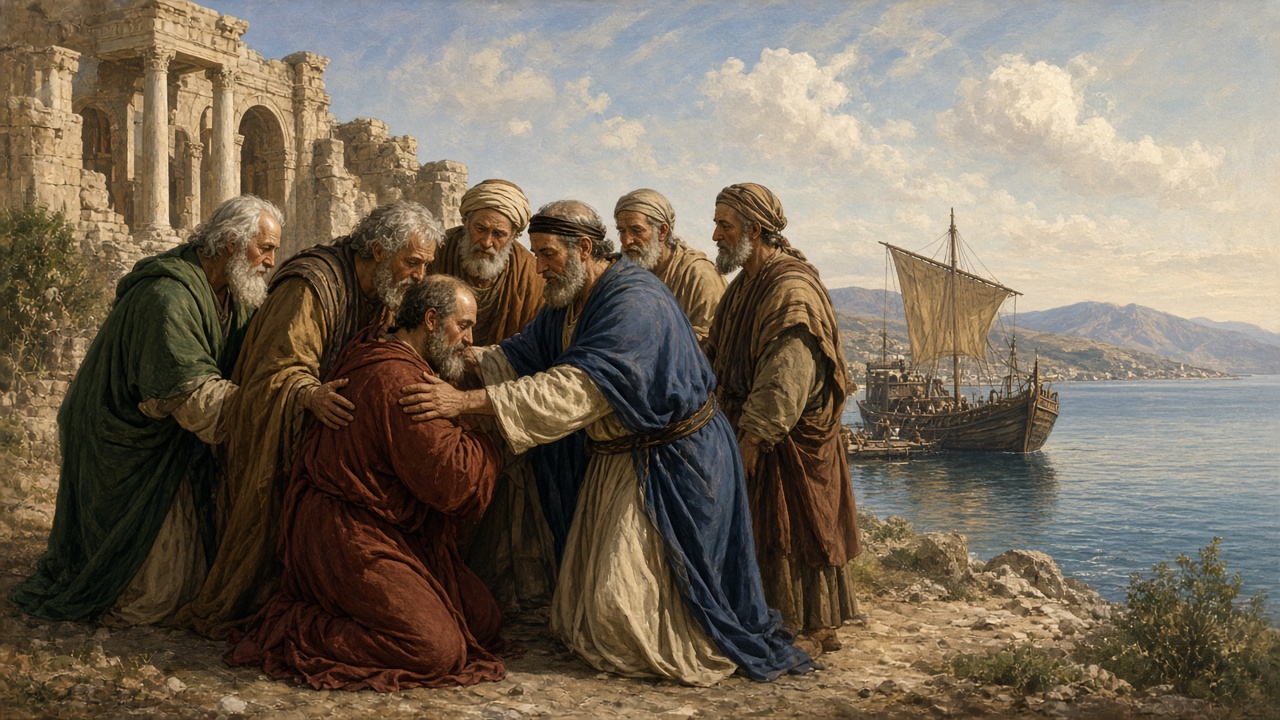
36Nadid, to pégkagi ni Pablo ta éya du matétanda, éy linumuhud side a minanalangin. 37Ey mégpégsanget side, sakay yinapus de siya a étanan. 38I nikalungkut dia éy tu kinagi na a éwan de dén siya meta a huway. Ey tulos niange de siya nitugén a nisakay to paraw.
Did you know?
Farewell on the way to Jerusalem
- Leaving Troas, Paul sent his companions ahead by ship and walked to Assos along the Roman road. Assos was a seaport of Proconsular Asia in Mysia, on the north shore of the Gulf of Adramyttium; the walk was about 20 miles, the sea route about 30, and the island of Lesbos lay about 7 miles offshore.Sources: the Bible text itself · Assos
- Paul sailed past Ephesus to avoid spending time in the province of Asia—the Roman province in western Asia Minor, with Ephesus as its capital—because he hoped, if possible, to reach Jerusalem by the day of Pentecost. He stopped at Miletus, a seaport and the ancient capital of Ionia about 36 miles south of Ephesus, and summoned the elders of the Ephesian church.Sources: the Bible text itself · Asia · Miletus
- Seven men traveled with him: Sopater of Berea, Aristarchus and Secundus of Thessalonica, Gaius of Derbe, Timothy, and Tychicus and Trophimus from Asia. Aristarchus of Thessalonica later shared Paul’s imprisonment in Rome, and Trophimus, an Ephesian, accompanied him on this part of the journey and was with him in Jerusalem.Sources: the Bible text itself · Aristarchus · Trophimus
Notes written with AI assistance from open sources (Theographic Bible Metadata, CC BY-SA 4.0; Easton’s Bible Dictionary, public domain) and reviewed before publishing.
Places in this chapter
- Macedonia · 41.600, 22.540 · verses 1, 3, 6
- Greece · 37.972, 23.727 · verse 2
- Syria · Today: Syria 2 · 33.511, 36.306 · verse 3
- Asia · 38.400, 28.300 · verses 4, 16, 18
- Berea · Today: Veria · 40.518, 22.200 · verse 4
- Thessalonica · Today: Thessaloniki · 40.638, 22.946 · verse 4
- Troas · Today: Alexandria Troas · 39.752, 26.159 · verses 5, 6
- Philippi · 41.012, 24.285 · verse 6
- Assos · 39.491, 26.337 · verses 13, 14
- Mitylene · Today: ancient theater at Mitylene · 39.110, 26.547 · verse 14
- Chios · 38.373, 26.137 · verse 15
- Miletus · 37.531, 27.276 · verses 15, 17
- Samos · 37.750, 26.833 · verse 15
- Trogyllium · Today: Cape Mycale · 37.659, 27.003 · verse 15
- Ephesus · 37.939, 27.341 · verses 16, 17
- Jerusalem · 31.777, 35.234 · verses 16, 22
Only places identified with high confidence are shown (90% or more according to the scholarly sources compiled by OpenBible). Period map: DARE (Digital Atlas of the Roman Empire), CC BY 4.0; modern map: © OpenStreetMap contributors; places: OpenBible.info (CC BY 4.0).
Credits and license for this translation
Bigu a tipan: I mahusay a baheta para ta panahun tam
New Testament in Agta, Casiguran Dumagat
copyright © 1979 Wycliffe Bible Translators, Inc.
Language: Casiguran Dumagat Agta (Agta, Casiguran Dumagat)
Translation by: Wycliffe Bible Translators
Contributor: Wycliffe Bible Translators, Inc.
Copyright Information
© 1979, Wycliffe Bible Translators, Inc. All rights reserved.
This translation text is made available to you under the
terms of the Creative Commons License: Attribution-Noncommercial-No Derivative Works.
( http://creativecommons.org/licenses/by-nc-nd/3.0/ )
In addition, you have permission to port the text to different file formats, as long as you
do not change any of the text or punctuation of the Bible.
You may share, copy, distribute, transmit, and extract portions
or quotations from this work, provided that you include the above copyright
information:
You must give Attribution to the work.
You do not sell this work for a profit.
You do not make any derivative works that change any of the actual words or punctuation of the Scriptures.
Permissions beyond the scope of this license may be
available if you contact
us with your request.
The New Testament
in Agta, Casiguran Dumagat
© 1979, Wycliffe Bible Translators, Inc. All rights reserved.
This translation is made available to you under the terms of the
Creative Commons Attribution-Noncommercial-No Derivatives license 4.0.
You may share and redistribute this Bible translation or extracts from it in any format, provided that:
You include the above copyright and source information.
You do not sell this work for a profit.
You do not change any of the words or punctuation of the Scriptures.
Pictures included with Scriptures and other documents on this site are licensed just for use with those Scriptures and documents.
For other uses, please contact the respective copyright owners.
2015-03-17
Source: http://ebible.org/dgc/ · eBible.org