Joshua 1
Textbibel von Kautzsch und Weizsäcker · Tap a verse to see its cross-references.
About this book
About Joshua
- Easton's Bible Dictionary (1897) explains Joshua's name as "Jehovah is his help" or "Jehovah the Saviour." He was the son of Nun, of the tribe of Ephraim, born in Egypt, and Moses' successor as leader of Israel; the wars of conquest he carried on are recorded in the book that bears his name. That entry does not name the book's author or give a date for its writing.Sources: Easton: Joshua · Joshua
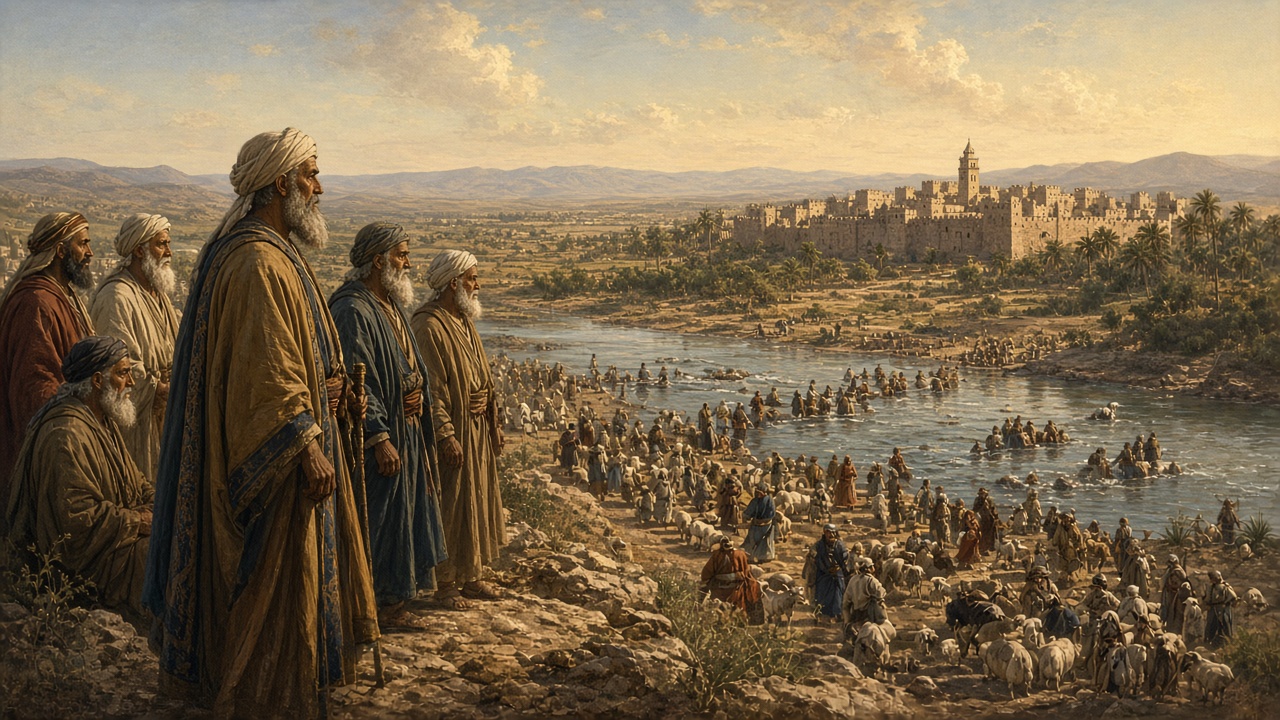
- When Joshua took command, the people were encamped at Shittim. They crossed the Jordan and camped at Gilgal, where, Easton says, he circumcised the people and kept the Passover. Jericho, a fortified city among palm trees about five miles west of the Jordan, is described as Canaan's strongest fortress and the key to western Palestine; Ai, east of Bethel, was the second Canaanite city taken, after an initial defeat.Sources: Easton: Joshua · Jericho · Ai
- Easton's Bible Dictionary (1897) says Joshua conquered six nations and thirty-one kings, then divided the land among the tribes, with Timnath-serah in Mount Ephraim assigned to himself. East of the Jordan, Gilead is described as a mountainous region held by the tribes of Gad and Reuben and the southern part of Manasseh.Sources: Easton: Joshua · Gilead
- Quoting Edersheim, the dictionary says Joshua's name was changed from Oshea, "help," to Jehoshua, "Jehovah is help," and notes that he is called Jesus in Acts 7:45 and Hebrews 4:8. It states that he died at the age of one hundred and ten, twenty-five years after crossing the Jordan, and was buried in his own city of Timnath-serah; of his father Nun, nothing more is recorded than that he was Joshua's father.Sources: Easton: Joshua · Joshua · Nun
- Before leading the conquest, Joshua commanded Israel's host against the Amalekites at Rephidim, served as Moses' minister, and was one of twelve sent to explore Canaan; only he and Caleb brought back an encouraging report. As Easton sketches the book, it runs from the crossing of the Jordan and the taking of Jericho through years of war to the division of the land and Joshua's last address.Sources: Easton: Joshua
Notes written with AI assistance from open sources (Theographic Bible Metadata, CC BY-SA 4.0; Easton’s Bible Dictionary, public domain) and reviewed before publishing.
Befehl zur Überschreitung des Jordan
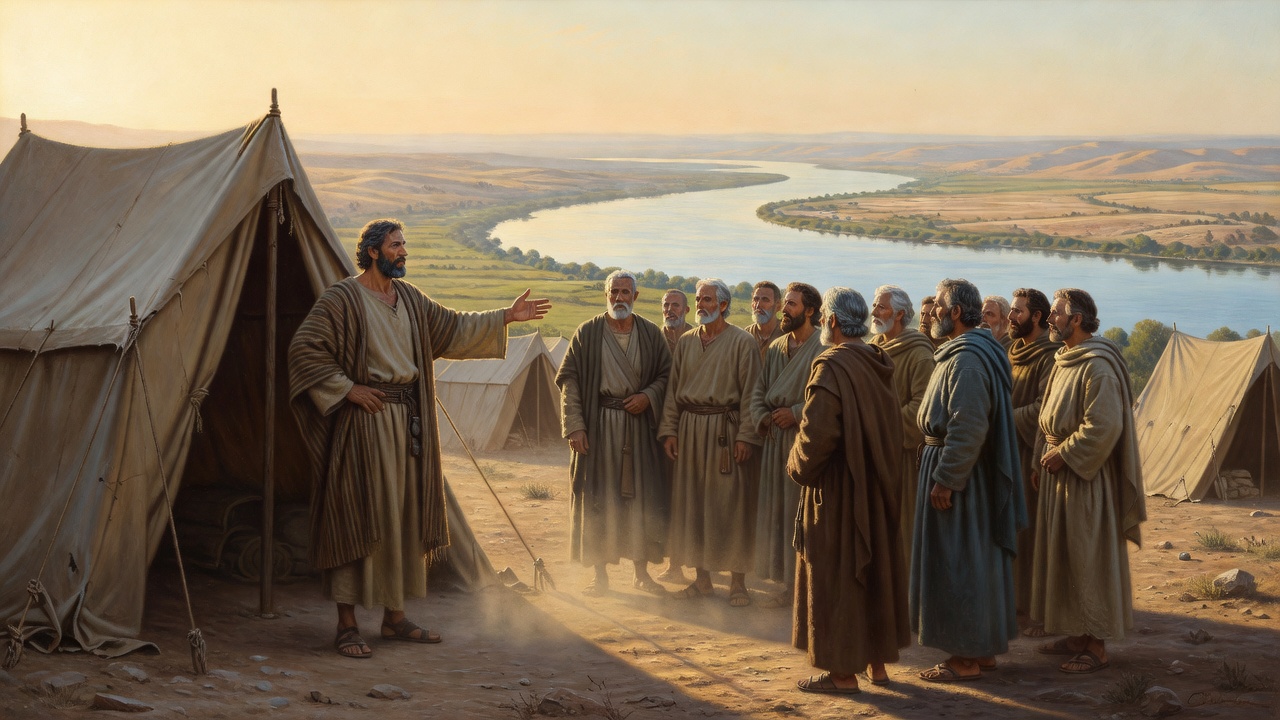
1Nach dem Tode Moses, des Knechtes Jahwes, aber sprach Jahwe zu Josua, dem Sohne Nuns, dem Diener Moses, also: 2Nun, da mein Knecht Mose gestorben ist, so brich du auf und ziehe mit diesem ganzen Volk über den Jordan da hinüber in das Land, das ich ihnen, den Israeliten, verleihen will. 3Eine jegliche Stätte, die eure Fußsohle betreten wird, will ich euch verleihen, wie ich es Mose verheißen habe. 4Von der Steppe an und dem Libanon dort bis an den großen Strom, den Euphratstrom, das ganze Land der Hethiter, bis zum großen Meer im Westen soll euer Gebiet reichen. 5Niemand wird vor dir standhalten können dein Leben lang. Wie ich mit Mose gewesen bin, will ich auch mit dir sein; ich will meine Hand nicht von dir abziehen und dich nicht im Stiche lassen. 6Sei fest und thatkräftig; denn du sollst an dieses Volk dieses Land, dessen Verleihung ich ihren Vätern zugeschworen habe, als Erbbesitz verteilen. 7Sei nur fest und eifrigst darauf bedacht, pünktlich, gemäß dem ganzen Gesetze, das mein Knecht Mose dir anbefohlen hat, zu handeln; weiche davon nicht ab weder nach rechts, noch nach links, damit du weislich handeltst in allem, was du unternimmst. 8Beständig sollst du dieses Gesetzbuch im Munde führen und ihm nachsinnen Tag und Nacht, damit du darauf bedacht seist, alles zu halten, was darin aufgezeichnet ist; dann wirst du deine Unternehmungen glücklich vollführen und weislich handeln. 9Habe ich dir ja doch anbefohlen: Sei fest und thatkräftig! Sei ohne Furcht und unverzagt, denn Jahwe, dein Gott, ist mit dir bei allem, was du unternimmst. 10Da gab Josua den Amtleuten des Volks folgenden Befehl: 11Geht durch das Lager hindurch und befehlt dem Volke: Macht euch Mundvorrat zurecht; denn wenn drei Tage um sind, sollt ihr den Jordan da überschreiten, um einzuziehen und das Land in Besitz zu nehmen, das euch Jahwe, euer Gott, zum Besitze geben will. 12Zu den Rubeniten, Gaditen und dem halben Stamme Manasse aber sprach Josua also: 13Seid dessen eingedenk, was euch Mose, der Knecht Jahwes befohlen hat, da er sagte: Jahwe, euer Gott, hat euch an euren Bestimmungsort gebracht und euch dieses Land verliehen. 14Eure Weiber, eure kleinen Kinder und euer Vieh sollen in dem Lande bleiben, das euch Mose jenseits des Jordan angewiesen hat; ihr aber, sämtliche streitbare Männer, sollt kampfgerüstet vor euren Volksgenossen einherziehen und ihnen Hilfe leisten, 15bis Jahwe auch eure Volksgenossen, gerade so wie euch, an ihren Bestimmungsort gebracht hat, und auch sie das Land, das ihnen Jahwe, ihr Gott, verleihen will, eingenommen haben. Dann sollt ihr in das Land, das euer Eigentum ist, zurückkehren und es in Besitz nehmen; denn Mose, der Knecht Jahwes, hat es euch ja jenseits des Jordan im Osten angewiesen. 16Da erwiderten sie Josua also: Alles, was du uns befiehlst, wollen wir thun, und wohin du uns ziehen heißest, wollen wir ziehen! 17Wie wir Mose in allen Stücken gehorcht haben, so wollen wir auch dir gehorchen, wenn nur Jahwe, dein Gott, mit dir ist, wie er mit Mose war. 18Ein jeder, der deinem Befehle zuwider handelt und deinen Anweisungen nicht gehorcht, in allem, was du uns gebietest, soll mit dem Tode bestraft werden; nur sei fest und thatkräftig!
Did you know?
Joshua Assumes Leadership
- Joshua, the son of Nun from the tribe of Ephraim, served as Moses' assistant and military commander before being commissioned to succeed him as leader of Israel. His name means "Jehovah is his help" or "Jehovah the Saviour."Sources: Joshua · the Bible text itself
- The territory outlined in God's commission to Joshua stretches from the southern wilderness and the Lebanon mountain range in the north to the Euphrates (called "the great river") in the east and the Mediterranean ("the Great Sea") to the west.Sources: the Bible text itself · Lebanon · Euphrates · Great Sea
- The tribes of Reuben, Gad, and the half-tribe of Manasseh had already received territory east of the Jordan River under Moses. However, their armed warriors were required to cross over ahead of the other tribes to assist them until the entire land was secured.Sources: the Bible text itself · Manasseh (son of Joseph)
Notes written with AI assistance from open sources (Theographic Bible Metadata, CC BY-SA 4.0; Easton’s Bible Dictionary, public domain) and reviewed before publishing.
Places in this chapter
- Jordan · Today: Jordan River · 31.761, 35.558 · verses 2, 11, 14, 15
- Euphrates · Today: Euphrates River · 31.004, 47.442 · verse 4
- Great Sea · Today: Mediterranean Sea · 31.805, 34.170 · verse 4
- Lebanon · 33.540, 35.584 · verse 4
- Negeb · 31.245, 34.841 · verse 4
- Syria · Today: Aram · 33.511, 36.306 · verse 4
Only places identified with high confidence are shown (90% or more according to the scholarly sources compiled by OpenBible). Period map: DARE (Digital Atlas of the Roman Empire), CC BY 4.0; modern map: © OpenStreetMap contributors; places: OpenBible.info (CC BY 4.0).
Credits and license for this translation
Textbibel von Kautzsch und Weizsäcker
The Holy Bible in German, translation by Kautzsch und Weizsäcker 1906
Public Domain
Language: Deutsch (German, Standard)
Dieser Textbibel wird Ihnen mit freundlicher Genehmigung von eBible.org zur Verfügung gestellt, mit der Hilfe unserer Partner, die für den Erhalt unserer Dienste spenden.
This Public Domain Bible text is provided to you courtesy of eBible.org with help from our partners who donate to keep our servers and services running.
Quelle: Textbibel.de (Hans J. Herbst Mitarbeit bei der Digitalisierung) ist frei!
2025-08-30
Source: http://ebible.org/deutkw/ · eBible.org