Zephaniah 1
Darby Unrevidierte Elberfelder · Tap a verse to see its cross-references.
About this book
About Zephaniah
- Easton's Bible Dictionary (1897) presents Zephaniah, whose name it explains as "Jehovah has concealed" or "Jehovah of darkness," as the son of Cushi and great-grandson of Hezekiah, and as the ninth of the minor prophets. It dates his prophecy to the reign of Josiah, king of Judah (641–610 B.C.), and says he was contemporary with Jeremiah, with whom he had much in common.Sources: Easton: Zephaniah · Zephaniah · Cushi
- Amon, Josiah's father, restored idolatry in Judah, and Easton reads Zephaniah 1:4 and 3:4, 11 as referring to that reign. The same dictionary links Zephaniah 1:4–6 with the worship of Baal and Zephaniah 1:5 with Malcham, described as the national idol of the Ammonites. Josiah, who came to the throne at eight, is presented as later acting against the idolatry that prevailed.Sources: Amon · Josiah · Baal · Malcham
- Easton's Bible Dictionary outlines the book as an introduction announcing judgment on the world and on Israel because of their transgressions (1:1–6), a description of the judgment (1:7–18), an exhortation to seek God while there is still time (2:1–3), judgment on other peoples (2:4–15), what it calls the hopeless misery of Jerusalem (3:1–7), and a promise of salvation (3:8–20).Sources: Easton: Zephaniah
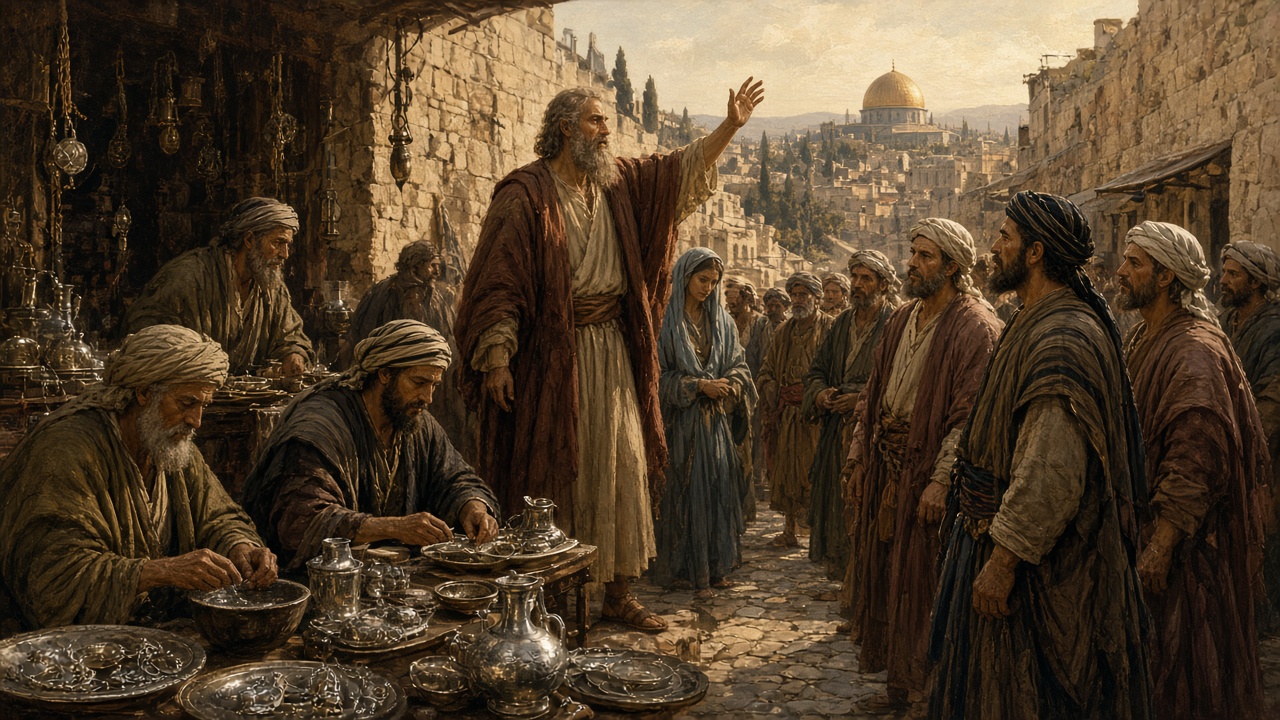
- Zephaniah 1:11 names the Mortar, a place in or near Jerusalem inhabited by silver merchants. It has been conjectured that this was the Phoenician quarter of the city, where traders of that nation lived.Sources: Mortar
Notes written with AI assistance from open sources (Theographic Bible Metadata, CC BY-SA 4.0; Easton’s Bible Dictionary, public domain) and reviewed before publishing.
1Das Wort Jehovas, welches zu Zephanja geschah, dem Sohne Kuschis, des Sohnes Gedaljas, des Sohnes Amarjas, des Sohnes Hiskijas, in den Tagen Josias, des Sohnes Amons, des Königs von Juda. 2Ich werde alles von der Fläche des Erdbodens gänzlich wegraffen, spricht Jehova; 3ich werde Menschen und Vieh wegraffen, ich werde wegraffen die Vögel des Himmels und die Fische des Meeres, und die Ärgernisse samt den Gesetzlosen; und ich werde die Menschen ausrotten von der Fläche des Erdbodens, spricht Jehova. - 4Und ich werde meine Hand ausstrecken wider Juda und wider alle Bewohner von Jerusalem. Und ich werde aus diesem Orte den Überrest des Baal, den Namen der Götzenpriester samt den Priestern ausrotten; 5und die auf den Dächern das Heer des Himmels anbeten, und die Anbetenden, welche dem Jehova schwören und bei ihrem König schwören; 6und die von Jehova zurückweichen, und die Jehova nicht suchen noch nach ihm fragen. 7Still vor dem Herrn Jehova! Denn nahe ist der Tag Jehovas; denn Jehova hat ein Schlachtopfer bereitet, er hat seine Geladenen geheiligt. 8Und es wird geschehen an dem Tage des Schlachtopfers Jehovas, da werde ich die Fürsten und die Königssöhne heimsuchen und alle, die sich mit fremder Kleidung bekleiden. 9Und an jenem Tage werde ich einen jeden heimsuchen, der über die Schwelle springt, alle, die das Haus ihres Herrn mit Gewalttat und Betrug erfüllen. 10Und an jenem Tage, spricht Jehova, wird ein Geschrei erschallen vom Fischtore her, und ein Geheul von der Unterstadt, und lautes Jammern von den Hügeln her. 11Heulet, ihr Bewohner von Maktesch! Denn alles Krämervolk ist vernichtet, alle mit Silber Beladenen sind ausgerottet. 12Und es wird geschehen zu jener Zeit, da werde ich Jerusalem mit Leuchten durchsuchen; und ich werde die Männer heimsuchen, welche auf ihren Hefen liegen, die in ihrem Herzen sprechen: Jehova tut nichts Gutes und tut nichts Böses. 13Und ihr Vermögen wird zum Raube, und ihre Häuser werden zur Wüste werden; und sie werden Häuser bauen und sie nicht bewohnen, und Weinberge pflanzen und deren Wein nicht trinken. 14Nahe ist der große Tag Jehovas; er ist nahe und eilt sehr. Horch, der Tag Jehovas! Bitterlich schreit dort der Held. 15Ein Tag des Grimmes ist dieser Tag, ein Tag der Drangsal und der Bedrängnis, ein Tag des Verwüstens und der Verwüstung, ein Tag der Finsternis und der Dunkelheit, ein Tag des Gewölks und des Wolkendunkels, 16ein Tag der Posaune und des Kriegsgeschreis wider die festen Städte und wider die hohen Zinnen. 17Und ich werde die Menschen ängstigen, und sie werden einhergehen wie die Blinden, weil sie gegen Jehova gesündigt haben; und ihr Blut wird verschüttet werden wie Staub, und ihr Fleisch wie Kot; 18auch ihr Silber, auch ihr Gold wird sie nicht erretten können am Tage des Grimmes Jehovas; und durch das Feuer seines Eifers wird das ganze Land verzehrt werden. Denn ein Ende, ja, ein plötzliches Ende wird er machen mit allen Bewohnern des Landes.
Did you know?
The Day of the LORD and Judgment on Idolatry
- Zephaniah traces his lineage back four generations to Hezekiah, dating his prophetic ministry to the reign of King Josiah of Judah. Josiah came to power after his father, King Amon, had restored idolatry across Judah before being assassinated by his own servants.Sources: the Bible text itself · Josiah · Amon · Hizkiah
- The chapter denounces religious syncretism in Jerusalem, where people bowed on rooftops to the host of heaven and combined their devotion to the LORD with oaths to Baal and Malcham, the national idol of the Ammonites.Sources: the Bible text itself · Baal · Malcham
- The prophecy specifies landmarks in Jerusalem that would experience turmoil, including the Fish Gate and the Mortar (or Hollow), a district inhabited by merchants who weighed out silver.Sources: the Bible text itself · Fish Gate · Mortar
Notes written with AI assistance from open sources (Theographic Bible Metadata, CC BY-SA 4.0; Easton’s Bible Dictionary, public domain) and reviewed before publishing.
Places in this chapter
- Jerusalem · 31.777, 35.234 · verses 4, 12
- Fish Gate · Today: in Jerusalem · 31.777, 35.234 · verse 10
- Second Quarter · Today: in Jerusalem · 31.777, 35.234 · verse 10
- Canaan · 32.767, 35.333 · verse 11
- Mortar · Today: in Jerusalem · 31.777, 35.234 · verse 11
Only places identified with high confidence are shown (90% or more according to the scholarly sources compiled by OpenBible). Period map: DARE (Digital Atlas of the Roman Empire), CC BY 4.0; modern map: © OpenStreetMap contributors; places: OpenBible.info (CC BY 4.0).
Credits and license for this translation
Darby Unrevidierte Elberfelder
The Holy Bible in German, Unrevised Elberfelder 1905
Public Domain
Language: Deutsch (German, Standard)
Translation by: Julius Anton von Poseck, Carl Brockhaus, and John Nelson Darby
https://de.wikipedia.org/wiki/Elberfelder_Bibel
Diese Bibel ist bei eBible.org verfügbar.
2023-09-19
Source: http://ebible.org/deuelo/ · eBible.org