Malachi 1
Die Schlachter-Bibel 1951 · Tap a verse to see its cross-references.
About this book
About Malachi
- Easton's Bible Dictionary (1897) presents Malachi, a name meaning "messenger" or "angel," as the last of the minor prophets and the writer of the last book of the Old Testament canon. Nothing is known of him beyond what is contained in his book of prophecies.Sources: Easton: Malachi · Malachi
- Some have supposed that the name is simply a title for a messenger of Jehovah, not a proper name. Easton's Bible Dictionary (1897) concludes, however, that there is reason to regard Malachi as the prophet's ordinary name.Sources: Easton: Malachi · Malachi
- Easton's Bible Dictionary (1897) dates the prophecies to about 420 B.C., after Nehemiah's second return from Persia, or possibly before that return. Because Ezra does not mention him and he does not mention the restoration of the temple, the dictionary infers that he prophesied after Haggai and Zechariah.Sources: Easton: Malachi
- Easton's Bible Dictionary (1897) treats Malachi as a contemporary of Nehemiah, comparing Malachi 2:8 with Nehemiah 13:15 and Malachi 2:10-16 with Nehemiah 13:23. It also notes that the temple services were still in existence, citing Malachi 1:10, 3:1 and 3:10.Sources: Easton: Malachi
Notes written with AI assistance from open sources (Theographic Bible Metadata, CC BY-SA 4.0; Easton’s Bible Dictionary, public domain) and reviewed before publishing.
1Dies ist der Ausspruch, das Wort des HERRN an Israel, durch die Hand Maleachis: 2Ich habe euch Liebe erwiesen, spricht der HERR. So sprechet ihr: Womit hast du uns Liebe erwiesen? 3Ist nicht Esau Jakobs Bruder? spricht der HERR. Dennoch habe ich Jakob geliebt, Esau aber habe ich gehaßt und sein Gebirge zur Wildnis gemacht und sein Erbteil den Schakalen der Wüste gegeben. 4Wenn aber Edom spräche: «Wir sind zwar zerstört, wir wollen aber die Trümmer wieder aufbauen», so sagt der HERR der Heerscharen: Sie mögen bauen, ich aber will niederreißen; und man wird sie nennen: «Land der Gottlosigkeit» und «das Volk, über das der HERR ewiglich zürnt». 5Wenn eure Augen das sehen, so werdet ihr sagen: Der HERR sei hochgepriesen über Israels Grenzen hinaus! 6Ein Sohn soll seinen Vater ehren und ein Knecht seinen Herrn! Bin ich nun Vater, wo ist meine Ehre? Bin ich Herr, wo ist die Furcht vor mir? spricht der HERR der Heerscharen zu euch Priestern, die ihr meinen Namen verächtlich macht. 7Und fragt ihr: «Womit haben wir deinen Namen verächtlich gemacht?» Damit, daß ihr auf meinem Altar verunreinigtes Brot darbringt! Fragt ihr aber: «Womit haben wir dich verunreinigt?» Damit, daß ihr sagt: «Der Tisch des HERRN ist geringzuschätzen!» 8Und wenn ihr ein blindes Tier zum Opfer bringt, ist das nichts Böses, und wenn ihr ein lahmes oder krankes darbringt, ist das auch nichts Böses? Bringe es doch deinem Statthalter! Wird er dir gnädig sein oder Rücksicht auf dich nehmen? spricht der HERR der Heerscharen. 9Und nun besänftiget doch das Angesicht Gottes, daß er uns gnädig sei! Wird er, weil solches von eurer Hand geschehen ist, auf jemand von euch Rücksicht nehmen? 10Es schließe doch lieber gleich jemand von euch die Türen [des Tempels] zu, daß ihr nicht vergeblich mein Altarfeuer anzündet! Ich habe kein Wohlgefallen an euch, spricht der HERR der Heerscharen, und die Opfergabe, die von euren Händen kommt, gefällt mir nicht! 11Denn vom Aufgang der Sonne bis zu ihrem Niedergang ist mein Name groß unter den Heiden, und allenthalben werden meinem Namen Räucherwerk und reine Opfergabe dargebracht; denn groß ist mein Name unter den Heiden, spricht der HERR der Heerscharen. 12Ihr aber entheiligt ihn damit, daß ihr sagt: «Der Tisch des Herrn darf verunreinigt werden, und die Speise, die von ihm kommt, ist geringzuschätzen!» 13Und ihr sprecht: «Siehe, ist es auch der Mühe wert?» Und ihr verachtet ihn, spricht der HERR der Heerscharen, und bringet Geraubtes und Lahmes und Krankes herbei und bringet solches als Opfergabe dar. Sollte ich das von eurer Hand wohlgefällig annehmen? spricht der Herr. 14Nein, verflucht sei der Betrüger, der in seiner Herde ein männliches Tier hat und ein Gelübde tut und dann doch dem Herrn ein schadhaftes opfert! Denn ich bin ein großer König, spricht der HERR der Heerscharen, und mein Name ist gefürchtet unter den Heiden.
Did you know?
Honoring God and Defective Offerings
- The name Malachi means messenger or angel. While some have suggested it was a title rather than a proper name, scholars and traditions widely treat it as the prophet's personal name, placing his ministry during the period of Nehemiah, after Haggai and Zechariah.Sources: Malachi
- The opening dispute recalls the twin brothers Jacob and Esau, the ancestors of Israel and Edom. The text contrasts God's covenant love for Israel with the judgment and desolation coming upon the mountainous region of Edom.Sources: Esau (Edom) · Jacob (Israel) · Edom · the Bible text itself
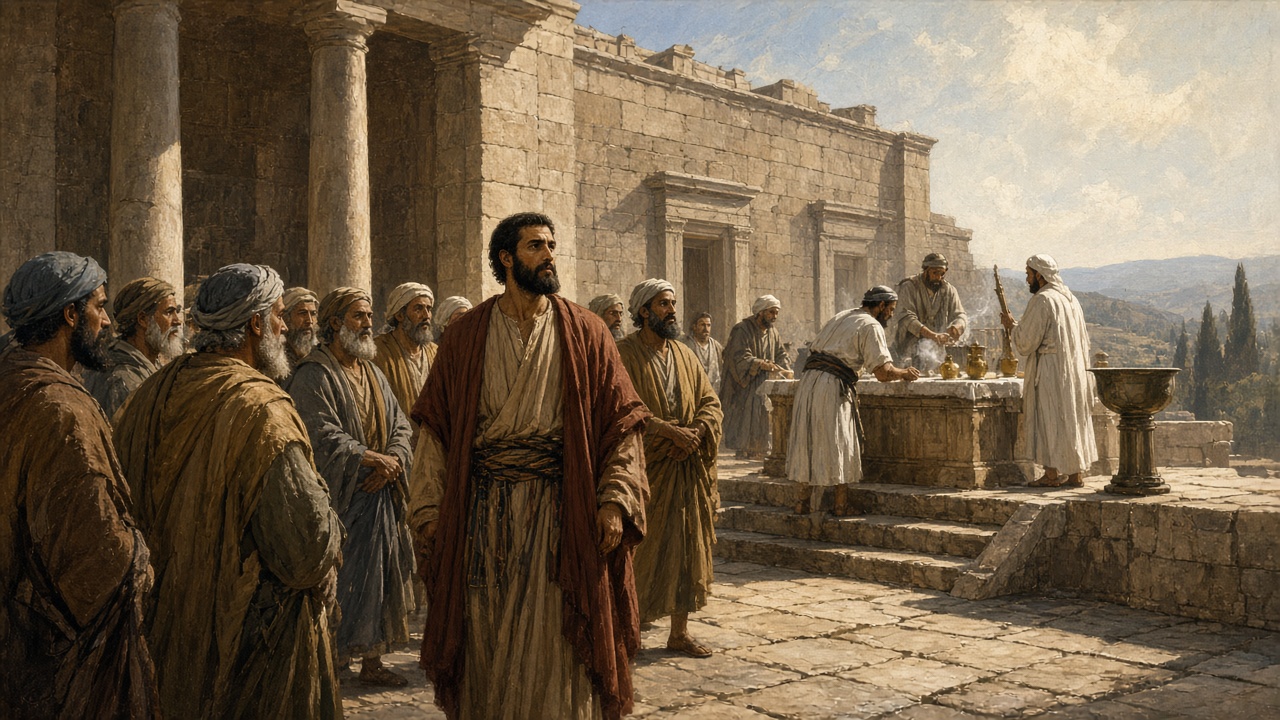
- The priests are rebuked for offering blind, lame, and diseased animals on the altar rather than unblemished livestock. Malachi exposes their disrespect by asking whether a civil governor would accept such inferior gifts.Sources: the Bible text itself
Notes written with AI assistance from open sources (Theographic Bible Metadata, CC BY-SA 4.0; Easton’s Bible Dictionary, public domain) and reviewed before publishing.
Places in this chapter
- Edom · 30.746, 35.604 · verse 4
Only places identified with high confidence are shown (90% or more according to the scholarly sources compiled by OpenBible). Period map: DARE (Digital Atlas of the Roman Empire), CC BY 4.0; modern map: © OpenStreetMap contributors; places: OpenBible.info (CC BY 4.0).
Credits and license for this translation
Die Schlachter-Bibel 1951
The Holy Bible in German, Schlachter 1951 version
copyright © 1951 Genfer Bibelgeschellschaft (Geneva Bible Society)
Language: Deutsch (German, Standard)
Translation by: Franz-Eugen Schlachter
Contributor: Genfer Bibelgesellschaft
Die Heilige Schrift des Alten und Neuen Testaments nach dem Urtext Übersetzt von Franz Eugen Schlachter. Neue Überarbeitung 1951 durch Genfer Bibelgesellschaft.
This translation is made available to you under the terms of the
Creative Commons Attribution license 4.0.
You may share and redistribute this Bible translation or extracts from it in any format, provided that:
You include the above copyright and source information.
If you make any changes to the text, you must indicate that you did so in a way that makes it clear that the original licensor is not necessarily endorsing your changes.
Pictures included with Scriptures and other documents on this site are licensed just for use with those Scriptures and documents.
For other uses, please contact the respective copyright owners.
Note that in addition to the rules above, revising and adapting God's Word involves a great responsibility to be true to God's Word. See Revelation 22:18-19.
2022-03-30
Source: http://ebible.org/deu1951/ · eBible.org