Song of Songs 7
Lutherbibel 1912 · Tap a verse to see its cross-references.
1Wie schön ist dein Gang in den Schuhen, du Fürstentochter! Deine Lenden stehen gleich aneinander wie zwei Spangen, die des Meisters Hand gemacht hat. 2Dein Schoß ist wie ein runder Becher, dem nimmer Getränk mangelt. Dein Leib ist wie ein Weizenhaufen, umsteckt mit Rosen. 3Deine zwei Brüste sind wie zwei Rehzwillinge. 4Dein Hals ist wie ein elfenbeinerner Turm. Deine Augen sind wie die Teiche zu Hesbon am Tor Bathrabbims. Deine Nase ist wie der Turm auf dem Libanon, der gen Damaskus sieht. 5Dein Haupt steht auf dir wie der Karmel. Das Haar auf deinem Haupt ist wie der Purpur des Königs, in Falten gebunden. 6Wie schön und wie lieblich bist du, du Liebe voller Wonne! 7Dein Wuchs ist hoch wie ein Palmbaum und deine Brüste gleich den Weintrauben. 8Ich sprach: Ich muß auf dem Palmbaum steigen und seine Zweige ergreifen. Laß deine Brüste sein wie Trauben am Weinstock und deiner Nase Duft wie Äpfel 9und deinen Gaumen wie guter Wein, der meinem Freunde glatt eingeht und der Schläfer Lippen reden macht. 10Mein Freund ist mein, und nach mir steht sein Verlangen. 11Komm, mein Freund, laß uns aufs Feld hinausgehen und auf den Dörfern bleiben, 12daß wir früh aufstehen zu den Weinbergen, daß wir sehen, ob der Weinstock sprosse und seine Blüten aufgehen, ob die Granatbäume blühen; da will ich dir meine Liebe geben. 13Die Lilien geben den Geruch, und über unsrer Tür sind allerlei edle Früchte. Mein Freund, ich habe dir beide, heurige und vorjährige, behalten.
Did you know?
Poetry of Love and Landscape
- The poem describes the woman's beauty using prominent landmarks of the region. Her eyes are compared to the calm pools of Heshbon near the gate of Bath-rabbim east of the Jordan, while her profile is likened to a majestic tower in the mountain range of Lebanon overlooking Damascus.Sources: the Bible text itself · Heshbon · Bath-rabbim · Lebanon
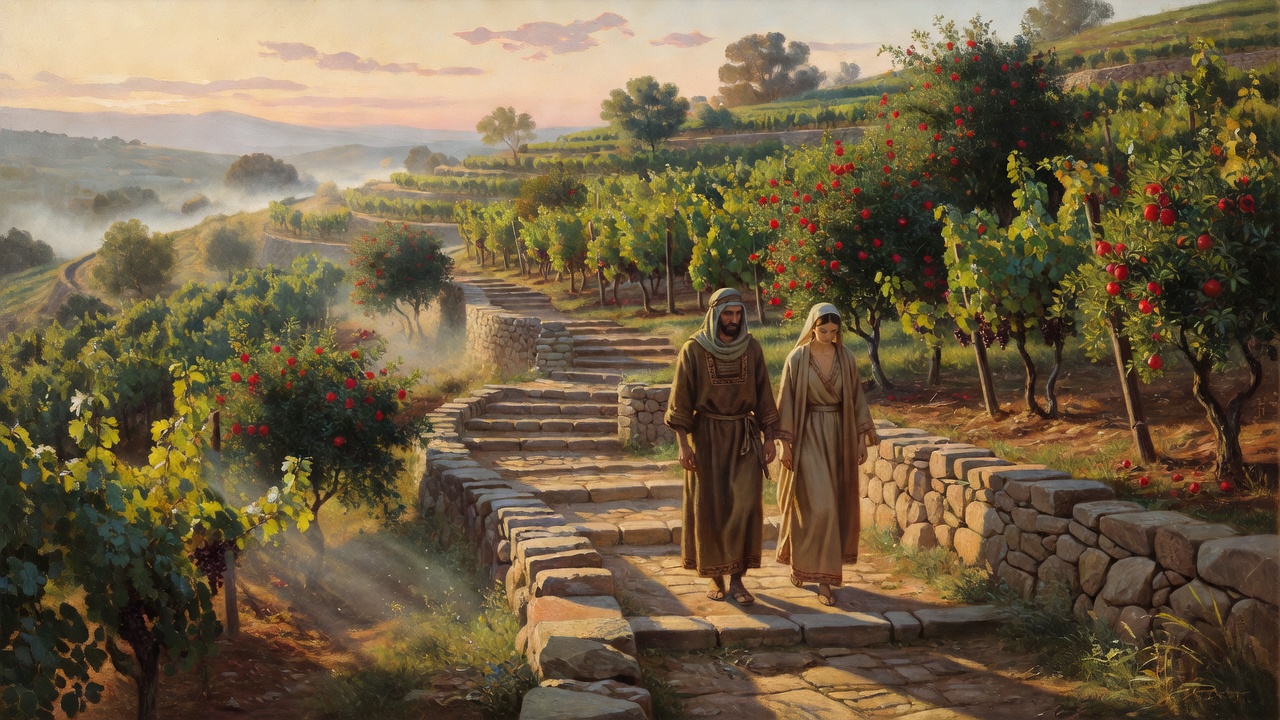
- The chapter concludes with an invitation to the countryside during the renewal of spring. The lovers seek out budding grapevines, blooming pomegranates, and fragrant mandrakes, reflecting the close connection in ancient Hebrew poetry between romantic intimacy and the vitality of the natural world.Sources: the Bible text itself
Notes written with AI assistance from open sources (Theographic Bible Metadata, CC BY-SA 4.0; Easton’s Bible Dictionary, public domain) and reviewed before publishing.
Places in this chapter
- Bath-rabbim · Today: in Tell Hesban · 31.801, 35.809 · verse 4
- Damascus · 33.511, 36.306 · verse 4
- Lebanon · 33.540, 35.584 · verse 4
- Mount Carmel · 32.672, 35.023 · verse 5
Only places identified with high confidence are shown (90% or more according to the scholarly sources compiled by OpenBible). Period map: DARE (Digital Atlas of the Roman Empire), CC BY 4.0; modern map: © OpenStreetMap contributors; places: OpenBible.info (CC BY 4.0).
Credits and license for this translation
Lutherbibel 1912
The Holy Bible in German, Luther 1912
Public Domain
Language: Deutsch (German, Standard)
Translation by: Martin Luther
2025-12-29
Source: http://ebible.org/deu1912/ · eBible.org