Deuteronomy 24
Hellig Bibel · Tap a verse to see its cross-references.
1Når en Mand tager en Kvinde til Ægte, og hun ikke vinder hans Yndest, fordi han finder noget ved hende, der vækker Ubehag hos ham, og han skriver hende et Skilsmissebrev og giver hende det i Hænde og sender hende ud af sit Hjem, 2så må hun efter at have forladt hans Hjem gå hen og gifte sig med en anden Mand; 3får denne anden Mand også Uvilje imod hende og skriver hende et Skilsmissebrev og giver hende det i Hænde og sender hende ud af sit Hjem, eller dør den anden Mand, der havde taget hende til Ægte, 4så har hendes første Mand, som havde sendt hende bort, ikke Ret til igen at tage hende til Hustru, efter at hun er blevet uren. Thi det er HERREN en Vederstyggelighed, og du må ikke bringe Brøde over det Land, HERREN din Gud vil give dig i Eje. 5Når en Mand nylig har taget sig en Hustru, skal han ikke drage med i Krig, og der skal ikke pålægges ham nogen som helst Forpligtelse; han skal have Frihed til at blive hjemme et År og glæde sin Hustru, som han har ægtet. 6Man må ikke tage en Håndkværn i Pant, heller ikke den øverste Møllesten; thi det var at tage Livet selv i Pant. 7Når nogen gribes i at stjæle en af sine Brødre blandt Israelitterne og gør ham Fortræd eller sælger ham, da skal en sådan Tyv lade sit Liv. Du skal udrydde det onde af din Midte. 8Tag dig i Vare med Spedalskhed, så du meget omhyggeligt handler efter alt, hvad Levitpræsterne lærer eder; som jeg har påbudt dem, skal I omhyggeligt handle. 9Kom i Hu, hvad HERREN din Gud gjorde ved Mirjam undervejs, da I drog bort fra Ægypten. 10Når du yder din Næste et Lån, må du ikke gå ind i hans Hus for at tage Pant af ham. 11Du skal blive stående udenfor, og den Mand, du yder Lånet, skal bringe Pantet ud til dig. 12Hvis han er en fattig Mand, må du ikke lægge dig til Hvile med hans Pant; 13ved Solnedgang skal du give ham Pantet tilbage, for at han kan lægge sig til Hvile i sin Kappe. Da velsigner han dig derfor, og du står retfærdiggjort for HERREN din Guds Åsyn. 14Du må ikke forurette en nødlidende, fattig Daglejer, hvad enten han hører til dine Brødre eller de fremmede inden dine Porte nogetsteds i dit Land. 15Dag for Dag skal du give ham hans Løn, så at Solen ikke går ned derover, thi han er nødlidende og venter med Længsel derpå. Ellers råber han til HERREN over dig, og du pådrager dig Skyld. 16Fædre skal ikke lide Døden for Børns Skyld, og Børn skal ikke lide Døden for Fædres Skyld. Enhver skal lide Døden for sin egen Synd. 17Du må ikke bøje Retten for den fremmede og den faderløse, og du må ikke tage Enkens Klædning i Pant. 18Men kom i Hu, at du var Træl i Ægypten, og at HERREN din Gud udløste dig derfra. Derfor byder jeg dig at handle således. 19Når du bjærger din Høst på din Mark og glemmer et Neg på Marken, må du ikke vende tilbage for at hente det; det skal tilfalde den fremmede, den faderløse og Enken, for at HERREN din Gud kan velsigne dig i alt, hvad du tager dig for. 20Når du slår dine Oliven ned, må du ikke bagefter gennemsøge Grenene; den fremmede, den faderløse og Enken skal det tilfalde. 21Når du høster din Vin, må du ikke holde Efterhøst; den fremmede, den faderløse og Enken skal det tilfalde. 22Kom i Hu, at du selv var Træl i Ægypten; derfor byder jeg dig at handle således.
Did you know?
Laws of Compassion, Justice, and Social Protection
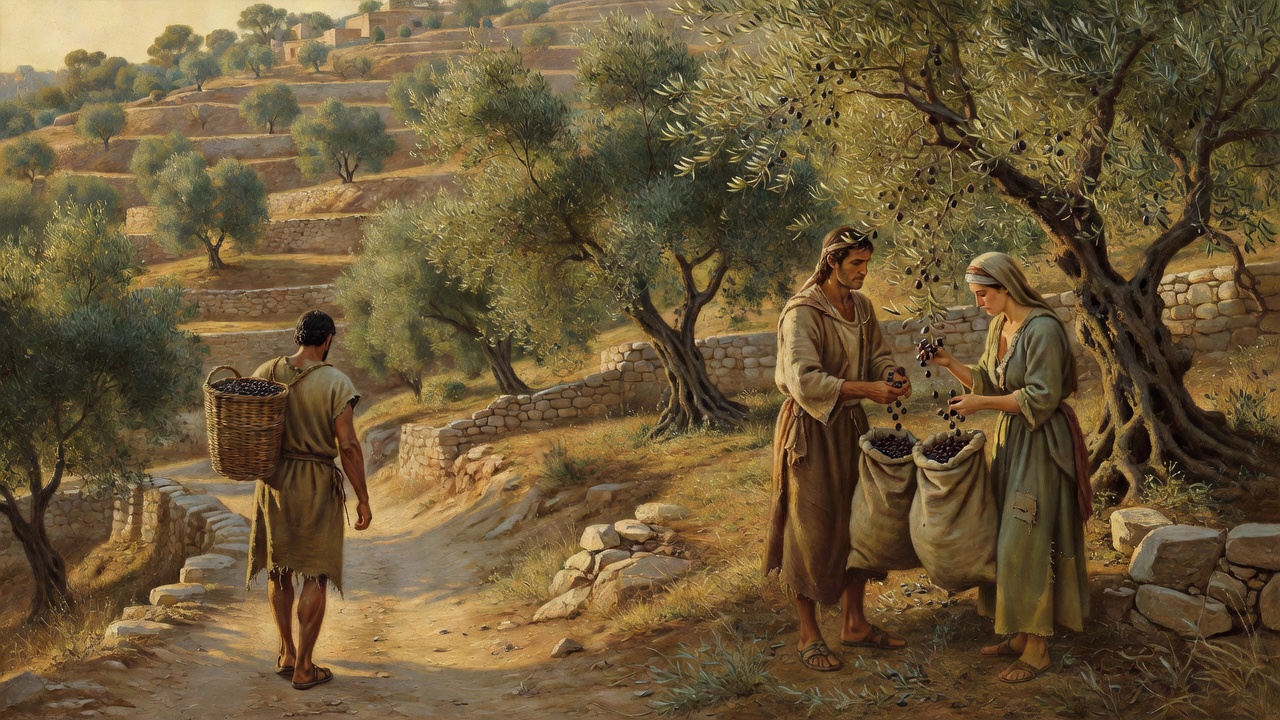
- Israelite harvesting laws required landowners to leave behind forgotten sheaves of grain, leftover olives, and grape gleanings for vulnerable groups: the resident foreigner, the orphan, and the widow. This social welfare system was grounded in the collective memory that the Israelites had once been oppressed slaves in Egypt.Sources: the Bible text itself · Egypt
- Debtors and hired workers were protected by explicit legal limits. Creditors were forbidden from entering a debtor's house to seize a pledge, taking essential millstones that provided a household's daily bread, or keeping an impoverished person's sleeping cloak past sunset, and day laborers had to be paid before nightfall.Sources: the Bible text itself
- When giving instructions concerning infectious skin diseases and the guidance of Levitical priests, the text points back to the affliction of Miriam, the sister of Moses and Aaron, during the wilderness journey following the Exodus from Egypt.Sources: the Bible text itself · Miriam · Egypt
Notes written with AI assistance from open sources (Theographic Bible Metadata, CC BY-SA 4.0; Easton’s Bible Dictionary, public domain) and reviewed before publishing.
Places in this chapter
Only places identified with high confidence are shown (90% or more according to the scholarly sources compiled by OpenBible). Period map: DARE (Digital Atlas of the Roman Empire), CC BY 4.0; modern map: © OpenStreetMap contributors; places: OpenBible.info (CC BY 4.0).
Credits and license for this translation
Hellig Bibel
The Holy Bible in Danish (OT 1931, NT 1907)
Copyright © 1907, 1931 Det Danske Bibelselskab
Language: Dansk (Danish)
Translation by: Danish Bible Society
The New Testament is in the Public Domain.
The Old Testament is © 1931
Det Danske Bibelselskab 1931.
[The Danish Bible Society]
This etext is distributed by Professor Michael S. Hart through
the Project Gutenberg Association at Carnegie-Mellon University
(the "Project") under the Project's "Project Gutenberg" trademark
and with the permission of the etext's copyright owner.
LICENSE
You can (and are encouraged!) to copy and distribute this
Project Gutenberg-tm etext. Since, unlike many other of the
Project's etexts, it is copyright protected, and since the
materials and methods you use will effect the Project's
reputation,
your right to copy and distribute it is limited by the copyright
laws and by the conditions of this "Small Print!" statement.
[A] ALL COPIES: The Project permits you to distribute
copies of this etext electronically or on any machine readable
medium now known or hereafter discovered so long as you:
(1) Honor the refund and replacement provisions of this
"Small Print!" statement; and
(2) Pay a royalty to the Project of 20% of the net
profits you derive calculated using the method you already use
to calculate your applicable taxes. If you don't derive
profits, no royalty is due. Royalties are payable to "Project
Gutenberg Association/Carnegie Mellon-University" within
the 60 days following each date you prepare (or were legally
required to prepare) your annual (or equivalent periodic) tax
return.
[B] EXACT AND MODIFIED COPIES: The copies you distribute
must either be exact copies of this etext, including this
Small Print statement, or can be in binary, compressed, mark-
up, or proprietary form (including any form resulting from
word processing or hypertext software), so long as *EITHER*:
(1) The etext, when displayed, is clearly readable, and
does *not* contain characters other than those intended by the
author of the work, although tilde (~), asterisk (*) and
underline (_) characters may be used to convey punctuation
intended by the author, and additional characters may be used
to indicate hypertext links; OR
(2) The etext is readily convertible by the reader at no
expense into plain ASCII, EBCDIC or equivalent form by the
program that displays the etext (as is the case, for instance,
with most word processors); OR
(3) You provide or agree to provide on request at no
additional cost, fee or expense, a copy of the etext in plain
ASCII.
LIMITED WARRANTY; DISCLAIMER OF DAMAGES
This etext may contain a "Defect" in the form of incomplete,
inaccurate or corrupt data, transcription errors, a copyright
or other infringement, a defective or damaged disk, computer
virus, or codes that damage or cannot be read by your
equipment. But for the "Right of Replacement or Refund"
described below, the Project (and any other party you may
receive this etext from as a PROJECT GUTENBERG-tm etext)
disclaims all liability to you for damages, costs and
expenses, including legal fees, and YOU HAVE NO REMEDIES FOR
NEGLIGENCE OR UNDER STRICT LIABILITY, OR FOR BREACH OF
WARRANTY OR CONTRACT, INCLUDING BUT NOT LIMITED TO INDIRECT,
CONSEQUENTIAL, PUNITIVE OR INCIDENTAL DAMAGES, EVEN IF YOU
GIVE NOTICE OF THE POSSIBILITY OF SUCH DAMAGES.
If you discover a Defect in this etext within 90 days of
receiving it, you can receive a refund of the money (if any)
you paid for it by sending an explanatory note within that
time to the person you received it from. If you received it
on a physical medium, you must return it with your note, and
such person may choose to alternatively give you a replacement
copy. If you received it electronically, such person may
choose to alternatively give you a second opportunity to
receive it electronically.
THIS ETEXT IS OTHERWISE PROVIDED TO YOU "AS-IS". NO OTHER
WARRANTIES OF ANY KIND, EXPRESS OR IMPLIED, ARE MADE TO YOU AS
TO THE ETEXT OR ANY MEDIUM IT MAY BE ON, INCLUDING BUT NOT
LIMITED TO WARRANTIES OF MERCHANTABILITY OR FITNESS FOR A
PARTICULAR PURPOSE. Some states do not allow disclaimers of
implied warranties or the exclusion or limitation of
consequential damages, so the above disclaimers and exclusions
may not apply to you, and you may have other legal rights.
INDEMNITY
You will indemnify and hold the Project, its directors,
officers, members and agents harmless from all liability, cost
and expense, including legal fees, that arise directly or
indirectly from any of the following that you do or cause:
[1] distribution of this etext, [2] alteration, modification,
or addition to the etext, or [3] any Defect.
WHAT IF YOU *WANT* TO SEND MONEY EVEN IF YOU DON'T HAVE TO?
Project Gutenberg is dedicated to increasing the number of
public domain and licensed works that can be freely distributed
in machine readable form. The Project gratefully accepts
contributions in money, time, scanning machines, OCR software,
public domain etexts, royalty free copyright licenses,
and whatever else you can think of. Money should be paid to
"Project Gutenberg Association/Carnegie-Mellon University".
2021-07-19
Source: http://ebible.org/dan1931/ · eBible.org