Acts 17
Hellig Bibel · Tap a verse to see its cross-references.
1Men de rejste igennem Amfipolis og Apollonia og kom til Thessalonika, hvor Jøderne havde en Synagoge. 2Og efter sin Sædvane gik Paulus ind til dem, og på tre Sabbater samtalede han med dem ud fra Skrifterne, 3idet han udlagde og forklarede, at Kristus måtte lide og opstå fra de døde, og han sagde: “Denne Jesus, som jeg forkynder eder, han er Kristus.” 4Og nogle af dem bleve overbeviste og sluttede sig til Paulus og Silas, og tillige en stor Mængde at de gudfrygtige Grækere og ikke få af de fornemste Kvinder. 5Men Jøderne bleve nidkære og toge med sig nogle slette Mennesker af Lediggængerne på Torvet, rejste et Opløb og oprørte Byen; og de stormede Jasons Hus og søgte efter dem for at føre dem ud til Folket. 6Men da de ikke fandt dem, trak de Jason og nogle Brødre for Byens Øvrighed og råbte: “Disse, som have bragt hele Verden i Oprør, ere også komne hid; 7dem har Jason taget ind til sig; og alle disse handle imod Kejserens Befalinger og sige, at en anden er Konge, nemlig Jesus.” 8Og de satte Skræk i Mængden og Byens Øvrighed, som hørte det. 9Og denne lod Jason og de andre stille Borgen og løslod dem. 10Men Brødrene sendte straks om Natten både Paulus og Silas bort til Berøa; og da de vare komne dertil, gik de ind i Jødernes Synagoge. 11Men disse vare mere velsindede end de i Thessalonika, de modtoge Ordet med al Redebonhed og ransagede daglig Skrifterne, om disse Ting forholdt sig således. 12Så troede da mange af dem og ikke få af de fornemme græske Kvinder og Mænd. 13Men da Jøderne i Thessalonika fik at vide, at Guds Ord blev forkyndt af Paulus også i Berøa, kom de og vakte også der Røre og Bevægelse iblandt Skarerne. 14Men da sendte Brødrene straks Paulus bort, for at han skulde drage til Havet; men både Silas og Timotheus bleve der tilbage. 15Og de, som ledsagede Paulus, førte ham lige til Athen; og efter at have fået det Bud med til Silas og Timotheus, at de snarest muligt skulde komme til ham, droge de bort. 16Medens nu Paulus ventede på dem i Athen, harmedes hans Ånd i ham, da han så, at Byen var fuld af Afgudsbilleder. 17Derfor talte han i Synagogen med Jøderne og de gudfrygtige og på Torvet hver Dag til dem, som han traf på. 18Men også nogle af de epikuræiske og stoiske Filosoffer indlode sig i Ordstrid med ham; og nogle sagde: “Hvad vil denne Ordgyder sige?” men andre: “Han synes at være en Forkynder af fremmede Guddomme;” fordi han forkyndte Evangeliet om Jesus og Opstandelsen. 19Og de toge ham og førte ham op på Areopagus* og sagde: “Kunne vi få at vide, hvad dette er for en ny Lære, som du taler om? { [*En Høj i Athen, hvor det øverste Råd forsamledes.] } 20Thi du bringer os nogle fremmede Ting for Øren; derfor ville vi vide, hvad dette skal betyde.” 21Men alle Atheniensere og de fremmede, som opholdt sig der, gave sig ikke Stunder til andet end at fortælle eller høre nyt. 22Men Paulus stod frem midt på Areopagus og sagde: “I atheniensiske Mænd! jeg ser, at I i alle Måder ere omhyggelige for eders Gudsdyrkelse. 23Thi da jeg gik omkring og betragtede eders Helligdommen, fandt jeg også et Alter, på hvilket der var skrevet: “For en ukendt Gud.” Det, som I således dyrke uden at kende det, det forkynder jeg eder. 24Gud, som har gjort Verden og alle Ting, som ere i den, han, som er Himmelens og Jordens Herre, bor ikke i Templer, gjorte med Hænder, 25han tjenes ikke heller af Menneskers Hænder som en, der trænger til noget, efterdi han selv giver alle Liv og Ånde og alle Ting. 26Og han har gjort, at hvert Folk iblandt Mennesker bor ud af ét Blod på hele Jordens Flade, idet han fastsatte bestemte Tider og Grænserne for deres Bolig, 27for at de skulde søge Gud, om de dog kunde føle sig frem og finde ham, skønt han er ikke langt fra hver enkelt af os; 28thi i ham leve og røres og ere vi, som også nogle af eders Digtere have sagt: Vi ere jo også hans Slægt. 29Efterdi vi da ere Guds Slægt, bør vi ikke mene, at Guddommen er lig Guld eller Sølv eller Sten, formet ved Menneskers Kunst og Opfindsomhed. 30Efter at Gud altså har båret over med disse Vankundighedens Tider, byder han nu Menneskene at de alle og alle Vegne skulle omvende sig. 31Thi han har fastsat en Dag, på hvilken han vil dømme Jorderige med Retfærdighed ved en Mand, som han har beskikket dertil, og dette har han bevist for alle ved at oprejse ham fra de døde.” 32Men da de hørte om de dødes Opstandelse, spottede nogle; men andre sagde: “Ville atter høre dig om dette.” 33Således gik Paulus ud fra dem. 34Men nogle Mænd holdt sig til ham og troede; iblandt hvilke også var Areopagiten Dionysius og en Kvinde ved Navn Damaris og andre med dem.
Did you know?
From the synagogue to the Areopagus
- Thessalonica was a large, populous city on the Thermaic bay, the capital of one of the four Roman districts of Macedonia, ruled by a praetor. Jason hosted Paul and Silas there; a crowd raided his house, and when the two were not found, Jason and some other brothers were dragged before the city officials. They were accused of welcoming men who defied Caesar's decrees and spoke of another king, Jesus, and the officials released them only after taking bond.Sources: Thessalonica · Jason · the Bible text itself
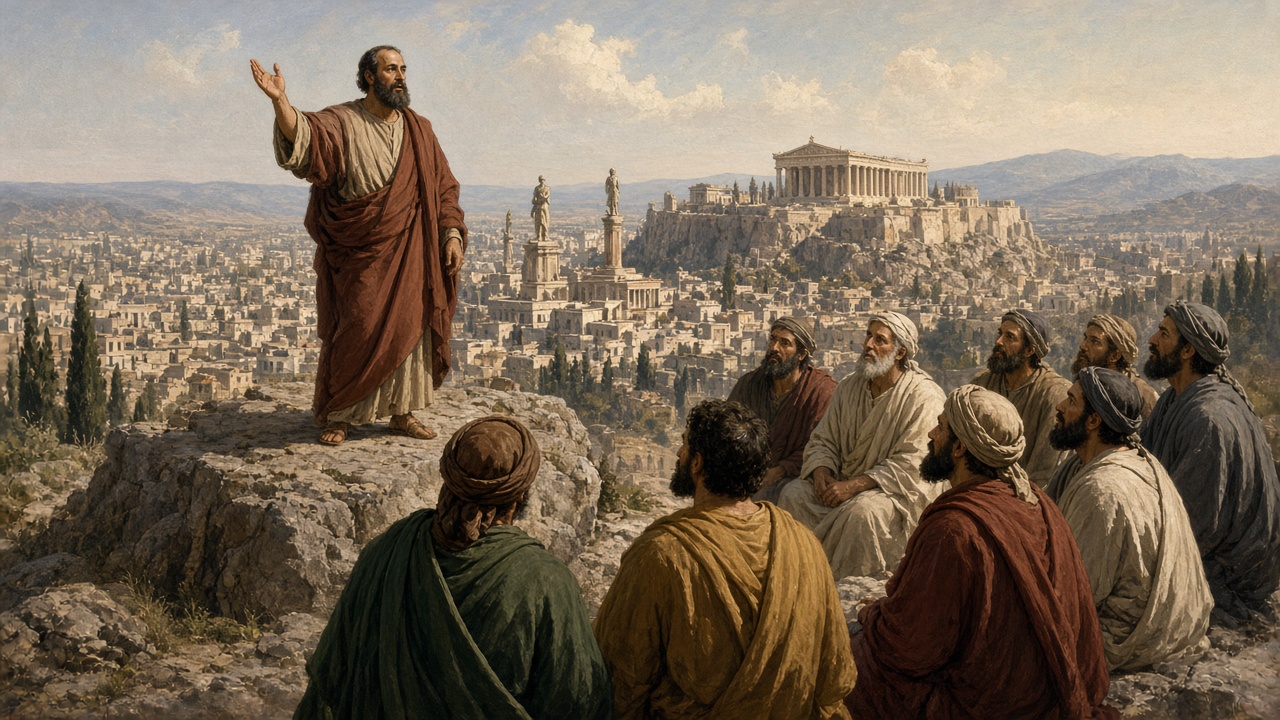
- Athens, the capital of Attica, was celebrated as a seat of Greek literature and art, and its inhabitants were fond of novelty and remarkable for their zeal in worshiping the gods. A Roman satirist said it was easier to find a god at Athens than a man. The Areopagus, a rocky hill northwest of the Acropolis, was where the Athenian supreme tribunal and court of morals was held, and Paul delivered this chapter's address from some part of that hill.Sources: Athens · Areopagus · the Bible text itself
- Paul and Silas reached Thessalonica only after passing through Amphipolis, a Macedonian city and great Roman military station thirty-three Roman miles from Philippi, and Apollonia, about thirty-six miles from Thessalonica. When trouble followed them to Berea, another city of Macedonia, the brothers sent Paul to the coast, and those who escorted him brought him on to Athens. Silas and Timothy stayed in Berea, with word to join Paul as soon as they could.Sources: Amphipolis · Apollonia · Berea · the Bible text itself
Notes written with AI assistance from open sources (Theographic Bible Metadata, CC BY-SA 4.0; Easton’s Bible Dictionary, public domain) and reviewed before publishing.
Places in this chapter
- Amphipolis · 40.820, 23.847 · verse 1
- Apollonia · 40.624, 23.470 · verse 1
- Thessalonica · Today: Thessaloniki · 40.638, 22.946 · verses 1, 11, 13
- Berea · Today: Veria · 40.518, 22.200 · verses 10, 11, 13, 14, 15
- Athens · 37.972, 23.727 · verses 15, 16, 21, 22
- Areopagus · 37.972, 23.724 · verses 19, 22, 33
Only places identified with high confidence are shown (90% or more according to the scholarly sources compiled by OpenBible). Period map: DARE (Digital Atlas of the Roman Empire), CC BY 4.0; modern map: © OpenStreetMap contributors; places: OpenBible.info (CC BY 4.0).
Credits and license for this translation
Hellig Bibel
The Holy Bible in Danish (OT 1931, NT 1907)
Copyright © 1907, 1931 Det Danske Bibelselskab
Language: Dansk (Danish)
Translation by: Danish Bible Society
The New Testament is in the Public Domain.
The Old Testament is © 1931
Det Danske Bibelselskab 1931.
[The Danish Bible Society]
This etext is distributed by Professor Michael S. Hart through
the Project Gutenberg Association at Carnegie-Mellon University
(the "Project") under the Project's "Project Gutenberg" trademark
and with the permission of the etext's copyright owner.
LICENSE
You can (and are encouraged!) to copy and distribute this
Project Gutenberg-tm etext. Since, unlike many other of the
Project's etexts, it is copyright protected, and since the
materials and methods you use will effect the Project's
reputation,
your right to copy and distribute it is limited by the copyright
laws and by the conditions of this "Small Print!" statement.
[A] ALL COPIES: The Project permits you to distribute
copies of this etext electronically or on any machine readable
medium now known or hereafter discovered so long as you:
(1) Honor the refund and replacement provisions of this
"Small Print!" statement; and
(2) Pay a royalty to the Project of 20% of the net
profits you derive calculated using the method you already use
to calculate your applicable taxes. If you don't derive
profits, no royalty is due. Royalties are payable to "Project
Gutenberg Association/Carnegie Mellon-University" within
the 60 days following each date you prepare (or were legally
required to prepare) your annual (or equivalent periodic) tax
return.
[B] EXACT AND MODIFIED COPIES: The copies you distribute
must either be exact copies of this etext, including this
Small Print statement, or can be in binary, compressed, mark-
up, or proprietary form (including any form resulting from
word processing or hypertext software), so long as *EITHER*:
(1) The etext, when displayed, is clearly readable, and
does *not* contain characters other than those intended by the
author of the work, although tilde (~), asterisk (*) and
underline (_) characters may be used to convey punctuation
intended by the author, and additional characters may be used
to indicate hypertext links; OR
(2) The etext is readily convertible by the reader at no
expense into plain ASCII, EBCDIC or equivalent form by the
program that displays the etext (as is the case, for instance,
with most word processors); OR
(3) You provide or agree to provide on request at no
additional cost, fee or expense, a copy of the etext in plain
ASCII.
LIMITED WARRANTY; DISCLAIMER OF DAMAGES
This etext may contain a "Defect" in the form of incomplete,
inaccurate or corrupt data, transcription errors, a copyright
or other infringement, a defective or damaged disk, computer
virus, or codes that damage or cannot be read by your
equipment. But for the "Right of Replacement or Refund"
described below, the Project (and any other party you may
receive this etext from as a PROJECT GUTENBERG-tm etext)
disclaims all liability to you for damages, costs and
expenses, including legal fees, and YOU HAVE NO REMEDIES FOR
NEGLIGENCE OR UNDER STRICT LIABILITY, OR FOR BREACH OF
WARRANTY OR CONTRACT, INCLUDING BUT NOT LIMITED TO INDIRECT,
CONSEQUENTIAL, PUNITIVE OR INCIDENTAL DAMAGES, EVEN IF YOU
GIVE NOTICE OF THE POSSIBILITY OF SUCH DAMAGES.
If you discover a Defect in this etext within 90 days of
receiving it, you can receive a refund of the money (if any)
you paid for it by sending an explanatory note within that
time to the person you received it from. If you received it
on a physical medium, you must return it with your note, and
such person may choose to alternatively give you a replacement
copy. If you received it electronically, such person may
choose to alternatively give you a second opportunity to
receive it electronically.
THIS ETEXT IS OTHERWISE PROVIDED TO YOU "AS-IS". NO OTHER
WARRANTIES OF ANY KIND, EXPRESS OR IMPLIED, ARE MADE TO YOU AS
TO THE ETEXT OR ANY MEDIUM IT MAY BE ON, INCLUDING BUT NOT
LIMITED TO WARRANTIES OF MERCHANTABILITY OR FITNESS FOR A
PARTICULAR PURPOSE. Some states do not allow disclaimers of
implied warranties or the exclusion or limitation of
consequential damages, so the above disclaimers and exclusions
may not apply to you, and you may have other legal rights.
INDEMNITY
You will indemnify and hold the Project, its directors,
officers, members and agents harmless from all liability, cost
and expense, including legal fees, that arise directly or
indirectly from any of the following that you do or cause:
[1] distribution of this etext, [2] alteration, modification,
or addition to the etext, or [3] any Defect.
WHAT IF YOU *WANT* TO SEND MONEY EVEN IF YOU DON'T HAVE TO?
Project Gutenberg is dedicated to increasing the number of
public domain and licensed works that can be freely distributed
in machine readable form. The Project gratefully accepts
contributions in money, time, scanning machines, OCR software,
public domain etexts, royalty free copyright licenses,
and whatever else you can think of. Money should be paid to
"Project Gutenberg Association/Carnegie-Mellon University".
2021-07-19
Source: http://ebible.org/dan1931/ · eBible.org