1 Corinthians 10
Hellig Bibel · Tap a verse to see its cross-references.
1Thi jeg vil ikke, Brødre, at I skulle være uvidende om, at vore Fædre vare alle under Skyen og gik alle igennem Havet 2og bleve alle døbte til Moses i Skyen og i Havet 3og spiste alle den samme åndelige Mad 4og drak alle den samme åndelige Drik; thi de drak af en åndelig Klippe, som fulgte med; men Klippen var Kristus. 5Alligevel fandt Gud ikke Behag i de fleste af dem; thi de bleve slagne ned i Ørkenen. 6Men disse Ting skete som Forbilleder for os, for at vi ikke skulle begære, hvad ondt er, således som hine begærede. 7Bliver ej heller Afgudsdyrkere som nogle af dem, ligesom der er skrevet: “Folket satte sig ned at spise og drikke, og de stode op at lege.” 8Lader os ej heller bedrive Utugt, som nogle af dem bedreve Utugt, og der faldt på én Dag tre og tyve Tusinde. 9Lader os ej heller friste Herren, som nogle af dem fristede ham og bleve ødelagte af Slanger. 10Knurrer ej heller, som nogle af dem knurrede og bleve ødelagte af Ødelæggeren. 11Men dette skete dem forbilledligt, men det blev skrevet til Advarsel for os, til hvem Tidernes Ende er kommen. 12Derfor den, som tykkes at stå, se til, at han ikke falder! 13Der er ikke kommet andre end menneskelige Fristelser over eder, og trofast er Gud, som ikke vil tillade, at I fristes over Evne, men som sammen med Fristelsen vil skabe også Udgangen af den, for at I må kunne udholde den. 14Derfor, mine elskede, flyr fra Afgudsdyrkelsen! 15Jeg taler som til forstandige; dømmer selv, hvad jeg siger. 16Velsignelsens Kalk, som vi velsigne, er den ikke Samfund med Kristi Blod? det Brød, som vi bryde, er det ikke Samfund med Kristi Legeme? 17Fordi der er ét Brød, ere vi mange ét Legeme; thi vi få alle Del i det ene Brød. 18Ser til Israel efter Kødet; have de, som spise Ofrene, ikke Samfund med Alteret? 19Hvad siger jeg da? At Afgudsofferkød er noget? eller at en Afgud er noget? 20Nej! men hvad Hedningerne ofre, ofre de til onde Ånder og ikke til Gud; men jeg vil ikke, at I skulle få Samfund med de onde Ånder. 21I kunne ikke drikke Herrens Kalk og onde Ånders Kalk; I kunne ikke være delagtige i Herrens Bord og i onde Ånders Bord. 22Eller skulle vi vække Herrens Nidkærhed? Mon vi ere stærkere end han? 23Alt er tilladt, men ikke alt er gavnligt; alt er tilladt, men ikke alt opbygger. 24Ingen søge sit eget, men Næstens! 25Alt, hvad der sælges i Slagterbod, spiser det, uden at undersøge noget af Samvittigheds-Hensyn; 26thi Herrens er Jorden og dens Fylde. 27Dersom nogen af de vantro indbyder eder, og I ville gå derhen, da spiser alt det, som sættes for eder, uden at undersøge noget af Samvittigheds-Hensyn. 28Men dersom nogen siger til eder: “Dette er Offerkød,” da lad være at spise for hans Skyld, som gav det til Kende, og for Samvittighedens Skyld. 29Samvittigheden siger jeg, ikke ens egen, men den andens; thi hvorfor skal min Frihed dømmes af en anden Samvittighed? 30Dersom jeg nyder det med Taksigelse, hvorfor hører jeg da ilde for det, som jeg takker for? 31Hvad enten I derfor spise eller drikke, eller hvad I gøre, da gører alt til Guds Ære! 32Værer uden Anstød både for Jøder og Grækere og for Guds Menighed, 33ligesom også jeg i alt stræber at tækkes alle, idet jeg ikke søger, hvad der gavner mig selv, men hvad der gavner de mange, for at de kunne frelses.
Did you know?
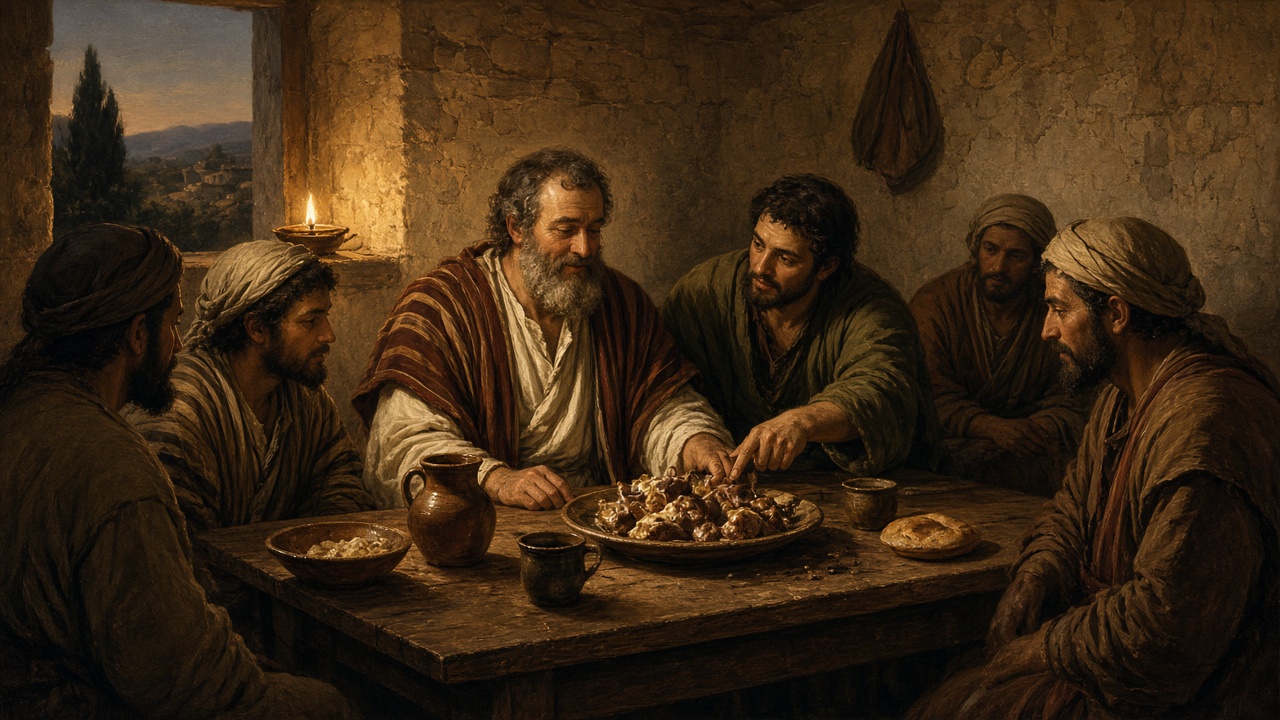
Wilderness Warnings and the Lord's Table
- Paul says he does not want the Corinthians unaware that the forefathers were all under the cloud and all passed through the sea, and that they were baptized into Moses in the cloud and in the sea. They all ate the same spiritual food and drank the same spiritual drink from the spiritual rock that accompanied them, and he says that rock was Christ.Sources: the Bible text itself
- Paul says God was not pleased with most of them, for they were struck down in the wilderness. He lists idolatry, sexual immorality in which twenty-three thousand died in one day, testing Christ, which brought death by snakes, and complaining, punished by the destroying angel, and calls these events examples written down as warnings.Sources: the Bible text itself
- He calls the cup of blessing and the bread that is broken a participation in the blood and body of Christ, and says pagan sacrifices are offered to demons, not to God, so the two tables cannot be shared. Food sold in the meat market may be eaten without raising questions of conscience, for "The earth is the Lord's, and the fullness thereof," but if someone says it was offered to idols, it should be refused for that person's conscience.Sources: the Bible text itself
Notes written with AI assistance from open sources (Theographic Bible Metadata, CC BY-SA 4.0; Easton’s Bible Dictionary, public domain) and reviewed before publishing.
Credits and license for this translation
Hellig Bibel
The Holy Bible in Danish (OT 1931, NT 1907)
Copyright © 1907, 1931 Det Danske Bibelselskab
Language: Dansk (Danish)
Translation by: Danish Bible Society
The New Testament is in the Public Domain.
The Old Testament is © 1931
Det Danske Bibelselskab 1931.
[The Danish Bible Society]
This etext is distributed by Professor Michael S. Hart through
the Project Gutenberg Association at Carnegie-Mellon University
(the "Project") under the Project's "Project Gutenberg" trademark
and with the permission of the etext's copyright owner.
LICENSE
You can (and are encouraged!) to copy and distribute this
Project Gutenberg-tm etext. Since, unlike many other of the
Project's etexts, it is copyright protected, and since the
materials and methods you use will effect the Project's
reputation,
your right to copy and distribute it is limited by the copyright
laws and by the conditions of this "Small Print!" statement.
[A] ALL COPIES: The Project permits you to distribute
copies of this etext electronically or on any machine readable
medium now known or hereafter discovered so long as you:
(1) Honor the refund and replacement provisions of this
"Small Print!" statement; and
(2) Pay a royalty to the Project of 20% of the net
profits you derive calculated using the method you already use
to calculate your applicable taxes. If you don't derive
profits, no royalty is due. Royalties are payable to "Project
Gutenberg Association/Carnegie Mellon-University" within
the 60 days following each date you prepare (or were legally
required to prepare) your annual (or equivalent periodic) tax
return.
[B] EXACT AND MODIFIED COPIES: The copies you distribute
must either be exact copies of this etext, including this
Small Print statement, or can be in binary, compressed, mark-
up, or proprietary form (including any form resulting from
word processing or hypertext software), so long as *EITHER*:
(1) The etext, when displayed, is clearly readable, and
does *not* contain characters other than those intended by the
author of the work, although tilde (~), asterisk (*) and
underline (_) characters may be used to convey punctuation
intended by the author, and additional characters may be used
to indicate hypertext links; OR
(2) The etext is readily convertible by the reader at no
expense into plain ASCII, EBCDIC or equivalent form by the
program that displays the etext (as is the case, for instance,
with most word processors); OR
(3) You provide or agree to provide on request at no
additional cost, fee or expense, a copy of the etext in plain
ASCII.
LIMITED WARRANTY; DISCLAIMER OF DAMAGES
This etext may contain a "Defect" in the form of incomplete,
inaccurate or corrupt data, transcription errors, a copyright
or other infringement, a defective or damaged disk, computer
virus, or codes that damage or cannot be read by your
equipment. But for the "Right of Replacement or Refund"
described below, the Project (and any other party you may
receive this etext from as a PROJECT GUTENBERG-tm etext)
disclaims all liability to you for damages, costs and
expenses, including legal fees, and YOU HAVE NO REMEDIES FOR
NEGLIGENCE OR UNDER STRICT LIABILITY, OR FOR BREACH OF
WARRANTY OR CONTRACT, INCLUDING BUT NOT LIMITED TO INDIRECT,
CONSEQUENTIAL, PUNITIVE OR INCIDENTAL DAMAGES, EVEN IF YOU
GIVE NOTICE OF THE POSSIBILITY OF SUCH DAMAGES.
If you discover a Defect in this etext within 90 days of
receiving it, you can receive a refund of the money (if any)
you paid for it by sending an explanatory note within that
time to the person you received it from. If you received it
on a physical medium, you must return it with your note, and
such person may choose to alternatively give you a replacement
copy. If you received it electronically, such person may
choose to alternatively give you a second opportunity to
receive it electronically.
THIS ETEXT IS OTHERWISE PROVIDED TO YOU "AS-IS". NO OTHER
WARRANTIES OF ANY KIND, EXPRESS OR IMPLIED, ARE MADE TO YOU AS
TO THE ETEXT OR ANY MEDIUM IT MAY BE ON, INCLUDING BUT NOT
LIMITED TO WARRANTIES OF MERCHANTABILITY OR FITNESS FOR A
PARTICULAR PURPOSE. Some states do not allow disclaimers of
implied warranties or the exclusion or limitation of
consequential damages, so the above disclaimers and exclusions
may not apply to you, and you may have other legal rights.
INDEMNITY
You will indemnify and hold the Project, its directors,
officers, members and agents harmless from all liability, cost
and expense, including legal fees, that arise directly or
indirectly from any of the following that you do or cause:
[1] distribution of this etext, [2] alteration, modification,
or addition to the etext, or [3] any Defect.
WHAT IF YOU *WANT* TO SEND MONEY EVEN IF YOU DON'T HAVE TO?
Project Gutenberg is dedicated to increasing the number of
public domain and licensed works that can be freely distributed
in machine readable form. The Project gratefully accepts
contributions in money, time, scanning machines, OCR software,
public domain etexts, royalty free copyright licenses,
and whatever else you can think of. Money should be paid to
"Project Gutenberg Association/Carnegie-Mellon University".
2021-07-19
Source: http://ebible.org/dan1931/ · eBible.org