Acts 20
I T’an Dios · Tap a verse to see its cross-references.
Tsa' majli Pablo ti Macedonia yic'ot Grecia
1Che' bʌ tsa'ix lajmi jini ju'ucña bʌ t'an, Pablo tsi' pʌyʌ tilel xcʌnt'añob. Tsi' xic'beyob ti jini wen t'an. Tsi' lajlaj jats'beyob i pat. Tsi' subeyob i bʌ adiós. Pablo tsa' loq'ui cha'an mi' majlel ti Macedonia. 2Che' bʌ woli' ñumel majlel ti' bijlel Grecia tsi' wen xic'beyob ti jini wen t'an. Tsa' c'oti ti Grecia. 3Ya'i tsa' jale uxp'ejl uw. Che' bʌ yomix majlel ti Siria ti barco, woli' chijtañob judíojob. Tsa' caji i ña'tan uts'at mi' cha' ñumel ti Macedonia. 4Tsi' pi'leyob majlel c'ʌlʌl ti Asia jini Sópater ch'oyol bʌ ti Berea, yic'ot Aristarco yic'ot Segundo ch'oyol bʌ ti Tesalónica, yic'ot Gayo ch'oyol bʌ ti Derbe, yic'ot Timoteo, yic'ot Tíquico, yic'ot Trófimo ch'oyolo' bʌ ti Asia. 5Jiñob tsa' ñaxan majliyob i pijtañon lojon ti Troas. 6Che' bʌ tsa' ñumi i q'uiñilel caxlan waj mach bʌ anic i levadurajlel, tsa' ochiyon lojon ti barco ya' ti Filipos. Jo'p'ejl q'uin tsac xʌñʌ lojon majlel. Ya' ti Troas tsac cha' taja lojon c bʌ. Ya'i tsa' jaleyon lojon wucp'ejl q'uin.
Pablo tsi' jula'tayob ya' ti Troas
7Ti ñaxan bʌ q'uin ti semana che' bʌ tsi' tempayob i bʌ xcʌnt'añob cha'an mi' xet'ob waj, Pablo tsi' cʌntesayob. Come yomix majlel ti yijc'ʌlal, tsa' jale ti t'an c'ʌlʌl ti ojlil ac'ʌlel. 8Ya'an cabʌl lámpara ti' mal otot ti cha' lajmlel otot ba' tsi' tempayob i bʌ. 9Juntiquil ch'iton, i c'aba' Eutico, buchul ti q'ueloñibʌl, woli ti wen wʌyel. Tsa' ñucle ti wʌyel come jal woli ti cʌntesa Pablo. Tsa' yajli ti lum. Chʌmenix tsi' lotoyob. 10Pablo tsa' jubi majlel. Tsa' bʌc' c'oti i mec'. Tsi' yʌlʌ: Mach la' mel la' pusic'al. Cuxul to, che'en. 11Che' bʌ tsa'ix cha' letsi Pablo, tsi' xet'eyob waj, tsi' c'uxuyob. Jalto tsi' cha'le t'an c'ʌlʌl tsa' sʌc'a. Tsa' majli. 12Cuxul tsi' pʌyʌyob majlel jini ch'iton. Jini cha'an tsa' ñuq'uesʌbentiyob i pusic'al jini hermanojob.
Pablo tsi' pejca ancianojob loq'uemo' bʌ ti Efeso ti Mileto
13Tsa' ochiyon lojon ti barco. Tsa' majliyon lojon ti Asón ba' com lojon c pʌy ochel Pablo, che' bajche' tsi' subeyon lojon. Come ti' yoc tsa' majli che' bajche' tsi' ña'ta. 14Che' bʌ tsi' tajayon lojon ti Asón, tsac pʌyʌ lojon ochel ti barco. Tsa' c'otiyon lojon ti Mitilene. 15Tsa' cha' majliyon lojon ti barco. Ti yijc'ʌlal tsa' c'otiyon lojon ti' tojel Quío. Ti' cha'p'ejlel q'uin tsa' c'otiyon lojon ti Samos. Tsac ñusa lojon ac'ʌlel ti Trogilio. Ti' yuxp'ejlel q'uin tsa' c'otiyon lojon ti Mileto. 16Pablo mach yomic majlel ti Efeso, come mach yomic jalijel ya' ti Asia. Woli' se'ñun i bʌ, come yom c'otel ti Jerusalén cha'an i q'uiñilel Pentecostés mi muc'ʌch i mejlel.
17Che' anto ti Mileto, Pablo tsi' choco majlel winicob ti Efeso. Tsi' pʌyʌ tilel jini ancianojob año' bʌ i ye'tel ti' tojlel xñopt'añob ya' ti Efeso. 18Che' bʌ tsa' c'otiyob, Pablo tsi' subeyob: La' wujil bajche' añon la' wic'ot ti pejtelel ora c'ʌlʌl ti ñaxan bʌ q'uin che' bʌ tsa' ochiyon ti Asia. 19Tsac mele c bʌ ti pec' che' bʌ tsac melbe i ye'tel lac Yum. Tsi' tajayon cabʌl wocol. Tsac cha'le uq'uel cha'an judíojob tsa' bʌ i chijtayoñob. 20Ma'anic tsac bʌc'ña c subeñetla jini am bʌ i c'ʌjñibal la' cha'an. Tsaj cʌntesayetla ti' wut winicob x'ixicob yic'ot ti jujump'ejl la' wotot. 21Tsa'ix c subeyob judíojob yic'ot gentilob cha'an mi' cʌyob i mul cha'an mi' ñopob Dios. Tsac subeyob cha'an mi' ñopob lac Yum Jesucristo.
22Awilan, samiyonix ti Jerusalén come pʌybilonix majlel cha'an jini Espíritu. Mach cujilic chuqui mi caj c tumbentel ya'i. 23Pero jini Ch'ujul bʌ Espíritu mi' subeñon ti jujump'ejl tejclum, mi caj i tajon wocol. Mi caj cochel ti mʌjquibʌl. 24Ma'anic mij q'uel j cuxtʌlel ti ñuc. Anquese mi cʌjq'uel ti chʌmel, tijicña c pusic'al mi uts'at mic ts'ʌctesan que'tel tsa' bʌ aq'uentiyon ti lac Yum Jesús cha'an mic sub jini wen t'an cha'an i yutslel i pusic'al Dios.
25Awilan, tsa'ix c subu i yumʌntel Dios ti la' tojlel. Wʌle cujil ma'anix mi caj la' chʌn q'uel c wut. 26Jini cha'an mic subeñetla ti jini jach bʌ ora, mach chʌn c wentajix la' cuxtʌlel ti la' pejtelel. 27Ma'anic tsac cha'le bʌq'uen, pero ts'ʌcʌl tsac subeyetla i t'an Dios. 28Chʌcʌ q'uele la' bʌ che' jini. Cʌntanla pejtelel jini tiñʌme', come jini Ch'ujul bʌ Espíritu tsi' yʌq'ueyetla la' we'tel ti xcʌntaya cha'an mi la' we'san jini xñopt'añob i cha'año' bʌ Dios tsa' bʌ i mʌñʌ ti' bajñel ch'ich'el. 29Come cujil che' majlemonix mi caj i yochelob ti la' tojlel jontol bʌ bʌte'el ts'i'. Ma'anic mi caj i p'untan tiñʌme'. 30Mi caj i wa'tʌlob winicob ti la' tojlel mu' bʌ i yʌlob sojquem bʌ t'an cha'an mi' pʌyob xcʌnt'añob cha'an mi' tsajcañob. 31Yom yʌxʌl la' wo che' jini. Ña'tanla, uxp'ejl jab ma'anic tsaj cʌyʌ c xic'beñetla ti jujuntiquiletla ti q'uiñil yic'ot ti ac'ʌlel. Tsac cha'le uq'uel.
32Wʌle, hermanojob, mi cʌq'uetla ti' c'ʌb Dios yic'ot ti' wenta jini t'an mu' bʌ i tsictesan i yutslel i pusic'al. An i p'ʌtʌlel jini t'an cha'an mi' xuc'chocon la' pusic'al, cha'an mi la' wʌq'uentel chuqui tac la' tem cha'an jach la' wic'ot pejtelel jini sʌq'uesʌbilo' bʌ. 33Ma'anic tsac mulʌbeyetla chuqui an la' cha'an, mi plata, mi oro, mi pisil. 34La' wujil, tsac cha'le e'tel tij c'ʌb cha'an i bʌl c ñʌc'. Tsac we'sa c pi'ʌlob ja'el año' bʌ quic'ot. 35Ti pejtelel tsa' bʌ c mele tsac pʌsbeyetla bajche' yom mi lac cha'len e'tel cha'an mi laj coltan jini mach bʌ p'ʌtʌlobic. Yom mi la' ña'tan i t'an lac Yum Jesús tsa' bʌ i yʌlʌ: “Ñumen tijicña jini mu' bʌ i yʌc' majtañʌl bajche' jini mu' bʌ i ch'ʌm i majtan”. Che' tsi' yʌlʌ Pablo.
36Che' bʌ tsa' ujti ti jini t'an tsa' ñocle. Pablo tsi' como pejca Dios yic'otob. 37Ti pejtelelob tsi' cha'leyob cabʌl uq'uel. Tsi' meq'ueyob Pablo. Tsi' ts'ujts'uyob. 38Wen ch'ijiyem tsi' yubiyob cha'an tsi' subeyob ma'anix mi caj i chʌn q'uelbeñob i wut. Tsi' pi'leyob majlel c'ʌlʌl ti barco.
Did you know?
Farewell on the way to Jerusalem
- Leaving Troas, Paul sent his companions ahead by ship and walked to Assos along the Roman road. Assos was a seaport of Proconsular Asia in Mysia, on the north shore of the Gulf of Adramyttium; the walk was about 20 miles, the sea route about 30, and the island of Lesbos lay about 7 miles offshore.Sources: the Bible text itself · Assos
- Paul sailed past Ephesus to avoid spending time in the province of Asia—the Roman province in western Asia Minor, with Ephesus as its capital—because he hoped, if possible, to reach Jerusalem by the day of Pentecost. He stopped at Miletus, a seaport and the ancient capital of Ionia about 36 miles south of Ephesus, and summoned the elders of the Ephesian church.Sources: the Bible text itself · Asia · Miletus
- Seven men traveled with him: Sopater of Berea, Aristarchus and Secundus of Thessalonica, Gaius of Derbe, Timothy, and Tychicus and Trophimus from Asia. Aristarchus of Thessalonica later shared Paul’s imprisonment in Rome, and Trophimus, an Ephesian, accompanied him on this part of the journey and was with him in Jerusalem.Sources: the Bible text itself · Aristarchus · Trophimus
Notes written with AI assistance from open sources (Theographic Bible Metadata, CC BY-SA 4.0; Easton’s Bible Dictionary, public domain) and reviewed before publishing.
Places in this chapter
- Macedonia · 41.600, 22.540 · verses 1, 3, 6
- Greece · 37.972, 23.727 · verse 2
- Syria · Today: Syria 2 · 33.511, 36.306 · verse 3
- Asia · 38.400, 28.300 · verses 4, 16, 18
- Berea · Today: Veria · 40.518, 22.200 · verse 4
- Thessalonica · Today: Thessaloniki · 40.638, 22.946 · verse 4
- Troas · Today: Alexandria Troas · 39.752, 26.159 · verses 5, 6
- Philippi · 41.012, 24.285 · verse 6
- Assos · 39.491, 26.337 · verses 13, 14
- Mitylene · Today: ancient theater at Mitylene · 39.110, 26.547 · verse 14
- Chios · 38.373, 26.137 · verse 15
- Miletus · 37.531, 27.276 · verses 15, 17
- Samos · 37.750, 26.833 · verse 15
- Trogyllium · Today: Cape Mycale · 37.659, 27.003 · verse 15
- Ephesus · 37.939, 27.341 · verses 16, 17
- Jerusalem · 31.777, 35.234 · verses 16, 22
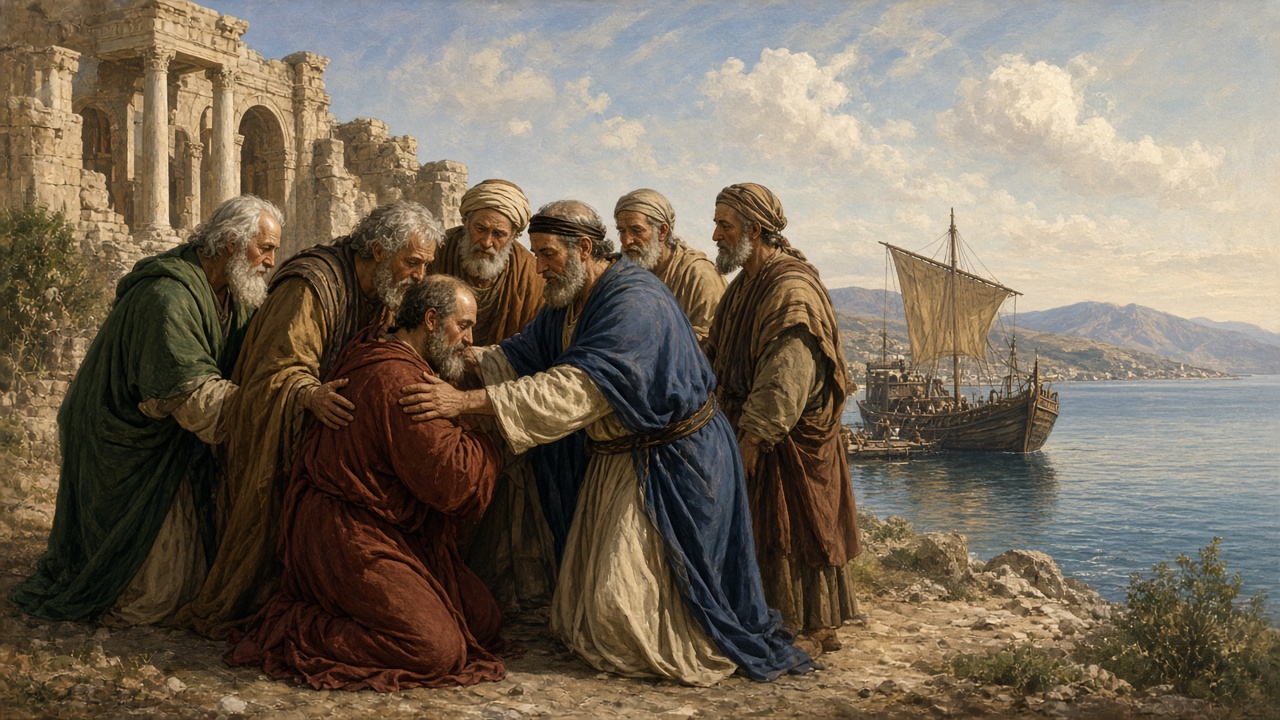
Only places identified with high confidence are shown (90% or more according to the scholarly sources compiled by OpenBible). Period map: DARE (Digital Atlas of the Roman Empire), CC BY 4.0; modern map: © OpenStreetMap contributors; places: OpenBible.info (CC BY 4.0).
Credits and license for this translation
I T’an Dios
Bible without Deuterocanon in Chol Tumbala; ctu (MX:ctu:Chol)
copyright © 1977 Wycliffe Bible Translators, Inc.
Language: Chol
Translation by: Wycliffe Bible Translators, Inc.
Chol, Tumbalá [ctu], Mexico
Copyright Information
© 1977, Bible League International
This translation text is made available to you under the
terms of the Creative Commons License: Attribution-Noncommercial-No Derivative Works.
( http://creativecommons.org/licenses/by-nc-nd/3.0/ )
In addition, you have permission to port the text to different file formats, as long as you
do not change any of the text or punctuation of the Bible.
You may share, copy, distribute, transmit, and extract portions
or quotations from this work, provided that you include the above copyright
information:
You must give Attribution to the work.
You do not sell this work for a profit.
You do not make any derivative works that change any of the actual words or punctuation of the Scriptures.
Permissions beyond the scope of this license may be
available if you contact
us with your request.
The Bible without Deuterocanon
in Chol
© 1977, Bible League International
This translation is made available to you under the terms of the
Creative Commons Attribution-Noncommercial-No Derivatives license 4.0.
You may share and redistribute this Bible translation or extracts from it in any format, provided that:
You include the above copyright and source information.
You do not sell this work for a profit.
You do not change any of the words or punctuation of the Scriptures.
Pictures included with Scriptures and other documents on this site are licensed just for use with those Scriptures and documents.
For other uses, please contact the respective copyright owners.
2014-04-22
Source: http://ebible.org/ctuBl/ · eBible.org