Job 5
Thai Phum Holy Bible · Tap a verse to see its cross-references.
1Atu kaw haw, na ka pato hane ao awh han vaimoe.
Kathounge tami, nâ lah maw na kamlang han.
2Bangkongtetpawiteh, lungkhueknae ni tamipathu a thei teh,
utsinnae ni kamawngrame a thei.
3Tami ni khawngyang a pabo e hah ka hmu,
hateiteh kho a saknae hmuen hah thoe tangka bo.
4A capanaw teh, a hlout nahane awm hoeh,
longkha koe a rawp awh vaiteh, a katin awh han.
Ka rungngang hane awm hoeh.
5Bangkongtetpawiteh, a von ka hlam e ni a a e cang hah be a ca pouh teh,
pâkhingum e patenghai hnopainaw hah a lawp awh.
6Bangkongtetpawiteh, khangnae teh talai dawk hoi ka tho e nahoeh.
Rucatnae hai talai dawk hoi ka tho e na hoeh.
7Hmaitali kahlun lah a luen e patetlah,
tami teh rucat hane doeh a khe.
8Hateiteh, kai niteh, Cathut ka tawng vaiteh,
ka rucatnae teh Cathut e hmalah ka dei pouh han.
9A bawilennae hoi dei thai hoeh e, touk thai hoeh e,
kângairunae kasakthaie koe vah.
10Talai dawk kho a rak sak teh,
law dawk tui a lawng sak.
11Kangduenae hmuen ka rahnoum e hah, a rasang sak teh,
lung kamathoutnaw hah, roumnae hmuen dawk a luen sak.
12Huenghai kaawmnaw khokhangnae hah a kahma sak teh,
a kut hoi a noe e naw koung a raphoe pouh.
13Tami lungkaang huenghai kaawm e hah,
a thoumthainae ni a man awh teh, huenghai kaawm naw e khokhangnae hah,
amamouh dawk tang a pha han.
14Kanîthun angnae dawk hmonae hoi a kâhmo awh teh,
kanî tuengtalueng thun nah tangmin e patetlah thupthup a payam awh.
15Hateiteh, tahloi hoi tami ka voutthoup e hah a rungngang teh,
athakaawme taminaw e apâhni hoi a kut ni a rungngang awh.
16Ka roedengnaw ni ngaihawinae a tawn awh teh,
lanhoehnae ni a pahni a cakuep pouh.
17Khenhaw! Cathut ni a toun e tami teh, tami a lung kahawi e doeh.
Hatdawkvah Athakasaipounge ni phepnae teh, noutna laipalah awm hanh.
18Bangkongtetpawiteh, ama ni a hem teh, a hmâ hah ama ni a kawm pouh.
Ama ni a hmâ a ca sak teh, a kut hoi a dam sak.
19Ama ni runae taruk touh dawk hoi a tâco sak e dueng khout laipalah,
sari touh thung dawk hoi hai kahawihoehe ni tek awh mahoeh.
20Ama ni takang duenae thung hoi a ratang awh vaiteh,
taran um e tahloi thaonae thung hoi a ratang awh han.
21Lawkthoeumkha thung hoi hro lah na o vaiteh,
rawkphainae a pha torei teh, na taket mahoeh.
22Rawkphainae hoi takangnae na panui sin vaiteh,
talai e sarangnaw hah na taket mahoeh.
23Bangkongtetpawiteh, kahrawng e talungnaw hoi rei kambawng vaiteh,
kahrawng e sarangmathengnaw hoi karoumcalah na o awh han.
24Na onae rim dawk karoumcalah na o e hah na panue han.
Na khosaknae hah na khet navah voutthoupnae banghai awm mahoeh.
25Na ca catoun moiapap hane hah a panue vaiteh,
nange na miphunnaw talai dawk phovai patetlah ao e hah na hmu han.
26Atueng pha toteh cabong taoung e patetlah na kumcue toteh,
phuen koe na pha han.
27Khenhaw! heteheh ka pakhingpalang awh teh, kalan e doeh ka tho.
Thaihaw, nama hane doeh tie hah panuek, telah atipouh.
Did you know?
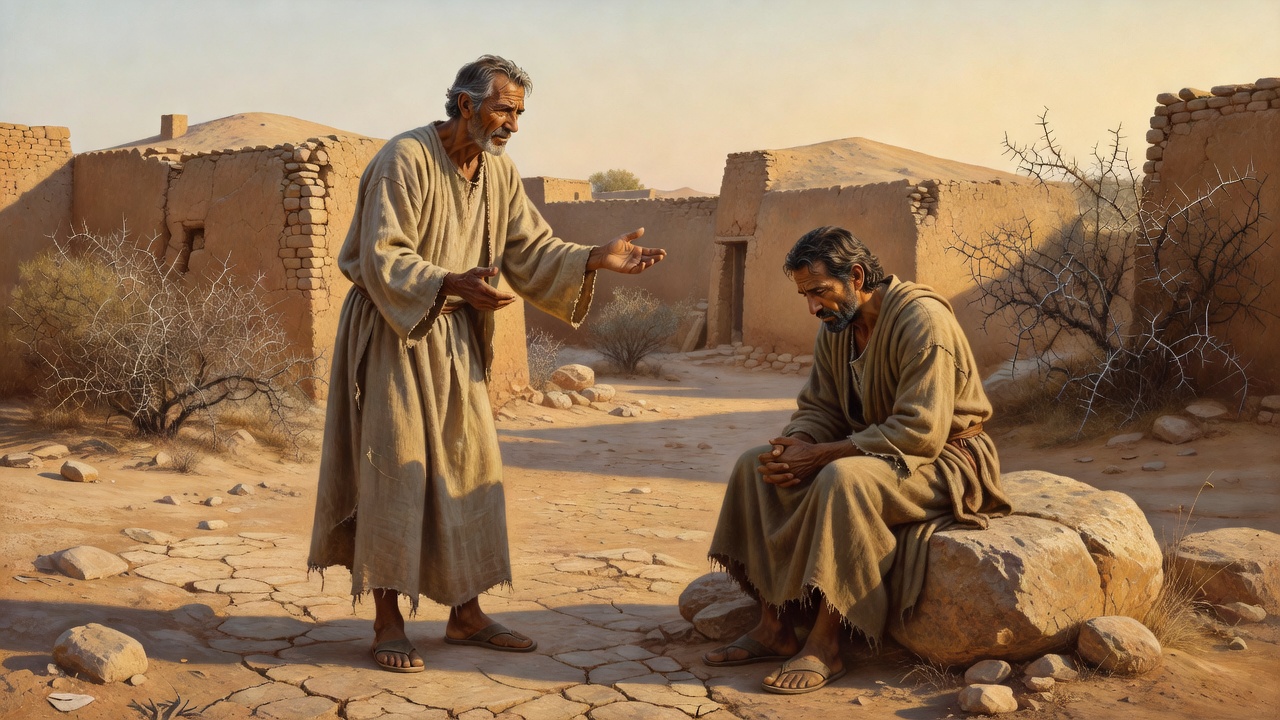
Eliphaz's Counsel on Suffering and Divine Correction
- Eliphaz portrays suffering as purposeful divine discipline rather than arbitrary misfortune, asserting that trouble does not arise without cause from the soil. He urges Job not to despise the correction of the Almighty, who wounds only to heal and restore.Sources: the Bible text itself
- In promising deliverance from six calamities and even seven, Eliphaz employs a traditional poetic formula known as graded numerical parallelism. This rhetorical pattern, common in ancient Near Eastern wisdom poetry, builds emphasis to express comprehensive and complete protection.Sources: the Bible text itself
- Eliphaz describes ultimate restoration in vivid agricultural and pastoral terms, depicting a life where wild beasts and stony soil cease to be hostile. He envisions a peaceful death occurring in full vigor, likened to a sheaf of grain harvested at the proper season.Sources: the Bible text itself
Notes written with AI assistance from open sources (Theographic Bible Metadata, CC BY-SA 4.0; Easton’s Bible Dictionary, public domain) and reviewed before publishing.
Credits and license for this translation
Thai Phum Holy Bible
The Holy Bible in the Thaiphum Chin language of Myanmar
Copyright © 2020 Batupuei Christian Fellowship
Language: Thai Phum (Chin, Thaiphum)
Translation by: Batupuei Christian Fellowship
copyright only valid in Myanmar; Public Domain elsewhere
This translation is made available to you under the terms of the
Creative Commons Attribution Share-Alike license 4.0.
You have permission to share and redistribute this Bible translation in any format and to make reasonable revisions and adaptations of this translation, provided that:
You include the above copyright and source information.
If you make any changes to the text, you must indicate that you did so in a way that makes it clear that the original licensor is not necessarily endorsing your changes.
If you redistribute this text, you must distribute your contributions under the same license as the original.
Pictures included with Scriptures and other documents on this site are licensed just for use with those Scriptures and documents.
For other uses, please contact the respective copyright owners.
Note that in addition to the rules above, revising and adapting God's Word involves a great responsibility to be true to God's Word. See Revelation 22:18-19.
2024-05-01
Source: http://ebible.org/cth/ · eBible.org