Jeremiah 23
Las Escrituras en Ashéninka Ucayali del Sur del Perú · Tap a verse to see its cross-references.

About this book
About Jeremiah
- Easton's Bible Dictionary (1897) presents Jeremiah, son of Hilkiah, a priest of Anathoth, as one of the greater prophets, called to that office while still young, in the thirteenth year of Josiah (628 B.C.). It says his prophecies cover about thirty years and are not recorded in chronological order, and that no one knows when or how the book took its present form. The same entry supposes that, after an interval in Egypt, Jeremiah added three further sections.Sources: Easton: Jeremiah, Book of · Jeremiah
- Easton's Bible Dictionary (1897) says Jeremiah left his native Anathoth for Jerusalem, where he assisted Josiah's reformation, and that he mourned Josiah's death as a national calamity. It dates Jehoiakim's eleven-year reign to 610–599 B.C.: Pharaoh Necho had deposed Jehoahaz and set Eliakim on the throne under the name Jehoiakim, and at the beginning of that reign the people's enmity against Jeremiah broke out in bitter persecution. After the Chaldeans defeated Egypt at Carchemish, the king of Egypt took no further part in Jewish politics.Sources: Jeremiah · Jehoiakim
- Zedekiah, the third son of Josiah, was the last king of Judah. Nebuchadnezzar placed him on the throne as successor to Jehoiachin and changed his name from Mattaniah to Zedekiah; the kingdom was then tributary to Nebuchadnezzar, and Jeremiah was his counsellor. After Jerusalem was destroyed, Nebuchadnezzar left Gedaliah to govern the country as his tributary at Mizpah, some four miles northwest of the city, where about three months later Ishmael killed Gedaliah and the Jews who were with him.Sources: Zedekiah · Gedaliah · Mizpah
- Easton's Bible Dictionary (1897) describes the book as twenty-three separate sections arranged in five books: an introduction, reproofs of the sins of the Jews, a review of the nations, sections picturing hopes of better times, and a conclusion, with historical appendices. It notes the frequent repetition of the same words, phrases, and images. It also records that the Septuagint differs sharply in arrangement and in other details, and omits about 2,700 words.Sources: Easton: Jeremiah, Book of
- Baruch, of the tribe of Judah, was Jeremiah's secretary. Jeremiah dictated to him prophecies about the Babylonian invasion and the captivity; in the fourth year of Jehoiakim, Baruch read them to the people from a window in the temple, then to the king's counsellors and to the king himself. After hearing part of the roll, Jehoiakim cut it with a penknife and threw it into the fire of the winter parlour where he was sitting.Sources: Baruch
Notes written with AI assistance from open sources (Theographic Bible Metadata, CC BY-SA 4.0; Easton’s Bible Dictionary, public domain) and reviewed before publishing.
23Iroka ikantaki Tajorentsi inaawaetzi, ikantzi:
“¿Kaarima naaka Tajorentsi jeekatsiri inteena, jeekita-chari eejatzi okaakiini?
24¿Eenitatsima materoni romana-pitha-tena?
Apatziro naaka nothotyiiro nojeekantawo maawoeni, nojeeki kepatsiki eejatzi inkiteki.
Tema naaka Tajorentsi naawaetzirori iroka ñaantsi.”
Did you know?
Shepherds, the Righteous Branch, and True Prophecy
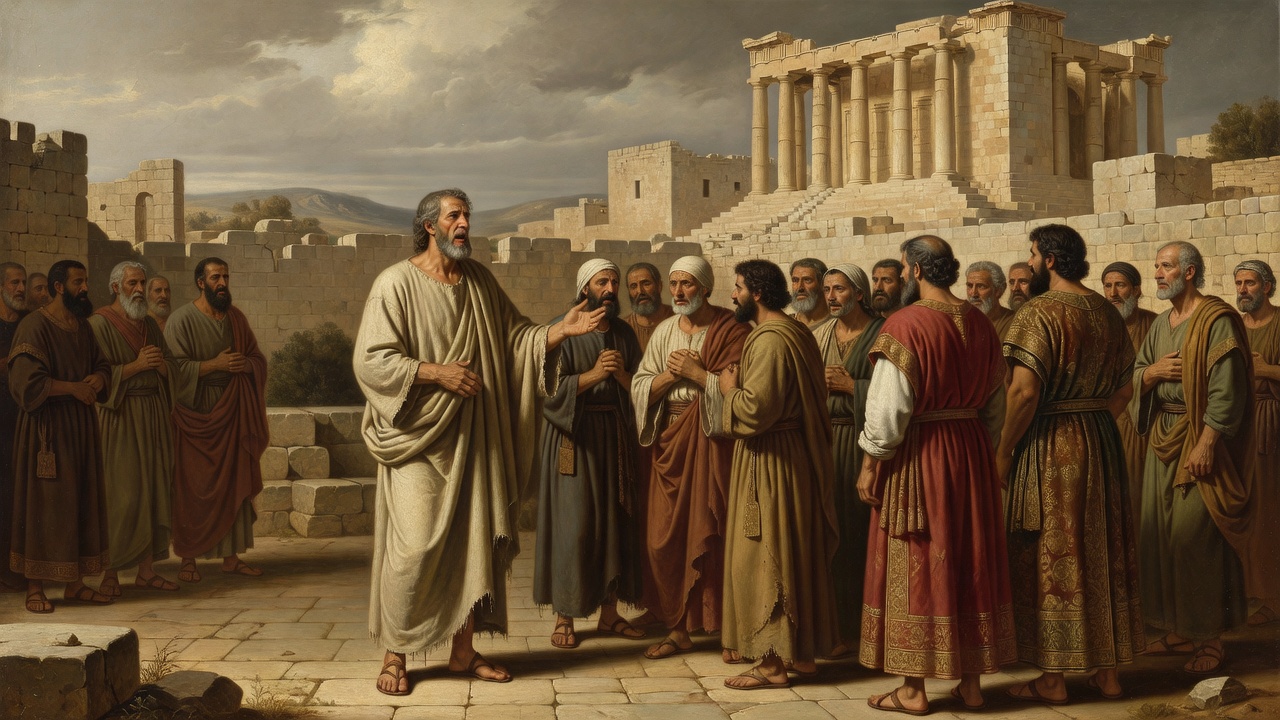
- In the ancient world, rulers were commonly described as shepherds. Jeremiah contrasts Judah's corrupt leaders who scattered their people with the promise of a righteous Branch from David's lineage who would reign wisely, execute justice, and gather the scattered flock.Sources: the Bible text itself
- The chapter contrasts the northern capital, Samaria, whose prophets invoked the Phoenician deity Baal, with the prophets of Jerusalem. Jeremiah depicts the moral failures and empty assurances of peace in Jerusalem as being as severe as the proverbial wickedness of Sodom and Gomorrah.Sources: the Bible text itself
- Jeremiah employs vivid imagery to distinguish genuine divine revelation from fabricated dreams. The authentic word of God is likened to nourishing grain, consuming fire, and a hammer that smashes rock, while false prophecies are dismissed as mere straw.Sources: the Bible text itself
Notes written with AI assistance from open sources (Theographic Bible Metadata, CC BY-SA 4.0; Easton’s Bible Dictionary, public domain) and reviewed before publishing.
Places in this chapter
- Egypt · 30.129, 31.308 · verse 7
- Samaria · 32.276, 35.195 · verse 13
- Jerusalem · 31.777, 35.234 · verses 14, 15, 16
Only places identified with high confidence are shown (90% or more according to the scholarly sources compiled by OpenBible). Period map: DARE (Digital Atlas of the Roman Empire), CC BY 4.0; modern map: © OpenStreetMap contributors; places: OpenBible.info (CC BY 4.0).
Credits and license for this translation
Las Escrituras en Ashéninka Ucayali del Sur del Perú
The Holy Bible in the South Ucayali Ashéninka language of Peru
Las Escrituras en Ashéninka Ucayali del Sur del Perú
copyright © 2008 Wycliffe Bible Translators, Inc.
Language: Ashéninka Ucayali del Sur (Ashéninka, South Ucayali)
Translation by: Wycliffe Bible Translators
This translation is made available to you under the terms of the
Creative Commons Attribution-Noncommercial-No Derivatives license 4.0.
You may share and redistribute this Bible translation or extracts from it in any format, provided that:
You include the above copyright and source information.
You do not sell this work for a profit.
You do not change any of the words or punctuation of the Scriptures.
Pictures included with Scriptures and other documents on this site are licensed just for use with those Scriptures and documents.
For other uses, please contact the respective copyright owners.
2016-06-08
Source: http://ebible.org/cpy/ · eBible.org