Genesis 44
Chiga Tevaen'Jema Atesuja 1, Aisheve Caña'cho · Tap a verse to see its cross-references.
José tasa
1Tsomba tse'i Joséja tise tsa'oma coira'suma manda:
—Va tsandiendeccumbe saquiyonga trigoma on'boenjan mangae tise'pa angaye o'shatsse. Toya'caen poi tsandiembe corifin'dima ppiñajan tise'pa angaya'cho saquiyonga. 2Tsa tise'pa quinshin chu'ambengaja trigone afepoen'cho corifin'di toya'caen ña totoacori tasama'qque ppiñajan.
Tsa'caen mandasi coira'suja José suqquia'caen tson. 3Caqui a'tasi sinte Joséja antte cuintsu tise'pa boroi'ccu ja'faye. 4Toya canqquema biani ja'fambi'te Joséja tise tsa'oma coira'sunga su:
—Va tsandiendeccuma omboemba cachuiccopa qquen suja: “¿Jongoesie qui ñotssiama egai'ccu afepoenqquia'caen tson'fa? ¿Jongoesie qui totoacori tasama cca'na'fa? 5Tsa tasanga tsu ña na'suja cu'ipa camba ma'caen daya'chove atesu'je'cho. ¡Ñoa'me egave qui tson'fa!”
6Tsa'caen susi japa tsa'oma coira'suja José antiandeccuma José mandaqquia'caen su. 7Tsa'caen susi tsandiendeccuja su'fa:
—¿Jongoesie qui ingima ya'caen afase? ¿Minguite'qque gi ingija tsa'caen tsomba canse'fambi? 8Nane tsa ingi saquiyoni pi'cho corifin'dima Canaánne toyaquiañe ji'je'chondeccu'ta, ¿ma'caen gi que na'su tsa'o'su cori ni totoacorima cca'na'faya? 9Ingi'su majan quema shondosundeccu tsa tasama an'biamba atteye'ta cuintsu paja. Nane ingi'qque gi quembe sema'suve dapa tsangae canse'faya.
10Tsa'caen su'fasi José tsa'oma coira'suja su:
—Que'i suqquia'caen tsu tsoña'cho. Tsa'ma majan tsa tasama an'bian'choyi tsu ñambe tsangae sema'suve daya. Poiyi'cco cca'indeccuja shacave me'cho'faya tsu.
11Tsa'caen susi junde poiyi'cco tise'pa saquiyoma andenga andiamba fetta'fa. 12Fetta'fasi José tsa'oma coira'suja poimbe saquiyoma tta'ttaye ashaen. Nane coenzane ashaemba tta'ttá chu'ani nepi. Tsa'caen nepipa Benjamín saquiyoni tsa tasa ppi'choma atte. 13Tsa'caen attesi tsendeccuja tisupa ondiccu'jema chitta'fa ñombi'ye'choma canjaeñe. Tsa'caen tsomba poiyi'cco tisumbema boronga andiamba toequi canqqueni ji'fa.
14Judá, tise antiandeccui'ccu jipa José tsaoni nepisi Joséja toya can'jen. Tsa'caen can'jensi poiyi'cco tisenga ccaru'fa. Nane camba'ju andenga ppo'rotsse puntssan'fa. 15Tsa'caen ccarupa puntssan'fasi Joséja tise'pama su:
—¿Jongoesuma qui tson'fa? ¿Atesu'fambi ti qui majan a'i ña'caen osha'chove atesucho'choma?
16Tsa'caen susi Judája su:
—¿Ma'caen gi quenga conda'faya? ¿Ma'caen gi ingija shaca me'choave canjaen'faya? Chiga tsu ingi egae tsincon'choma tayo atte. Va'tti qui ingima an'bian tsangae quembe semasundeccuve, tsa tasama an'bian'choi'ccu fae'ngae.
17Tsa'ma Joséja su:
—Tsa'caenjan tson'masia tsu. Jo'su tsa tasama an'bian'choyi tsu ñambe tsangae sema'suve daya'cho. Que'ija opatsse qui que yaya tsaoni ja'faya'cho. Ni majañi'qque tsu que'ima noñangiaña'bi.
Judá Benjamíne iñajan'cho
18Tsonsi Judája Josénga catsepa su:
—Na'su, quema gi iñajan, chigáne antteja ña re'riccoe quenga a'tutsse afaye. Nane ñama iyicca'yembe'yi ñotsse pañajan. Queja ñoa'me qui na'su faraóni'ccu fae'ngatssi. 19Que qui ingima tayoe iñajampaña: ‘¿Yaya'pa'fa ti qui? ¿Faesu antianmenda ti qui an'bian'fa?’ 20Tsonsi gi conda'fa ingi yaya coenza ccashe'ye, toya'caen ingi antian chu'a'qque can'jen'chove. Nane tsaja ingi yaya coenza ccashe'yeve dapa du'sian'cho. Toya'caen gi conda'fa ingi yaya tsa du'shuve ñotsse in'jan'choma. Nane fae chan'su ccoangi'ccoa, fae'cco pasi tsayi tisei'ccu can'jensi tsu tsama ñotsse in'jan. 21Tsama pañamba qui ingima iñajan tsa du'shuma isi atteye in'jamba. 22Tsonsi gi su'fa tsa du'shumajan tise yaya antteya'bi cuintsu jiye. Nane tisema moeñe antte'ta tsu tise yayaja paya. 23Tsa'ma queja ingima su: ‘Tsa du'shu que'i'ccu jimbian'da ccase qui ñama atte'faya'bi.’
24“Tsa'caen que su'choma gi pa'ccoma yayani japa conda'fa. 25Can'jemba yayaja ingima ccase su: ‘Ccase japa trigoma chavanga'faja.’ 26Tsa'ma ingija su'fa: ‘Ingi antian chu'a ingi'ccu jayimbian'da jaye osha'fambi gi. Nane tise ingi'ccu jambian'da tsa na'suma atte'faya'bi gi.’ 27Tsonsi ingi yayaja su: ‘Que'ija atesu'fa ña pushe dos du'shuve an'bian'choma. 28Tsa'su fae'cco tsu ña'ñe tayo joqquitssi. Tsa'cansi gi tisema atte'jembi. Tsampi'su ttesi tisema ansi tsa'caen nepi qquen gi in'jan. 29Tsa'caeñi faesu ña du'shuma'qque ña'ñe joqquitssiamba angasi mingae egae da'ninda que'i qui va ccashe'ye ñombi'yepa pa'chone shacapa'faya.’
30“Tsa'caen tsu ña yayaja pa'cco tise canse'pai'ccu va du'shuma in'jamba canse. Nane va du'shu ingi'ccu toequi jambian'da 31ingi yaya tsu tisema attembipa paya. Tsa'caen ñombi'yepa ingi yaya coenza ccashe'ye pa'ninda ingi gi tise pa'chone shacapa'faya. 32Nane tsa'caen ña yaya se'pisi ña gi tisenga su: ‘Ña gi tsa du'shuve toyaquian'su.’ Toya'caen gi su: ‘Nane tisema vani toequi imbi'ta tsangae tisene quei'ccu shacapae dapa gi canseya.’ 33Tsa'camba gi quema iñajan antteja cuintsu tsa du'shu tise antiandeccui'ccu jasi ñajan tsa du'shuve daqquia'caen can'jemba tsangae quembe sema'suve daye. 34¿Ma'caen gi tsa du'shuve me'cco toequi ña yayani jaya? Nane in'jambi gi ña yaya ñombi'ye'choma atteye.”
Did you know?
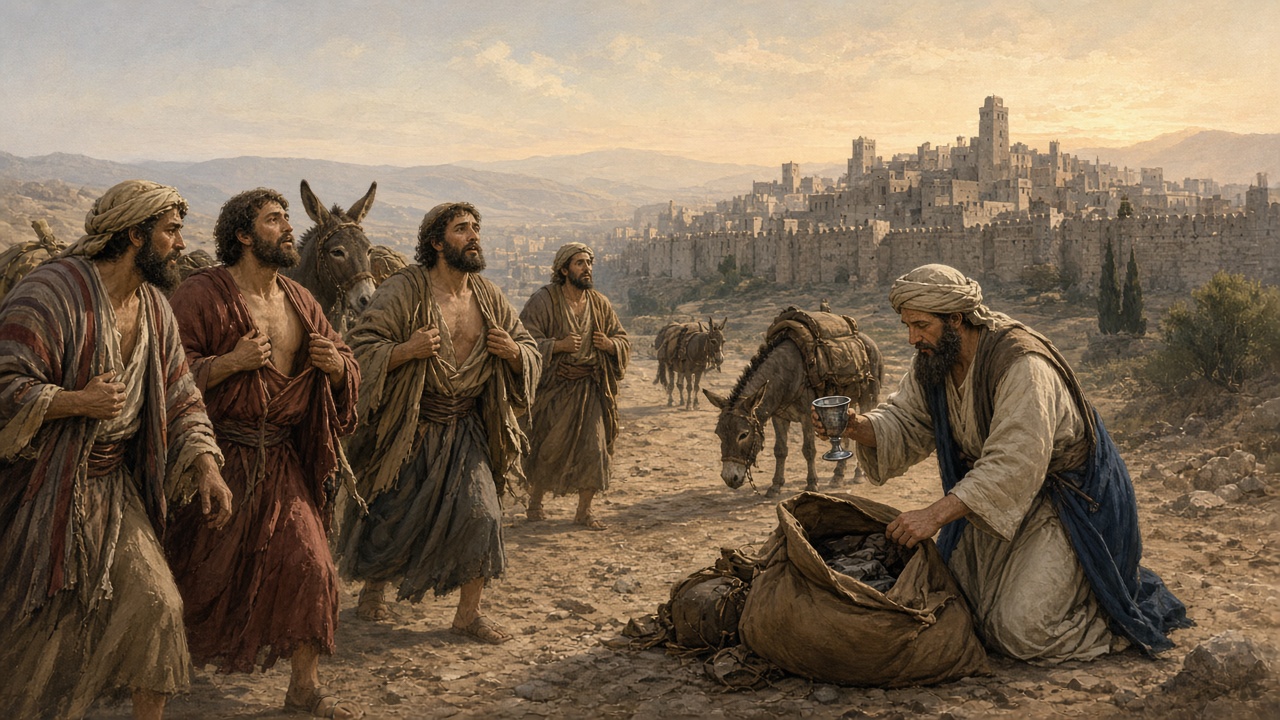
The Hidden Cup and Judah's Plea
- Judah, Jacob's fourth son by Leah, speaks for the brothers and offers to remain as a slave in the boy's place so that Benjamin may return with his brothers. Easton's Bible Dictionary (1897) notes that Judah had earlier intervened to spare Joseph's life, and that he took the lead in the family's affairs, including in the appeal recorded in this chapter.Sources: Judah (patriarch) · the Bible text itself
- Benjamin was the younger of Jacob's two sons by Rachel; she died giving birth to him and called him Ben-oni, "son of my pain," before his father named him Benjamin. The brothers tell Joseph that the boy is the only son of his mother still living, and that their father believes the other was torn to pieces. They say this to Joseph himself—Rachel's elder son, loved by Jacob as the child of his old age—while still speaking to him as a lord equal to Pharaoh.Sources: Benjamin (patriarch) · Joseph (son of Jacob) · the Bible text itself
- On Joseph's orders, the steward hid Joseph's silver cup—the cup he drank from and used for divination—in Benjamin's sack, along with the silver paid for the grain. When it was found, the brothers tore their clothes and returned to the city. Joseph then asked whether they did not know that a man like him could divine the truth, although the narrative shows that he had arranged for the cup to be found.Sources: the Bible text itself
Notes written with AI assistance from open sources (Theographic Bible Metadata, CC BY-SA 4.0; Easton’s Bible Dictionary, public domain) and reviewed before publishing.
Places in this chapter
- Canaan · 32.767, 35.333 · verse 8
Only places identified with high confidence are shown (90% or more according to the scholarly sources compiled by OpenBible). Period map: DARE (Digital Atlas of the Roman Empire), CC BY 4.0; modern map: © OpenStreetMap contributors; places: OpenBible.info (CC BY 4.0).
Credits and license for this translation
Chiga Tevaen'Jema Atesuja 1, Aisheve Caña'cho
New Testament and Genesis in Cofán (EC:con:Cofán)
copyright © 2012 Wycliffe Bible Translators, Inc.
Language: Cofán
Translation by: Wycliffe Bible Translators, Inc.
Cofán
con
Ecuador
Copyright Information
©Wycliffe Bible Translators, Inc. All rights reserved.
This translation text is made available to you under the
terms of the Creative Commons License: Attribution-Noncommercial-No Derivative Works.
( http://creativecommons.org/licenses/by-nc-nd/3.0/ )
In addition, you have permission to port the text to different file formats, as long as you
do not change any of the text or punctuation of the Bible.
You may share, copy, distribute, transmit, and extract portions
or quotations from this work, provided that you include the above copyright
information:
You must give Attribution to the work.
You do not sell this work for a profit.
You do not make any derivative works that change any of the actual words or punctuation of the Scriptures.
Permissions beyond the scope of this license may be
available if you contact
us with your request.
The New Testament
in Cofán
©Wycliffe Bible Translators, Inc. All rights reserved.
This translation is made available to you under the terms of the
Creative Commons Attribution-Noncommercial-No Derivatives license 4.0.
You may share and redistribute this Bible translation or extracts from it in any format, provided that:
You include the above copyright and source information.
You do not sell this work for a profit.
You do not change any of the words or punctuation of the Scriptures.
Pictures included with Scriptures and other documents on this site are licensed just for use with those Scriptures and documents.
For other uses, please contact the respective copyright owners.
2014-04-22
Source: http://ebible.org/conNTpo/ · eBible.org