Genesis 31
Chiga Tevaen'Jema Atesuja 1, Aisheve Caña'cho · Tap a verse to see its cross-references.
Jacob Labánma catipa ja'cho
1Tsa'ma Jacobja tayo atesucho Labán dushundeccu tisene qquen su'choma: “Jacobja pa'cco ingi yayambema isupa tsai'ccu ricove da.” 2Toya'caen tsu Jacobja atesu Labán tayoe tisema in'janqquia'caen in'jambipa chi'ga'chove. 3Tsa'cansi Na'su Chigaja Jacobnga su: “Que yayandeccu andeni ccase jaja, que antiandeccu can'jeni. Ña gi fuitepa angaya.”
4Tsama pañamba Jacobja manda cuintsu Raquel, Leama'qque ttu'sesi ji'faye tise ovejandeccui'ccu can'jen'cho potreroni.
5Ji'fasi su:
—Tayo gi atesu que'i yaya tayoe ñama in'janqquia'caen in'jambipa chi'ga'chove. Tsa'ma ña yayambe Chiga tsu anttembe'yi ñama fuite'je. 6Que'i'qque qui atesu'fa ñajan tisu osha'fanga que yayambe ñotsse sema'jen'chove. 7Tsa'caen semasi tiseja ñama afopoemba tsu anttembe'yi ña afepoen'choma cambi'bian. Tsa'ma Chiga Quitsaja se'pi cuintsu tise ñama egae tsoñe. 8Nane que'i yaya ‘Ze'nzetssiai'ccu gi ñajan quenga afepoeña’ qquen susi poiyi'cco oveja tsu ze'nzetssia du'shuve isu'fa. Toya'caen ‘Chhifai'ccu gi ñajan quenga afepoeña’ qquen susi poiyi'cco tsu chhifave isu'fa. 9Tsa'caen tsu Chiga Quitsa tise'be'suma ñanga afe.
10“Toya'caen fae a'ta ovejandeccu foña'jen'ni anamba gi qquen ayo'o: atte gi oveja quitsaye ze'nzia, chhifa, pi'piayi pushei'ccu tandange'je'choma. 11Tsa'caen ayo'o'je'ni tsu Chigama sefacconi'su shondo'su ña inisei'ccu ñama ttu'se. Ttu'sesi gi su: ‘Va'tti gi can'jen.’ 12Tsa'caen susi tsu Chigama shondo'suja su: ‘Ñotsse camba qui atteya poiyi'cco oveja quitsaye pushei'ccu tandange'je'cho tsu ze'nzia, chhifa, toya'caen pi'piayi. Nane tayo gi atte pa'cco Labán quenga tson'choma. 13Ña gi quenga Betelni attian'cho Chiga. Nane tseni qui que asusupa ana'cho patuma ccutsiamba ñoa'me su'chove ñanga afa. Jangija, jinge jaye, quema isu'cho andeni.’–qquen tsu Chigama shondo'suja Chiga su'choma conda.”
14Tsa'caen susi pañamba Raquel, toya'caen Lea'qque su'fa:
—Ingija jongoesu isuya'chove an'bian'fambi gi ingi yaya tsaoni. 15Nane tiseja faesu ande'suma'caen ingima tsincon. Toya'caen ingima chavaemba que ingima pusheye afepoen'choma tise'yi isupa sefaen. 16Tsa'cansi pa'cco ingi yaya an'bian'choma itsapa Chiga quenga afe'cho tsu ingimbe toya'caen ingi dushundeccumbe. Nane Chiga quenga tsa'caen su'choma pa'ccoma tsonjan.
Padan-aramne Jacob sombo'cho
17Tsa'caen susi tse'i Jacobja ñoñañe ashaen tise yaya Isaac can'jen'cho ande Canaánni jaye. Nane tise dushundeccu, tise pushendeccuma'qque cameyondeccunga otsian pa'cco tise an'bian'choma'qque. Tsa'caen tsomba tise aiña'chondeccu, Padan-aramni semamba gana'choma angaye ashaen. 19Jacob tsa'caen jaye ashaenqui Labánjan biani can'jen tise oveja tosema chattu'su japa. Tsa'caen biani jacansi Raquelja tise yaya an'bian'cho ñoña'cho chigama cca'namba anga. 20Tsa'caen tsu Jacobja arameo ande'su Labánga tisu jaya'choma condambe'yi ja. 21Nane pa'cco tisu an'bian'choma a'tutsseyi anga. Junde tsu Eufrates Na'ema cca'ya isepa tansintsse Galaad ccotta'cconga jaye ashaen'fa.
Labán Jacobma mandian'cho
22Tres a'ta pasasi Labánjan in'jan Jacob ccuyapa ja'chove. 23Tsomba tise antiandeccui'ccu sombopa mandiañe ashaemba siete a'ta pa'cco japa Galaad ccotta'cconga nepi. 24Tsa'ma tsequi cose Chigaja ayo'oni, Labán, tsa arameo'su a'inga attiamba su: “¡Injama'tse! Jacobma iyicca'yeye'tsse afajama.”
25Jacob Galaad Ccotta'cconi toya can'jen'choma Labán nepipa cachui. Cachuipa Labán'qque tise antiandeccui'ccu tse'ttini can'jen'fa. Tsa'caen can'jemba 26Jacobma su:
—¿Jongoesie qui qquen tson? ¿Ma'caen qui ñama afopoemba ña onquengendeccuma an'bian geraemba indi'chondeccuma'caen? 27¿Jongoesie qui ñama afopoenqquia'caen condambe'yi a'tutsse vani ccuyin ji? Nane que qquen jiya'chove atesu'choecan'da gi avujatsse ccosha, gitarai'ccu jeñamba can moeñe'can. 28Toya'caen ña onquengendeccu ña jarichondeccuma'qque mochapa chigambiañe qui anttembi. Ñoa'me sumbia'caen qui tsincon. 29Nane ñoa'me gi ñajan que'ima egae tsoñe osha. Tsa'ma ja'ño cose tsu que yayambe Chiga ñama afapa qquen su: ‘¡Injama'tse! Jacobma iyicca'yeye'tsse afajama.’ 30Tsa'ma pashaen tisu yayani jaye in'jamba jayi'a'qque, ¿jongoesie qui ña chigandeccuma cca'namba i?
31Tsa'caen susi Jacobja Labánma su:
—Dyojopa gi a'tutsse sombo, que ñama fi'ttipa tisu onquengendeccuma itsasa'ne. 32Tsa'ma majan va'tti canjen'su que chigandeccuma an'bian'da, ¡cuintsu paja! Nane ingi antiandeccu tsu paña'jen'fa. ¡Tta'ttapa atteja jongoesu quembema ña an'bian'chove!
Tsa'ma Jacobja Raquel tsa chigandeccuma cca'na'chove atesumbipa tsa'caen su.
33Tsonsi Labán Jacob carpa tsa'onga ca'nimba tse'ttieja Leambenga'qque, toya'caen tsa dos sema'su pushesundeccumbenga'qque ca'nimba tta'tta'ma attembi. Lea carpa'ye sombopa Raquelmbenga ca'ni. 34Toya ca'nimbi'ta Raquelja tsa chigandeccuma cameyonga ottaemba dyai'je'chombe tsosiccufa'su bosanga ppiñamba tsambe ombanga dyai. Labánjan tsa'caen ca'nimba pa'cco tsa'oma tta'tta'ma attembi. 35Tsonsi Raquelja su:
—Yaya, ñama iyicca'yejama que caña'jen'ni jangiye oshambi gi tisu ñotssimbipa.
Labán tsa'caen pa'cco ettima tta'tta nani'ma tisu chigandeccuve attembisi 36Jacobja iyicca'yepa su:
—¿Jongoesie gi egae tson'an? ¿Jongoesuma egae tsinconsi qui ñama mandiamba ji? 37Pa'cco ña an'bian'choma asitta'a'qque, ¿jongoesu quembema qui atte? ¡Va'ttinga tsama ccuiñajan! Tsonsi que antiandeccu, ña antiandeccu'qque tsu su'faya majan ingi ñotsse injienge'chove. 38Nane veinte canqque'fa pa'cco quembe semamba ñotsse coirasi tsu majan ovejayi'qque ni chivo pusheyi'qque toya chu'ama cati'fambi. Ni fae oveja quitsayeveyi'qque gi que oveja naccu'suma ambi. 39Ttesi ovejama fi'tti'ni'qque queni imbi gi tsa pa'choma. Nane ñañi gi tsa qque'chone afepoen. Toya'caen maqui cose maqui a'ta que oveja naccu'suma cca'na'fa'ni'qque ñama qui tsane iñajan. 40A'taja coe'jenga gi pa'ma ccusha. Coseja chandi'supa gi pa'ma ccusha. Toya'caen anae'sui'ccu gi ata'je. 41Nane veinte canqque'fa pa'cco que tsaoni can'jensi qui tsa'caen ñanga tson. Catorce canqque'fa pa'cco gi que onquengendeccune sema. Toya'caen seis canqque'fa pa'cco que aiña'chondeccuma coiraye semasi qui anttembe'yi ña afepoen'choma cambi'bian. 42Nane Abraham Chiga, tsa ña yaya Isaac iñajan'jen'cho Chiga ñai'ccu can'jembiecan'da qui ñama itsapa me'ccoe moeñe'can. Tsa'ma Chiga tsu ña ñombi'ye'cho, ña ñotsse sema'choma'qque attepa ja'ño cose quema tsa'caen iyu'u.
Jacob, Labáni'ccu injancco'fa'cho
43Tsa'caen susi Labánjan Jacobnga su:
—Pushesundeccuja ña onquengendeccu tsu. Dushundeccuja ña jarichondeccu tsu. Oveja'qque ña ovejandeccu tsu. Nane pa'cco va'ttima atte'choja ñambeyi tsu. Tsa'ma, ¿ma'caen gi va ña onquengendeccu, tise'pa an'bian'cho dushundeccuma'qque tsoña? 44Tsa'cansi jinge que ñai'ccu fae'ngae injanccoye tisupanaccui'ccu ingi'su ma'caen canseya'chove atesuye.
45Tsa'caen susi Jacobja patuma isupa tansintsse ccutsiamba 46tise antiandeccuma su:
—¡Patuma boña'faja!
Poiyi'cco tsu patuma fae'ttinga boñamba, tsa boña'cho pporotsse dyaipa an'fa. 47Labánjan tse'ttima inisian, tise aya'fangae, Jegar Sahaduta. Jacob'qque, tisu aya'fangae, tse'ttima inisian Galaad.
48Tsa'caen tsomba Labánjan su:
—Ja'ñojan va patu boña'cho tsu ingi fae'ngae injancco'choma canjaeña.
Tsa'camba tsu Galaad qquen va'ttija inisecho. 49Toya'caen tsu inisecho Mizpa, Labán qquen su'ttipa:
—Nane Na'su Chiga tsu ingima caña'jeña ingi fae'ngae can'jembi'ni'qque. 50Ña onquengendeccuma que egae tsincon'ninda, tsambi'ta faesu pushesundeccuma pushe'ñacca'ninda ingi'suja me'i'oña tsu tsane afaye. Tsa'ma Chigayi tsu tsane afaya.
51Labán tsa'caen supa ti'tsse qquen afa'je:
—Que canjan, va patu boña'cho, toya'caen patuma ingi ccutsian'cho 52tsu poiyi'cco canjaen'faya ingi va'ttima panshansa'ne. Nane que qui ñani panshamba ni ña gi queni panshamba iyiccoye osha'fambi. 53Chiga Quitsa, tsa que yaya ccashe'ye Abraham, ña yaya ccashe'ye Nacormbe Chiga tsu ingima camba ingi ma'caen tson'chone afaya.
Tsa'caen pañamba Jacobja, tise yaya Isaac iñajan'jen'cho Chiga paña'jen'ni tansintsse supa “Ñotssi tsu” qquen afa. 54Tsa'caen tsomba Jacobja ccotta'cconga ansundepa Chiganga afeya'choma oque o'raemba tise antiandeccuma ttu'se cuintsu tseni an'faye. Ansundepa tseni amba cosesi tseniñi poiyi'cco ana'fa. 55Ccaqui a'ta sinte'yi Labánjan jangipa tise jarichondeccu, tise onquengendeccuma'qque mochapa chigambiamba Chiga tise'panga ñotsse tsoña'chove afapa toequi tisu andeni ja.
Did you know?
Parting at the Heap of Witness
- Laban called the stone heap Jegar-sahadutha, an Aramaic name, and Jacob called it Galeed, Hebrew for “heap of witness.” A Bible dictionary suggests that Nahor’s family originally spoke Aramaic, while Abraham and his descendants learned Hebrew, a kindred dialect, in Canaan.Sources: Galeed · the Bible text itself
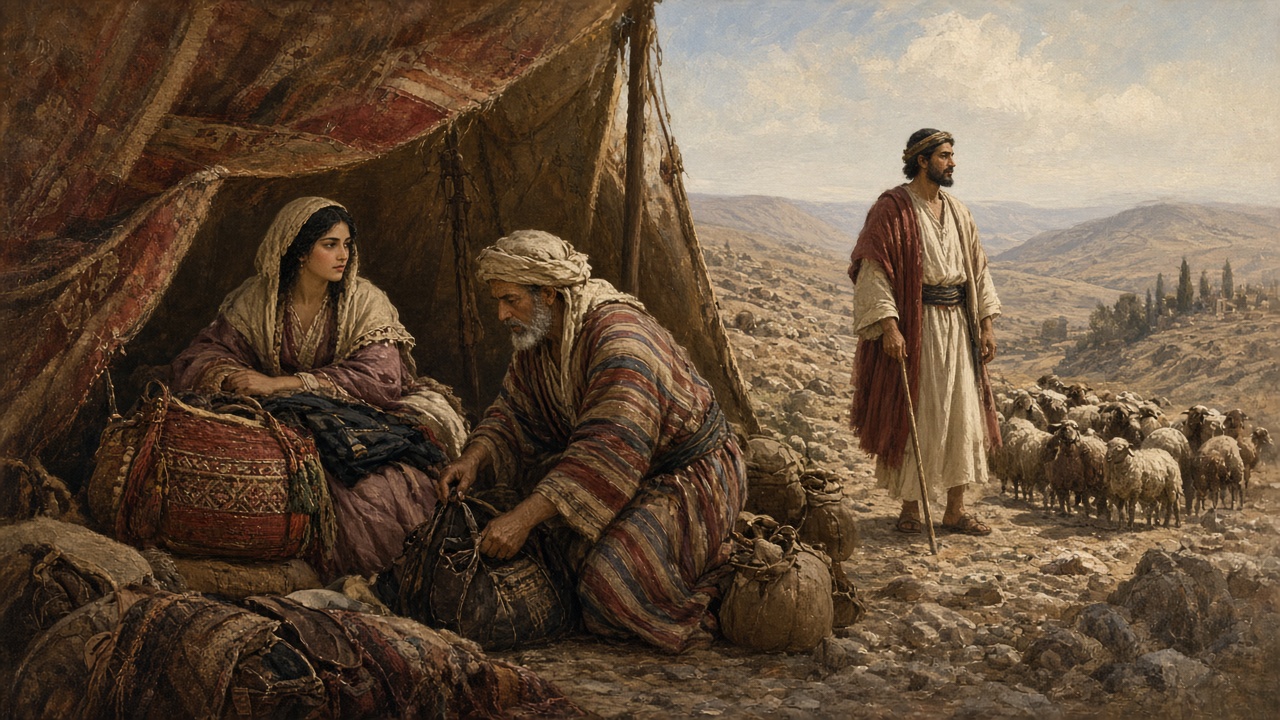
- As they left, Rachel took her father’s household idols, the teraphim, hid them in her camel’s saddlebag, and sat on them while Laban searched the tents. Jacob did not know she had stolen them, though he had declared that anyone found with the idols would not live.Sources: Rachel · the Bible text itself
- Jacob left Paddan-aram, the plain of Aram, commonly regarded as the Mesopotamian district around Haran, crossed the Euphrates, and was overtaken in the hill country of Gilead after a pursuit of seven days. Gilead is described as a “hill of testimony,” a mountainous region east of the Jordan. A dictionary notes that, when Jacob fled from Haran, contact between Abraham’s family in Canaan and the relatives who had remained there came to an end.Sources: Paddan-aram · Gilead · Nahor (brother of Abraham) · the Bible text itself
Notes written with AI assistance from open sources (Theographic Bible Metadata, CC BY-SA 4.0; Easton’s Bible Dictionary, public domain) and reviewed before publishing.
Places in this chapter
- Canaan · 32.767, 35.333 · verse 18
- Euphrates · Today: Euphrates River · 31.004, 47.442 · verse 21
- Gilead · Today: Gilead 1 · 32.187, 35.692 · verses 21, 23, 25
Only places identified with high confidence are shown (90% or more according to the scholarly sources compiled by OpenBible). Period map: DARE (Digital Atlas of the Roman Empire), CC BY 4.0; modern map: © OpenStreetMap contributors; places: OpenBible.info (CC BY 4.0).
Credits and license for this translation
Chiga Tevaen'Jema Atesuja 1, Aisheve Caña'cho
New Testament and Genesis in Cofán (EC:con:Cofán)
copyright © 2012 Wycliffe Bible Translators, Inc.
Language: Cofán
Translation by: Wycliffe Bible Translators, Inc.
Cofán
con
Ecuador
Copyright Information
©Wycliffe Bible Translators, Inc. All rights reserved.
This translation text is made available to you under the
terms of the Creative Commons License: Attribution-Noncommercial-No Derivative Works.
( http://creativecommons.org/licenses/by-nc-nd/3.0/ )
In addition, you have permission to port the text to different file formats, as long as you
do not change any of the text or punctuation of the Bible.
You may share, copy, distribute, transmit, and extract portions
or quotations from this work, provided that you include the above copyright
information:
You must give Attribution to the work.
You do not sell this work for a profit.
You do not make any derivative works that change any of the actual words or punctuation of the Scriptures.
Permissions beyond the scope of this license may be
available if you contact
us with your request.
The New Testament
in Cofán
©Wycliffe Bible Translators, Inc. All rights reserved.
This translation is made available to you under the terms of the
Creative Commons Attribution-Noncommercial-No Derivatives license 4.0.
You may share and redistribute this Bible translation or extracts from it in any format, provided that:
You include the above copyright and source information.
You do not sell this work for a profit.
You do not change any of the words or punctuation of the Scriptures.
Pictures included with Scriptures and other documents on this site are licensed just for use with those Scriptures and documents.
For other uses, please contact the respective copyright owners.
2014-04-22
Source: http://ebible.org/conNTpo/ · eBible.org