Genesis 18
Chiga Tevaen'Jema Atesuja 1, Aisheve Caña'cho · Tap a verse to see its cross-references.
Abraham dutssi'yeve condase'cho
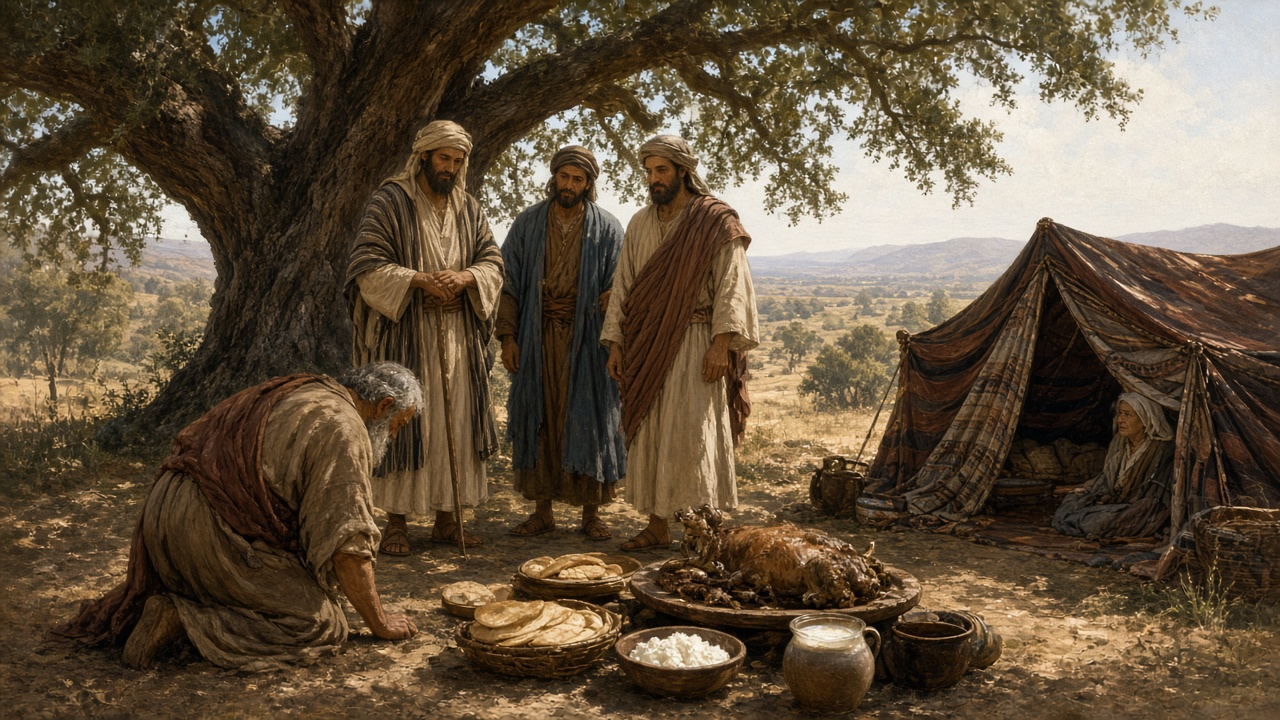
1Tsonsi Na'su Chiga ccase Abrahamnga attian Mamrembe roble quini'ccoccuni. Enttinge a'ta a'que'osi Abrahamjan tise carpa tsa'o'su sombo'ttini dyai. 2Dyaipa asuccocamba tres tsandiema atte tse'tti pporotsse ccutsu'fa'choma. Tise'pama attepa carpa'ye butto jangipa chigambiañe catse. Buttopa japa tise'panga catsepa tise tsovema andenga puntssamba ccuipa 3su:
—Ña na'su, chigáne va'tti re'riccone dyaiccaja. 4Quema shondo'su gi. Que in'jan'ninda gi tsa'ccuve iñajamba afeya que'i tsu'ttema cashiye. Cashipa quini'cco'su tumbianccuni dyaicca'faja. 5Que'i tsa'caen ño'fa dyai'ninda gi panma iya cuintsu que'i an tteppuye. Nane va quema shondo'su tsaoni jipa qui tsa'caen an tteppupa ti'tsse jaya.
Tsa'caen susi tise'paja Abrahamnga su'fa:
—Ñotssi tsu. Tsa'caen tsonjan.
6Tsonsi Abrahamjan carpanga ca'nimba Sarama su:
—Uta'tsseyi ñotssia harinama cuarenta librave isupa panme ñoñajan.
7Tsa'caen supa Abrahamjan vaura ttuccuni buttopa japa bove ñotssia vaura du'shuma indipa tise'be sema'sunga afe cuintsu fi'ttipa sho'ccoeñe. 8Tsonsi sho'ccoen nanimba chocho, quesoma'qque ipa pasiasundeccunga afe vaura nai'ccu añe. Tsendeccu quini'cco tumbianccuni dyaipa an'jen'fasi Abrahamjan tise'pama shondo'je.
9An nanimba Abrahamnga su'fa:
—¿Mani tsu que pushe Saraja?
Iñajampañasi Abrahamjan su:
—Carpani tsu can'jen.
10Tsonsi fae'cco tsendeccu'suja su:
—Fae canqque'fa panshansi gi ccase queni jiya. Ña jisi tsu que pushe Saraja tsandie du'shuve isuya.
Tsa'caen su'je'choma Saraja Abraham sepaccofae a'tutsse carpani pañá ccutsu. 11Nane Abrahamjan, Sara'qque coenza. Saraja coenza ccasheve dapa tayo samboen'cho. 12Tsa'camba Saraja pañamba feña. Nane feñamba asi'ttaen: “¿Ñoa'me ti gi tsa'caen avujaya? Ña, ña tsa'ndu'qque coenzata, ¿ma'caen?” 13Tsa'ma Na'su Chigaja tise asi'ttaen'choma in'jamba Abrahamnga su:
—¿Micomba tsu Saraja feñamba “¿Ñoa'me ti gi coenza ccasheve dapa du'shuve isuya?” qquen su? 14¿Oshambi ti Na'su Chigaja osha'choma oshapa tsa'caen tsoñe? Nane ñoa'me fae canqque'fa pasasi ña ccase jisi tsu Saraja tsandie du'shuve isuya.
15Tsa'caen susi pañamba Saraja dyopa a'tiemba su:
—Me'in, feñambi gi.
Tsa'ma Na'su Chigaja su:
—Atte gi que feña'choma.
Sodomama ccusheñe iñajan'cho
16Tsa'caen condasepa an nanimba pasiasundeccu jangipa Sodoma canqqueni jaye ashaen'fa. Abrahamjan camoeñe in'jamba re'riccoe tise'pai'ccu fae'ngae ja. 17Tsonsi Na'su Chigaja qquen asi'ttaen: “Ñotssi tsu ña tsoña'choma Abrahamnga condaye. 18Nane tiseja tsain'bitssi a'ive atapasi joccapitssia aindeccuve tsu da'faya. Tisei'ccu gi poi ande'su aindeccuma ñotsse tsoña. 19Nane tisema gi in'jan cuintsu tise mandasi tise dushundeccu, tise omba'su dutssiyendeccu'qque ña su'choma pañamba ñotsse canse'faye. Tsa'caen tson'ninda gi pa'cco ña su'choma tsoña.” 20Tsa'caen asi'ttaemba Na'su Chigaja su:
—Sodoma canqque'su aindeccu, Gomorra canqque'su aindeccu'qque ñoa'me dyo'oe egae tsincon'fa. Tsa'caen tsincon'choma poi ande'su aindeccu in'jamba condasecco'fasi gi paña. 21Tsane gi japa atesuya tise'pa ña pañaqquia'caen tsincon'choma. Attepa gi in'jaña.
22Tsa'caen su'je'ni tsa faesu dos pasiasundeccuja Sodomani jaye ja'fa. Tsa'ma Abrahamjan toya Na'su Chigai'ccu ccutsupa 23ti'tsse catsepa iñajampaña:
—¿Ñoa'me ti qui egae tsinconsundeccui'ccu fae'ngae ño'andeccuma'qque fi'ttiya? 24¿Nane cincuenta ño'andeccu tseni can'jen'ni'qque ti qui poiyi'cco tsa canqquesundeccuma fi'ttiya? Tsambi'ta, ¿ño'andeccuma ccushaeñe ti qui antteya? 25Ñoa'me qui oshambi tsa'caen ño'andeccuma egae tsinconsundeccui'ccu fae'ngae fi'ttiye. Nane tsendeccuja fae'ngae egae tsincon'fambi. Me'in, tsa'caen qui tsoña'bi. Nane queja poi aindeccu injama'choma somboen'su, ¿poiyi'ccoma ñotsse in'jan'da ti qui ñotsse tsoña?
26Pañamba Na'suja su:
—Cincuenta ño'andeccuma tseni atte'ta gi poiyi'cco tsa canqque'su aindeccuma ccushaeña.
27Toya'caen tsu Abrahamjan su:
—Queja Chiga. Ñajan aqquia a'i gi. Tsa'ma ña injanga qquen afasi ñama iyicca'yejama. 28¿Cinco ño'andeccu cincuentave nepiya'cho shaca'ni'qque ti qui poiyi'cco tsa canqque'suma fi'ttiya?
Tsonsi Na'suja su:
—Cuarenta y cinco ño'andeccuma atte'ta gi poiyi'ccoma ccushaeña.
29Toya'caen Abrahamjan su:
—Da, ¿cuarenta ño'andeccuma tseni atte'ta–?
Tsonsi Na'suja su:
—Cuarenta can'jen'ninda gi antteya.
30Ccase Abrahamjan su:
—Ñama iyicca'yejama. Tsa'ma, ¿aqquia treintaveyi atte'ta–?
Na'suja su:
—Treintave atte'ta gi antteya.
31Ti'tsse tsu Abrahamjan su:
—Ñoa'me opa gi ya'caen ña Na'suma afaye. Tsa'ma, ¿veinteveyi atte'ta ti qui antteya?
Na'suja su:
—Ju, veinteveyi atte'ta gi tsa canqque'su a'ima fi'ttiya'bi.
32Toya'caen Abrahamjan su:
—Chigáne, ña Na'su, ñama iyicca'yejama. Tsa'ma ti'tsse fae seyi gi afaya. ¿Mingae qui tsoña aqquia diez ño'andeccuma atte'ta?
Tsonsi Na'suja su:
—Nane ñoa'me ño'andeccuma diezve atte'ta gi tsa canqquesundeccuma fi'ttiya'bi.
33Na'suja tsa'caen Abrahami'ccu afa nanimba ja. Abraham'qque toequi tise carpa tsaoni shanda.
Did you know?
Visitors at Mamre and a Plea for Sodom
- In Genesis 18, the LORD appeared to Abraham by the Oaks of Mamre in the heat of the day, while Abraham sat at the entrance of his tent. Mamre was an Amorite chief in alliance with Abraham. Abraham ran to meet three men, bowed to the ground, offered them water for their feet and rest under the tree, and then set before them bread, a tender and choice calf, curds, and milk.Sources: the Bible text itself · Mamre
- Sarah, Abraham’s wife, is given the sense “Princess” in Easton's Bible Dictionary (1897), which says the name was given when it was announced that she would be the mother of the promised child. In Genesis 18 the LORD said he would return in about a year and Sarah would have a son, though both were already old and she had passed the age of childbearing. She laughed to herself and, because she was afraid, denied that she had laughed.Sources: Sarah · the Bible text itself
- Sodom, a city in the vale of Siddim, and Gomorrah, one of the five cities of that plain, are named together in Genesis 18 because of the great outcry against their grievous sin. Easton's Bible Dictionary (1897) says the cities of that plain probably stood close together near the northern end of what is now the Dead Sea, and explains Sodom and Gomorrah as “Burning; the walled” and “Submersion.” Two of the men went toward Sodom, while Abraham stayed and asked the LORD to spare the city for the sake of the righteous, lowering the number from fifty to ten.Sources: Sodom · Gomorrah · the Bible text itself
Notes written with AI assistance from open sources (Theographic Bible Metadata, CC BY-SA 4.0; Easton’s Bible Dictionary, public domain) and reviewed before publishing.
Credits and license for this translation
Chiga Tevaen'Jema Atesuja 1, Aisheve Caña'cho
New Testament and Genesis in Cofán (EC:con:Cofán)
copyright © 2012 Wycliffe Bible Translators, Inc.
Language: Cofán
Translation by: Wycliffe Bible Translators, Inc.
Cofán
con
Ecuador
Copyright Information
©Wycliffe Bible Translators, Inc. All rights reserved.
This translation text is made available to you under the
terms of the Creative Commons License: Attribution-Noncommercial-No Derivative Works.
( http://creativecommons.org/licenses/by-nc-nd/3.0/ )
In addition, you have permission to port the text to different file formats, as long as you
do not change any of the text or punctuation of the Bible.
You may share, copy, distribute, transmit, and extract portions
or quotations from this work, provided that you include the above copyright
information:
You must give Attribution to the work.
You do not sell this work for a profit.
You do not make any derivative works that change any of the actual words or punctuation of the Scriptures.
Permissions beyond the scope of this license may be
available if you contact
us with your request.
The New Testament
in Cofán
©Wycliffe Bible Translators, Inc. All rights reserved.
This translation is made available to you under the terms of the
Creative Commons Attribution-Noncommercial-No Derivatives license 4.0.
You may share and redistribute this Bible translation or extracts from it in any format, provided that:
You include the above copyright and source information.
You do not sell this work for a profit.
You do not change any of the words or punctuation of the Scriptures.
Pictures included with Scriptures and other documents on this site are licensed just for use with those Scriptures and documents.
For other uses, please contact the respective copyright owners.
2014-04-22
Source: http://ebible.org/conNTpo/ · eBible.org