Acts 20
Chiga Tevaen'Jema Atesuja 1, Aisheve Caña'cho · Tap a verse to see its cross-references.
Macedonia, Greciani'qque ja'cho
1Tsomba qquejian'cho ziya'fasi Pabloja Jesúsve in'jan'chondeccuma ttu'sepa candusian. Candusian nanimba chigambiamba Macedoniani ja. 2Macedonia ande'ye jacamba tseni'su aindeccuma candusian in'jaemba Grecia andeni napi. 3Tseni napipa tres ccovuve can'jen. Tsomba Siriani jaye pan barconga otseye tson'jemba israendeccu tisema fi'ttiye in'jan'fa'choma paña. Tsa'caen pañamba asi'ttaemba sa'ngae toequi Macedoniani jaye in'jan. 4Tsomba jayisi faesundeccu'qque tisei'ccu fae'ngae jaja'fa. Berea'su a'i, Sópater –tsa Pirus dutssi'ye– tsu ja. Tesalónica aindeccu Aristarco, Segundo'qque jaja'fa. Toya'caen Derbe'su a'i, Gayo, tsu ja. Timoteo, toya'caen Asia'su aindeccu, Tíquico, Trófimo'qque tsu jaja'fa. 5Tsendeccuja o'tie japa Troasni ingive ronda'je'fa. (Ña Lucas gi Pabloma cachui Filipos canqqueni.) 6Tsomba gi pan cupana'cco mechoa fiesta pasasi barconga otsepa Filiposne sombopa cinco a'tangae Troasni napi'fa. Napipa o'tie jacansundeccuma cachuipa fae avujaqui pa'cco tseni can'jen'fa.
Pablo Troasni can'jen'cho
7Domingo cose ingija poiyi'cco bo'fa Jesúsve injan'jeña'cho panma doñamba añe. Pabloja ccaqui sinte'yi jaya'pa poiyi'cconga condasé ñoa'me enttinge cose'tsse. 8Nane ingija sefani'su cuartonga bopa cosesi tsain'bitssi tuñoma setsaen'fa. 9Tsa'caen bopa fae chu'a tsandie, Eutico qquen inisecho'cho, cuarto ventana'ttini dyaipa paña'jen. Tsonsi Pablo ti'tsse bia've condase'jesi Euticoja anae'supa ñoa'me ana. Tsa'caen anamba amppi ja tres ppappacco'ye. Tsa'caen amppi jasi andin japa opi jangia'nijan tayo pajin ccui. 10Tsonsi Pablo'qque andepa junde tisema pporaemba munsimba su:
—Dyombe can'faja. Toya tsu canse.
11Tsa'caen tsomba Pabloja ccase ansundepa Jesúsve injan'jeña'cho panma doñamba attufaemba afe cuintsu an'faye. An nanimba ti'tsse condasé a'ta. A'tasi sombopa ja. 12Chu'a tsandieja tayo qquendyasi tisesundeccu tisema avujatsse tsaoni anga'fa.
Troasne sombopa Miletoni ja'fa'cho
13Tsomba Pabloja sa'ngae Asón canqqueni jaye in'jansi ingija o'tie barconga otsepa ja'fa. Otsepa marngae Asóni ja'fa, tseni Pabloma cachuiye. 14Tsomba Asóni Pabloma cachuisi Pablo'qque otsepa ingi'ccu fae'ngae Mitilene canqqueni ja'fa. 15Tseni sombopa ccaqui a'ta Quío canqque isevetssia'ma panshamba ccaqui a'ta Samos canqqueni napipa ccattufa'fa. Tsomba Trogilio canqqueni ñofaccapa ccaqui a'ta Mileto canqqueni napi'fa. 16Nane Pabloja asi'ttaemba Asia andeni bo'tsse can'jeñe in'jambipa Efesoma tsa'caen panshamba Miletoni ccattufa'fa. Junde tsu Jerusaléni jaye in'jan osha'ta tseni Pentecostés fiestama panshaeñe.
Efeso'su coenzandeccuma ttu'se'cho
17Tsa'caen Miletoni can'jemba Pabloja manda cuintsu Efeso'su Jesúsve in'jamba bo'je'cho coenzandeccuma ttuséngaye. 18Ttusengapa i'fasi Pabloja tsendeccunga su:
—Que'ija pa'tssima qui atesu'fa ña que'i'ccu ma'caen canse'choma tseyi Asiani jipa. 19Nane cca'ima quinsepoembe'yi gi que'i'ccu can'jemba Na'su Jesús in'jan'choma sema. Toya'caen israendeccu ñama fi'ttiye in'jan'fasi vana'je'an'qque gi inanzaccui'ccu sema. 20Tsa'ma anttembe'yi gi osha'cho ñotssiama que'inga atesian que'ima fuiteye. Nane pa'o a'i paña'je'ni toya'caen que'i tsa'onga'qque gi candusiamba fuite. 21Israendeccunga, griegondeccunga'qque gi condase cuintsu Chiga in'janqquia'caen tise'pa egae tsincon'choma catipa ingi Na'su Jesucristove in'jamba canse'faye. 22Ja'ño Chiga Qquendya'pa ñama in'jaensi gi Jerusaléni jaya'cho. Ña tseni jasi ñama ma'caen tson'faya'chove ñajan atesumbi. 23Tsa'ma poi canqquenga mani ña jayi'nijan Chiga Qquendya'pa tsu ñanga conda “Indipa picco'fasi qui me'detsse vanaña.” 24Tsa'ma mingavieyi'qque gi tsane dyombi. Ni paye'qque gi dyombi. Nane ñoa'me gi in'jan Na'su in'jan'cho sema'bama avujatsse naniñe. Na'su Jesús tsa sema'banga ñama mandasi gi va Chiga ingima in'jan'chone ñotsse condase'choma condase'je.
25¡Que canjan! Ja'ño gi in'jan que'ija ccatsse ñama atte'faya'bi. Nane poiyi'cco majanga ña Chiga aindeccuve daya'chone conda'chondeccu ccatsse ñama atte'faya'bi. 26Tsa'camba gi que'inga ja'ño a'ta conda: Ñajan majaneñi'qque shacapa'bi gi tise'pa tsangae catiyeya'chone. 27Ni fae afa'choveyi'qque se'pimbe gi pa'cco Chiga in'jan'choma que'inga conda. 28Tsa'cansi injama'tse tisupa qquesa'ne. Tansintsse atesiamba poiyi'cco Jesúsve in'jamba bo'je'chondeccuma ñotsse coira'faja. Nane Na'su Jesúsja tisu anjampai'ccu tayo tsendeccuma ccushaen. Tsendeccuma tsa'caen ccushaensi Chiga Qquendya'pa que'ima ttu'sepa manda tsendeccuma coira'suve da'faye. 29Atesu gi ña jasi faesu a'i jipa tsu ttesi putsa'su ovejama dyoña shequianqquia'caen tsendeccuma dañoñe in'jan'faya. 30Nane majan que'i'su tsu enttingenga ccutsupa ñotsse condase'choma ccaningae afopoeña cuintsu majan tisema pañasundeccuja tisia'caen in'jan'faye. 31Injama'tse, ñotsse in'jan'faja ña que'i'ccu tres canqque'fave can'jemba poi a'ta poi cose quimbingae poiyi'cconga candusian'jen'choma.
32Ja'ñojan Chiganga gi que'ima antte Tise in'jan'cho Aya'fama pañamba canse'faye. Tise Aya'fa tsu que'ima quiñaeñe osha cuintsu que'i poiyi'cco Chiga in'jan'chondeccui'ccu Chiga tsangae canseye afe'choma fae'ngae isu'faye. 33Ni majambe corifin'dima ni sarupama'qque gi in'jambi'a. 34Atesu'fa qui que'ija ma'caen ñajan tisu tivei'ccu semamba gana tisu canseya'chove; toya'caen ñai'ccu jacansundeccune'qque. 35Tsa'caen gi que'ima atesian semamba tsu mendeqquiama fuiteya'cho. In'jan'faja Na'su Jesús qquen su'choma: “Afe'su tsu isu'suma ti'tsse avujatsse afeya'cho.”
36Tsa'caen supa Pabloja poiyi'ccoi'ccu ccarupa fae'ngae Chigama iñajan'fa. 37Poiyi'cco i'namba Pabloma munsimba chigambiamba mochapa'fa. 38Pablo “Ccatsse ñama atte'faya'bi qui” qquen susi tsu i'na'fa. Tsa'caen i'namba Pabloi'ccu fae'ngae barco duseni ja'fa camoeñe.
Pablo Jerusaléni ja
Did you know?
Farewell on the way to Jerusalem
- Leaving Troas, Paul sent his companions ahead by ship and walked to Assos along the Roman road. Assos was a seaport of Proconsular Asia in Mysia, on the north shore of the Gulf of Adramyttium; the walk was about 20 miles, the sea route about 30, and the island of Lesbos lay about 7 miles offshore.Sources: the Bible text itself · Assos
- Paul sailed past Ephesus to avoid spending time in the province of Asia—the Roman province in western Asia Minor, with Ephesus as its capital—because he hoped, if possible, to reach Jerusalem by the day of Pentecost. He stopped at Miletus, a seaport and the ancient capital of Ionia about 36 miles south of Ephesus, and summoned the elders of the Ephesian church.Sources: the Bible text itself · Asia · Miletus
- Seven men traveled with him: Sopater of Berea, Aristarchus and Secundus of Thessalonica, Gaius of Derbe, Timothy, and Tychicus and Trophimus from Asia. Aristarchus of Thessalonica later shared Paul’s imprisonment in Rome, and Trophimus, an Ephesian, accompanied him on this part of the journey and was with him in Jerusalem.Sources: the Bible text itself · Aristarchus · Trophimus
Notes written with AI assistance from open sources (Theographic Bible Metadata, CC BY-SA 4.0; Easton’s Bible Dictionary, public domain) and reviewed before publishing.
Places in this chapter
- Macedonia · 41.600, 22.540 · verses 1, 3, 6
- Greece · 37.972, 23.727 · verse 2
- Syria · Today: Syria 2 · 33.511, 36.306 · verse 3
- Asia · 38.400, 28.300 · verses 4, 16, 18
- Berea · Today: Veria · 40.518, 22.200 · verse 4
- Thessalonica · Today: Thessaloniki · 40.638, 22.946 · verse 4
- Troas · Today: Alexandria Troas · 39.752, 26.159 · verses 5, 6
- Philippi · 41.012, 24.285 · verse 6
- Assos · 39.491, 26.337 · verses 13, 14
- Mitylene · Today: ancient theater at Mitylene · 39.110, 26.547 · verse 14
- Chios · 38.373, 26.137 · verse 15
- Miletus · 37.531, 27.276 · verses 15, 17
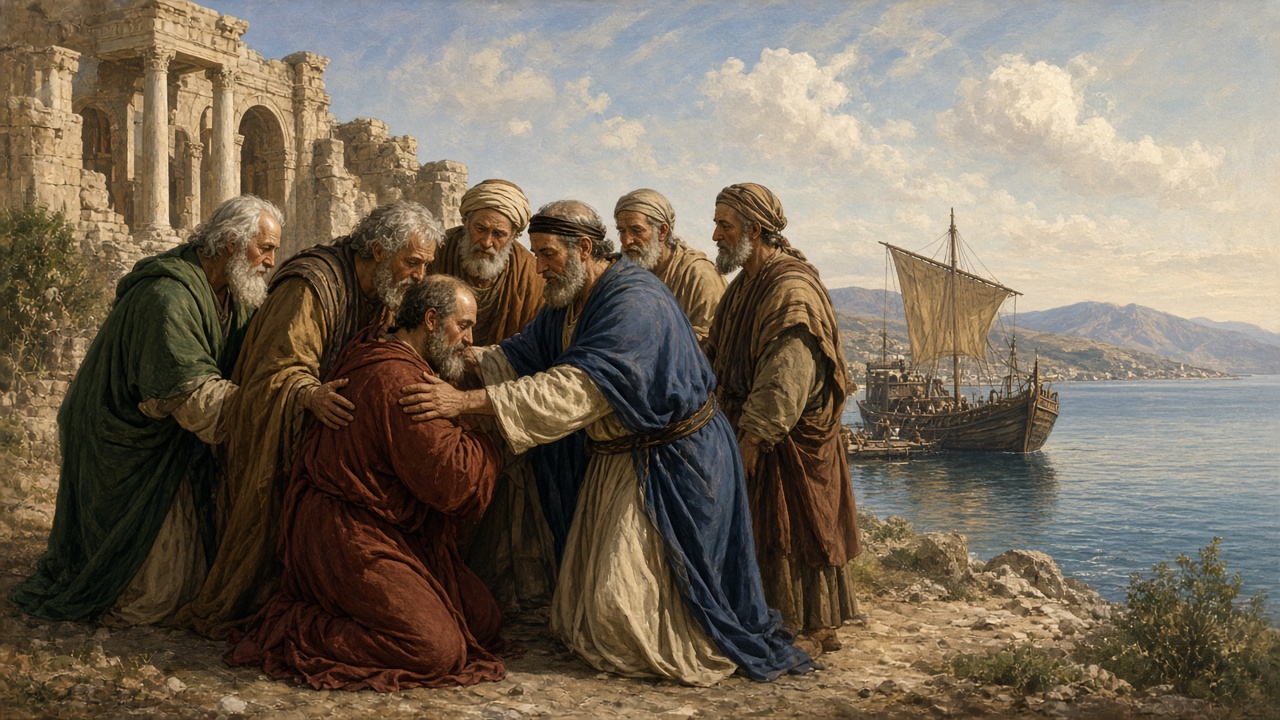
- Samos · 37.750, 26.833 · verse 15
- Trogyllium · Today: Cape Mycale · 37.659, 27.003 · verse 15
- Ephesus · 37.939, 27.341 · verses 16, 17
- Jerusalem · 31.777, 35.234 · verses 16, 22
Only places identified with high confidence are shown (90% or more according to the scholarly sources compiled by OpenBible). Period map: DARE (Digital Atlas of the Roman Empire), CC BY 4.0; modern map: © OpenStreetMap contributors; places: OpenBible.info (CC BY 4.0).
Credits and license for this translation
Chiga Tevaen'Jema Atesuja 1, Aisheve Caña'cho
New Testament and Genesis in Cofán (EC:con:Cofán)
copyright © 2012 Wycliffe Bible Translators, Inc.
Language: Cofán
Translation by: Wycliffe Bible Translators, Inc.
Cofán
con
Ecuador
Copyright Information
©Wycliffe Bible Translators, Inc. All rights reserved.
This translation text is made available to you under the
terms of the Creative Commons License: Attribution-Noncommercial-No Derivative Works.
( http://creativecommons.org/licenses/by-nc-nd/3.0/ )
In addition, you have permission to port the text to different file formats, as long as you
do not change any of the text or punctuation of the Bible.
You may share, copy, distribute, transmit, and extract portions
or quotations from this work, provided that you include the above copyright
information:
You must give Attribution to the work.
You do not sell this work for a profit.
You do not make any derivative works that change any of the actual words or punctuation of the Scriptures.
Permissions beyond the scope of this license may be
available if you contact
us with your request.
The New Testament
in Cofán
©Wycliffe Bible Translators, Inc. All rights reserved.
This translation is made available to you under the terms of the
Creative Commons Attribution-Noncommercial-No Derivatives license 4.0.
You may share and redistribute this Bible translation or extracts from it in any format, provided that:
You include the above copyright and source information.
You do not sell this work for a profit.
You do not change any of the words or punctuation of the Scriptures.
Pictures included with Scriptures and other documents on this site are licensed just for use with those Scriptures and documents.
For other uses, please contact the respective copyright owners.
2014-04-22
Source: http://ebible.org/conNTpo/ · eBible.org