Ruth 3
Paipel · Tap a verse to see its cross-references.
Rut a küna eman pwülüan
1Iwe, ekoch fansoun mürin Naomi a üreni Rut, “Nei föpwül, ifa usun, esap öch ai üpwe kütta eman pwülüom pwe epwe wor leniom ia kopwe kinamwe ie? 2Kopwe chechemeni pwe Poas eman märärich, ätewe ka fen nonom ren nöün kewe chon angang fefin. Kopwe rongorong. Lepwinei epwe wichi parli lon ewe lenien wichiwich. 3Iei mine kopwe tütü o epituk, kopwe pwal üföüf ufom mi mürina. Mürin kopwe feitiu ren ewe lenien wichiwich, nge kosap pwärukela ngeni ewe mwän tori an epwe pwi le mongö o ün. 4Iwe, lupwen epwe konola, kopwe nenengeni ewe leni ia a kon ie. Nge lupwen a annut, kopwe feila ren, kopwe särifätä pwölüpwölün pachapachan o konola ünükün. Iwe, epwe ürenuk mine kopwe föri.” 5Nge Rut a pälüeni, “Meinisin mine ka üreniei üpwe föri.” 6Iwe, Rut a feitiu ren ewe lenien wichiwich o föri usun chök mine inen pwülüan we a üreni. 7Nge lupwen Poas a pwi le mongö o ün, letipan a pwapwa. A feila lesopun ewe chukun föün parli o konola pwe epwe annut. Mürin, Rut a anifeto, a särifätä pwölüpwölün pachapachan o konola ünükün. 8Nge lukenipwin ewe mwän a mefi o kulu, a weitifengeni pwe a küna eman fefin mi kon ünükün pechen. 9Iwe, a aisini, “En iö?” Nge neminewe a pälüeni, “Ngang Rut noum we chon angang fefin. Pokiten en märärin pwülüei we, ka wisen tümwünüei. Kose mochen sipwe pwüpwülü.” 10Iwe, Poas a üreni, “Kopwe feiöch me ren ewe Samol mi Lapalap, nei föpwül. Ei föförün kirikiröch ka föri a fen lapala seni ewe ka föri me mwan ngeni inen pwülüom we. Pun kosap tapwela mürin ekewe alüal, ika ra wöüngau ika pisekisek. 11Nge iei kosap niuokus, Rut. Üpwe apwönüetä meinisin mine ka tüngor. Chienei meinisin lon ei telinimw ra silei pwe en eman fefin mi mürina. 12Mi pwüng pwe ngang eman märärin pwülüom we mi wisen tümwünuk, nge mi wor eman märärin mi kan ngonuk lap seniei. 13Iwe, kopwe chök nonom lon ei pwinin. Nge lesosorun lesor sipwe pi are ätewe epwe föri wisan ngonuk usun wisen märärin pwülüom. Are epwe föri ina usun, a öch. Nge are esap mochen föri wisan ngonuk, üa akapel iten ewe Kot mi Manau pwe üpwe föri wisei ngonuk. Iwe, kopwe chök kokon tori lesosorun lesor.”
14Iei mine Rut a konola ünükün pachapachen Poas tori lesosor. Iwe, a pwätä mwen eman esamwo tongeni silleni eman. Pun Poas esap mochen pwe eman epwe silei, pwe Rut a feito ren ei lenien wichiwich umwun parli. 15Iwe, Poas a üreni Rut, “Kopwe uwato ena mangaku ka pwölü ngonuk o ameresala ikei.” Iwe, neminewe a föri iei usun, nge Poas a aükü ngeni ina epwe ükükün lime paun parli o ekietä won Rut. Mürin a liwinla ngeni ewe telinimw. 16Nge lupwen Rut a tori lenien inen pwülüan we, Naomi a aisini, “Met pworausom, nei föpwül?” Iwe, Rut a apworausa meinisin mine Poas a föri ngeni. 17A pwal apasa, “Poas a üreniei pwe üsap liwinto reöm fän asöülapö, iei mine a ngeniei ei ükükün parli.” 18Iwe, Naomi a üreni, “Rut, kopwe chök witiwit tori om kopwe silei met epwe fis ngonuk. Pun Poas esap kinamwe tori epwe awesala ei mettoch ikenai.”
Did you know?
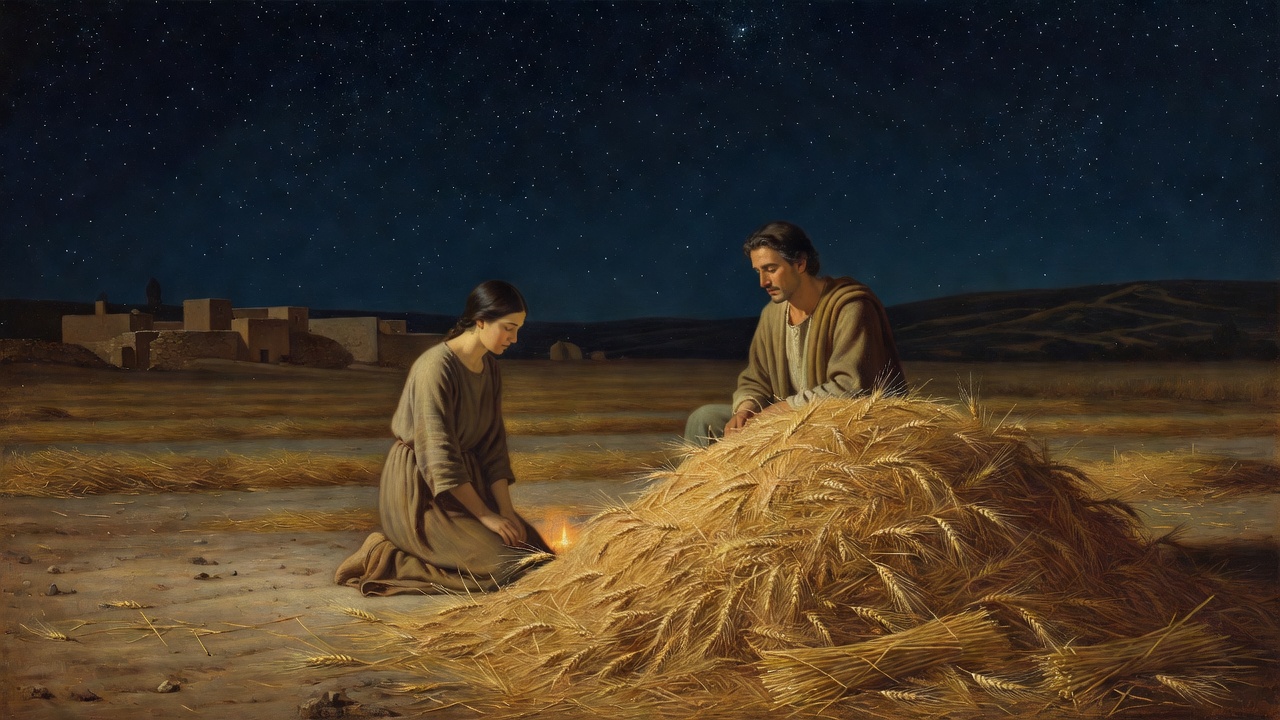
Ruth at the Threshing Floor
- Winnowing barley often took place during the evening when cooling breezes helped separate the grain from the chaff. Landowners like Boaz stayed overnight at the threshing floor to sleep beside their heaps of harvest and protect the grain.Sources: the Bible text itself
- Ruth asked Boaz to spread the corner of his garment over her, an action signifying marriage and protection under the custom of the family redeemer. Boaz praised her loyalty and character, noting her dedication to Naomi rather than pursuing younger suitors.Sources: the Bible text itself · Boaz
- Although Boaz was a wealthy relative of Naomi and her late son Mahlon, he noted that another family member had a closer kinship and therefore held the first legal right to redeem the family property and marry Ruth.Sources: the Bible text itself · Boaz · Ruth
Notes written with AI assistance from open sources (Theographic Bible Metadata, CC BY-SA 4.0; Easton’s Bible Dictionary, public domain) and reviewed before publishing.
Credits and license for this translation
Paipel
The Holy Bible in the Chuukese language of the Federated States of Micronesia
copyright © 1984, 1989, 1991, 2001 Liebenzel Mission
Language: Chuukese
Translation by: Liebenzell Mission
Old Testament © 1989, 2001 Liebenzel Mission
New Testament © 1984, 1991 Liebenzel Mission
This translation is made available to you under the terms of the
Creative Commons Attribution-No Derivatives license 4.0.
You may share and redistribute this Bible translation or extracts from it in any format, provided that:
You include the above copyright and source information.
You do not make any derivative works that change any of the actual words or punctuation of the Scriptures.
Pictures included with Scriptures and other documents on this site are licensed just for use with those Scriptures and documents.
For other uses, please contact the respective copyright owners.
2024-01-24
Source: http://ebible.org/chk/ · eBible.org