Psalms 68
Paipel · Tap a verse to see its cross-references.
Ewe Koten Sinai me an we mwichefel
Ngeni ewe mi emweni chon köl: Echö än Tafit köl.
1Kot epwe ütä o atoropasafeili chon oputan,
chokewe mi oputa i repwe sü me mwan.
2Usun asepwäl a ässala ötüötün ekkei, iei usun epwe ässirela.
Usun kiris a telila ren ekkei,
iei usun ekewe aramasangau repwe rosola me fän mesen Kot.
3Nge ekewe chon pwüng repwe uren pwapwa, repwe mwänek me fän mesen Kot,
repwe mweireir fän pwapwa.
4Oupwe köl ngeni Kot, oupwe kölün mwareiti itan.
Oupwe chietä echö köl ngeni ewe mi wawa ekewe kuchu,
itan ewe Samol mi Lapalap. Oupwe mwänek me fän mesan.
5Kot ewe mi nom lon imwan mi pin,
i semen ekewe mi mäsen me chon tümwünün ekewe fefin mi mä pwülüer.
6Kot a ngeni ekewe mi akaleman ar famili,
a emwenawu ekewe chon fötek pwe repwe ngasala fän pwapwa,
nge ekewe chon ü ngeni Kot repwe nom lon eu fanü mi pwasapwas o pwichikar.
7Ai Kot, lupwen ka akom mwen noum aramas,
lupwen ka pwerela lon ewe fanüapö,
8fanüfan a chechech, ekewe läng ra apüngätiu üt me fän mesen Kot.
Ewe chuk Sinai a chechech me fän mesen Kot,
ewe Koten Israel.
9Ai Kot, ka apüngätiu ütomong ekis meinisin.
Ka amürinala fanüom, lupwen a pwasala.
10Noum kewe aramas ra küna lenier me lon.
Lon om kirikiröch, ai Kot, ka tümwünü ekewe chon wöüngau.
11Ewe Samol a atowu ewe kapas.
A fokun lapalap ewe mwichen fefin mi arongafeili ewe pworausen win,
12“Ekewe king me nöür kewe mwichen sounfiu ra süla.”
Ekewe fefin mi nom leimw ra inetifengeni mine ekewe sounfiu ra liapeni lon maun.
13Uluulun lisom, pöükässir ra pwölüpwöl ngeni silifer,
nge ülöüler ra molupolup ren kolt mi mürina.
Pwota ekoch me leimi ra chök nonom lefilen ekewe lenien sip?
14Lupwen Ewe mi Unusen Manaman a atoropasafeili ekewe king won ewe fanü,
snow a püngütiu won ewe chuk Salmon.
15Ewe chuk Pasan eu chuk mi tekia.
Eu chuk mi wor chomong chukun.
16En chuk mi chukuchukutä, pwota ka nennetiu fän lolowo
won ewe chuk Kot a filätä pwe epwe nonom won.
Ewer, iei ewe leni ewe Samol mi Lapalap epwe nonom ie tori feilfeilachök.
17Ewe Samol a feito seni ewe chuk Sinai ngeni ewe leni mi pin
fiti ngeröün wan woken mi pöchökül.
18A feitä won ewe chuk mi tekia
o emwenätä chon oola lon an mwich mi tapwela mürin,
a pwal angei lifang seni aramas, fokun seni chokewe mi ü ngeni,
Kot ewe Samol mi Lapalap epwe nonom ikenan.
19Sipwe mwareiti ewe Samol
mi mwärei ach wosochou iteiten rän.
Kot ach Chon Amanau.
20Ach Kot eman Kot mi amanauakich,
Kot ewe Samol
a angasakich seni mäla.
21Nge Kot epwe amökkü möküren chon oputan,
epwe amökkü mongosaponen ätewe mi chök föföri tipis.
22Iwe, ewe Samol a apasa, “Üpwe aliwinato chon oputom seni Pasan.
Üpwe aliwinireto seni epin matau,
23pwe pecheöm epwe fetal lon char,
nge noum kewe kolak repwe asomwa inetir seniir.”
24Ai Kot, aramas ra küna om fetal fän win,
ra küna än ai Kot me ai king fetalelong lon imwan mi pin.
25Ekewe chon köl ra akom, ekewe chon ettik pisekin ettik ra nom mürin,
nge ekewe föpwül mi ettik pisekin kaktai ra nom lukalaper,
26“Oupwe mwareiti Kot lon ewe mwich mi lap.
Oupwe mwareiti ewe Samol mi Lapalap, ämi mwirimwirin Jakop.”
27Peniamin ewe ainang mi kükün me leir a akom mwer,
ekewe samolun Juta lon mwicheicher ra tapw müriir,
nge ekewe samolun Sepulon me Naftali ra kükümwir.
28Ai Kot, kopwe aworato om manaman.
Ai Kot, kopwe pwärawu ngenikem om pöchökül usun ka fen föri me mwan.
29Pokiten om we imwenfel lon Jerusalem
ekewe king repwe uwato lifang ngonuk.
30Kopwe apwüngü Isip, ewe manmwacho mi nom lein ekewe wowo.
Kopwe apwüngü ekewe mwü, ewe pwiin ätemwänin kow me nöür kewe nienifön kow,
tori repwe chapetiu me mwom o fang ngonuk ar silifer.
Kopwe atoropasafeili chon ekewe mwü mi pwapwaiti maun.
31Chon künö repwe feito seni Isip.
Chon Itiopia repwe aitietä pöür lon ar iotek ngeni Kot.
32Oupwe köl ngeni Kot, ämi chon ekewe mwü won fanüfan,
oupwe kölün mwareiti ewe Samol,
33ewe mi saifeil lon ekewe läng,
ekewe längin lomlom.
I ewe mi fos fän mwelian mi leüömong.
34Oupwe asilefeili än Kot manaman,
lingan a nom won Israel,
nge an manaman a nom lon ekewe läng.
35Kot a men eniwokus, lupwen a towu seni imwan mi pin.
I ewe Koten Israel
mi ngeni nöün kewe aramas manaman me pöchökül.
Sipwe mwareiti Kot!
Did you know?
The Victorious God of Israel
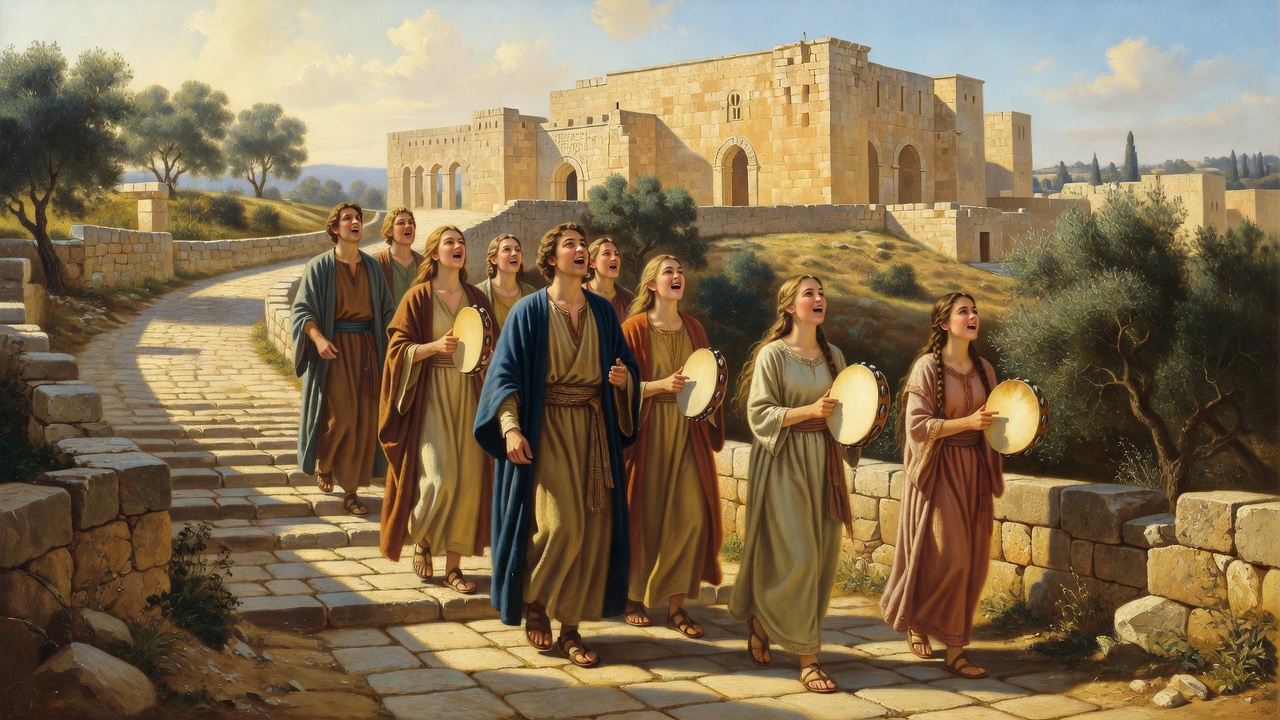
- The psalm describes a grand festival procession into the sanctuary led by singers, musicians, and young women playing tambourines. Representatives from both southern tribes, like little Benjamin and Judah, and northern tribes, like Zebulun and Naphtali, unite in the celebration.Sources: the Bible text itself · Benjamin (patriarch) · Zebulun · Naphtali
- The text contrasts the majestic, many-peaked mountain of Bashan with the mountain God chose for His dwelling in Jerusalem. It also compares the scattering of defeated kings across the land to snow falling on Zalmon, a wooded mountain near Shechem.Sources: the Bible text itself · Bashan · Zalmon · Jerusalem
- Beyond Israel, the psalm foresees foreign nations submitting and bringing gifts to Jerusalem. It explicitly mentions envoys arriving from Egypt and the southern land of Cush reaching out their hands to God.Sources: the Bible text itself · Egypt · Cush · Jerusalem
Notes written with AI assistance from open sources (Theographic Bible Metadata, CC BY-SA 4.0; Easton’s Bible Dictionary, public domain) and reviewed before publishing.
Places in this chapter
- Egypt · 30.129, 31.308 · verses 7, 31
- Mount Bashan · Today: Jebel Druze · 32.667, 36.733 · verse 15
- Mount Zion · 31.772, 35.229 · verse 16
- Holy Place · Today: on Mount Moriah · 31.778, 35.236 · verse 17
- Bashan · 32.781, 35.935 · verse 22
- Jerusalem · 31.777, 35.234 · verse 29
- Cush · Today: Cush 1 · 16.935, 33.751 · verse 31
Only places identified with high confidence are shown (90% or more according to the scholarly sources compiled by OpenBible). Period map: DARE (Digital Atlas of the Roman Empire), CC BY 4.0; modern map: © OpenStreetMap contributors; places: OpenBible.info (CC BY 4.0).
Credits and license for this translation
Paipel
The Holy Bible in the Chuukese language of the Federated States of Micronesia
copyright © 1984, 1989, 1991, 2001 Liebenzel Mission
Language: Chuukese
Translation by: Liebenzell Mission
Old Testament © 1989, 2001 Liebenzel Mission
New Testament © 1984, 1991 Liebenzel Mission
This translation is made available to you under the terms of the
Creative Commons Attribution-No Derivatives license 4.0.
You may share and redistribute this Bible translation or extracts from it in any format, provided that:
You include the above copyright and source information.
You do not make any derivative works that change any of the actual words or punctuation of the Scriptures.
Pictures included with Scriptures and other documents on this site are licensed just for use with those Scriptures and documents.
For other uses, please contact the respective copyright owners.
2024-01-24
Source: http://ebible.org/chk/ · eBible.org