Numbers 19
Paipel · Tap a verse to see its cross-references.
Än chon limengau limelim
1Iwe, ewe Samol mi Lapalap a üreni Moses me Aaron, 2“Iei pwüngün ewe allük ewe Samol mi Lapalap a allük: Kopwe üreni ekewe aramasen Israel pwe repwe nukieto eman kow mi par esamwo nöünöü, esap wor terin ika ngauan, esap pwal uwei mwo efoch waas fän eu. 3Iwe, oupwe ngeni ewe souasor Eleasar ewe kow. Nge ewe kow epwe nukunukula lükün ewe ia oua imweimw ie o ninnila me fän mesan. 4Mürin, ewe souasor Eleasar epwe angei ekis chan ewe kow won aütün o äsupu fän fisu ngeni awenewenen asamalapen ewe imwenfel seni mangaku. 5Nge ewe kow epwe kekila me fän mesen Eleasar: silin, fitukan, chan pwal taran epwe chök kekila. 6Iwe, ewe souasor epwe angei mwüüch seni ewe irä setar, ülün ewe irä isop pwal ekam mangaku mi par o moneerelong lon ewe ekkei. 7Mürin, ewe souasor epwe sopuni üfan o tütü. Iwe, mürin epwe tolong lon ewe ia oua nonom ie, nge epwe nom lon tettelin chon limengau tori lekuniol. 8Nge ätewe mi kenala ewe kow epwe sopuni üfan o tütü, epwe pwal nom lon tettelin chon limengau tori lekuniol. 9Mürin, eman mwän mi limöch epwe tukei falangen ewe kow o iseis lükün ewe ia oua nonom ie lon eu leni mi limöch. Iwe, ewe falang epwe iseis fän iten ekewe aramasen Israel pwe epwe nofit me koluk, pwe epwe wor kolukun limelim. Pun ei koluk kolukun limeti tipis. 10Nge ätewe mi tukei falangen ewe kow epwe sopuni üfan o nom lon tettelin chon limengau tori lekuniol. Ei epwe eu allük tori feilfeilachök fän iten ekewe aramasen Israel, pwal fän iten ekewe chon ekis mi nom leir.
11Iwe, eman mi atapa eman somä epwe nom lon tettelin chon limengau lon ükükün fisu rän. 12Iwe, epwe alimelima ren ewe kolukun limelim lon aülüngatin me afisuen rän, mürin epwe limöch. Nge are esap alimelima lon aülüngatin me afisuen rän, esap limöch. 13Iwe, iö a atapa inisin eman somä, nge esap alimelima, a alimengaua än ewe Samol mi Lapalap we imwenfel seni mangaku. Ewe aramas epwe käriwu seni ekewe chon Israel. Pokiten ewe kolukun limelim esap utututä won, ätewe epwe nom lon tettelin chon limengau, nge an limengau epwe chök nonom won.
14Iwe, iei ewe allük lupwen eman aramas a mäla lon eu imw mangaku: Iteiten eman me eman mi tolong lon ewe imw mangaku, pwal iteiten eman me eman mi nom lon epwe nom lon tettelin chon limengau lon ükükün fisu rän. 15Nge iteiten sepi esap wor pwölüpwölün mi riritä won epwe pwal limengau. 16Iwe, iö a atapa eman somä mi mäla ren ketilas, ika eman somä mi chök püsin mäla me lemäl, ika chün eman somä, ika eu peias, epwe nom lon tettelin chon limengau lon ükükün fisu rän. 17Iwe, repwe angei ekis falangen ewe kow mi kekila fän iten asoren tipis o nofiti ngeni koluk mi limöch lon eu sepi fän iten ewe mi limengau. 18Mürin, eman aramas mi limöch epwe angei ülün ewe irä isop, epwe atukalong lon ewe koluk o äsupu won ewe imw mangaku, won pisekin lon meinisin pwal won ekewe aramas mi nom lon. Epwe pwal äsupu won ätewe mi atapa chün eman somä ika atapa eman mi ninnila, ika atapa eman somä mi püsin mäla, ika atapa eu peias. 19Iwe, ewe aramas mi limöch epwe äsupu ewe koluk won ätewe mi nom lon tettelin chon limengau lon aülüngatin me afisuen rän. Iei usun epwe alimelima ätewe mi limengau lon afisuen rän. Iwe, ätewe mi limengau epwe sopuni üfan o tütü, nge lekuniol epwe limöch.
20Iwe, are eman aramas a nom lon tettelin chon limengau, nge esap kütta limelim, ätewe epwe käriwu seni ewe mwichen aramas, pun i a alimengaua än ewe Samol mi Lapalap leni mi pin. Pokiten ewe kolukun limelim esap utututä won, a limengau. 21Ei epwe eu allük fän itemi fansoun meinisin. Iwe, ätewe mi äsupu ewe kolukun limelim epwe sopuni üfan. Nge ätewe mi atapa ewe kolukun limelim epwe nom lon tettelin chon limengau tori lekuniol. 22Iwe, mettoch meinisin ewe aramas mi limengau a atapa epwe limengau, nge eman mi atapa ekei mettoch epwe pwal limengau tori lekuniol.”
Did you know?
The Red Heifer and Purification from Death
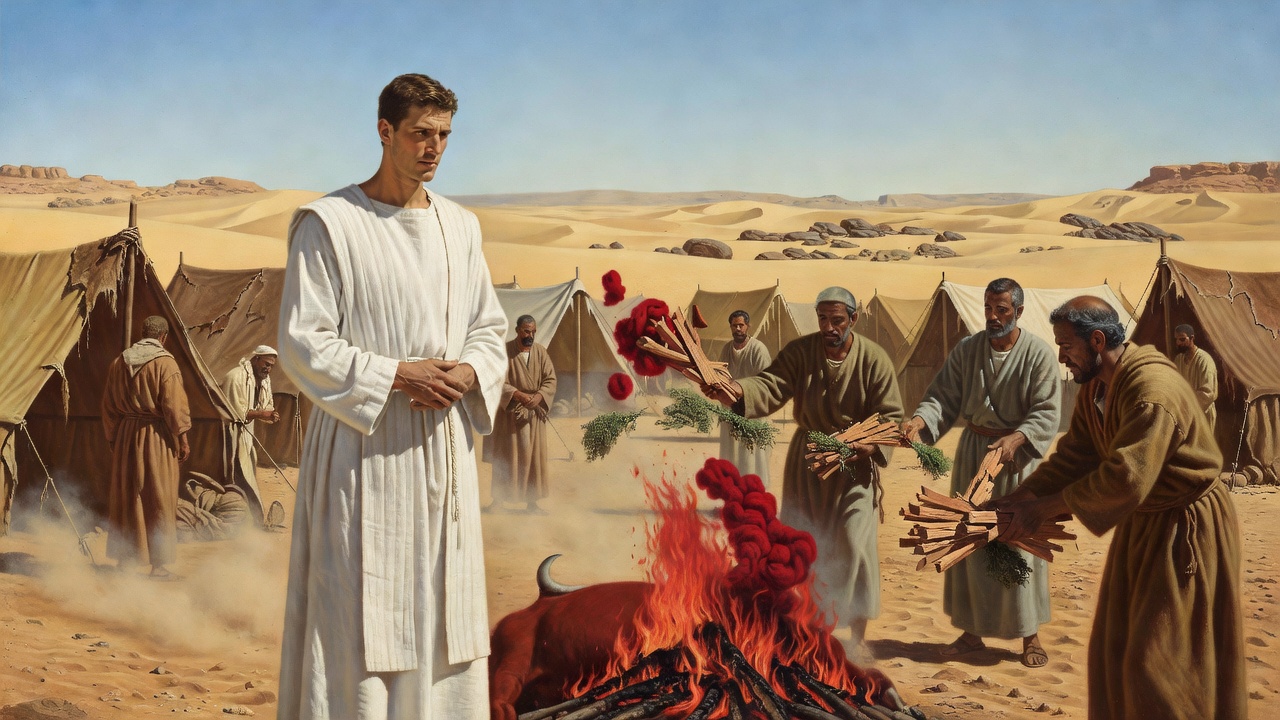
- Unlike typical sacrifices offered at the tabernacle altar, the unblemished red heifer that had never worn a yoke was taken outside the camp. There it was slaughtered in the presence of the priest Eleazar and burned whole along with cedar wood, hyssop, and scarlet wool.Sources: the Bible text itself · Eleazar
- The ashes of the heifer were stored outside the camp to prepare the water of purification. Paradoxically, while this mixture purified individuals who were defiled by death, everyone who handled the burning heifer, gathered its ashes, or sprinkled the water became temporarily unclean until evening.Sources: the Bible text itself
- Contact with a corpse, a human bone, a grave, or merely being inside a tent where someone died caused seven days of ceremonial uncleanness. To be restored, the person had to be sprinkled with the purification water on the third and seventh days and wash their clothes and body.Sources: the Bible text itself
Notes written with AI assistance from open sources (Theographic Bible Metadata, CC BY-SA 4.0; Easton’s Bible Dictionary, public domain) and reviewed before publishing.
Credits and license for this translation
Paipel
The Holy Bible in the Chuukese language of the Federated States of Micronesia
copyright © 1984, 1989, 1991, 2001 Liebenzel Mission
Language: Chuukese
Translation by: Liebenzell Mission
Old Testament © 1989, 2001 Liebenzel Mission
New Testament © 1984, 1991 Liebenzel Mission
This translation is made available to you under the terms of the
Creative Commons Attribution-No Derivatives license 4.0.
You may share and redistribute this Bible translation or extracts from it in any format, provided that:
You include the above copyright and source information.
You do not make any derivative works that change any of the actual words or punctuation of the Scriptures.
Pictures included with Scriptures and other documents on this site are licensed just for use with those Scriptures and documents.
For other uses, please contact the respective copyright owners.
2024-01-24
Source: http://ebible.org/chk/ · eBible.org