Nehemiah 8
Paipel · Tap a verse to see its cross-references.
Esra a aleani ewe allük ngeni ekewe aramas
1Iwe, lupwen a tori ewe afisuen maram, nge ekewe chon Israel ra nonom lon ar kewe telinimw, ir meinisin ra mwichefengen fän tipeeu lon Jerusalem lon ewe leni mi amassawa mwen ewe Asamalapen Koluk. Iwe, ra üreni Esra ewe sousile allük pwe epwe uwato än Moses we puken allük, ia a mak ie ekewe allük ewe Samol mi Lapalap a ngeni chon Israel. 2Lon aeuin ränin ewe afisuen maram ewe souasor Esra a uwato ewe puken allük me mwen ewe mwichen aramas, ir ekewe mwän me fefin, pwal semirit meinisin mi tongeni weweiti. 3A aleani ewe allük le sape ngeni ewe leni mi amassawa me mwen ewe Asamalapen Koluk seni lesosorusich tori leoloas. A aleani mwen ekewe mwän me fefin pwal ekewe semirit meinisin mi tongeni weweiti. Iwe, ekewe aramas meinisin ra aü selinger ngeni masouen ewe puken allük. 4Nge Esra a ütä won eu lenien afalafal mi för seni irä, ra föri fän iten ei popun. Iwe, Matitia, Sema, Anaia, Uria, Hilkia me Maseia ra ü ünükün me lepelifichin. Nge Petaia, Misael, Malkia, Hasum, Haspatana, Sekaria me Mesulam ra ü ünükün me lepelimöngün. 5Esra a suki ewe puk won lenian mi tekia, nge ekewe aramas meinisin ra chök nenengeni. Nge lupwen a suki ewe puk, ekewe aramas meinisin ra ütä. 6Esra a mwareiti ewe Samol mi Lapalap ewe Kot mi Tekia, nge ekewe aramas meinisin ra aitietä pöür o apasa, “Amen, Amen.” Iwe, ra rotiu, ra chapetiu lepwül o fel ngeni ewe Samol mi Lapalap. 7Mürin, ekewe aramas ra ütä lon en me lenian, nge ekewe mwän seni ewe ainangen Lefi iter Jesua, Pani, Serepia, Jamin, Akup, Sapetai, Hotia, Maseia, Kelita, Asaria, Josapat, Hanan me Pelaia ra awewei ngeniir ewe allük. 8Ra aleaniöchü ewe puken allük än Kot, ra aföüü o aweweni, pwe ekewe aramas ra tongeni weweiti.
9Iwe, lupwen ekewe aramas ra rongorong kapasen ewe allük, a mwökütüküt letiper pwe ra kechü. Iei mine ewe kepina Nehemia, ewe souasor Esra, i ewe sousile allük, me ekewe mwän seni ewe ainangen Lefi mi aiti ngeni ekewe aramas ewe allük ra üreni ekewe aramas meinisin, “Ei rän a pin fän iten ewe Samol mi Lapalap äm we Kot. Ousap letipeta ika kechü.” 10Mürin, Nehemia a üreniir, “Oupwe liwiniti en me lenian, oupwe eni mongö mi anö o ünümi wain mi arar. Oupwe pwal tinala och seni enemi me ünümemi ngeni chokewe resap tongeni amolätä och. Pun ei rän a pin fän iten ewe Samol. Ousap letipeta, pun ewe pwapwa seni ewe Samol mi Lapalap epwe apöchökülakemi.” 11Iei usun ekewe mwän seni ewe ainangen Lefi ra amosonosonala ekewe aramas meinisin o üreniir, “Oupwe chipila, pun ei rän a pin. Ousap letipeta.” 12Mürin, ekewe aramas meinisin ra liwiniti en me lenian, ra mongö o ün fän watten pwapwa, ra pwal tinala och ngeni chokewe esap wor ener, pun ra weweiti ekewe kapas ra rongorong.
13Iwe, lon aruuen ränin ewe maram ekewe mwänirelan än semer kewe cho seni ekewe aramas meinisin, pwal ekewe souasor me ekewe mwän seni ewe ainangen Lefi ra feitopök ren Esra ewe sousile allük, pwe repwe kaiö kapasen ewe allük. 14Iwe, ra küna pwe a mak lon ewe allük Moses a allük fän alon ewe Samol mi Lapalap pwe ekewe aramasen Israel repwe nonom lon likachoch lupwen ewe fansoun chulapen likachoch lon afisuen maram. 15Iei mine ra asilefeili o arongafeili lon ar kewe telinimw meinisin pwal lon Jerusalem, pwe aramas repwe feila won ekewe chuk o uwato palen ewe irä olif, mwoosor me palm, pwal palen sokopaten irä mi muresires, pwe repwe föri likachoch usun a fen mak lon ewe allük. 16Mürin, ekewe aramas ra feila o uwato ekewe palen irä. Iwe, ra föri likachoch fän iter won en me imwan, lon ekewe leni lükün imwer, pwal lükün ewe imwen Kot, lon ekewe leni mi amassawa arun ewe Asamalapen Koluk me arun ewe Asamalapen Efraim. 17Iwe, ekewe aramas meinisin mi liwinto seni ar oola ra föri likachoch o nonom lor. Pun seni fansoun Josua nöün Nun we mwän tori ei rän ekewe aramasen Israel resap föri mwo iei usun. Iwe, a fis watten pwapwa. 18Seni aeuin ränin ewe chulap tori lesopolan Esra a aleani ewe puken allük än Kot ngeni ekewe aramas. Ra föri ewe chulap lon ükükün fisu rän, nge lon awaluen rän ra föri eu mwich mi pin, usun a mak lon ewe allük.
Did you know?
The Reading of the Law and the Feast of Booths
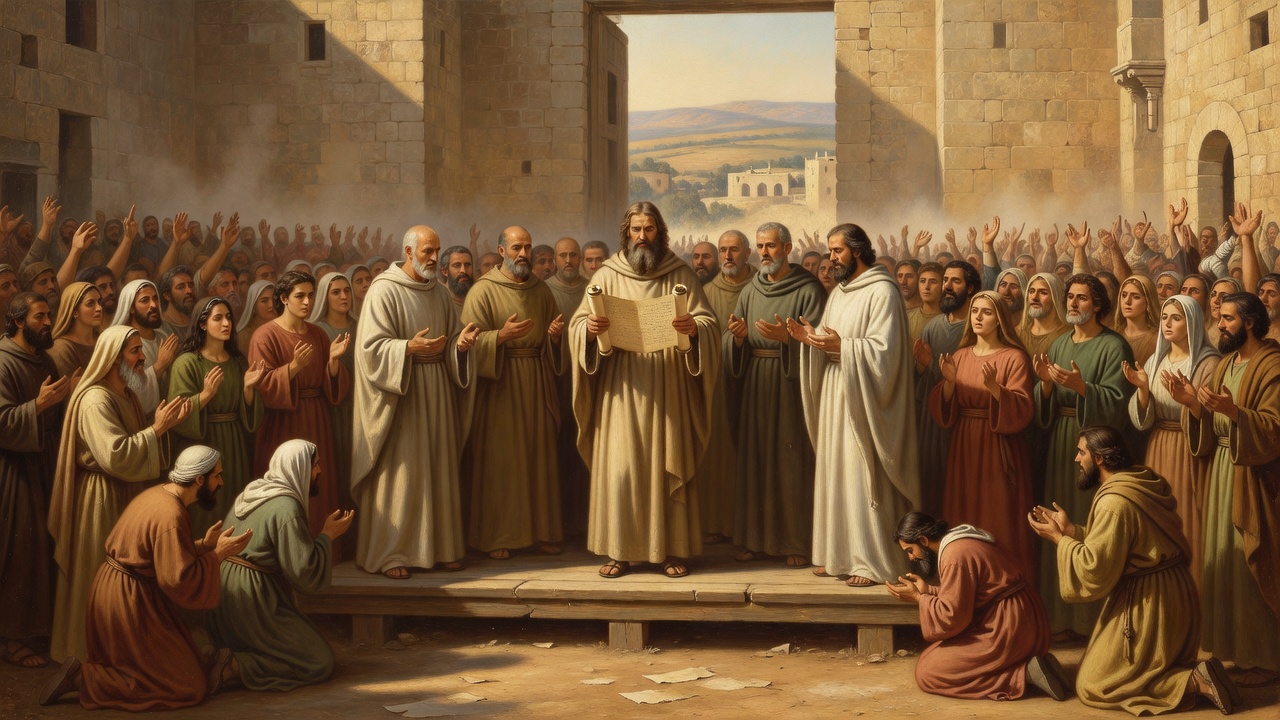
- Ezra the scribe, a priest descended from Aaron who had led exiles back from Babylon, read the Book of the Law of Moses from daybreak until noon to the assembly in Jerusalem. Standing on a high wooden platform in the square before the Water Gate, he read while Levites explained the text so the entire crowd could understand.Sources: the Bible text itself · Ezra · Water Gate · Jerusalem
- When the people wept upon hearing the Law read, Nehemiah the governor, Ezra, and the Levites instructed them not to grieve on a holy day. The people were told to celebrate with rich food and sweet drinks, share portions with those who had nothing prepared, and take comfort in the joy of the Lord.Sources: the Bible text itself
- After discovering the command in the Law to live in booths during the seventh month, the returned exiles gathered palm, olive, and myrtle branches to build shelters across Jerusalem's rooftops, courts, and squares by the Water Gate and the Gate of Ephraim. The text notes that the Israelites had not celebrated this feast in such a manner since the time of Joshua son of Nun.Sources: the Bible text itself · Water Gate · Gate of Ephraim
Notes written with AI assistance from open sources (Theographic Bible Metadata, CC BY-SA 4.0; Easton’s Bible Dictionary, public domain) and reviewed before publishing.
Places in this chapter
- Water Gate · Today: in Jerusalem · 31.777, 35.234 · verses 1, 3, 16
- Jerusalem · 31.777, 35.234 · verse 15
- Ephraim Gate · Today: in Jerusalem · 31.777, 35.234 · verse 16
Only places identified with high confidence are shown (90% or more according to the scholarly sources compiled by OpenBible). Period map: DARE (Digital Atlas of the Roman Empire), CC BY 4.0; modern map: © OpenStreetMap contributors; places: OpenBible.info (CC BY 4.0).
Credits and license for this translation
Paipel
The Holy Bible in the Chuukese language of the Federated States of Micronesia
copyright © 1984, 1989, 1991, 2001 Liebenzel Mission
Language: Chuukese
Translation by: Liebenzell Mission
Old Testament © 1989, 2001 Liebenzel Mission
New Testament © 1984, 1991 Liebenzel Mission
This translation is made available to you under the terms of the
Creative Commons Attribution-No Derivatives license 4.0.
You may share and redistribute this Bible translation or extracts from it in any format, provided that:
You include the above copyright and source information.
You do not make any derivative works that change any of the actual words or punctuation of the Scriptures.
Pictures included with Scriptures and other documents on this site are licensed just for use with those Scriptures and documents.
For other uses, please contact the respective copyright owners.
2024-01-24
Source: http://ebible.org/chk/ · eBible.org