Jonah 4
Paipel · Tap a verse to see its cross-references.
Sona esap efich pwe Kot a eäni ümöümöch
1Iwe, lupwen Sona a küna ei, a oput o song ren. 2Mürin a iotek ngeni ewe Samol mi Lapalap o apasa, “Ai Samol mi Lapalap, ifa usun, sap iei usun mine üa apasa pwe kopwe föri, lupwen üa chüen nonom won fanüei? Iei popun ai süla Tarsis, pun üa silei pwe en eman Kot mi ümöümöch o lukpwetete, ka pwal songomang o tongotam. Iwe, üa pwal silei pwe ka tipemecheres le siwili om ekiekin afeiengaua aramas kana. 3Iei mine, ai Samol mi Lapalap, üa fokun tüngor ngonuk pwe kopwe angei seniei manauei, pun üa efich ai üpwe mäla mwen ai üpwe manau.” 4Iwe, ewe Samol mi Lapalap a aisini Sona, “Ifa usun, mi pwüng om song?” 5Iwe, Sona a towu seni ewe telinimw o feila ötiuan. A aüetä eu likachoch o mot fän nürün, a witiwit pwe epwe küna mine epwe fis ngeni ewe telinimw.
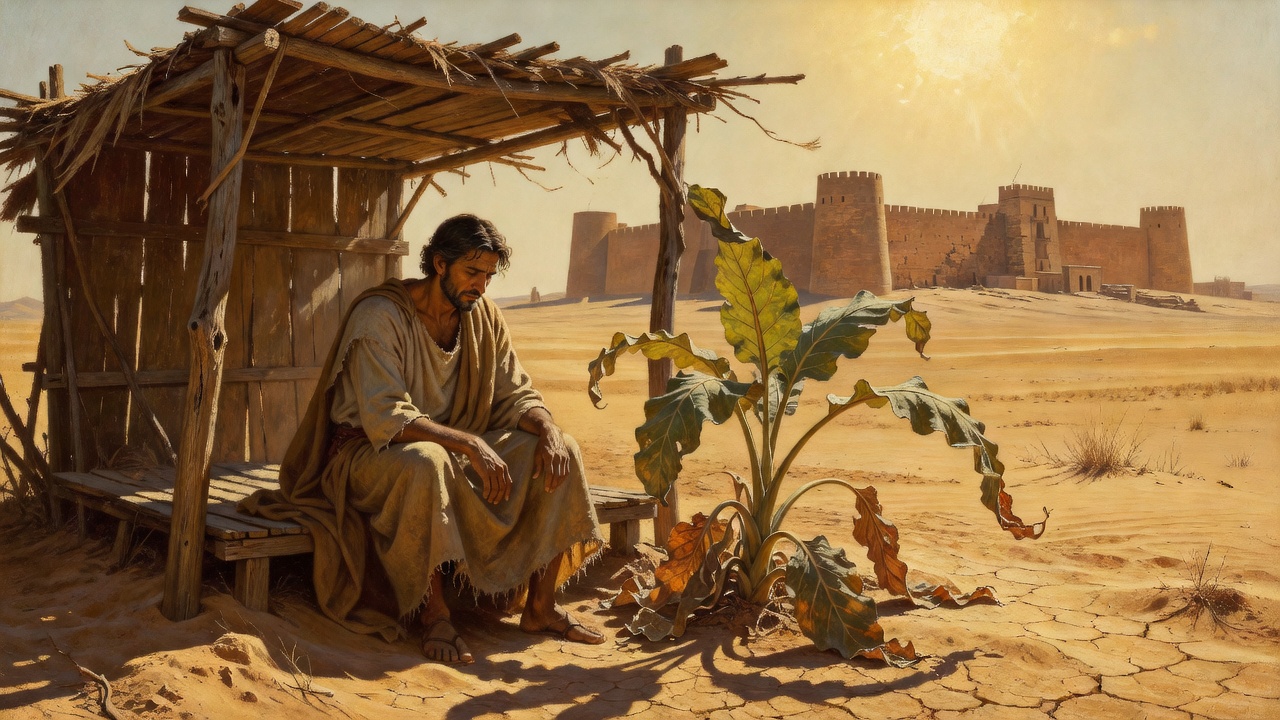
6Mürin, Kot ewe Samol mi Lapalap a amärätä efoch irä, pwe epwe anürü möküren Sona o angasa seni an weires. Iwe, Sona a fokun pwapwa ren ewe irä. 7Iwe, lupwen a tötä mallen rän, Kot a tinato eman man pwe epwe eni uapwalen ewe irä, pwe a pwasala o mäla. 8Nge lupwen akkar a tötä, Kot a tinato och asepwäl mi pwichikar seni ötiu. Iwe, akkar a pwichiti möküren Sona pwe a fokun aiengau. Iwe, a tüngor pwe epwe mäla. A pwal apasa, “A mürina ai üpwe mäla mwen ai üpwe manau.” 9Iwe, Kot a aisini Sona, “Ifa usun, a pwüng om song ren ewe irä?” Nge Sona a pälüeni, “Mi pwüng ai song, inamwo are üpwe mäla lon ai song.” 10Iwe, ewe Samol mi Lapalap a üreni, “Ka achika ewe irä, nge kosap angang ngeni, kosap pwal amärätä. Pun a püsin märitä lon eu pwin, nge a pwal pwasala lon eu pwin. 11Nge ifa usun, ngang üsap achika Ninifa ewe telinimw mi lapalap, ia a wor ie lap seni ipükü rüengeröü aramas resamwo silei lefilen öch me ngau, a pwal wor chomong man lon?”
Did you know?
Jonah's Anger and God's Compassion
- Jonah admits that he originally attempted to flee toward Tarshish precisely because he knew God is gracious, compassionate, slow to anger, and relents from sending disaster. His distress arose when God chose to spare Nineveh rather than destroy it.Sources: the Bible text itself · Tarshish
- Nineveh, the flourishing capital of the Assyrian empire, is described at the conclusion of the book as home to more than 120,000 people who cannot discern between their right and left hand, along with many cattle. God highlights this massive population to contrast divine compassion with Jonah's concern for a single withered plant.Sources: the Bible text itself · Nineveh
Notes written with AI assistance from open sources (Theographic Bible Metadata, CC BY-SA 4.0; Easton’s Bible Dictionary, public domain) and reviewed before publishing.
Places in this chapter
- Nineveh · 36.359, 43.153 · verse 11
Only places identified with high confidence are shown (90% or more according to the scholarly sources compiled by OpenBible). Period map: DARE (Digital Atlas of the Roman Empire), CC BY 4.0; modern map: © OpenStreetMap contributors; places: OpenBible.info (CC BY 4.0).
Credits and license for this translation
Paipel
The Holy Bible in the Chuukese language of the Federated States of Micronesia
copyright © 1984, 1989, 1991, 2001 Liebenzel Mission
Language: Chuukese
Translation by: Liebenzell Mission
Old Testament © 1989, 2001 Liebenzel Mission
New Testament © 1984, 1991 Liebenzel Mission
This translation is made available to you under the terms of the
Creative Commons Attribution-No Derivatives license 4.0.
You may share and redistribute this Bible translation or extracts from it in any format, provided that:
You include the above copyright and source information.
You do not make any derivative works that change any of the actual words or punctuation of the Scriptures.
Pictures included with Scriptures and other documents on this site are licensed just for use with those Scriptures and documents.
For other uses, please contact the respective copyright owners.
2024-01-24
Source: http://ebible.org/chk/ · eBible.org