Judges 18
Paipel · Tap a verse to see its cross-references.
Maika me ekewe chon Tan
1Iwe, lon ekana fansoun esap wor eman king lon Israel. Lon ena fansoun chon ewe ainangen Tan ra kütta eu fanü fän iter pwe repwe nonom lon, pun resap mwo angei fanüer me lein ekewe ainangen Israel. 2Iei mine ekewe chon Tan ra filätä limman mwän mi pwora seni lon unusen ar ainang. Ra tinirela seni Sora me Estaol o üreniir pwe repwe operi ewe fanü o ouwasacha. Iwe, ra tori chukuchukutän ewe fanü Efraim lon imwen Maika o pwinipwin ikenan. 3Nge lupwen ra nom ikenan ren imwen Maika, ra silleni ngingin ewe alüal seni ewe ainangen Lefi. Iwe, ra sap ngeni o üreni, “Iö a emwenukoto ikei? Met ka föri lon ei leni? Met om angang ikei?” 4Nge ätewe a üreniir, “Iei usun mine Maika a föri ngeniei. A möniei pwe üpwe eman nöün souasor.” 5Iwe, ra üreni, “Äm aia tüngoreek, kopwe aisini Kot pwe aipwe silei ika äm sai epwe fisiöch.” 6Nge ewe souasor a üreniir, “Oupwe feila fän kinamwe. Ämi sai a nom fän emwenien ewe Samol mi Lapalap.”
7Mürin, ekewe limman mwän ra feila o tori ewe telinimw Lais. Iwe, ra küna ekewe aramas mi nonom ikenan, pwe ra nom fän kinamwe usun chon Siton. Ra mosonoson, nge resap ekieki pwe eman epwe maun ngeniir, esap pwal wor och mine ra osupwang ren me won fanüfan, pun ra fokun pisekisek. Ra pwal küna pwe ra toau seni chon Siton, nge resap chiechi ngeni mwo eman. 8Iwe, lupwen ekewe limman mwän ra liwiniti Sora me Estaol, aramaser kewe ra aisiniir, “Met pworausemi?” 9Nge ir ra pälüeni, “Oupwe ütä, ousipwe feila o maun ngeni chon Lais. Pun äm aia küna ewe fanü pwe a fokun pwülüöch. Ifa usun, oupwe chök momot ikei? Oupwe müttir feila o tolong lon ewe fanü pwe oupwe fanüeni. 10Lupwen oupwe feila, oupwe tori eu mwichen aramas resap ekieki pwe eman epwe maun ngeniir. Ewe fanü a watte, esap pwal wor och mine a osupwang ren, nge Kot a ngenikemi ewe fanü.”
11Iwe, ükükün wonopükü mwän seni ewe ainangen Tan ra feila seni Sora me Estaol fän ar pisekin maun. 12Ra feitä o nonom ünükün Kiriat-jearim lon Juta. Iei popun pwe ewe leni pelilotoun Kiriat-jearim a iteni Mahane-tan tori ikenai. 13Seni ikenan ra feila ngeni chukuchukutän ewe fanü Efraim o tori imwen Maika.
14Mürin, ekewe limman mwän mi piin feila pwe repwe operi ewe fanü ünükün Lais ra üreni chiener, “Ifa usun, oua silei pwe lon eu ekei imw a wor echö efot, ekoch uluulun anün leimw me eu uluulun anü mi fal, a kapachetä silifer won? Iei mine oupwe ekieki mine oupwe föri.” 15Iwe, ra rik seni ewe al o feila ren imwen ewe alüal seni ewe ainangen Lefi lon lenien Maika o aisini usun an nonom. 16Nge ekewe wonopükü re Tan ra ütä leasamalapen tittin ewe leni fän ar pisekin maun. 17Iwe, ekewe limman mwän mi piin operi ewe fanü ra tolong lon ewe imw o angei ewe uluulun anü mi fal a kapachetä silifer won, ewe efot me ekewe uluulun anün leimw, lupwen ewe souasor a ütä ren ekewe wonopükü mwän mi nom leasamalapen tittin ewe leni fän ar pisekin maun. 18Iwe, lupwen ekewe limman mwän ra tolong lon imwen Maika o angei ewe uluulun anü mi fal a kapachetä silifer won, ewe efot me ekewe uluulun anün leimw, ewe souasor a aisiniir, “Met oua föri?” 19Nge ir ra üreni, “Kopwe chök fanafanala, kosap apasa och, kopwe etikem pwe kopwe eman semem me eman nöüm souasor. Ifa usun, esap mürina om kopwe souasor ngeni unusen eu ainang me eu eterekesin lon Israel lap seni om kopwe souasor ngeni chon leimwen eman mwän chök?” 20Ren ekei kapas ewe souasor a fokun pwapwa lon lelukan. A angei ewe efot, ekewe uluulun anün leimw me ewe uluulun anü mi fal o eti ekewe aramas.
21Mürin, ekewe aramas ra kul o feila, nge nöür semirit, nöür man me pisekir ra akom mwer. 22Iwe, lupwen ra toauela seni imwen Maika, Maika a kökkörawu ekewe mwän mi nom lon ekewe imw lükün imwan, pwe repwe tapweri ekewe chon Tan. Iwe, ra kan ngeni ekewe chon Tan 23o leüömong le kökkö ngeniir. Nge ir ra kulsefäl o aisini Maika, “Met om osukosuk, pwe ka tapwerikem me om ei mwich?” 24Nge Maika a pälüeniir, “Pwota oua fen aisiniei met ai osukosuk? Ämi oua angei ai kewe kot üa föriir me nei we souasor o süla far.” 25Iwe, ekewe chon Tan ra üreni, “Kosap anini ngenikem pwe mwän mi nisosong rese turufuk o nikemiila me chon leimwom.” 26Mürin, ekewe chon Tan ra feila won aler. Nge lupwen Maika a küna pwe ra kon pöchökül mwan, a kul o liwinsefäl ngeni lenian. 27Mürin än ekewe chon Tan angei mine Maika a föri pwal nöün we souasor ra feila Lais, ra tori eu mwichen aramas mi mosonoson, resap ekieki pwe eman epwe maun ngeniir. Iwe, ra nirela ren ketilas o kenala ewe telinimw. 28Esap wor eman mi angaseer, pun ar telinimw a toau seni Siton, resap pwal chiechi ngeni mwo eman. Iwe, Lais a nom lon ewe lemol arap ngeni Pet-rehop. Nge ekewe chon Tan ra aüsefälietä ewe telinimw o imweimw lon. 29Iwe, ra aita ngeni ewe telinimw Tan, iten mwirimwirin ar we lewo nöün Israel we. Nge iten ewe telinimw me mwan Lais. 30Iwe, ekewe chon Tan ra aütai ewe uluulun anü mi fal pwe repwe fel ngeni, nge Jonatan me nöün kewe mwän pwal mwirimwirir ra souasor ngeni ewe ainangen Tan tori fansoun ar oola seni ewe fanü. Iwe, Jonatan nöün Kersom we mwän, nge Kersom nöün Moses mwän. 31Nge förien Maika we uluulun anü mi fal a nom ikenan lon ükükün fansoun ewe imwen Kot a nom lon Silo.
Did you know?
The Migration of Dan and the Stolen Sanctuary
- Seeking territory of their own, Danite scouts identified Laish, a tranquil and isolated settlement in the far north near the sources of the Jordan. Because the city had no military alliances and was far from the Phoenician city of Sidon, six hundred Danite warriors easily captured and burned it, rebuilding the settlement and renaming it Dan.Sources: the Bible text itself · Laish · Dan · Sidon
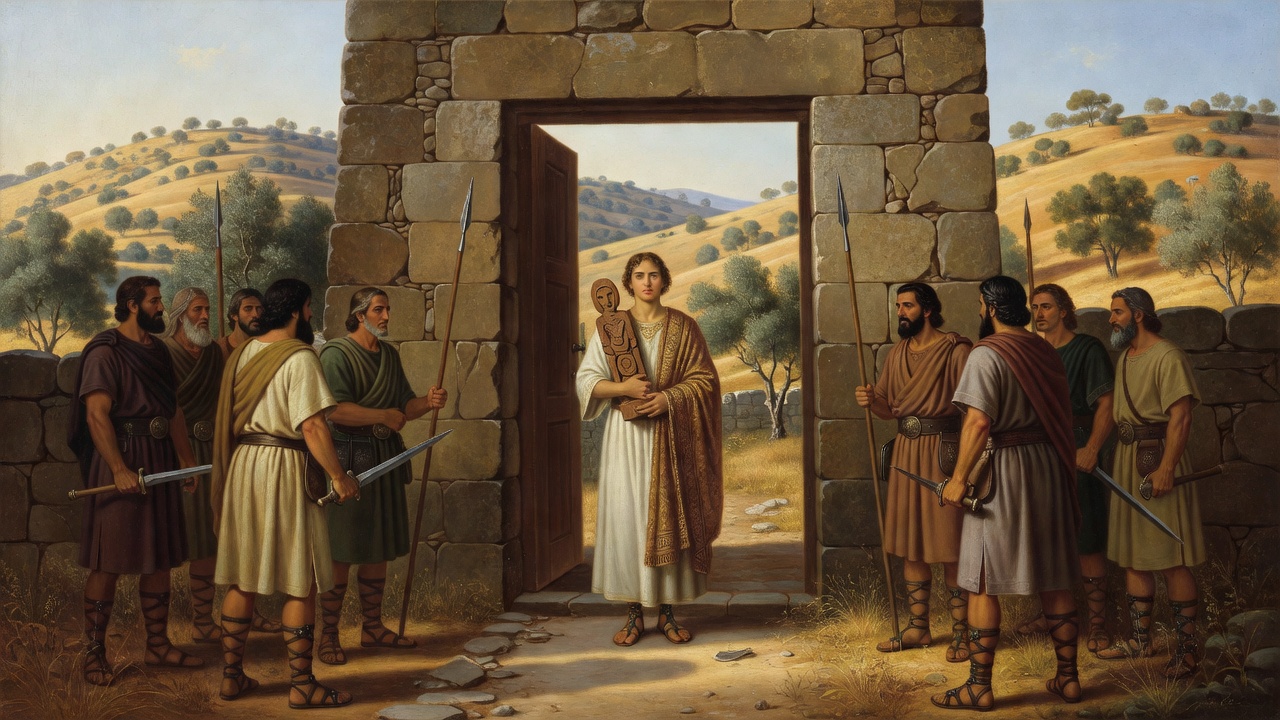
- On their march northward, the Danites confiscated Micah's carved idol, ephod, and household gods, convincing his young Levite priest to join them as tribal priest. At the end of the narrative, the priest is identified as Jonathan, son of Gershom, a descendant of Moses, whose family maintained this northern priesthood for generations.Sources: the Bible text itself · Jonathan · Gershom · Micah
- The six hundred armed Danites mobilized from the towns of Zorah and Eshtaol. Their temporary encampment west of Kiriath-jearim in the territory of Judah became known as Mahaneh-dan, which means 'Camp of Dan.'Sources: the Bible text itself · Mahaneh-dan · Zorah · Eshtaol
Notes written with AI assistance from open sources (Theographic Bible Metadata, CC BY-SA 4.0; Easton’s Bible Dictionary, public domain) and reviewed before publishing.
Places in this chapter
- Aram · 33.511, 36.306 · verses 7, 28
- Dan · Today: Tel Dan · 33.249, 35.652 · verses 7, 14, 27, 29
- Sidon · Today: Sandikli archaeological site in Sidon · 33.561, 35.372 · verses 7, 28
- Kiriath-jearim · Today: Deir el Azar · 31.809, 35.104 · verse 12
- Shiloh · Today: Khirbet Seilun · 32.056, 35.290 · verse 31
Only places identified with high confidence are shown (90% or more according to the scholarly sources compiled by OpenBible). Period map: DARE (Digital Atlas of the Roman Empire), CC BY 4.0; modern map: © OpenStreetMap contributors; places: OpenBible.info (CC BY 4.0).
Credits and license for this translation
Paipel
The Holy Bible in the Chuukese language of the Federated States of Micronesia
copyright © 1984, 1989, 1991, 2001 Liebenzel Mission
Language: Chuukese
Translation by: Liebenzell Mission
Old Testament © 1989, 2001 Liebenzel Mission
New Testament © 1984, 1991 Liebenzel Mission
This translation is made available to you under the terms of the
Creative Commons Attribution-No Derivatives license 4.0.
You may share and redistribute this Bible translation or extracts from it in any format, provided that:
You include the above copyright and source information.
You do not make any derivative works that change any of the actual words or punctuation of the Scriptures.
Pictures included with Scriptures and other documents on this site are licensed just for use with those Scriptures and documents.
For other uses, please contact the respective copyright owners.
2024-01-24
Source: http://ebible.org/chk/ · eBible.org