Hosea 10
Paipel · Tap a verse to see its cross-references.
1Chon Israel ra wewe ngeni efoch irän wain mi mwuresires o ua. Lupwen a chomongola uar, ra pwal senätä chomong rongen asor. Lupwen fanüer a öchüla, ra pwal aöchüla ar kewe ür mi pin ra fel ngeni. 2Leluker a atuputup. Iei repwe angei liwinin ar tipis. Ewe Samol mi Lapalap epwe ataetiu ar kewe rongen asor o ataela ar kewe ür mi pin.
3Mürin ekewe aramas repwe apasa, “Esap wor ach king, pun sisap niuokusiti ewe Samol mi Lapalap. Nge met eman king epwe tongeni föri fän itach?” 4Ra chök fos pön o föri pwonen atipeeu fän akapelmwäl. Iei mine pwüng a wiliti pwüngingau, a märitä usun fetil mi poison lon eu mälämäl mi tu. 5Ekewe chon Samaria repwe niuokus fän äsengesin ewe uluulun nienifön kow mi nom Pet-awen. Repwe letipeta pokitan, nge ekewe souasor mi angang ngeni ewe uluulun anümwäl repwe kechüeiti lingan, pun a oola seniir. 6Ewer, repwe uweela ewe uluulun anümwäl ngeni Asiria pwe eu lifang ngeni ewe king mi lap. Chon Israel repwe itengau me säw ren ar we uluulun anümwäl. 7Ewe kingen Samaria epwe maanüla usun taronumo a maanüla won matau. 8Ekewe lenien fel won ekewe leni tekia mi nom Awen, ewe ia chon Israel ra tipis me ie, repwe tala. Iräfölüföl me pötöwölingau repwe märitä won ar kewe rongen asor. Mürin ekewe aramas repwe üreni ekewe chukutekia, “Oupwe pwölükeemila,” repwe pwal üreni ekewe chukutekison, “Oupwe turutiu wom.”
9Iwe, ewe Samol mi Lapalap a apasa, “Chon Israel ra chök sopwela le tipis ngeniei seni ewe fansoun ra tipis me lon Kipea. Iei mine maun epwe tori ekewe chon föföringau me lon Kipea. 10Lupwen üa mochen apwüngüür, üpwe chök apwüngüür. Chon ekewe mwü repwe chufengen o maun ngeniir, pwe repwe apwüngüür fän iten ar tipis mi chomong.
11Israel a wewe ngeni eman nienifön kow mi sile angang, a fokun efich ewe angangen wichiwich umwun wiich. Nge iei üpwe uwätä efoch waas won üan mi mürina pwe epwe molotä ngeni angang weires. Juta epwe tuw pwül, nge Israel epwe asosonöchü ewe pwül. 12Oupwe tuw ämi pwül esamwo tu me mwan. Oupwe amora pwüng fän itemi pwe oupwe kini ewe ua tong ellet. Pun a tori fansoun ämi oupwe kütta ewe Samol mi Lapalap tori epwe war o awarato manau womi.
13Nge ämi oua fotuki föföringau o kini föföringau. Oua mongö uän ämi chofana. Pokiten oua eäni apilükülük wämi woken me chomongun nöümi sounfiu, 14iei mine maun epwe tori nöümi aramas, nge ämi kewe imwen maun mi pöchökül meinisin repwe tala. Epwe usun ewe fansoun Salman a ataela Pet-arpel, lupwen a maun ngeni o atatakisi ekewe inelap fengen me nöür. 15Iei usun epwe fis ngenikemi, ämi chon Petel, pokiten ämi föföringau mi fokun watte. Lupwen ewe maun epwe popuetä, ewe kingen Israel epwe mäla.”
Did you know?
Judgment on Idols and Broken Altars
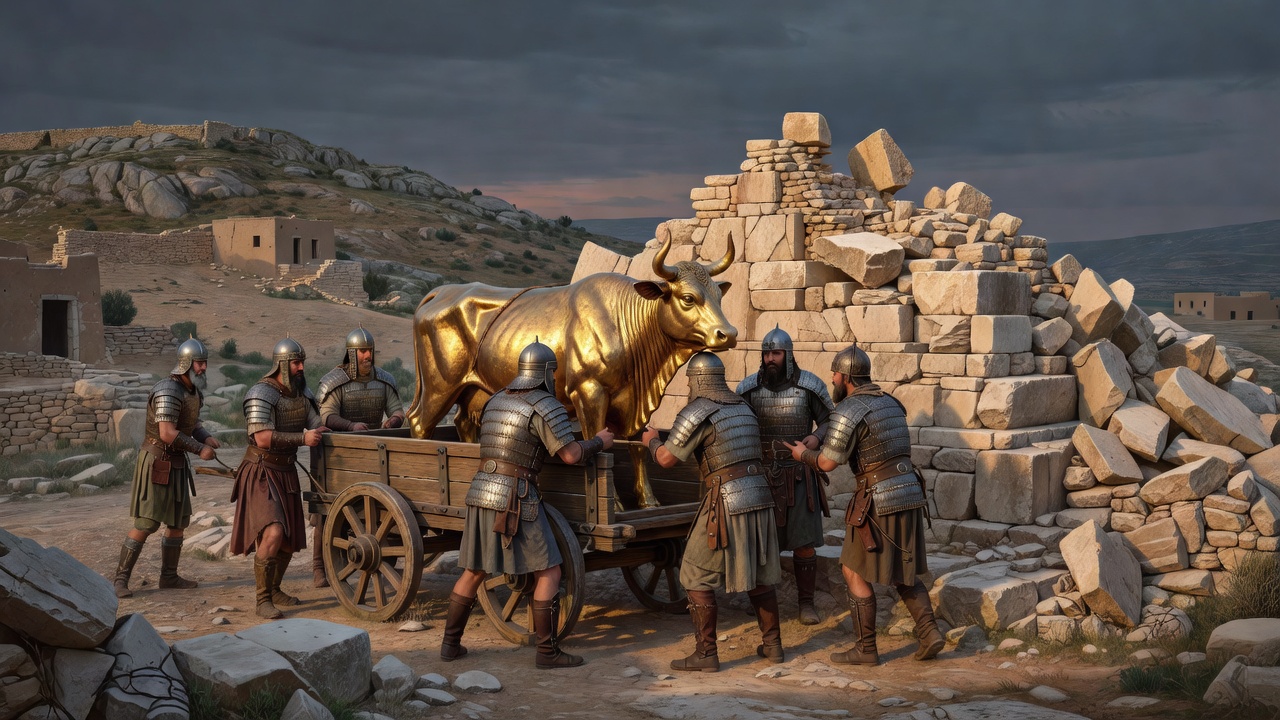
- The prophet refers to Bethel, which means house of God, by the derogatory name Beth-aven, meaning house of nothingness or house of idols. This wordplay highlights how the calf shrine erected there transformed a sacred site into a center of idolatry, whose revered calf would eventually be carried away to Assyria.Sources: Beth-aven · the Bible text itself
- Hosea evokes the days of Gibeah to remind Israel of a historic moral catastrophe recorded in Judges 19 and 20, where horrific violence in the town of Gibeah led to a disastrous civil war against the tribe of Benjamin.Sources: Gibeah · the Bible text itself
- The text warns of devastating military defeat by citing the ruin of Beth-arbel by Shalman. Scholars generally identify Shalman with the Assyrian monarch Shalmaneser, whose brutal conquests served as a vivid warning to Israel.Sources: Beth-arbel · Shalmaneser · the Bible text itself
Notes written with AI assistance from open sources (Theographic Bible Metadata, CC BY-SA 4.0; Easton’s Bible Dictionary, public domain) and reviewed before publishing.
Places in this chapter
- Beth-aven · Today: Beitin · 31.923, 35.241 · verse 5
- Samaria · 32.276, 35.195 · verses 5, 7
- Assyria · 36.359, 43.153 · verse 6
Only places identified with high confidence are shown (90% or more according to the scholarly sources compiled by OpenBible). Period map: DARE (Digital Atlas of the Roman Empire), CC BY 4.0; modern map: © OpenStreetMap contributors; places: OpenBible.info (CC BY 4.0).
Credits and license for this translation
Paipel
The Holy Bible in the Chuukese language of the Federated States of Micronesia
copyright © 1984, 1989, 1991, 2001 Liebenzel Mission
Language: Chuukese
Translation by: Liebenzell Mission
Old Testament © 1989, 2001 Liebenzel Mission
New Testament © 1984, 1991 Liebenzel Mission
This translation is made available to you under the terms of the
Creative Commons Attribution-No Derivatives license 4.0.
You may share and redistribute this Bible translation or extracts from it in any format, provided that:
You include the above copyright and source information.
You do not make any derivative works that change any of the actual words or punctuation of the Scriptures.
Pictures included with Scriptures and other documents on this site are licensed just for use with those Scriptures and documents.
For other uses, please contact the respective copyright owners.
2024-01-24
Source: http://ebible.org/chk/ · eBible.org