Ezekiel 46
Paipel · Tap a verse to see its cross-references.
1Iei alon Kot ewe Samol mi Lapalap, “Asamalapen ewe leni mwen Imwenfel mi sape ngeni ötiu epwe kapüngüla lupwen ekewe wonu ränin angang, nge epwe sukula lon ränin sapat, pwal lon ränin chulapen popun maram. 2Iwe, ewe samol epwe tolong me lon kengkangen ewe asamalap mi sape ngeni ewe leni lükün Imwenfel o ütä ren üran, nge ekewe souasor repwe eäni än ewe samol asoren kek, pwal an kewe asoren kilisou. Iwe ewe samol epwe fel ngeni Kot me lon ewe asamalap. Mürin epwe towu, nge ewe asamalap esap kapüngüla tori lekuniol. 3Iwe, lon iteiten ekewe ränin sapat, pwal lon iteiten ekewe ränin chulapen popun maram, aramasen ewe fanü repwe fel ngeni ewe Samol mi Lapalap mwen ewe asamalap. 4Nge lon ränin sapat än ewe samol asoren kek ngeni ewe Samol mi Lapalap epwe wonoman apanen sip, pwal eman ätemwänin sip esap wor terir. 5Iwe, epwe apacha ngeni ewe ätemwänin sip pilawa mi amas ükükün ilik paun, nge ngeni iteiten ekewe apanen sip epwe apacha ükükün an mochen fiti ülüngat kuoch apüra seni föün olif fän iten iteiten ilik paun pilawa mi amas, pwe asoren mongö. 6Nge lon ränin chulapen popun maram ewe samol epwe eäni asor eman nienifön ätemwänin kow, pwal wonoman apanen sip me eman ätemwänin sip esap wor terir. 7Iwe, epwe apacha ngeni iteiten ätemwänin kow me ätemwänin sip pilawa mi amas ükükün ilik paun, nge ngeni iteiten ekewe apanen sip epwe apacha ükükün an mochen fiti ülüngat kuoch apüra seni föün olif fän iten iteiten ilik paun pilawa mi amas pwe asoren mongö. 8Lupwen ewe samol epwe tolong, epwe chök tolong me lon kengkangen ewe asamalap, epwe pwal towu chök me lon.
9Iwe, aramasen ewe fanü repwe feito ren ewe Samol mi Lapalap lon fansoun ar kewe chulap mi kefilitä, pwe repwe fel ngeni. Nge wesin ar fel, chokewe ra tolong me lon ewe asamalap mi sape ngeni efeng repwe towu me lon ewe asamalap mi sape ngeni ör, nge chokewe ra tolong me lon ewe asamalap mi sape ngeni ör repwe towu me lon ewe asamalap mi sape ngeni efeng. Iwe, esap wor eman epwe liwiniti ewe asamalap a tolong me lon, nge iteiten eman me eman epwe chök fetal wenewen. 10Lupwen ekewe aramas repwe tolong, ewe samol epwe pwal etiir le tolong, nge lupwen repwe towu, epwe pwal etiir le towu.
11Iwe, lon ekewe rän mi pin me ekewe ränin chulap mi kefilitä, aramas repwe apacha ngeni iteiten ätemwänin kow me ätemwänin sip ilik paun pilawa mi amas fän iten ar asoren mongö, nge ngeni ekewe apanen sip repwe apacha ükükün ar mochen fiti ülüngat kuoch apüra seni föün olif fän iten iteiten ilik paun pilawa mi amas. 12Are ewe samol epwe eäni asor ngeni ewe Samol mi Lapalap eu asoren kek ika asoren kilisou seni püsin letipan, ewe asamalap mi sape ngeni ötiu epwe suk ngeni. Iwe, epwe eäni an we asoren kek ika asoren kilisou usun a föri lon ekewe ränin sapat. Nge wesin an towu, ewe asamalap epwe kapüngüla me mürin.
13Iwe, iteiten lesosor oupwe eäni asoren kek ngeni ewe Samol mi Lapalap eman nienifön sip eu ierin, esap wor terin. 14Iteiten lesosor oupwe pwal eäni asoren mongö ngeni ewe Samol mi Lapalap limu paun pilawa mi amas me eu kuoch apüra seni föün olif, pwe epwe nofitfengen me ewe pilawa. Iei usun pwüngün ewe asor epwe fis iteiten rän, epwe chök pwönüetä tori feilfeilachök. 15Iei usun oupwe eäni asoren kek eman nienifön sip fiti ewe pilawa mi amas me ewe apüra iteiten lesosor. Ei asoren kek epwe fis fansoun meinisin.”
16Iei alon Kot ewe Samol mi Lapalap, “Are ewe samol epwe fang ngeni eman nöün mwän eu fanü seni wisan, ätewe epwe fanüeni ewe fanü. 17Nge are ewe samol epwe fangala eu fanü ngeni eman nöün chon angang, i epwe chök fanüeni tori ewe Ierin Ngasala. Mürin, ewe fanü epwe liwiniti ewe samol, pwe püsin nöün mwän chök repwe fanüeni, pun fanüer me won semer. 18Iwe, ewe samol esap tongeni angei fanüen aramas o asürela seni fanüer. Iwe, mine epwe afanüa ngeni nöün mwän, epwe chök ngeniir seni püsin fanüan, pwe esap wor eman lein nei aramas kana epwe towu seni fanüan.”
19Mürin, ewe mwän a emwenieilong lon ewe asamalap mi nom lepekin ewe kengkang o emwenieila ren ekewe rum mi pin rumwen ekewe souasor mi sap ngeni efeng. Ikenan üa küna eu leni mi nom lesopun ekewe rum mi sap ngeni lotou. 20Iwe, a üreniei, “Iei ewe leni ia ekewe souasor repwe kuku fituken ekewe mönün asoren amusamusen pupungau me amusamusen tipis ie. Ikei repwe pwal umuni ewe asoren mongö, nge resap uwala och lon ewe leni lükün Imwenfel, pun a pin ngeni aramas.”
21Mürin, ewe mwän a emwenieila lon ewe leni lükün Imwenfel, pwal ngeni lepwokukun me rüanü. Iwe, lon iteiten pwokuku üa küna eu kükün leni. 22Iwe, lepwokukun ewe leni lükün Imwenfel me rüanü a wor leni mi tit langatamer ükükün wone me walu fiit, nge chölaper faik me walu fiit. Nge ekewe rüanü leni ra wewefengen. 23Iwe, lon iteiten ekewe rüanü leni a wor eu tit seni fau pwelin ünükün, nge ünükün me fän ewe tit a wor lenien kuk. 24Mürin, ewe mwän a üreniei, “Ikei ekewe lenien kuk ia ekewe chon angangen lon Imwenfel repwe kuku ekewe mönün asor ie, aramas ra uwato pwe ar asor.”
Did you know?
Worship, Royal Duties, and Temple Kitchens
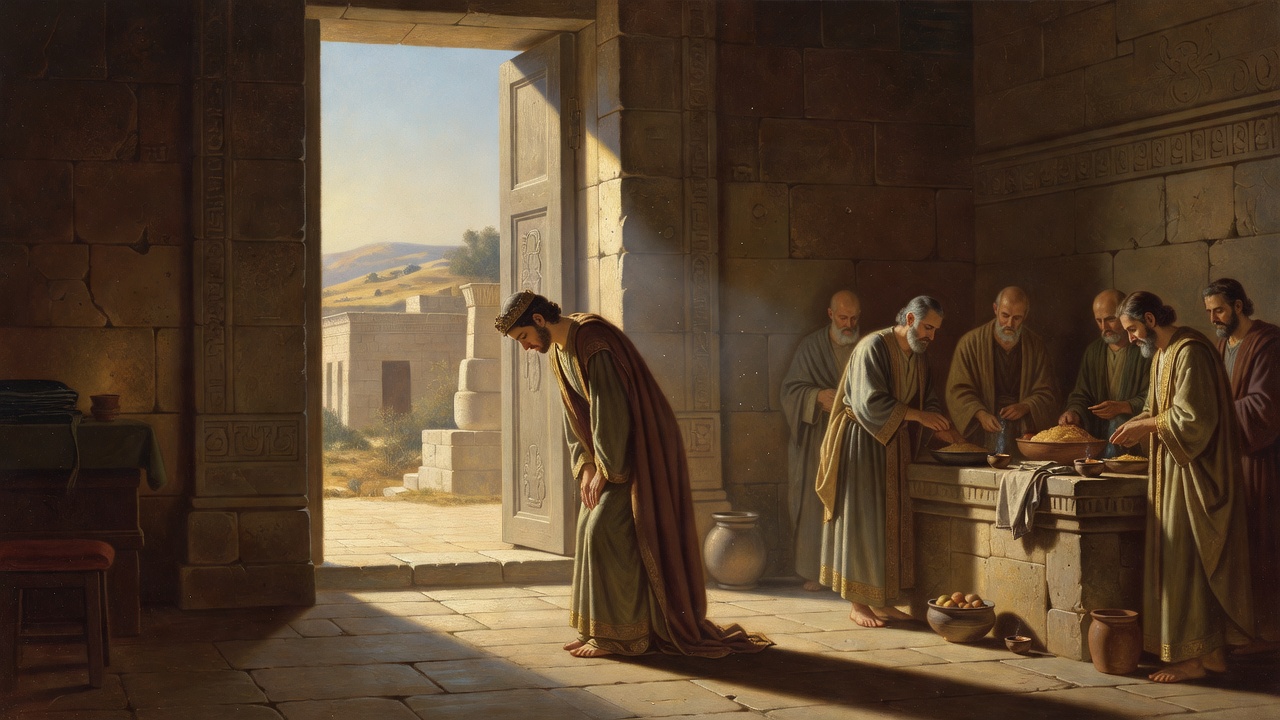
- The east inner gate of the temple was kept shut during the six working days but opened on the Sabbath and New Moon festivals. The prince was instructed to stand by the gatepost and worship at the threshold while the priests offered his sacrifices, after which the gate stayed open until evening.Sources: the Bible text itself
- To regulate worship during the appointed feasts, worshippers entering by the north gate were required to exit through the south gate, and vice versa. Furthermore, property laws strictly prevented the prince from seizing the land of the people, requiring him to provide inheritances only from his own possessions.Sources: the Bible text itself
- The vision details separate cooking areas in the temple complex: special rooms at the western end for priests to boil guilt and sin offerings to avoid transmitting sacredness to the people, and four large enclosed corner courts in the outer court used by temple ministers to cook communal sacrifices.Sources: the Bible text itself
Notes written with AI assistance from open sources (Theographic Bible Metadata, CC BY-SA 4.0; Easton’s Bible Dictionary, public domain) and reviewed before publishing.
Credits and license for this translation
Paipel
The Holy Bible in the Chuukese language of the Federated States of Micronesia
copyright © 1984, 1989, 1991, 2001 Liebenzel Mission
Language: Chuukese
Translation by: Liebenzell Mission
Old Testament © 1989, 2001 Liebenzel Mission
New Testament © 1984, 1991 Liebenzel Mission
This translation is made available to you under the terms of the
Creative Commons Attribution-No Derivatives license 4.0.
You may share and redistribute this Bible translation or extracts from it in any format, provided that:
You include the above copyright and source information.
You do not make any derivative works that change any of the actual words or punctuation of the Scriptures.
Pictures included with Scriptures and other documents on this site are licensed just for use with those Scriptures and documents.
For other uses, please contact the respective copyright owners.
2024-01-24
Source: http://ebible.org/chk/ · eBible.org