Ezekiel 31
Paipel · Tap a verse to see its cross-references.
Farao me nöün aramas repwe feiengau
1Lon engol me aeuin ierin ach oola, lon aeuin ränin ewe aülüngatin maram, ewe Samol mi Lapalap a kapas ngeniei, 2“Nöün aramas, kopwe üreni Farao kingen Isip me nöün mwicheichen aramas:
Iö ka wewe ngeni
lon om ling me itetekia?
3Üpwe awewe ngonuk Asiria.
Me lom a usun efoch irä setar won Lepanon.
Iwe, palen ewe setar ra fokun mwuresires,
a pwal fokun tekia pwe ülülan a tori lein kuchu.
4Ekewe koluk ra achöchönü,
nge kolukun fän pwül a amärätä pwe a tekiatä.
Chanpupu ra pupu ünükün,
nge an kewe öüwö ra pula ngeni ekewe lusun irän lemäl meinisin.
5Iwe, a tekia seni ekewe irän lemäl meinisin,
nge palan ra fokun öümong
o mwuresires pokiten chomongun ewe koluk.
6Ekewe machang meinisin ra fas won palan,
ekewe mönün lemäl ra nöünöü fan,
nge chomong mwü mi tekia ra nonom fän nürün.
7Ewe setar a fokun mürina
ren tekian me langatamen palan,
pun waran ra feitiu tori ekewe kolukun fan.
8Ekewe setar lon tanipin Kot resap mürina seni,
ekewe palen saipires resap wewe ngeni palan,
fasaren ekewe irä plein resap pwal wewe ngeni fasaran.
Ewer, esap wor efoch irä lon ewe tanipin Kot a wewe ngeni lingan.
9Üa alinga pwe a mwuresires,
nge ekewe irän Eten meinisin lon tanipin Kot ra lolowoiti.
10Iei ngang Kot ewe Samol mi Lapalap üa apasa: Pokiten ewe setar a fokun tekia, pwe ülülan a tori lein kuchu, pwal pokiten a lamalamtekia ren tekian, 11üa asechala ngeni eman sounemenemen ekewe mwü. I a wesewesen liwini ngeni ükükün liwinin an föföringau. Ngang üa pöütala, 12nge chon ekis seni ekewe mwü mi fokun eniwokus ra pöküela o likitala. Palan kewe ra turutiu won ekewe chuk, pwal lon ekewe lemol, nge ülün kewe ra kup o turutiu lepekin chanpupun ewe fanü meinisin. Iwe, aramas meinisin won fanüfan ra towu seni fän nürün o likitala. 13Ekewe machang meinisin ra so won ewe irä mi turula, nge mönün lemäl meinisin ra nom lein palan kewe. 14Iei mine esap chüen wor efoch irä mi mär ünükün ekewe koluk epwe tekiatä, pwe ülün epwe tori lein ekewe kuchu. Esap pwal chüen wor irä mi pöchökül ünükün ekewe koluk repwe üwenewenetä o tekia. Pun ir meinisin repwe mäla, repwe feitiu leutun fanüfan ren ekewe somä ren chokewe mi fen feitiu lon lenien sotup.”
15Iei alon Kot ewe Samol mi Lapalap, “Lon ewe rän, lupwen a feitiu lon lenien sotup, üa pwölüela ekewe kolukun fän pwül ren letipeta, üa pwal pinei ekewe chanpupu, pwe resap chüen pula. Iwe, üa pwölüela Lepanon fän rochopwak, nge ekewe irän lemäl meinisin ra pwasala pokitan. 16Üa achecha ekewe mwün fanüfan ren akürangen an tur, lupwen üa aturätiu lon lenien sotup ren chokewe mi fen nom lon. Lon ewe fansoun ekewe irän Eten, pwal ekewe irä mi fokun mürina o chöchön ren üt me won Lepanon mi fen nom leutun fanüfan ra chipila ren an tur. 17Iwe, chokewe mi nom fän nürün me chon pelieni me lein ekewe mwü ra eti le feitiu lon lenien sotup ren chokewe mi mäla lon maun. 18Meni lein ekewe irän Eten ka wewe ngeni lon lingom me om itetekia? Nge pwal en kopwe eti ekewe irän Eten le turutiu leutun fanüfan, kopwe kon lein chokewe resap sirkomsais, pwal lein chokewe ra mäla lon maun. Iei usun mine epwe fis ngeni Farao me nöün mwicheichen aramas,” iei alon Kot ewe Samol mi Lapalap.
Did you know?
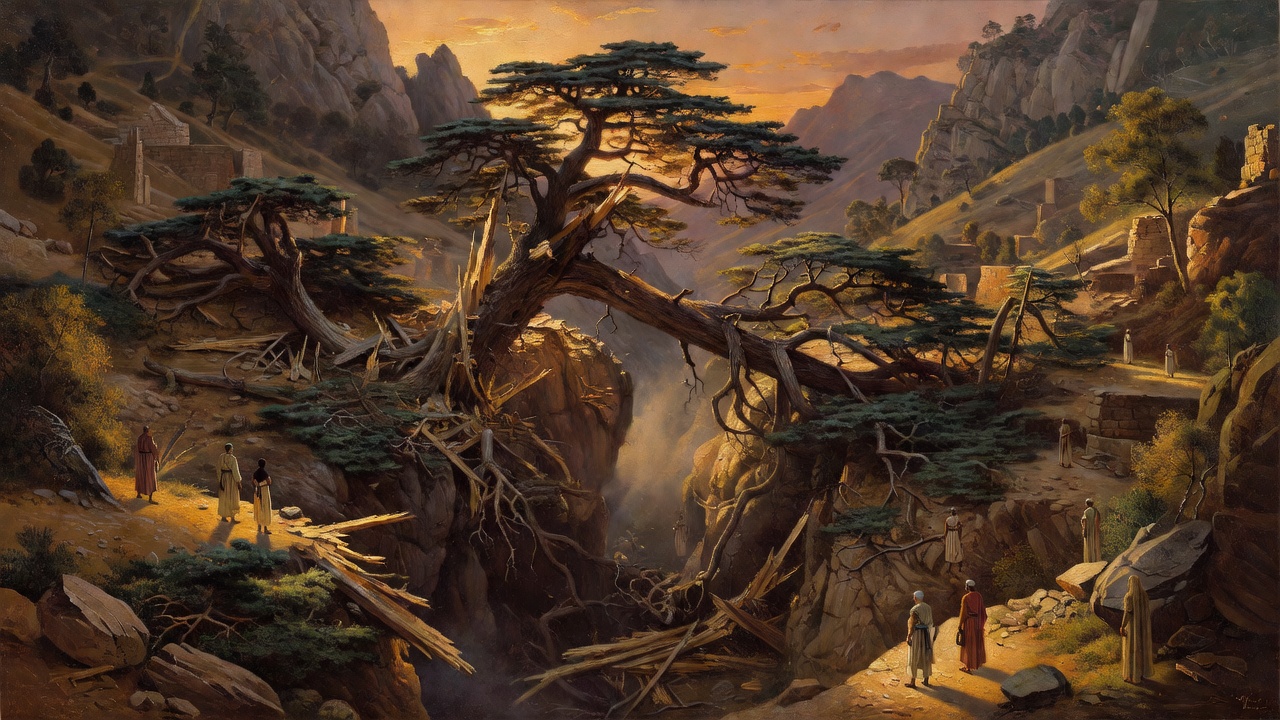
The Fallen Cedar of Lebanon
- Ezekiel employs the metaphor of a towering cedar of Lebanon—a celebrated mountain range in Syria—to illustrate the grandeur and sudden collapse of the Assyrian empire as a direct warning to Pharaoh and Egypt.Sources: the Bible text itself · Lebanon · Assyria · Pharaoh
- The allegory describes the majestic tree as surpassing in height and splendor all the trees in the garden of God, or Eden, an ancient fertile region situated along the great rivers of Western Asia.Sources: the Bible text itself · Eden
- Because of its pride, the great tree is cut down by ruthless foreign conquerors and cast down to Sheol, demonstrating that no worldly empire or ruler is exempt from mortality and judgment.Sources: the Bible text itself · Pharaoh
Notes written with AI assistance from open sources (Theographic Bible Metadata, CC BY-SA 4.0; Easton’s Bible Dictionary, public domain) and reviewed before publishing.
Places in this chapter
- Egypt · 30.129, 31.308 · verses 2, 10, 18
- Assyria · 36.359, 43.153 · verses 3, 15
- Lebanon · 33.540, 35.584 · verses 3, 15, 16
Only places identified with high confidence are shown (90% or more according to the scholarly sources compiled by OpenBible). Period map: DARE (Digital Atlas of the Roman Empire), CC BY 4.0; modern map: © OpenStreetMap contributors; places: OpenBible.info (CC BY 4.0).
Credits and license for this translation
Paipel
The Holy Bible in the Chuukese language of the Federated States of Micronesia
copyright © 1984, 1989, 1991, 2001 Liebenzel Mission
Language: Chuukese
Translation by: Liebenzell Mission
Old Testament © 1989, 2001 Liebenzel Mission
New Testament © 1984, 1991 Liebenzel Mission
This translation is made available to you under the terms of the
Creative Commons Attribution-No Derivatives license 4.0.
You may share and redistribute this Bible translation or extracts from it in any format, provided that:
You include the above copyright and source information.
You do not make any derivative works that change any of the actual words or punctuation of the Scriptures.
Pictures included with Scriptures and other documents on this site are licensed just for use with those Scriptures and documents.
For other uses, please contact the respective copyright owners.
2024-01-24
Source: http://ebible.org/chk/ · eBible.org