2 Kings 2
Paipel · Tap a verse to see its cross-references.
Elias a feitä läng
1Lupwen a tori fansoun pwe ewe Samol mi Lapalap epwe le angeatä Elias läng lon eu ewiniär, Elias me Elisa ra feila seni Kilkal. 2Iwe, Elias a üreni Elisa, “Üa tüngor ngonuk pwe kopwe le nonom ikei, pun ewe Samol mi Lapalap a tinieila Petel.” Nge Elisa a üra, “Mwo manauen ewe Samol mi Lapalap, pwal mwo manauom, üsap likituk.” Iei mine ra mwinela Petel. 3Iwe, eu mwichen soufos mi nom Petel ra feila ren Elisa o üreni, “Ka silei pwe ewe Samol mi Lapalap epwe angei senuk om samol ikenai?” Nge Elisa a üra, “Ewer, üa silei. Nge ousap kapas usun.”
4Mürin, Elias a üreni Elisa, “Üa tüngor ngonuk pwe kopwe le nonom ikei, pun ewe Samol mi Lapalap a tinieila Jeriko.” Nge Elisa a üra, “Mwo manauen ewe Samol mi Lapalap, pwal mwo manauom, üsap likituk.” Iei mine ra mwinela Jeriko. 5Iwe, eu mwichen soufos mi nom Jeriko ra kaneto ren Elisa o üreni, “Ka silei pwe ewe Samol mi Lapalap epwe angei senuk om samol ikenai?” Nge Elisa a üra, “Ewer, üa silei. Nge ousap kapas usun.”
6Mürin, Elias a üreni Elisa, “Üa tüngor ngonuk pwe kopwe le nonom ikei, pun ewe Samol mi Lapalap a tiniela ren ewe chanpupu Jortan.” Nge Elisa a üra, “Mwo manauen ewe Samol mi Lapalap, pwal mwo manauom, üsap likituk.” Iei mine ekewe ruoman ra mwinela. 7Iwe, lime mwän seni ewe mwichen soufos ra pwal feila o ütä ekis toau seni Elias me Elisa, lupwen ekewe ruoman ra ü ünükün ewe chanpupu Jortan. 8Mürin, Elias a angei üfan owokot, a numifengeni o opuli ewe koluk lon ewe chanpupu, pwe ewe koluk a kinikinfesen lon ruu pekin. Iwe, ekewe ruoman ra pwerela won pwasapwas tori epek.
9Mürin ar tori ewe epek, Elias a üreni Elisa, “Kopwe tüngor mine üpwe föri fän itom me mwen än Kot epwe angeei senuk.” Nge Elias a üra, “Üa tüngor senuk kopwe mwüt ngeniei pwe üpwe angei ruu inet seni ngünum.” 10Iwe, Elias a üra, “Om tüngor a weires. Nge are ka künaei, lupwen Kot epwe angeei senuk, epwe fis ngonuk om tüngor. Nge are kosap künaei, esap fis ngonuk.” 11Lupwen ra chüen mwinela o kapasfengen, nengeni, efoch woken mi pulopulen ekkei me oris mi pulopulen ekkei ra aimwüfeseni ekewe ruoman, nge Elias a feitä läng lon eu ewiniär. 12Iwe, Elisa a küna ei lapalap o kökkö, “Semei, semei! Ewe chon peni Israel mi manaman. Iei ka feil senikem.” Iwe, esap chüen küna Elias. Mürin, Elisa a kamwöch püsin üfan o kamweetiu lon ruu kinikin fän an letipeta.
Elisa a siwili Elias
13Iwe, Elisa a angeetiuei üfen Elias we owokot mi tur seni, a liwinla o ütä aropen ewe chanpupu Jortan. 14Mürin, a angei ewe üf, a opuli ewe koluk o üra, “Ifa i ewe Samol mi Lapalap än Elias we Kot?” Iwe, lupwen a opuli ewe koluk, ewe koluk a kinikinfesen lon ruu pekin, nge Elisa a pwerela epek. 15Iwe, lupwen ewe mwichen soufos seni Jeriko ra küna mine Elisa a föri, ra üra, “Ngünün Elias a nom won Elisa.” Ra feito pwe repwe churi, iwe, ra chapetiu lepwül me mwan 16o üreni, “Mi wor ükükün lime mwän mi pöchökül me leim äm noum chon angang. Aia tüngor, kopwe mwüt ngeniir pwe repwe feila o kütta om we samol. A tongeni fis pwe Ngünün ewe Samol mi Lapalap a uwei o likitala won eu lein ekewe chuk ika lon eu lein ekewe lemol.” Nge Elisa a üra, “Ousap tinirela.” 17Nge lupwen ra ariani tori a säw, a üra, “Oupwe tinirela.” Iei mine ra tinala lime mwän. Lon ükükün ülüngat rän ra kütta Elias, nge resap küna. 18Iwe, ra liwinto ren Elisa, lupwen a chüen nonom Jeriko, nge Elisa a üreniir, “Ifa usun, üsap ürenikemi pwe ousap feila?”
19Iwe, ekewe re Jeriko ra feila ren Elisa o üreni, “Äm samol, nengeni, lenien ei telinimw a mürina, usun ka püsin küna. Nge ewe koluk a ngau, iei mine ewe fanü esap up.” 20Iwe, Elisa a üra, “Oupwe uwato rei eu sepi mi fö o uwalong salt lon.” Iei mine ra uwato ren ewe sepi me ewe salt. 21Mürin, Elisa a feila ren puächen ewe koluk, a aturalong ewe salt lon o üra, “Iei alon ewe Samol mi Lapalap, ‘Üa alimöchü ewe koluk. Seni ikenai esap chüen fis mäla ika mwetelan mönükol ren ewe koluk.’” 22Iei mine ewe koluk a limöch tori ikenai, usun Elisa a apasa.
23Mürin, Elisa a feila seni Jeriko tori Petel. Nge lupwen a fetal won al, ekoch kükün ät ra towu seni ewe telinimw, ra ngäri o kökkö, “Kopwe süla, en möküröpan, kopwe süla, en möküröpan.” 24Elisa a kul, nge lupwen a küneer, a anümamaueer fän iten ewe Samol mi Lapalap. Mürin, ruoman liafefinin pear ra towu seni ewe wöllap o atatakisi inisin faik me ruoman me lein ekewe ät, pwe ra mäla. 25Iwe, seni ikenan Elisa a feila ren ewe chuk Karmel, mürin a liwiniti Samaria.
Did you know?
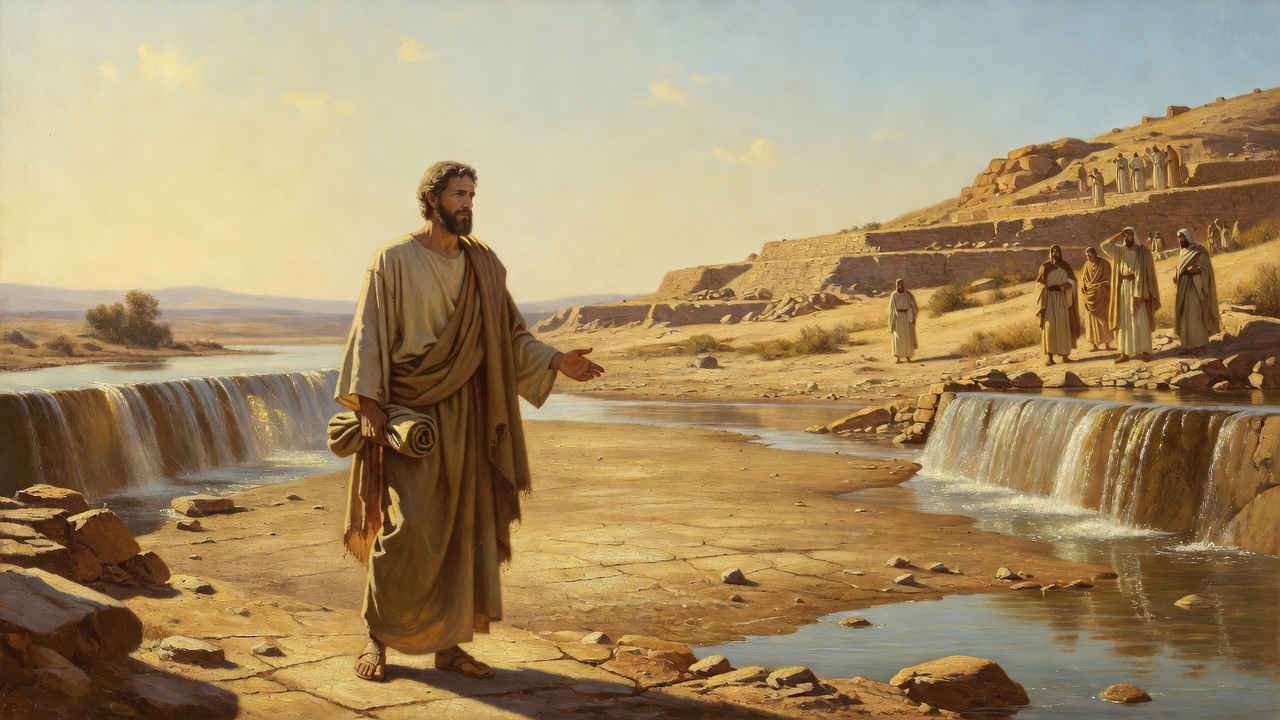
The Departure of Elijah and the Succession of Elisha
- Elijah's rough mantle had first marked Elisha's calling when Elijah threw it over his shoulders in the field. When Elijah was taken into heaven in a whirlwind, Elisha picked up the fallen cloak and struck the Jordan River with it, demonstrating to the watching prophets that he had received Elijah's spirit and succeeded him as prophet.Sources: Elisha · the Bible text itself
- The spring near Jericho, historically identified with Ain es-Sultan or Elisha's Fountain, had unwholesome water that left the surrounding land barren. Elisha purified the water by casting salt from a new bowl directly into the spring.Sources: Jericho · the Bible text itself
- Before crossing the Jordan, Elijah and Elisha visited communities of the sons of the prophets located at Bethel and Jericho. Fifty men from these prophetic groups watched the miraculous crossing from afar and later spent three days searching the surrounding hills and valleys for Elijah.Sources: Bethel (of Palestine) · Jericho · the Bible text itself
Notes written with AI assistance from open sources (Theographic Bible Metadata, CC BY-SA 4.0; Easton’s Bible Dictionary, public domain) and reviewed before publishing.
Places in this chapter
- Jericho · Today: Tell es Sultan · 31.872, 35.445 · verses 4, 5, 15, 18, 19, 23
- Jordan · Today: Jordan River · 31.761, 35.558 · verses 6, 7, 13
- Mount Carmel · 32.672, 35.023 · verse 25
- Samaria · 32.276, 35.195 · verse 25
Only places identified with high confidence are shown (90% or more according to the scholarly sources compiled by OpenBible). Period map: DARE (Digital Atlas of the Roman Empire), CC BY 4.0; modern map: © OpenStreetMap contributors; places: OpenBible.info (CC BY 4.0).
Credits and license for this translation
Paipel
The Holy Bible in the Chuukese language of the Federated States of Micronesia
copyright © 1984, 1989, 1991, 2001 Liebenzel Mission
Language: Chuukese
Translation by: Liebenzell Mission
Old Testament © 1989, 2001 Liebenzel Mission
New Testament © 1984, 1991 Liebenzel Mission
This translation is made available to you under the terms of the
Creative Commons Attribution-No Derivatives license 4.0.
You may share and redistribute this Bible translation or extracts from it in any format, provided that:
You include the above copyright and source information.
You do not make any derivative works that change any of the actual words or punctuation of the Scriptures.
Pictures included with Scriptures and other documents on this site are licensed just for use with those Scriptures and documents.
For other uses, please contact the respective copyright owners.
2024-01-24
Source: http://ebible.org/chk/ · eBible.org