1 Samuel 9
Paipel · Tap a verse to see its cross-references.
Saul a kefilitä pwe epwe king
1Mi wor eman mwän mi pisekisek lon ewe fanü Peniamin itan Kis, i nöün Apiel we mwän, nge Apiel nöün Seror, Seror nöün Pekorat, nge Pekorat nöün Afia seni ewe ainangen Peniamin. 2Iwe, a wor eman mwän itan Saul, i eman alüal mi äteöch. Esap wor eman mwän me lein ekewe aramasen Israel mi äteöch seni, a pwal langatam seni aramas meinisin seni afaran tori ulungen möküran.
3Iwe, a fis pwe ekoch nöün Kis kewe aas ra mwälechela. Iei mine Kis a üreni Saul nöün we, “Kopwe angei eman lein ekewe chon angang pwe epwe etuk le feila kütta ekewe aas.” 4Iei mine ra feila lemenen chukuchukutän ewe fanü Efraim, pwal lemenen ewe fanü Salisa, nge resap küneer. Ra pwal feila lemenen ewe fanü Saalim, nge resap pwal nom ikenan. Mürin, ra feila lemenen ewe fanü Peniamin, nge resap küneer.
5Iwe, lupwen ra tori ewe fanü Suf, Saul a üreni nöün we chon angang, “Sipwe le liwinla, pun semei epwe ükütiu le ekieki ekewe aas, nge ina epwe le aürekikich.” 6Nge ewe chon angang a üreni Saul, “Nengeni, mi wor eman soufos lon ei telinimw, i eman mwän mi iteföüla. Meinisin mine a apasa a fisitä. Sipwe le feila ren. Eli a tongeni pwäri ngenikich ia sipwe tongeni küna ekewe aas me ie. 7Mürin, Saul a üreni nöün we chon angang, “Nge are sipwe feila, met sipwe uwala ren ewe mwän? Pun anach mongö lon ach tuk a it, nge esap wor eu lifang sipwe uwala ren ewe soufos. Iwe, met echök sipwe ngeni?” 8Nge ewe chon angang a üreni Saul, “Iei mi wor rei eföü kükün föün moni silifer. Üpwe ngeni ewe soufos pwe epwe pwäri ngenikich ia sipwe küt ie.” 9Lon Israel me lom, lupwen eman aramas a feila pwe epwe aisini Kot och kapas ais, epwe apasa, “Ousipwe feila ren ewe souwo.” Pun ätewe mi iteni soufos ikenai a iteni souwo me lom. 10Iwe, Saul a üreni nöün we chon angang, “A öch mine ka apasa. Sipwe feila ren.” Iei mine ra feila lon ewe telinimw ia ewe soufos a nom ie.
11Iwe, lupwen ra feitä won ewe chukutekison o feila ngeni ewe telinimw, ra churi ekoch föpwül mi towu seni ewe telinimw pwe repwe üfüf koluk. Ra aisiniir, “Ifa usun, a nom ewe soufos lon enan telinimw?” 12Nge ra pälüeni, “Ewer, a nom. A chök akomwola mwemi. Oupwe müttirila mürin. Iei ekärän chök tolong lon ewe telinimw, pun ekewe aramas repwe eäni ar asor ikenai won ewe lenien fel won ewe chuk. 13Lon ewe otun oupwe tolong lon ewe telinimw, oupwe küna mwen än epwe feitä ren ewe lenien fel pwe epwe mongö. Pun ekewe aramas resap mongö tori epwe war, pokiten i epwe afeiöchü ewe asor. Mürin, chokewe mi kökköto repwe mongö. Oupwe müttir feitä, pun oupwe churi iei chök.” 14Iei mine ra feitä ren ewe telinimw. Nge lupwen ra tolong lon, ra küna Samuel won ewe al pwe epwe towu o feitä ren ewe lenien fel won ewe leni tekia.
15Iwe, ewe rän me mwen än Saul feito, ewe Samol mi Lapalap a fen pwäri ngeni Samuel, 16“Lesor lon ei chök otun üpwe tinala reöm eman mwän seni ewe fanü Peniamin, ätewe kopwe epiti pwe epwe samol won nei kewe aramasen Israel. Epwe amanaua nei aramas seni ekewe chon Filistia. Pun üa küna ar riaföü, nge ar siö a toriei.” 17Nge lupwen Samuel a küna Saul, ewe Samol mi Lapalap a üreni, “Ina i ewe mwän üa kapas ngonuk usun. Iei i ätewe epwe nemenem won nei aramas.” 18Mürin, Saul a kan ngeni Samuel lon asamalapen ewe telinimw o üreni, “Kose mochen aiti ngeniei ia imwen ewe soufos a nom ie.” 19Nge Samuel a üreni Saul, “Ngang ewe soufos. Kopwe akomwotä mwei ren ewe lenien fel, pun ikenai kopwe etiei le mongö. Nge lesosorun lesor üpwe pwäri ngonuk mine a nom lon lelukom o afeilook. 20Nge noum kewe aas mi mwälechela ülüngat rän a la kosap chüen ekieki usur, pun ra pwä. Ifa usun, än chon Israel mochen a weneiti iö? Sap ämi me chon leimwen semom meinisin?” 21Iwe, Saul a aisini, “Ifa usun, sap ngang eman chon Peniamin seni ewe ainang mi chokükün me lein ekewe ainangen Israel? Ifa usun, ai famili sap eu famili mi tekison seni ekewe familien ainangen Peniamin? Pwota ka fos iei usun ngeniei?”
22Mürin, Samuel a emwenala Saul me nöün we chon angang lon ewe lenien mwich o amoteer me mwen chokewe mi kö ina epwe ükükün ilik aramas. 23Iwe, Samuel a üreni ewe chon kuk, “Kopwe uwato ewe kinikinin fituk üa ngonuk me mwan o ürenuk pwe kopwe aimwüela.” 24Iei mine ewe chon kuk a angei pechen ewe mönün asor me mine a pach ngeni o iseni mwen Saul. Nge Samuel a üreni, “Nengeni, iei ewe kinikin a imwüla fän itom. Kopwe mongö, pun a imwüla fän itom tori ei fansoun mi kefilitä pwe kopwe eti ekewe chon kö le mongö.” Iei mine Saul a eti Samuel le mongö lon ewe ränin.
25Iwe, lupwen ra feitiu seni ewe lenien fel o tolong lon ewe telinimw, eu peet a molotä won eu imw fän iten Saul, Iwe, a konola o annut. 26Nge ünümweerän Samuel a kökkötä ren Saul won ewe imw, “Kopwe pwätä pwe üpwe tinukela won om al.” Iwe, Saul a pwätä, nge i me Samuel ra feila won ewe al.
27Iwe, lupwen ra tori lesopolan ewe telinimw, Samuel a üreni Saul, “Kopwe üreni ewe chon angang pwe epwe akomwola mwach. Nge lupwen a feila, en kopwe üla ekis fansoun pwe üpwe asile ngonuk än Kot kapas.”
Did you know?
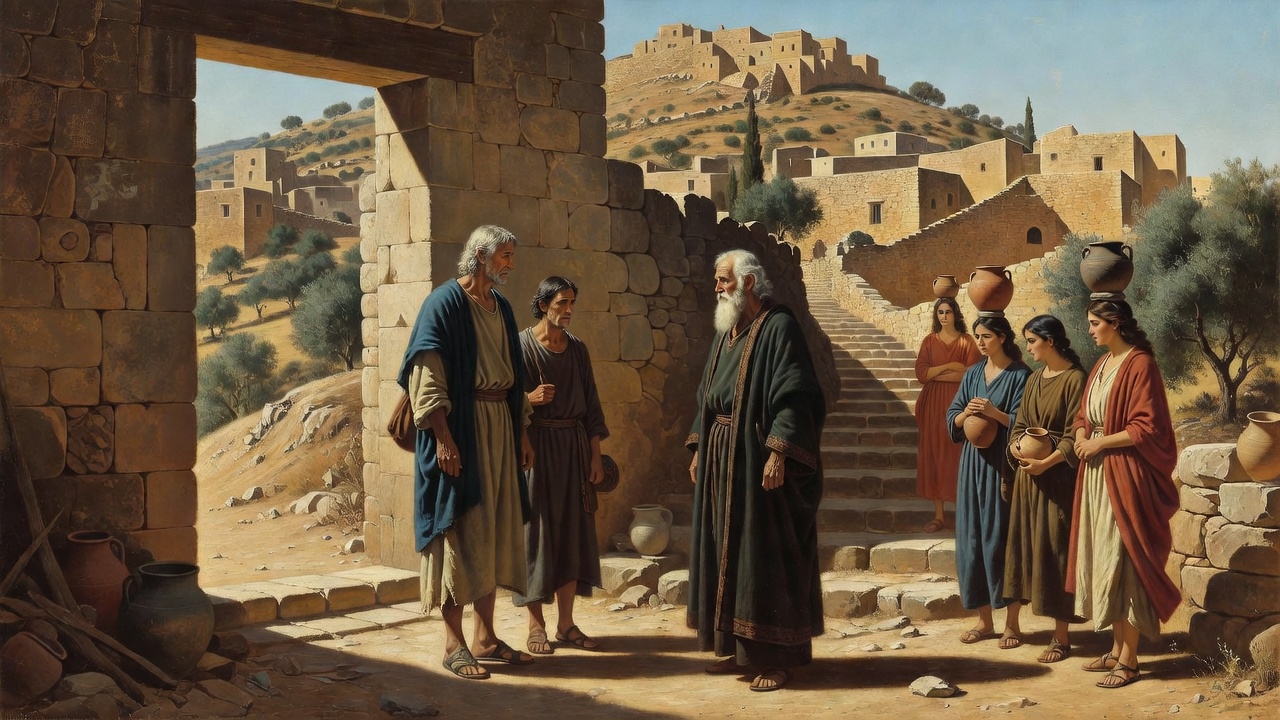
Saul's Search and Meeting with Samuel
- Saul's journey in search of his father's lost donkeys took him through the hill country of Ephraim, the land of Shalishah, the region of Shaalim, and finally to the district of Zuph, where Samuel's hometown of Ramah was located.Sources: the Bible text itself · Saul · Zuph
- The narrative notes that the title 'prophet' had replaced the older term 'seer' by the time the text was written down. Approaching a seer to inquire of God often involved bringing a customary modest gift or token, such as the quarter shekel of silver offered by Saul's servant.Sources: the Bible text itself
- At local sacrificial feasts held on high places, the presiding priest or prophet had to bless the offering before the guests could eat. Samuel honored Saul by seating him at the head of about thirty invited guests and serving him a special reserved portion of meat.Sources: the Bible text itself
Notes written with AI assistance from open sources (Theographic Bible Metadata, CC BY-SA 4.0; Easton’s Bible Dictionary, public domain) and reviewed before publishing.
Credits and license for this translation
Paipel
The Holy Bible in the Chuukese language of the Federated States of Micronesia
copyright © 1984, 1989, 1991, 2001 Liebenzel Mission
Language: Chuukese
Translation by: Liebenzell Mission
Old Testament © 1989, 2001 Liebenzel Mission
New Testament © 1984, 1991 Liebenzel Mission
This translation is made available to you under the terms of the
Creative Commons Attribution-No Derivatives license 4.0.
You may share and redistribute this Bible translation or extracts from it in any format, provided that:
You include the above copyright and source information.
You do not make any derivative works that change any of the actual words or punctuation of the Scriptures.
Pictures included with Scriptures and other documents on this site are licensed just for use with those Scriptures and documents.
For other uses, please contact the respective copyright owners.
2024-01-24
Source: http://ebible.org/chk/ · eBible.org