1 Kings 5
Paipel · Tap a verse to see its cross-references.
Än Salomon pwonen atipeeu ngeni Hairam
1Iwe, lupwen Hairam ewe kingen Tirus a rongorong pwe Salomon a siwili saman we lon wisan wisen king, a tinala nöün chon künö ren. Pun Hairam a fen pwipwi ngeni Tafit. 2Iwe, Salomon a tinala pworaus ren Hairam o üra, 3“Ka silei pwe Tafit semei we esap tongeni aüetä eu imwenfel fän iten ewe Samol mi Lapalap an we Kot, pokiten chon ekewe mwü mi nom ünükün ra maun ngeni, tori ewe Samol mi Lapalap a atolongeer meinisin fän nemenian. 4Nge iei ewe Samol mi Lapalap ai we Kot a fang ngeniei kinamwe lekiännin fanüei meinisin. Esap wor chon oputaei ika och mi afeiengauaei. 5Iei mine üa ekiekin aüetä eu imwenfel fän iten ewe Samol mi Lapalap ai we Kot, usun i a fen üreni Tafit semei we, ‘Noum mwän üpwe seikätä pwe epwe siwiliik lon wisom wisen king, ätei epwe aüetä eu imwenfel fän itei.’ 6Iei mine kopwe tinala noum chon angang, pwe repwe pökü ekewe irä setar won Lepanon fän itei. Iwe, nei kewe chon angang repwe eti noum kewe chon angang, nge ngang üpwe wisen möni noum kewe chon angang won ükükün ewe liwin ka filätä. Pun ka silei pwe esap wor eman me lein nei kewe chon angang a sile fotopen usun ekewe re Siton.”
7Iwe, lupwen Hairam a rongorong alon Salomon, a fokun pwapwa o apasa, “Üpwe mwareiti ewe Samol mi Lapalap ikenai mi fang ngeni Tafit eman nöün mwän mi tipachem, pwe epwe nemenem won ei mwü mi iteföüla.” 8Mürin, Hairam a titila ei pworaus ren Salomon, “Üa rong ewe pworaus ka tinato rei. Üa molotä pwe üpwe föri meinisin mine ka mochen o awora ekewe irä setar me saipires. 9Nei kewe chon angang repwe uwätiu ekewe irä seni Lepanon tori aroset. Iwe, repwe rifengeniir usun ärai, pwe repwe pwer lematau tori ewe leni ka filätä. Ikenan repwe atomwerela, nge noum kewe chon angang repwe angeiir. Nge en kopwe apwönüetä ai mochen ren om kopwe amongöni chon leimwei.” 10Iei mine Hairam a ngeni Salomon ekewe irä setar me saipires won ükükün an mochen, 11nge Salomon a ngeni Hairam ina epwe ükükün ipükü rüe me limungeröü tuk wiich, pwal ina epwe ükükün ipükü engol me limungeröü kalon apüra seni föün olif, pwe enen chon leimwan iteiten ier. 12Iwe, ewe Samol mi Lapalap a ngeni Salomon tipachem usun a pwon ngeni. A wor kinamwe lefilen Hairam me Salomon, nge ir me ruoman ra föri eu pwonen atipeeufengen.
13Iwe, ewe king Salomon a achufengeni eu mwichen chon angangen kinroosi seni lein chon Israel meinisin iteiter ilik ngeröü mwän. 14A kiniir lon ülüngat mwich, eu mwich nge engol ngeröü. A tinala eu mwich pwe epwe angang lon Lepanon lon ükükün eu maram, nge ruu mwich repwe nom lon lenier lon ükükün ruu maram, nge repwe akasiwil. Iwe, Atoniram a wisen nemeni ewe mwichen chon angangen kinroosi. 15A pwal wor ükükün fik ngeröü nöün Salomon chon uwochou me walik ngeröü chon tuw fau lon ewe fanü mi chukuchukutä. 16Lükün ekei chon angang a pwal wor ükükün ülüngat ngeröü ülüpükü souemwenin angang mi nemeniir o tümwünü ewe angang. 17Iwe, fän än ewe king allük ra tuw fau mi watte o mürina, pwe repwe föri longolongun ewe imwenfel ren fau mi fal. 18Iei usun nöün Salomon me nöün Hairam kewe chon kaü imw, pwal ekewe re Kepal ra falei ekewe fau o amolätä ekewe irä, pwe repwe aüetä ewe imwenfel.
Did you know?
Preparations for the Temple
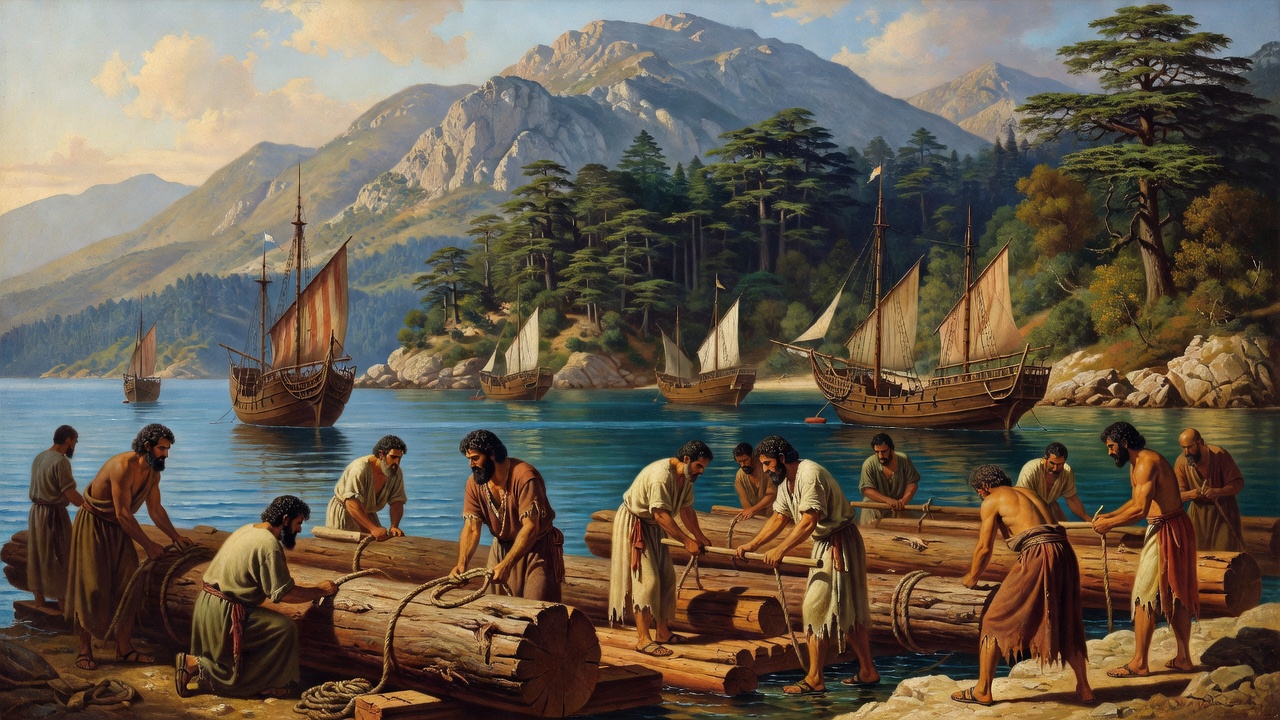
- King Hiram of Tyre, a major Phoenician maritime city, maintained friendly relations with David and entered into a formal treaty with Solomon. In exchange for cedar and cypress timber from Lebanon floated down the coast as rafts, Solomon supplied Hiram's household with annual provisions of wheat and pure olive oil.Sources: Hiram · Tyre · the Bible text itself
- To prepare materials for the temple, Solomon relied on Phoenician craftsmanship, noting the logging skills of the Sidonians. Builders from Tyre and Gebal—an ancient Phoenician coastal city known to the Greeks as Byblos—worked alongside Israelites to quarry large, dressed foundation stones and prepare the timber.Sources: Gebal · the Bible text itself
- Solomon organized a massive labor force for the project, conscripting 30,000 Israelites who served in Lebanon in rotating shifts of 10,000 per month under the supervisor Adoniram. An additional 70,000 transporters and 80,000 stonecutters labored in the mountains, directed by 3,300 foremen.Sources: Adoniram · the Bible text itself
Notes written with AI assistance from open sources (Theographic Bible Metadata, CC BY-SA 4.0; Easton’s Bible Dictionary, public domain) and reviewed before publishing.
Places in this chapter
- Tyre · 33.271, 35.196 · verse 1
- Lebanon · 33.540, 35.584 · verses 6, 9, 14
- Great Sea · Today: Mediterranean Sea · 31.805, 34.170 · verse 9
- Gebal · Today: Byblos · 34.119, 35.646 · verse 18
Only places identified with high confidence are shown (90% or more according to the scholarly sources compiled by OpenBible). Period map: DARE (Digital Atlas of the Roman Empire), CC BY 4.0; modern map: © OpenStreetMap contributors; places: OpenBible.info (CC BY 4.0).
Credits and license for this translation
Paipel
The Holy Bible in the Chuukese language of the Federated States of Micronesia
copyright © 1984, 1989, 1991, 2001 Liebenzel Mission
Language: Chuukese
Translation by: Liebenzell Mission
Old Testament © 1989, 2001 Liebenzel Mission
New Testament © 1984, 1991 Liebenzel Mission
This translation is made available to you under the terms of the
Creative Commons Attribution-No Derivatives license 4.0.
You may share and redistribute this Bible translation or extracts from it in any format, provided that:
You include the above copyright and source information.
You do not make any derivative works that change any of the actual words or punctuation of the Scriptures.
Pictures included with Scriptures and other documents on this site are licensed just for use with those Scriptures and documents.
For other uses, please contact the respective copyright owners.
2024-01-24
Source: http://ebible.org/chk/ · eBible.org