Matthew 9
U Chʼuʼul Tʼan Dios · Tap a verse to see its cross-references.
Jesús sana a un paralítico
1De ya'i ochi aj Jesús tama ni jucub, bixi tunxe nab. C'oti tu cäji. 2Jinq'uin c'oti ya'i, u täsijob bajca an aj Jesús untu winic chämen yoc. U täsijob tu pam u ch'a'liba. Jinq'uin u chäni aj Jesús cache' u totoj tz'onänob, u yälbi ni ajc'ojpan ca'da:
―Ch'a'alesan ajin cä ch'oc. A tanä alaj uti perdona.
3Jinq'uin u yubijob cha'tu uxtu jini que tä' yuwijob ni ley taj Moisésba, u yälijob tan u c'ajalinob ca'da: “Jini winicda u chen uba ca' Dios, y ca' jini u xiq'ue' Dios”. 4Aj Jesús yuwi chich cua' an tu c'ajalinob. U yälbijob ca'da:
―¿Cua' uc'a u te ta' c'ajalinla cua' chichca jini mach utz? 5¿Caxcamba jiq'uin más u ch'e' älbintic: “A tanä alaj cherbintet perdona”, o älbintic: “Ch'oyen, chen xämba”? 6Iranla cua' cä xe cä chen uc'a a wina'tanla cache' no'on que sutwänon de winicba cä cänäntan poder tu pancab tuba cä chen perdona u tanä untu.
Jin uc'a aj Jesús u yälbi najc'ojpan ca'da:
―Ch'oyen, ch'ä a ch'a'lib y corre cux ta' wotot.
7De ya'i ni ajc'ojpan ch'oyi y bixi tu yotot. 8Jinq'uin u chänijob ni gente cua' uti, tajch'icwäni u jutob. U ch'u'ul c'ajti'inob Dios, uc'a Dios u yäc'bi winic u poder tuba u tz'äcälin ni ajc'ojpan jini.
Jesús llama a Mateo
9Tu pase aj Jesús ya'i u chäni untu winic u c'aba' aj Mateo, ya' chumu tama ump'e otot bajca u tojcan derecho. Aj Jesús u yälbi ca'da:
―Tzäypätinon.
Une ch'oyi y u tzäypäti.
10De ya'i aj Jesús chunwäni tä c'uxnan tama ump'e otot. C'otijob täcä q'uen ajcojtaq'uinob y ajcherajtanäjob. Chunwänijob nämte' t'oc aj Jesús y u yajcänt'anob tä c'uxnan. 11Jinq'uin u chänijob aj fariseojob ca' jini, u yälbijob u yajcänt'anob aj Jesús ca'da:
―¿Cuaxca uc'a u c'uxnan a maestrola t'oc ajcojtaq'uinob y ajcherajtanäjob?
12Jinq'uin u yubi aj Jesús ca' jini, u yälbijob ca'da:
―Machcatac t'oc u yutzi, mach c'änä uc'ajob ajtz'ac. Sec' jini machcatac c'ojojtacobba, unejob c'änä uc'ajob ajtz'ac. 13Cuxla jiq'uin, y tic ta' c'ajalinla cua' u yäle' ni t'an a cänila ca'daba: “Ajnic utz a c'ajalinla toc a lotla. Jin une ni más co que ni matän que a subbenonba”. No'onba mach ajulon pancab tuba cä sacän machcatac an tu toja. Ajulon cä sacän machcatac ajcherajtanä tuba cä'ben u q'uexe' u c'ajalinob.
Le preguntan a Jesús sobre el ayuno
14C'oti u yajcänt'anob aj Juan u yälben aj Jesús ca'da:
―¿Cua' uc'a no'on t'ocobba y aj fariseojob mach unnum cä chen su'q'uin t'ocob, y a wajcänt'anobba mach u chejob?
15Aj Jesús u yälbijob ca'da:
―¿U ch'e' quira ajnic ch'oc u pixanob machcatac ya'an bajca an lotojan jinq'uin ajlotojan ya'to an bajca anob? U xe tä c'ote q'uin jinq'uin ajlotojan u xe tä pase bajca anob. Jinq'uintoba u xe u ch'e' u chen su'q'uinob. Ca' jini, jinq'uin ya'to anon t'oc cajcänt'anob, mach u ch'ä u chen su'q'uinob. Pero cuanta bixonba, u xe u chen su'q'uinob.
16’Niuntu mach u tzutzä u jelem buc t'oc tzijib noc', uc'a ni tzijib noc' u xe u yuch'en ja' y u sätz'e' ni jelem buc y más u no'an u xet'ota. Ca' jini mach yo cä xabänla ni u t'an aj fariseojob t'oc ni cä ye'e' no'on badaba. 17Che' chich täcä niuntu mach u yäc'ä chij tzijibba tama ump'e jelem pächil ch'ujliba, uc'a si utic ca' jiniba, u xe tä tzale ni pächil ch'ujliba. De ya'i u wech'can ni chij, y ni pächil ch'ujliba mach u ni' che servi. U yä'can tzijib chij tama tzijib pächil ch'ujliba. Ca' jini u chap'elma mach usat.
La hija de Jairo, y la mujer que tocó la ropa de Jesús
18Aj Jesús mu'to u t'an t'oc ni gente, c'oti untu ajnoja taj judíosob, nocwäni tu pänte' u yälben ca'da:
―Quixic ch'oc atotaj chämi. La'ix ane, äc'ben a c'äb tu pam, y u xe chich tä cuxpan.
19De ya'i ch'oyi aj Jesús, bixi tu pat con to'o u yajcänt'anob. 20Jimba rato jini que bixe to u chenba, c'oti ca'an aj Jesús untu ixic c'ojo t'oc u yaj de ch'ich' que u cänäntan doce año c'ojo t'oc jini yaj. Tutz'i tu pat aj Jesús u tälbi u ti' u buc. 21Uc'a ti tu c'ajalin ni ixic jini ca'da: “Si cä chen trebe namás cä tälben u ti' u bucba, cä xe cä pojlen cäba”. 22De ya'i u suti uba aj Jesús u chänen, u yälbi ca'da:
―Ch'a'alesan ajin cä ch'oc. Uc'a a tz'oni, a pojli aba.
Jinchichba rato jini u pojli uba jini ixic.
23Jinq'uin c'oti aj Jesús tu yotot ni ajnoja taj judíosob, u chäni cache' ya'anob aj ustaj ämäyob y noj q'uenel gente tä bänäcne. 24Aj Jesús u yälbijob ca'da:
―Tz'eje abala. Ni yoc ixocda mach chämen. Wäye u chen une.
De ya'i ni gente cayi u bon tze'tanob. 25Cuantu tz'eji ubajob ni gente, ochi aj Jesús u q'uechbi u c'äb ni yoc ixoc. De ya'i ch'oyi ni yoc ixoc. 26Ni jinda que u chi aj Jesúsba, laj ubqui tama entero ni cab jini.
Jesús sana a dos ciegos
27Jinq'uin pasi aj Jesús ya'i, bixe u chen tä bij, u tzäypäti cha'tu ajchoc'. U pecänob t'oc noj t'an, u yäle'ob ca'da:
―¡Ch'ämbenon t'ocob yajin, ajlo'et taj David, ni reyba!
28Jinq'uin ochi aj Jesús tama ump'e otot, c'otijob ni ajchoc' bajca an. Aj Jesús u yälbijob ca'da:
―¿A tz'onänla quira cache' cä chen trebe cä tz'äcälinetla?
Unejob u p'alijob:
―A chen chich trebe a tz'äcälinon t'ocob ane, Cajnoja.
29De ya'i aj Jesús u tälbi u jutob, u yälbenob ca'da:
―Ca' chich a tz'onänla, che' chich utic t'oc anela.
30Jini ajchoc' seb u laj jäbi uba u jutob y u chi chanäjob. Aj Jesús u c'alin älbijob ca'da:
―Iranla que mach xic yuwina'tan niuntu cache' cä tz'äcäletla.
31Unejobba jinq'uin pasijob, u bon tz'ayquijob cachichcada tama ni cab jini cua' u chi aj Jesús.
Jesús sana a un mudo
32Pase u chen unejob, c'osinti bajca an aj Jesús untu a'uma', que ya'an tzuc pixan tuyac'o. 33Cuanta u pa'säbi aj Jesús ni tzuc pixan tuyac'o ni a'uma', cayi u chen t'an. Ni gentejob que ya'an u chänenobba, tajch'icwäni u jutob, u yäle'ob ca'da:
―Mach bay cä chänila utic cua' chichca ca' jini tä Israel.
34Aj fariseojobba u yäle'ob ca'da:
―Ajnoja tuba tzuc pixanob u yäc'ben u poder u pa'sen tzuc pixan.
Jesús tiene compasión de la gente
35Aj Jesús u nume cachichcada tama upete nuc caj y bit caj u ye'e' u t'an Dios tama ch'uj taj judíosob. U ye'e' jini t'an que u yäq'ue' ch'a'aljin, cache' Dios ni mero ajnoja. U tz'äcälin upete ajc'ojpan tama jini caj t'oc cua' chichca yaj que u cänäntanob. 36Jinq'uin u chäni aj Jesús ni noj q'uenel gente, u ch'ämbi lástimajob, uc'a ya'anob tä tentenbäji, mach yuwi cache'da u numejob, ca' ni ovejajob que mach'an machca u cänäntanobba. 37Aj Jesús u yälbi u yajcänt'anob ca'da:
―Q'uen machcatac yo u yubin u t'an Dios, pero mäx tz'ita' machcatac u ye'e'. Es ca' ni päc'äbi, q'uen chich u jut ayan, y mach'an q'uen ajpatan tuba u ch'uch'än. 38A c'atbenla jiq'uin cä Yumla que u täscun q'uen u yajpatan tuba u ye'e' u t'an, ca' chich u yum päc'äbi c'änä u täscun q'uen u yajpatan tuba u ch'uch'ben u jut ni päc'äbi.
Did you know?
Mercy, Healing, and New Wine
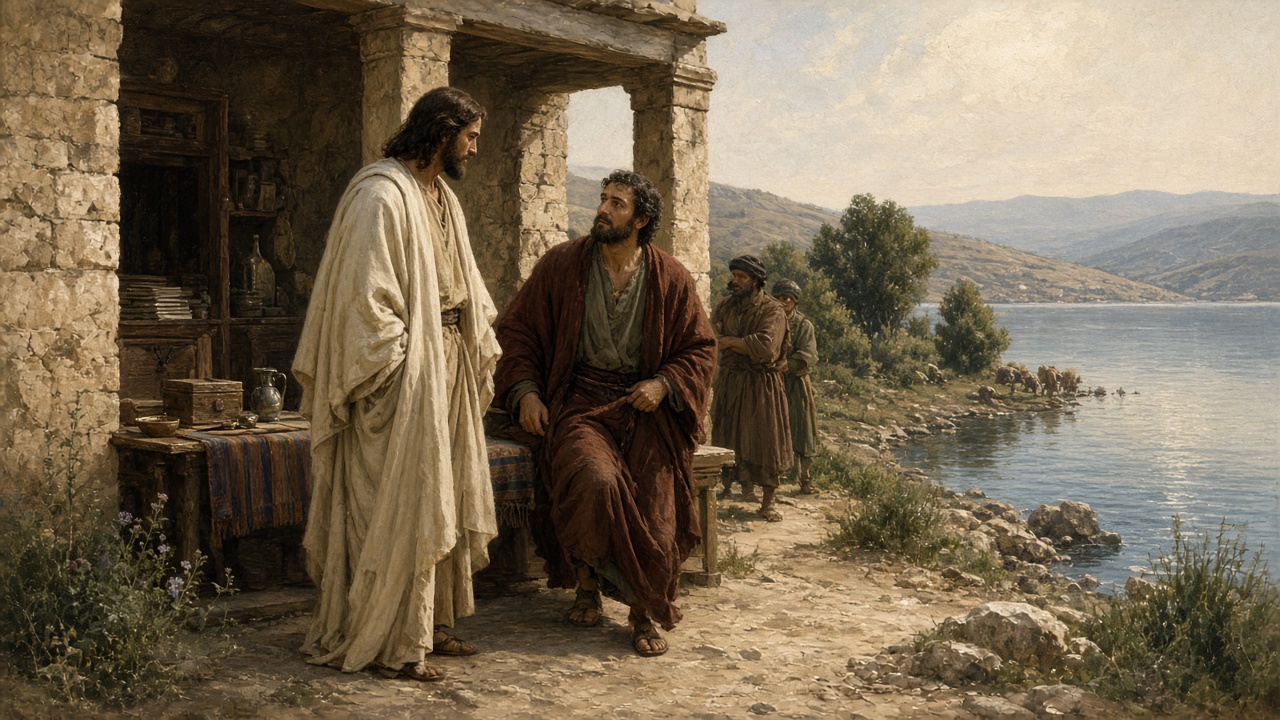
- Matthew, son of Alphaeus, was a publican, or tax collector, at Capernaum. Jesus, coming up from the side of the lake, passed the custom-house where Matthew sat and said, “Follow me.” He had formerly been known as Levi; that same day he gave a great feast, described as a farewell, for Jesus, the disciples, and probably many of his old associates.Sources: Matthew · the Bible text itself
- Those who ask why they and the Pharisees fast so often, while Jesus’ disciples do not, are disciples of John the Baptist. John is called the forerunner; he was of priestly descent, his father Zacharias a priest of the course of Abia and his mother Elisabeth one of the daughters of Aaron.Sources: John the Baptist · the Bible text itself
- One chronology places the healing of the paralyzed man, the call of Matthew, the question about fasting, and the parable of the wineskins in AD 28.Sources: Healing the Man with Palsy · Jesus Calls Matthew · Fasting Question · Parable of the Winseskins
Notes written with AI assistance from open sources (Theographic Bible Metadata, CC BY-SA 4.0; Easton’s Bible Dictionary, public domain) and reviewed before publishing.
Places in this chapter
- Sea of Galilee · 32.819, 35.590 · verse 1
Only places identified with high confidence are shown (90% or more according to the scholarly sources compiled by OpenBible). Period map: DARE (Digital Atlas of the Roman Empire), CC BY 4.0; modern map: © OpenStreetMap contributors; places: OpenBible.info (CC BY 4.0).
Credits and license for this translation
U Chʼuʼul Tʼan Dios
New Testament in Chontal, Tabasco (MX:chf:Chontal, Tabasco)
copyright © 1977 Wycliffe Bible Translators, Inc.
Language: Chontal, Tabasco
Translation by: Wycliffe Bible Translators, Inc.
Chontal, Tabasco [chf], Mexico
Copyright Information
© 1977, Wycliffe Bible Translators, Inc.
This translation text is made available to you under the
terms of the Creative Commons License: Attribution-Noncommercial-No Derivative Works.
( http://creativecommons.org/licenses/by-nc-nd/3.0/ )
In addition, you have permission to port the text to different file formats, as long as you
do not change any of the text or punctuation of the Bible.
You may share, copy, distribute, transmit, and extract portions
or quotations from this work, provided that you include the above copyright
information:
You must give Attribution to the work.
You do not sell this work for a profit.
You do not make any derivative works that change any of the actual words or punctuation of the Scriptures.
Permissions beyond the scope of this license may be
available if you contact
us with your request.
The New Testament
in Chontal, Tabasco
© 1977, Wycliffe Bible Translators, Inc.
This translation is made available to you under the terms of the
Creative Commons Attribution-Noncommercial-No Derivatives license 4.0.
You may share and redistribute this Bible translation or extracts from it in any format, provided that:
You include the above copyright and source information.
You do not sell this work for a profit.
You do not change any of the words or punctuation of the Scriptures.
Pictures included with Scriptures and other documents on this site are licensed just for use with those Scriptures and documents.
For other uses, please contact the respective copyright owners.
2014-04-22
Source: http://ebible.org/chfNT/ · eBible.org