Revelation 6
Lataiquiʼ loyaʼapa iƚe al cʼa lixpicʼepa L̵anDios · Tap a verse to see its cross-references.
1Iya' cahuelonge, aixim'ma Ƚa'hua Moƚ lits'aƚ'ma anuli iƚniya lan caitsi sello. Aicuej'ma tipalay anuli iƚne lam malujxi' lam paxi quinneja, tocomma to muna'a'ma. Ticua: “¡To'huanni!” 2Lijou'ma aixim'ma joupa icuai'ma anuli cal fujca caihuala. Ƚocutsafya ƚaihuala i'noƚi lomf'ants'. Epi'im'me licorona, ipanni tulijcale. Ƚinca ti'hua tulijcalecona'ma.
3Ƚa'hua Moƚ lits'aƚcona'ma ƚocuena sello, aicuej'ma tipalay ƚocuena iƚne lam malujxi' lam paxi quinneja. Ticua: “¡To'huanni!”
4Icuai'ma ƚocuena caihuala. Iƚque ƚaihuala ma' unxali. Iƚque ƚocutsafya epi'im'me limane ti'e'ma tifuleƚe lan xanuc' nomana' li'a ƚamats', tima'a'moƚtsi anuli anuli. Epi'im'me juaiconapa itoqui licutsilo.
5Lijou'ma Ƚa'hua Moƚ its'aƚcona'ma ƚocuena sello. Toƚta'a i'ipa afane' lan sello lits'aƚpola'. Aicuej'ma tipalay ƚocuena iƚne lam malujxi' lam paxi quinneja. Ticua: “¡To'huanni!”
Aixim'ma icuai'ma ƚumi caihuala. Iƚque ƚocutsafya ƚaihuala i'noƚi calxpicoƚma. 6Aicuej'ma tocomma tipalquinni jiƚpe nolojmay pe lomana' iƚne lam malujxi' lam paxi quinneja. Ticuayi: “Ƚinca ti'i'mola' huata cal trigo, lan cebada. Tiƚof'ma liƚpitali. Anuli kilo cal trigo lipitali lolijpa anuli quitine cal xans. Afane' kilo lan cebada lipitali lolijpa anuli quitine cal xans. Timanecu lan oliva laipamma caceite, jouc'a lan 'uva laipamma al vino. Iƚniya aimomints'e'mola'.”
7Lijou'ma Ƚa'hua Moƚ its'aƚcona'ma ƚocuena sello. Toƚta'a i'ipa amalpu' lan sello lits'aƚpola'. Aicuej'ma tipalay ƚocuena quinneja, ticua: “¡To'huanni!”
8Aixim'ma icuai'ma ƚefouc'o ƚaihuala. Tocomma ailopa'a quijuats'. Iƚque ƚocutsafya ƚaihuala lipuftine Lamaya. Ihuequi anuli cuftine Hades. (Toƚta'a lecui'impa jiƚpe pe lomana' lamizhua.)
Iƚque ƚocutsafya ƚaihuala epi'im'me limane ticuxe'ma hualca li'a ƚamats'. Petsi petsi ticuxe'ma hualca. Ni petsi locuxeya iƚque tima'a'mola' lan xanuc'. Hualca tima'aco'mola' acutsilo. Hualca tima'aco'mola' cumemma. Hualca tima'aco'mola' al cuana. Locuenaye tima'a'me lan ximalo quinneja.
9Ƚa'hua Moƚ its'aƚcona'ma ƚocuenaj sello. Toƚta'a i'ipa amaque' lan sello lits'aƚpola'. Aixim'mola' liƚ'alma lapimaye nimanapola'. Iƚniya nepenufpá litaiqui' ȽanDios, uya'a'me, ihuej'me iƚe lataiqui'. Toƚiya ixtuc'om'mola', ima'am'mola'. Iƚniya liƚ'alma timana' al 'ocay jiƚpe al altar. Iƚe al altar ti'onƚcospa to al altar petsi titsufcoyi ȽanDios. 10Iƚniya tija'ayi ujfxi, ticuis'eyi, timiyi ȽanDios: “Ima' maƚPoujna, illanc' omozó. Ima' umPaxi, ima' unȽinca, aimofel'miyale. ¿Te ti'hua ticoƚ'mo'? ¿Te aimaƚ―linc'iyaconga'? ¿Te aimoteƚ'miyacola' iƚne naƚma'aponga'? Iƚne jouc'a liƚf'as xanuc' nomana' li'a ƚamats', ma' anuli liƚ'ejma'.”
11Anuli anuli iƚniya nopalaipá toƚta'a, umim'mola' afujca liƚpijahua'. Timila': “Tehue'e' huata. Ti'hua tulunxajle. Tixhuai'ni'mola' loƚpimaye, iƚniya jouc'a imozó ȽanDios ƚiƚPoujna. Iƚniya jouc'a tima'am'mola'. Tijouƚa' tima'antsola' ƚinca cateƚ'mi'mola' iƚne ninma'ahualepá, jouc'a iƚniya nima'apolhuo' imanc'.”
12Aixim'ma Ƚa'hua Moƚ its'aƚcona'ma ƚocuena sello. Toƚta'a i'ipa acamts'us lan sello lits'aƚpola'. Ife'ne'ma acueca' cunanto. Cal 'ora i'i'ma umi umi, tocomma to lijahua' mipo'noyi nohuotsopá. Ƚitojpa mut'ƚa i'i'ma cunxali to lajuats'. 13Lan xamna nomana' lema'a ecangoƚenca ƚamats'. Iƚe li'ipola' lan xamna ti'onƚcospa to lo'iya ƚi'as 'icux mi'hua'ma ujfxi cahua', tife'ne ƚimané al 'ec, ƚaxhuaica qui'as tecangoƚecu. 14Lema'a ijuis'moxi to anuli al je'e, ijuisquim'me, ejac'e'moxi. Ƚijualay jouc'a ƚamats' isla, jahuay iƚniya iƚonc'em'me. Ailopa'a quipaneya pe lopa'a al te'a. 15Li'ipa toƚta'a jahuay lan xanuc' inulna'me. Emi'moƚtsi lunts'ejay, jouc'a emi'moƚtsi lijualay pe lopa'a lan tsilaj capic'. Iƚne lan xanuc', ja'ni lan rey nocuxepá fa'a li'a ƚamats', ja'ni lan tsilaj xanuc', ja'ni lan tsilaj soldado nocuxepá liƚf'as soldado, ja'ni lan xanuc' ts'iƚ'hueca acueca', ja'ni acueca' quiƚpujfxi, ja'ni notahuaicopá tipa'a ƚiƚpoujnalá, ja'ni ailopa'a quiƚpoujna, jahuay ma' anuli emi'moƚtsi. 16Tipalaic'oyi lijualay jouc'a lan tsilaj capic', timiyi: “Tonlacangoƚenca, alamitsonga'. Aimaƚsim'monga' iƚque Nocutsuya jiƚpe lexpats'qui li'nof'quiya. Aimaƚteƚ'mi'monga' Ƚa'hua Moƚ. Iƚque ixtunni. 17Joupa icuai'ma al Cuecaj Quitine. Iƚne nulemma timuj'me liƚpoyac'. ¿Te naitsi noxnet'ƚya?”
Did you know?
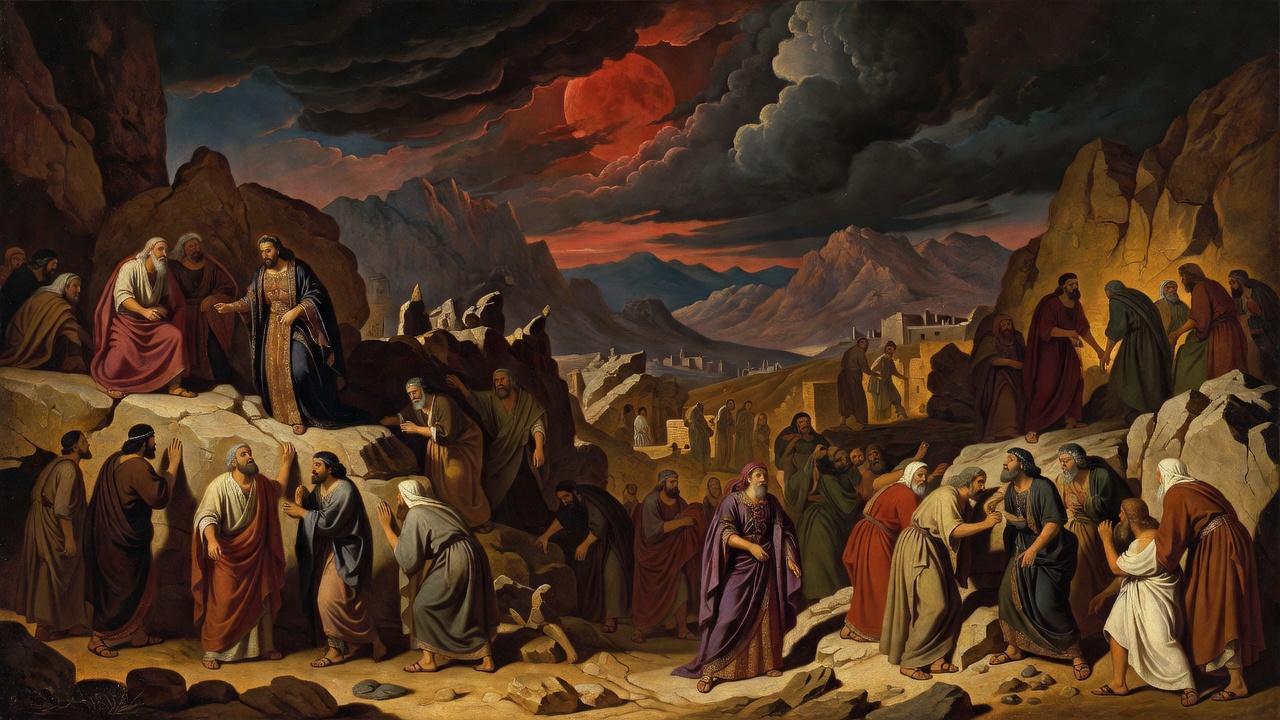
The Opening of the Six Seals
- The first four seals reveal four riders on white, bright red, black, and pale green horses, summoned one by one by the four living creatures. Each horseman brings a distinct affliction across the earth, ranging from conquest and the loss of peace to widespread famine, plague, and death.Sources: the Bible text itself
- The third horseman holds a pair of scales, accompanied by a proclamation setting the price of a quart of wheat or three quarts of barley at a denarius, reflecting severe inflation and food rationing while oil and wine are preserved.Sources: the Bible text itself
- When the fifth and sixth seals are opened, the focus shifts to the souls of slain believers waiting under the altar, followed by immense cosmic and earthly upheavals that lead people of every social station to hide in mountain caves.Sources: the Bible text itself
Notes written with AI assistance from open sources (Theographic Bible Metadata, CC BY-SA 4.0; Easton’s Bible Dictionary, public domain) and reviewed before publishing.
Credits and license for this translation
Lataiquiʼ loyaʼapa iƚe al cʼa lixpicʼepa L̵anDios
New Testament in Chontal, Highland Oaxaca (MX:chd:Chontal, Highland Oaxaca)
copyright © 1991 Wycliffe Bible Translators, Inc.
Language: Chontal, Highland Oaxaca
Translation by: Wycliffe Bible Translators, Inc.
Chontal, Sierra de Oaxaca [chd], Mexico
Copyright Information
© 1991, Wycliffe Bible Translators, Inc.
This translation text is made available to you under the
terms of the Creative Commons License: Attribution-Noncommercial-No Derivative Works.
( http://creativecommons.org/licenses/by-nc-nd/3.0/ )
In addition, you have permission to port the text to different file formats, as long as you
do not change any of the text or punctuation of the Bible.
You may share, copy, distribute, transmit, and extract portions
or quotations from this work, provided that you include the above copyright
information:
You must give Attribution to the work.
You do not sell this work for a profit.
You do not make any derivative works that change any of the actual words or punctuation of the Scriptures.
Permissions beyond the scope of this license may be
available if you contact
us with your request.
The New Testament
in Chontal, Highland Oaxaca
© 1991, Wycliffe Bible Translators, Inc.
This translation is made available to you under the terms of the
Creative Commons Attribution-Noncommercial-No Derivatives license 4.0.
You may share and redistribute this Bible translation or extracts from it in any format, provided that:
You include the above copyright and source information.
You do not sell this work for a profit.
You do not change any of the words or punctuation of the Scriptures.
Pictures included with Scriptures and other documents on this site are licensed just for use with those Scriptures and documents.
For other uses, please contact the respective copyright owners.
2014-04-22
Source: http://ebible.org/chdNT/ · eBible.org