Genesis 25
Yosë nanamën · Tap a verse to see its cross-references.
Apraan Sitoraquë hui'nahuaninsopita
1Apraanso', a'na sa'in ya'huëtaantarin. Inaso', Sitora itopi. 2Inaquënta hui'nahuaantarin. Inaquë hui'ninpitaso': Simiran, Cocosan, Mitan, Matian, Isopa, Soa, inapita. 3Cocosan hui'ninpitaso': Sipa, Titan, inapita. Titan quëran pipipisopitaso': Asororo'sa', nitosoro'sa', niomoro'sa inapita. 4Matian hui'ninpitaso': Ipan, Ihuiri, Anoco, Apitan, Iritan inapita. Ya'ipi inapitaso', Sitora quëran pipipi.
5Na'a hui'ninpita Apraan ya'huëtopirinhuë', Isacoráchin pochin ya'ipi ma'shanënpita, quëtërin. Sitoraquë, Acaraquë hui'nahuaninsopitaso', pi'piyan pi'piyan ma'sha nicanarin. Naporahuaton, nanpiso chachin niquë a'parin. Pi'i pipirinso parti ya'huëcaiso marë' a'parin. Co nohuantërinhuë' Isacorë' napopináchin ya'huëcaiso'.
Apraan chimininso'
7Apraanso ya'ipiya quëran, pasa canchisë shonca a'natërápo pi'i icanin. 8Nani noyá mashoya nipachina, mashori quëparin. Chiminpachina, shimashonënpita, quënancontarin huachi. 9Hui'ninpita: Isaco, Ismairo, inapitari, pa'pitopi. Maquipira naninquë po'mopi. Maquipiraso', sha'huirahuëso chachin, insina nararo Mamiriri hua'anëntërin quëran, pi'i pipirinso parti quëparitërin. Soaro hui'nin Ipron itopisoari, ina no'paso' hua'anëntopirinhuë'. (Inapitaso' itiro'sa'.) 10Ina no'pa chachin iráca Apraan nanpipon itiro'sa', pa'antërin. Inaquë inanta', sa'inco' Sara itopiso' pirayan, po'mopi.
11Apraan chiminpachina, Yosëri Isaco, catahuamiatërin. Inaso Nipicarë chachin: “Nanpiton ni'sárincoso' poso,” itopiso' pirayan, ya'huërapi.
Ismairo quëran pipipisopita
12Sha'huitëranquëmaso chachin, Apraan Acaraquëya hui'nahuanpachina, Ismairo itopi. Acaraso', iquipitoron. Sara piyapinën. Ismairo hui'ninpitaso', isopita: 13Paninantërinso' Nipayo itërin. Ina piquëran niantapisopitaso': Sitaro, Atipiri, Mipisan, Misma, Toma, Masa, Atar, Tima, Quitoro, Nahui, Sitima inapita. 16Ina nápo Ismairo hui'ninpita ya'huëpi. Shonca cato ya'ipiya quëran. A'naya a'naya no'panëna hua'anëntopiso', niapora'piapi. Ya'huëpisonta inapotopi. Naporahuaton, inapitaso inahuara inahuara huëntonënaquë, hua'an ya'conpi.
17Ismairo pasa cara shonca canchisë pi'ipitaso' chiminin. Chiminpachina, pa'pitopi huachi. 18Ismairo quëran pipipisopitaso', Apira parti, Shor parti, inapita partiro'sari ahuancanapirin. Inaquë, no'pa' macatona ya'huëpi. Iquipito notënanquë ya'huëpi. Ina partitaquëchin Iquipito quëran, Asiriaquë ira pa'ninso' na'huërin. Iinpitari, co nohuantopirinahuë', inaquë no'pa' macatona', ya'huëpi huachi.
Isaco hui'ninpita nasitërinso'
19Iporaso Isaco naporinso sha'huichinquëma': Inaso', Apraan hui'nin. 20Catapini shonca pi'ipitaso', sa'arin. Pitoiro hui'nin Nipica itopiso', manin. Inaso yo'in, Napano itopi. Inapitaso' arano'sa itopi. Patan-aran parti ya'huëpi. 21Nipicaso', co nanitërinhuë hua'huanacaso'. Ina marë' Isaco Sinioro nontërin. Napohuachina, nontërinso' natanahuaton, catahuarin ni'ton, Nipica cayorin huachi.
22Catopia'huaya cayoaton, yo'namënquë niahuërapi natanin. Napoaton yonquirin. “Hua'huahuëpita iporaquëranchin niahuërapi ni'quëhuarë': ¿Ma'marëta aquëtë huarë' nanpiiso'?” tënin. Inapochin yonquiaton, Siniorori anitotacaso marë' nontërin. 23Natanpachina, Siniorori itapon:
“Catopia'huaya cayoran.
Inapita shinpita quëran cato nacion pipipon.
Cato huënton nicatona', niahuërápona'.
Ipora shimashonëna co'huara nasichátëraponahuë',
niahuëpiso pochin nicapona'.
A'nara chini chiníquën nanantapon.
Naporahuaton hua'hua nininsoari
masho masho nininso camairápon,” itërin.
24Napoin quëran, Nipica huaicaso nanirin. Catopia'huaya huairin. 25Quëchitërinsoso' quëhuashin aina'huatahuaton, ya'ipi anporotërin. Napoaton Isao itopi. 26Ina pa'taso chachin, iionta', a'na imirin quëran Isao matocanahuaton, hua'huataantarin. Naporinso marë' inaso', Cacopo itopi. Isaco saota shonca pi'ipitaso', hui'ninpita nasitapi.
Isao tëhuërinso'
27Catopia'huaro'sa noya so'sopi. Isaoso' hui'napitahuaton, ma'sha yonicaso pa'yatërin. Míso inantërin. Cacoposo nipirinhuë', co inaporinhuë'. Ya'huëpiquë pa'yatërin ya'huápaso'. 28Isaoso', pa'pini na'con na'con pa'yatërin. Inantërinso capaton, napotërin. Ya'huërë' Nipicaso', Cacopo na'con na'con pa'yatërin.
29A'na tahuëri Cacopo shantë a'itarin. Inapoaso Isaonta', inantapon pa'nin quëran, pa'pi canotërin huënantarin. 30Cacopo a'itërinso ni'sahuaton itapon:
—Nosoroco iya, tana yatëparinco caso'. Quëhuashin cosharo anpiranso', canta quëtoco ca'i, itërin. 31Napotohuachina, Cacopori itapon:
—Paninanquën ni'ton, na'con ya'huëtarinquën canacamaso'. Carinquën nipachin ya'huërëchinquën. Naporo huarë' iso cosharo quëtaranquën, itërin. 32Napotohuachina, Isaoso' tapon:
—Ni'quë iyasha, tana caso yatëpararinco. Chiminpatoso', paninan ninahuëso marë' cana'huaso' ya'huëtërincosopita, topinan quëran nisarin, itërin.
33—Yoscoarë' quëtaranquën itoco nipachin, itaantarin Cacopori. Napotohuachina, “Yoscoarë' quëtaranquën,” itërin. Inapoaton, Isaoso paninan nininso marë' canacaso ya'huëtërinsopita, co pa'yatërinhuë'. 34Naporo huarë' Cacopori, pan acotahuaton, shantë a'itërinsonta o'huintërin. Nani ca'sahuaton, o'osahuaton, Isaoso' pa'nin huachi. Paninan nininso marë' canacaso ya'huëtërinso', co manta pa'tërinhuë pochin nitërin.
Did you know?
Abraham’s heirs and the twin brothers
- Keturah, whose name Easton's Bible Dictionary (1897) explains as “incense,” is introduced here as another wife of Abraham. That dictionary says he probably married her after Sarah’s death, though her nationality is unknown, and notes that 1 Chronicles calls her a concubine. She bore him six sons, including Jokshan and Midian, the father of the Midianites; while Abraham was still alive he gave gifts to the sons of his concubines and sent them away from Isaac to the land of the east.Sources: Keturah · Midian · the Bible text itself
- Isaac and Ishmael together buried Abraham in the cave of Machpelah near Mamre, in the field Abraham had bought from Ephron the Hittite, where Sarah already lay. Easton's Bible Dictionary (1897) explains Machpelah as “portion” or “double cave,” set on a hillside east of Hebron and facing Mamre, a place called the oaks—or, in a margin, the terebinths—of Mamre.Sources: Machpelah · Mamre · the Bible text itself
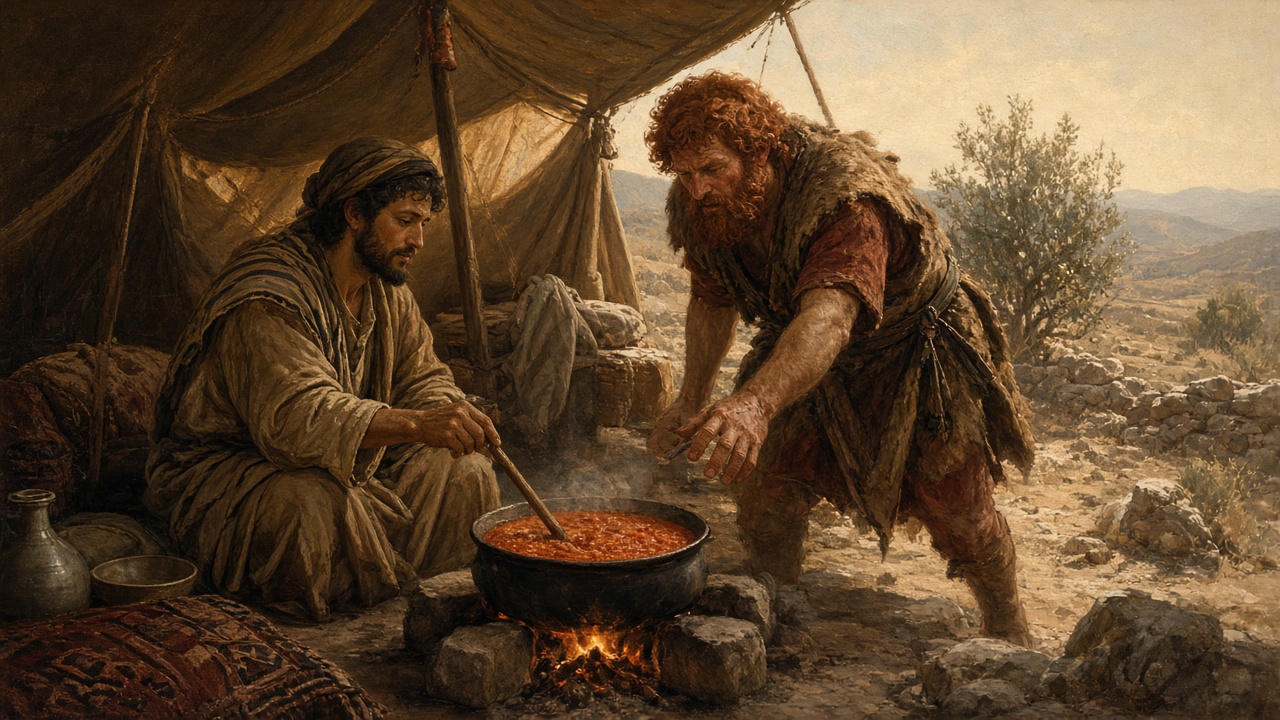
- Esau, Rebekah’s firstborn twin, was born red and covered with hair like a fur coat. Easton's Bible Dictionary (1897) links the further name Edom, “red,” to the red lentil stew for which he sold his birthright, and explains Jacob as “one who follows on another’s heels” or “supplanter,” matching the report that Jacob was born grasping Esau’s heel. Esau grew up as a skillful hunter and a man of the field, while Jacob was a quiet man who stayed at home.Sources: Esau (Edom) · Jacob (Israel) · the Bible text itself
Notes written with AI assistance from open sources (Theographic Bible Metadata, CC BY-SA 4.0; Easton’s Bible Dictionary, public domain) and reviewed before publishing.
Places in this chapter
- East · Today: region around Amman · 31.955, 35.934 · verse 6
- Machpelah · Today: Cave of the Patriarchs · 31.525, 35.111 · verse 9
- Negeb · 31.245, 34.841 · verse 11
- Assyria · 36.359, 43.153 · verse 18
- Egypt · 30.129, 31.308 · verse 18
Only places identified with high confidence are shown (90% or more according to the scholarly sources compiled by OpenBible). Period map: DARE (Digital Atlas of the Roman Empire), CC BY 4.0; modern map: © OpenStreetMap contributors; places: OpenBible.info (CC BY 4.0).
Credits and license for this translation
Yosë nanamën
New Testament in Chayahuita (PE:cbt:Chayahuita)
copyright © 2011 Wycliffe Bible Translators, Inc.
Language: Chayahuita
Translation by: Wycliffe Bible Translators, Inc.
Chayahuita
cbt
Peru
Copyright Information
© 2011, Wycliffe Bible Translators, Inc. All rights reserved.
This translation text is made available to you under the
terms of the Creative Commons License: Attribution-Noncommercial-No Derivative Works.
( http://creativecommons.org/licenses/by-nc-nd/3.0/ )
In addition, you have permission to port the text to different file formats, as long as you
do not change any of the text or punctuation of the Bible.
You may share, copy, distribute, transmit, and extract portions
or quotations from this work, provided that you include the above copyright
information:
You must give Attribution to the work.
You do not sell this work for a profit.
You do not make any derivative works that change any of the actual words or punctuation of the Scriptures.
Permissions beyond the scope of this license may be
available if you contact
us with your request.
The New Testament
in Chayahuita
© 2011, Wycliffe Bible Translators, Inc. All rights reserved.
This translation is made available to you under the terms of the
Creative Commons Attribution-Noncommercial-No Derivatives license 4.0.
You may share and redistribute this Bible translation or extracts from it in any format, provided that:
You include the above copyright and source information.
You do not sell this work for a profit.
You do not change any of the words or punctuation of the Scriptures.
Pictures included with Scriptures and other documents on this site are licensed just for use with those Scriptures and documents.
For other uses, please contact the respective copyright owners.
2014-04-22
Source: http://ebible.org/cbtNTpo/ · eBible.org