Zephaniah 1
A Ch'an Biblia D'a Chuj San Mateo · Tap a verse to see its cross-references.
About this book
About Zephaniah
- Easton's Bible Dictionary (1897) presents Zephaniah, whose name it explains as "Jehovah has concealed" or "Jehovah of darkness," as the son of Cushi and great-grandson of Hezekiah, and as the ninth of the minor prophets. It dates his prophecy to the reign of Josiah, king of Judah (641–610 B.C.), and says he was contemporary with Jeremiah, with whom he had much in common.Sources: Easton: Zephaniah · Zephaniah · Cushi
- Amon, Josiah's father, restored idolatry in Judah, and Easton reads Zephaniah 1:4 and 3:4, 11 as referring to that reign. The same dictionary links Zephaniah 1:4–6 with the worship of Baal and Zephaniah 1:5 with Malcham, described as the national idol of the Ammonites. Josiah, who came to the throne at eight, is presented as later acting against the idolatry that prevailed.Sources: Amon · Josiah · Baal · Malcham
- Easton's Bible Dictionary outlines the book as an introduction announcing judgment on the world and on Israel because of their transgressions (1:1–6), a description of the judgment (1:7–18), an exhortation to seek God while there is still time (2:1–3), judgment on other peoples (2:4–15), what it calls the hopeless misery of Jerusalem (3:1–7), and a promise of salvation (3:8–20).Sources: Easton: Zephaniah
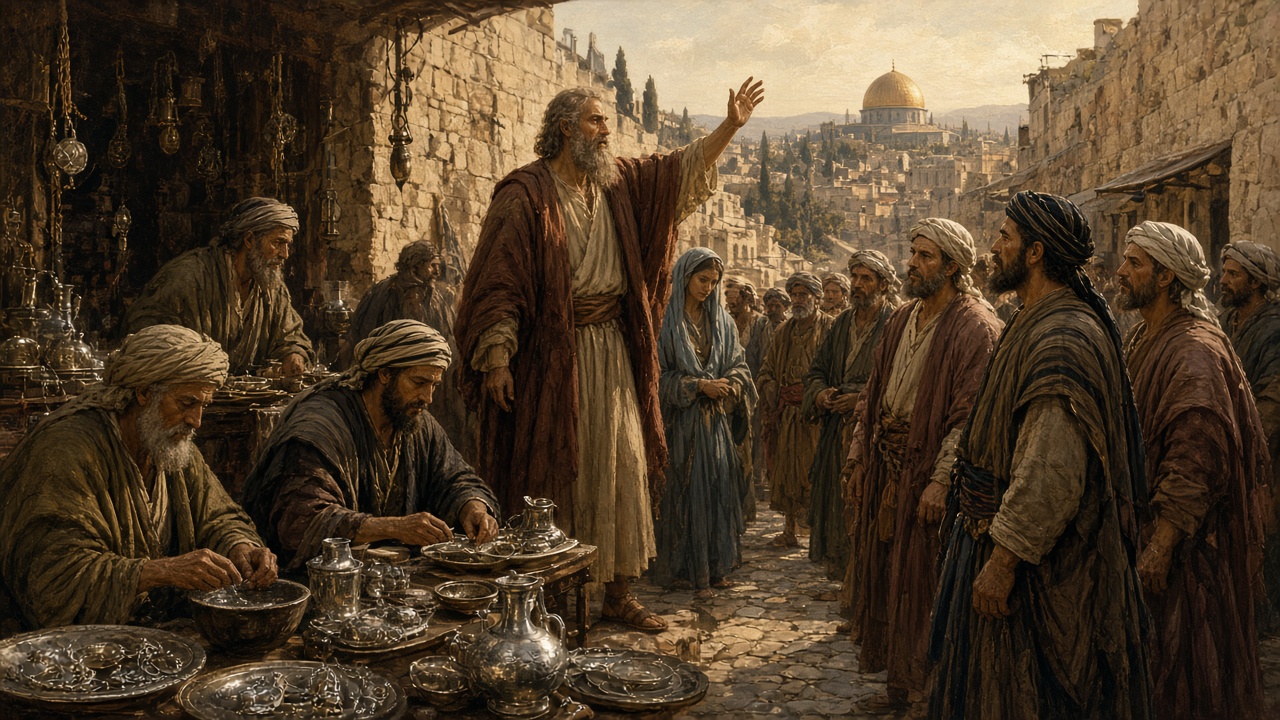
- Zephaniah 1:11 names the Mortar, a place in or near Jerusalem inhabited by silver merchants. It has been conjectured that this was the Phoenician quarter of the city, where traders of that nation lived.Sources: Mortar
Notes written with AI assistance from open sources (Theographic Bible Metadata, CC BY-SA 4.0; Easton’s Bible Dictionary, public domain) and reviewed before publishing.
Sc'ual yoval sc'ol Jehová
1Aton juntzan̈ lolonel tic ix yal Jehová d'ayin Sofonías in tic, yuninal in vin̈aj Cus, yixchiquin in vin̈aj Gedalías yuninal vin̈aj Amarías yuninal vin̈aj Ezequías. Ayic ayoch vin̈aj Josías yuninal vin̈aj Amón reyal d'a Judá, ata' ix lolon Jehová d'ayin.
2A Jehová ix alan d'ayin icha tic: Ol in satel masanil tas ay d'a sat luum tic.
3Ol in satel eb' anima, ol in satel noc' noc', noc' much yed' pax noc' chay. Ol in satel eb' chuc yed' schucal. Ol in satel eb' anima d'a sat lum luum tic.
4Ol vac'och yaelal d'a yib'an̈ chon̈ab' Judá yed' pax d'a yib'an̈ masanil eb' cajan d'a Jerusalén. Ol in satel juntzan̈ b'aj tz'och eb' ejmelal d'a comon dios scuchan Baal d'a jun chon̈ab' tic. Man̈xa b'aj ol checlajcanoc yed' pax sb'i eb' sacerdote ol in sucsatoc.
5Ol in satel eb' sq'ue d'a yib'an̈tac pat lesal d'a masanil tas chequel d'a satchaan̈. Ol in satpaxel eb' tz'em cuman yic tzin yac'an b'inajoc, palta syac'pax b'inaj sdiosal eb' scuch Milcom.
6Ol in satpaxel eb' syiq'uel sb'a d'ayin, aton eb' max yal sb'a d'ayin, eb' max yaq'uem sb'a yic sc'anb'an sb'a d'ayin.
7Numan tzex aj d'a vichan̈ a in Jehová in tic, yujto a sc'ual yoval in c'ool, lac'anxo ay. Toxo ix in siq'uel noc' noc' ol in milcham silab'oc. Toxo pax ix in sic'canel mach avtab'il vael vuuj.
8A d'a jun c'ual chi', ol vac' val och yaelal d'a yib'an̈ eb' yajal yed' d'a yib'an̈ eb' yuninal eb' vin̈ rey yed' pax d'a yib'an̈ juntzan̈xo eb' tz'ac'anoch spichul eb' ch'oc chon̈ab'il.
9Ol vac'och yaelal d'a yib'an̈ eb' tz'ochb'at tz'itnaj d'a yib'an̈ sb'achnub' spuertail templo, eb' syac' b'ud'joc stemplo scomon diosal yed' b'eyumal syic' eb' d'a spatic yelc'umal yed' pax yuj yac'an musansatil eb' yetanimail.
10A d'a jun c'ual chi', ol ab'chaj yel yav anima d'a puerta b'aj tz'och eb' chon̈um chay d'a schab'il macan̈ chon̈ab'. Ol ab'chaj sc'an̈ yel c'acap d'a lum tzalquixtac.
11Avajan̈ec, mach ex cajan ex d'a mercado, yujto masanil eb' chon̈vajum ol chamel eb', masanil eb' tz'ac'an tumin majanil, ol satel eb'.
12A d'a jun c'ual chi', ol in say vil Jerusalén, icha tz'aj saychaj junoc tas satb'at yed' te' tz'ictaj. Ol vac'och yaelal d'a yib'an̈ eb' anima malaj tas sna' ticnaic, lajan eb' icha vino ton̈ej tan̈anem yich, syal eb' icha tic: A Jehová, max yac'cotlaj vach'il d'a quib'an̈, an̈ejtona' man̈ ol yac'paxcotlaj chucal, xchi eb'.
13Yuj chi' a masanil jantac sb'eyumal eb', ol ic'chajec'oc yed' spat eb' ol juchajemoc. Ol sb'oq'ue spat eb', palta man̈oc eb' ol cajnaj d'a yool. Ol yavej yuva eb', palta man̈oc eb' ol uc'an svinoal, xchi Jehová.
14Lac'anxo ay jun sc'ual yoval sc'ol Jehová. Te nivan yelc'och jun c'ual chi'. Lac'anxo ay, yelc'olal sjavi. Ab'ec, a d'a jun c'ual chi', vach'chom eb' soldado te tec'an, ol oc' eb' yuj xivelal.
15A jun c'ual chi', sc'ual yoval sc'ol Jehová, sc'ual yaelal yed' cusc'olal. A d'a jun c'ual chi', ol juvoquel chon̈ab', tz'inini ol ajcanoc, ol q'uic'b'oc q'uinal, q'uic'alq'uinalxon̈ej ol ajoc, ol muslajpaxoc, vevenxon̈ej ol ajcanoc.
16A d'a jun c'ual chi', sc'ual spuchaj q'uen trompeta yic oval yed' yel yav eb' soldado yac'an oval d'a chon̈ab' ayoch smuroal yed' storreal te chaan̈ yajq'uei.
17Syalan Jehová icha tic: Ol vac' val och eb' anima d'a ilc'olal, yuj chi' lajan ol aj sb'eyec' eb' icha sb'eyec' eb' max uji yilani, yujto sic'lab'il ix och schucal eb' d'a vichan̈. A schiq'uil eb', ol b'atcan quib'naj icha lum pococ, axo snivanil eb', toxon̈ej ol q'uecan b'ulan icha stza' noc' noc', xchi Jehová chi'.
18A d'a sc'ual yoval sc'ol Jehová, a q'uen oro yed' q'uen splata eb' anima, man̈xo ol yal scoljiel eb' yuj q'ueen. Yujto a yoval sc'ol chi' ol ac'an satel jun nación tic. Man̈ junipoc ol satel masanil eb' cajan d'a jun nación tic. Icha tz'aj stz'ab'at junoc tas yuj te' c'ac', icha chi' ol aj satel eb'.
Did you know?
The Day of the LORD and Judgment on Idolatry
- Zephaniah traces his lineage back four generations to Hezekiah, dating his prophetic ministry to the reign of King Josiah of Judah. Josiah came to power after his father, King Amon, had restored idolatry across Judah before being assassinated by his own servants.Sources: the Bible text itself · Josiah · Amon · Hizkiah
- The chapter denounces religious syncretism in Jerusalem, where people bowed on rooftops to the host of heaven and combined their devotion to the LORD with oaths to Baal and Malcham, the national idol of the Ammonites.Sources: the Bible text itself · Baal · Malcham
- The prophecy specifies landmarks in Jerusalem that would experience turmoil, including the Fish Gate and the Mortar (or Hollow), a district inhabited by merchants who weighed out silver.Sources: the Bible text itself · Fish Gate · Mortar
Notes written with AI assistance from open sources (Theographic Bible Metadata, CC BY-SA 4.0; Easton’s Bible Dictionary, public domain) and reviewed before publishing.
Places in this chapter
- Jerusalem · 31.777, 35.234 · verses 4, 12
- Fish Gate · Today: in Jerusalem · 31.777, 35.234 · verse 10
- Second Quarter · Today: in Jerusalem · 31.777, 35.234 · verse 10
- Canaan · 32.767, 35.333 · verse 11
- Mortar · Today: in Jerusalem · 31.777, 35.234 · verse 11
Only places identified with high confidence are shown (90% or more according to the scholarly sources compiled by OpenBible). Period map: DARE (Digital Atlas of the Roman Empire), CC BY 4.0; modern map: © OpenStreetMap contributors; places: OpenBible.info (CC BY 4.0).
Credits and license for this translation
A Ch'an Biblia D'a Chuj San Mateo
The Holy Bible in the Chuj San Mateo language of Guatemala
La Santa Biblia en Chuj de San Mateo Ixtatán
copyright © 2007 Sociedad Bíblica de Guatemala
Language: Chuj de San Mateo Ixtatán (Chuj)
Dialect: Ixtatán
Translation by: Wycliffe Bible Translators
This translation is made available to you under the terms of the
Creative Commons Attribution-Noncommercial-No Derivatives license 4.0.
You may share and redistribute this Bible translation or extracts from it in any format, provided that:
You include the above copyright and source information.
You do not sell this work for a profit.
You do not change any of the words or punctuation of the Scriptures.
Pictures included with Scriptures and other documents on this site are licensed just for use with those Scriptures and documents.
For other uses, please contact the respective copyright owners.
2016-06-08
Source: http://ebible.org/cac/ · eBible.org