John 7
Di Nyoo Testiment eena Bileez Kriol · Tap a verse to see its cross-references.
Jeezas breda dehn neva bileev eena ahn
1Afta dat Jeezas gaahn bowt Gyalilee. Ih neva waahn goh da Judeeya dischrik, kaa di Jooish leeda dehn mi-di luk fi wahn chaans fi kil ahn. 2Now da mi nayli taim fi di Jooish selibrayshan weh nayhn di Boot Festival. 3Wel, Jeezas breda dehn tel ahn seh, “Lef ya ahn goh da Judeeya, soh dat yu falowa dehn ku si aala di mirakl dehn weh yu di du; 4kaa nobadi du ting eena seekrit if dehn waahn peepl noa da hoo dehn. Laik how yu di du aala dehn ting deh, den mek evribadi si weh yu di du.” 5Yu si, noh eevn Jeezas oan breda dehn mi bileev eena ahn.
6Jeezas ansa dehn seh, “Noh, da noh taim fi Ai goh yet, bot aal laik unu, unu ku goh enitaim ahn ih noh wahn mek no difrens. 7Di peepl a dis werl noh ga no reezn fi hayt unu, bot dehn hayt mee kaa Ai kohn rait owt ahn tel dehn bowt aala di rang ting dehn weh dehn di du. 8Unu goh hed ahn goh da di selibrayshan. Ai noh gwehn da dis wan kaa mi taim noh kohn yet.” 9Wen ih don seh dat, ih stay da Gyalilee.
10Bot afta ih breda dehn don gaahn da di selibrayshan, Jeezas stil gaan aftawodz, bot ih gaahn seekrit laik, mek nobadi noh si ahn. 11Di Jooish leeda dehn mi-di luk fi si ahn da di selibrayshan ahn dehn mi-di aks, “Da weh da man deh?”
12Lata peepl monks di krowd mi-di taak bowt ahn. Dehn seh, “Ih da wahn gud man.”
Sohn neks wan seh, “Noh, aal hihn di du da fool op di peepl dehn.” 13Bot nobadi neva waahn taak tu haad bowt ahn kaa dehn mi frayd fi di Jooish leeda dehn.
Jeezas teech joorin // di Boot Festival
14Di selibrayshan mi deh bowt haaf way wen Jeezas gaan op da di templ ahn staat tu teech. 15Di Jooish leeda dehn kudn bileev dehn ayz wen dehn yehr ahn, ahn dehn seh, “Da how kom hihn noa soh moch ahn hihn neva gaahn da nobadi fi mek dehn teech ahn?”
16Den Jeezas ansa dehn seh, “Di ting dehn weh Ai di teech da noh fahn mee, bot dehn kohn fahn di Wan weh sen mee. 17If unu reeli waahn obay Gaad, den unu wahn noa weda er nat di ting dehn weh Ai di teech da fahn Gaad er da fi mee oan ting. 18If Ai mi waahn aana maiself, den Ah wuda taak fi mai oanself. Bot Ai waahn aana di Wan weh sen mee. Dat da wai Ai tel di chroot; Ai noh tel lai. 19Da hoo mi gi unu di Laa? Da noh Moaziz? Bot non a unu noh du weh ih seh. Soh da wai unu di luk fi wahn chaans fi kil mee den?”
20Di krowd ansa Jeezas seh, “Yoo mosi ga deeman! Hoo di chrai kil yoo?”
21Jeezas ansa dehn seh, “Ah du wan mirakl pahn di Sabat ahn unu di goh aaf! Bot unu werk pahn di Sabat tu wen unu kohn serkomsaiz unu bwai baybi laik weh Moaziz Laa seh. (Akchwali da laa da neva fahn Moaziz, bot ih goh way bak da unu ansesta dehn bifoa hihn.) Wel, wen di day fi serkomsaiz faal pahn di Sabat, unu stil goh hed ahn serkomsaiz unu baybi jos soh dat unu ku kip di Laa weh Moaziz gi. Soh wai unu wahn beks wid mee kaa Ai heel wahn man hoal badi pahn di Sabat? Noh joj nobadi bai how ting luk, bot joj fyaa-wan!”
Peepl aks if Jeezas da di Krais
25Now som a di peepl dehn fahn Jeroosalem mi-di seh, “Bot dis da noh di man weh dehn di chrai kil? 26Ahn luk how ih deh ya di taak owt eena poblik, ahn nobadi noh di tel ahn notn! Unu tink dat di leeda dehn don noa dat dis da di Krais fi chroo? 27Bot stil, wee noa weh dis man kohn fram; wen di Krais kohn, nobadi noh wahn noa weh ih kohn fram.”
28Den Jeezas hala owt wail ih mi-di teech da di templ, “Unu oanli tink seh unu noa mee, ahn weh Ai kohn fram. Ai noh kohn pahn mai oan, yu noh, bot unu ku chros di Wan weh sen mi. Unu noh noa hihn, bot 29Ai noa ahn, kaa Ai da fahn hihn, ahn da hihn sen mee.”
30Wen Jeezas seh dat, som a dehn chrai ares ahn, bot nobadi neva lay wahn finga pan ahn kaa ih taim neva kohn yet. 31Stil, wahn lata peepl eena di krowd mi bileev eena ahn, ahn dehn mi-di seh, “Wen di Krais kohn, yu tink ih wahn du moa mirakl dahn weh dis man don du?”
32Wen di Farisee dehn yehr weh di krowd mi-di mombl seh bowt Jeezas, dehn ahn di cheef prees dehn sen di templ gyaad dehn fi ares ahn.
33Den Jeezas seh, “Ah oanli wahn deh wid unu wahn lee wail langa, den Ah gwehn bak da di Wan weh sen mi. 34Unu wahn luk fi mi, bot unu noh wahn fain mi; ahn wehpaa Ai gwehn, unu kyaahn kohn.”
35Di Jooish leeda dehn seh tu wan anada, “Da weh dis man meen fi goh, soh dat wee wahn kyaahn fain ahn? Yu meen fi seh, ih gwehn tu dehn Jooz weh liv monks di Greek peepl dehn, ahn teech di Greek dehn? 36Da weh hihn meen wen ih seh, ‘Unu wahn luk fi mi, bot unu wahn kyaahn fain mi,’ ahn ‘Wehpaa Ai gwehn, unu kyaahn kohn’?”
Jeezas taak bowt di // waata weh gi laif
37Pahn di laas day a di selibrayshan weh da-mi di bigis day, Jeezas stan op ahn ih hala owt, “Enibadi weh tersti, mek dehn kohn tu mi ahn jrink. 38If dehn bileev eena mee, lata waata weh gi laif wahn poar owt laik wahn riva fahn deep dong eensaida dehn, jos laik weh di Skripcha seh.” 39Wen Jeezas seh dat, ih mi-di taak bowt Gaad Hoali Spirit weh dehn wan weh bileev eena hihn mi wahn geh. Yu si, op tu den, nobadi neva ga Gaad Hoali Spirit di liv eena dehn, kaa Gaad neva rayz op Jeezas eena aala ih gloari yet.
Di peepl dehn aagyu // bowt Jeezas
40Wen dehn yehr aala dehn ting deh, di krowd seh, “Dis da di Prafit fi chroo.”
41Sohn ada wan seh, “Dis da di Krais.”
Bot som a dehn aks, “Di Krais ku kohn fahn Gyalilee? 42Di Skripcha neva seh dat di Krais kohn fahn King Dayvid famili lain? Ahn ih neva sopoas tu kohn fahn Betlihem, weh da-mi Dayvid hoamtong?” 43Soh divizhan mi deh monks di peepl dehn sayka Jeezas. 44Som a dehn mi waahn ares ahn, bot nobadi neva toch ahn.
45Wen di templ gyaad dehn gaahn bak, di cheef prees ahn di Farisee dehn aks dehn seh, “Wai unu neva ares Jeezas?”
46Di gyaad dehn ansa dehn seh, “Wee neva yehr nobadi taak laik dis man yet!”
47Den di Farisee dehn ansa dehn seh, “Weh hapm, ih ga unu fool tu? 48Unu si eni a di leeda dehn er di Farisee dehn di bileev eena hihn? 49Bot dis krowd weh noh eevn noa Moaziz Laa don kandem aredi eniway.”
50Wan a di Farisee dehn weh mi dehdeh da-mi Nikodeemos. Hihn mi gaahn taak tu Jeezas wahn taim. Ih aks dehn seh, “Fi wee Laa noh mek wi kandem peepl bifoa wi yehr weh dehn ga fi seh, rait? Soh wi kyaahn joj dehn bifoa wi noa weh dehn du.”
52Dehn tel ahn seh, “Soh wat, yoo da fahn Gyalilee tu? Yoo chek di Skripcha, ahn yu wahn si dat no prafit kyaahn kohn fahn Gyalilee.”
53[Afta dat evribadi gaahn hoahn.
Did you know?
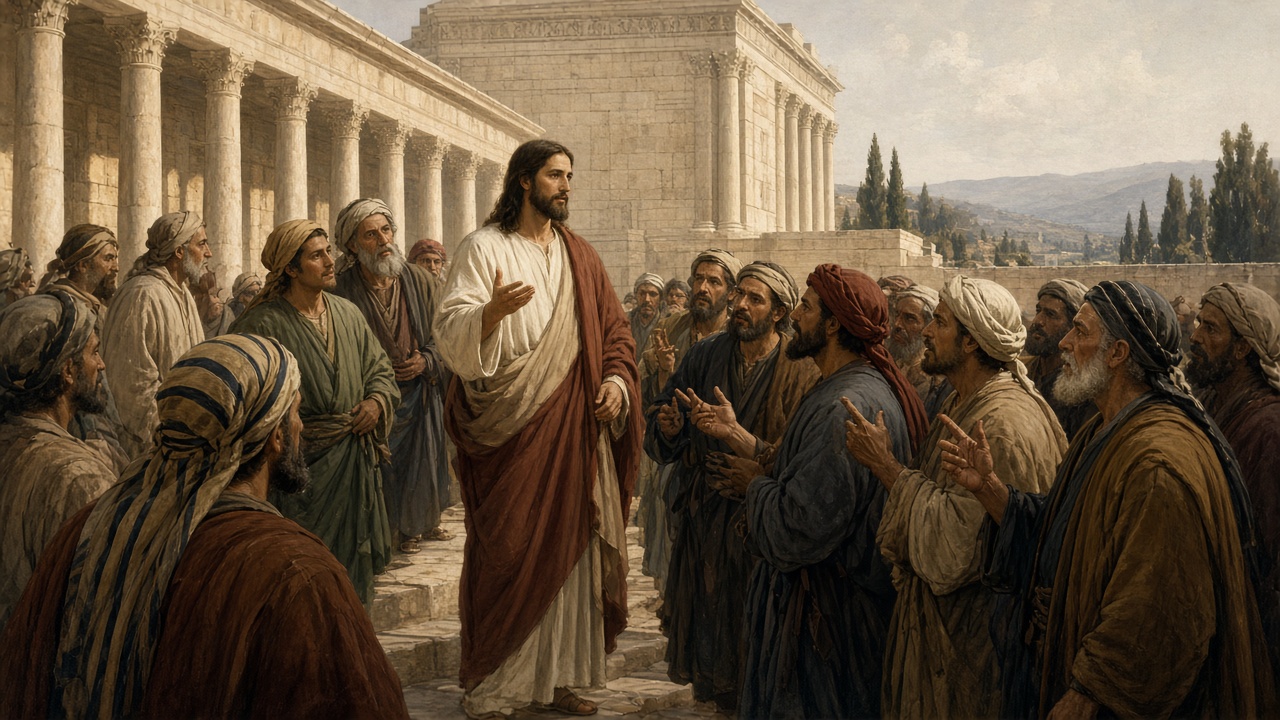
Jesus at the Feast of Tabernacles
- As the Jewish Feast of Tabernacles, a seven-day feast, drew near, Jesus stayed in Galilee and avoided Judea, where people were trying to kill him. In his time Judea was the southernmost of the three Roman divisions of Palestine, distinct from Galilee and Samaria; he later went up to the feast in secret and taught in the temple courts.Sources: the Bible text itself · Feast of Tabernacles · Judea
- The crowds were divided over where the Christ would come from. Some said that Scripture places him in David's line and in Bethlehem, the village where David, the eighth and youngest son of Jesse, lived; others objected that he could not come from Galilee, a region long called Galilee of the Gentiles, and the Pharisees insisted that no prophet comes from there.Sources: the Bible text itself · David · Galilee
- Nicodemus, a Pharisee and a member of the Sanhedrin, had earlier come to Jesus at night. When the officers sent to arrest Jesus returned without him, Nicodemus protested and asked whether their law condemned a man before hearing him and finding out what he had done.Sources: the Bible text itself · Nicodemus
Notes written with AI assistance from open sources (Theographic Bible Metadata, CC BY-SA 4.0; Easton’s Bible Dictionary, public domain) and reviewed before publishing.
Places in this chapter
- Galilee · 32.760, 35.527 · verses 1, 3, 9, 41, 52
- Judea · Today: Judea 1 · 31.777, 35.234 · verses 1, 3
- Jerusalem · 31.777, 35.234 · verse 25
- Bethlehem · 31.704, 35.208 · verse 42
Only places identified with high confidence are shown (90% or more according to the scholarly sources compiled by OpenBible). Period map: DARE (Digital Atlas of the Roman Empire), CC BY 4.0; modern map: © OpenStreetMap contributors; places: OpenBible.info (CC BY 4.0).
Credits and license for this translation
Di Nyoo Testiment eena Bileez Kriol
New Testament in Belize Kriol English (BH:bzj:Belize Kriol English)
copyright © 2012 Wycliffe Bible Translators, Inc.
Language: Bileez Kriol (Belize Kriol English)
Translation by: Wycliffe Bible Translators, Inc.
Copyright Information
© 2012, Wycliffe Bible Translators, Inc. All rights reserved.
This translation text is made available to you under the
terms of the Creative Commons License: Attribution-Noncommercial-No Derivative Works.
( http://creativecommons.org/licenses/by-nc-nd/3.0/ )
In addition, you have permission to port the text to different file formats, as long as you
do not change any of the text or punctuation of the Bible.
You may share, copy, distribute, transmit, and extract portions
or quotations from this work, provided that you include the above copyright
information:
You must give Attribution to the work.
You do not sell this work for a profit.
You do not make any derivative works that change any of the actual words or punctuation of the Scriptures.
Permissions beyond the scope of this license may be
available if you contact
us with your request.
The New Testament
in Belize Kriol English
© 2012, Wycliffe Bible Translators, Inc. All rights reserved.
This translation is made available to you under the terms of the
Creative Commons Attribution-Noncommercial-No Derivatives license 4.0.
You may share and redistribute this Bible translation or extracts from it in any format, provided that:
You include the above copyright and source information.
You do not sell this work for a profit.
You do not change any of the words or punctuation of the Scriptures.
Pictures included with Scriptures and other documents on this site are licensed just for use with those Scriptures and documents.
For other uses, please contact the respective copyright owners.
2022-12-21
Source: http://ebible.org/bzj/ · eBible.org