Genesis 48
Tte Pa̱'a̱li̱ Me' Skëköl tö Se' a̱ · Tap a verse to see its cross-references.
Jacob e̱r buaë ché José ala'r a̱
1E' ukuöki̱ ta̱ ie'pa wa̱ biyö̀ debitu̱ José a̱: “Be' yë́ duöke tso' suluë.” Eta̱ José mía̱ isa̱u̱k ila'r böl mí iwa̱ e̱' ta̱. 2Mik ie'pa tö iché Jacob a̱ tö José debitu̱ be' sa̱u̱k, eta̱ ie' e̱' tkéka̱ isulú wa ika̱' ki̱. 3Eta̱ ie' tö iché José a̱:
—Skëköl Diché Ta̱' Íyi Ulitane Tsa̱ta̱ e' e̱' kkayë' ye' a̱ ká̱ kiè Luz a̱te̱ Canaán ee̱. Ee̱ ie' e̱r buaë yë' ye' a̱ 4ta̱ ichéitö ña: “Ye' tö be' aleripa alöwe̱raë tai̱ë. Ie'pa döraë ká̱ tai̱ë e' wakpaie. Ká̱ i' meraëyö ie'pa a̱, e' a̱tdaë ie'pa ulà a̱ ke̱kraë michoë.” 5Be' ala'r böl, Efraín ena Manasés, e'pa ku̱ne ka̱m ye' dö̀ Egipto e' yöki̱. Ie'pa tsé̱tköyö we̱s ye' wák ala'r es we̱s ye' ala'r Rubén ena Simeón dör ye' ala'r es. 6E' kue̱ki̱ ká̱ meraëyö ie'pa a̱ we̱s ye' wák ala'r a̱ es. Ie'pa itöki̱ be' ala'r skà ku̱rmi, e'pa dör be' wák a̱. Erë ie'pa dör Efraín ena Manasés ëlpa, e' kue̱ki̱ ká̱ ñe' kak döraë ie'pa ulà a̱ ñies. 7Mik ye' manét Padán-aram e' demi Canaán dökettsa̱tke Efrata, eta̱ ee̱ ñala̱ ki̱ be' mì blënewa̱ ye' yöki̱. Ee̱ ye' tö ie' nu blë'wa̱a̱t Efrata ñalé̱ ki̱. (I̱'ñe ta̱ ká̱ e' kiè Belén.)
8Mik Jacob tö José ala'r sué̱ eta̱ ichakéitö:
—¿Se̱pa dör yi?
9Ie' tö iiu̱té:
—I'pa dör ye' ala'r mé Skëköl tö ye' a̱ ká̱ i' ki̱.
Eta̱ iyë́ tö iché ia̱:
—Ie'pa tsú̱bitu̱ ye' ska' a̱s ye' e̱r bua' chö̀ ie'pa a̱.
10Jacob kënewa̱tke e' kue̱ki̱ iwöbla kë̀ wawëria̱ buaë. E' kue̱ki̱ José tö ila'r patkémi tsi̱net iyë́ o̱'mik. Eta̱ Jacob tö italapa paklö'wé̱ wöalattsé. 11E' ukuöki̱ ichéitö José a̱:
—Ye' ibikeits tö ye' kë̀ tö be' sue̱paia̱, erë Skëköl tö ka̱wö mé ye' a̱ be' ena be' ala'r suo̱ie.
12Eta̱ José tö ila'r skéttsa̱ iyë́ o̱'mik ta̱ iwöéwa dö̀ i̱ski̱ iyë́ dalöioie. 13E' ukuöki̱ ta̱ ila'r böl klö'wé̱wa̱itö iulà a̱. Efraín mí José ulà bua'kka, Manasés mí José ulà bakli̱'kka. Es itsé̱miitö iyë́ ska'. Eta̱ Efraín a̱te̱ Jacob ulà bakli̱'kka, Manasés a̱te̱ Jacob ulà bua'kka. 14Erë Jacob ulà bua'kka méka̱ Efraín dur ie' ulà bakli̱'kka e' wökir ki̱. Erë́ e' dör alà tsirla. Eta̱ iulà bakli̱'kka méka̱itö Manasés dur ie' ulà bua'kka e' wökir ki̱. Erë́ e' dör alà kibi. Es Jacob ulà tsé̱tkö wi̱'kë io̱'kë. 15Eta̱ ie̱r bua' ché José a̱ i' es:
“A̱s Skëköl e̱r buaë chö̀ ala'r böl i' a̱ ke̱kraë.
Ye' yë́pa bak Abraham ena Isaac, e'pa bak Skëköl e' dalöiök,
e' tö ye' kkö'nami kuaë dö̀ ikkë ta̱.
Ie' tö ye' tsa̱tké ke̱kraë íyi sulusi ulà a̱.
A̱s ala'r i' wa kë̀ ye' chöwa sulitane é̱na ke̱kraë.
Ñies ye' yë́pa bak Abraham ena Isaac a̱s e'pa kë̀ chöwa sulitane é̱na ke̱kraë.
A̱s ala'r i' alör tai̱ë ká̱ ulitane ki̱.”
17Jacob ulà bua'kka méka̱ Efraín wökir ki̱, e' kë̀ mène José a̱ buaë. E' kue̱ki̱ ie' tö iyë́ ulà bua'kka e' klö'wé̱wa̱ mèka̱ ilà kibi dör Manasés e' wökir ki̱. 18E' dalewa ichéitö ia̱:
—¡A yë́wö, kë̀ idör es! I' dör alà kibi. Be' ulà bua'kka múka̱ i' wökir ki̱.
19Erë iyë́ kë̀ wa̱ io̱ne es. Ie' tö iché ia̱:
—¡A alà, e' jche̱r ye' wa̱, e' jche̱r ye' wa̱! Ie' alördaë tai̱ë, ie' döraë këkëpa tai̱ë. Erë itsirla ë́k e' döraë këkëpa tai̱ë shu̱te̱ ikibi tsa̱ta̱. Ñies ie' aleripa döraë ká̱ tai̱ë e' wakpaie.
20Es e' ë̀ diwö wa Jacob e̱r buaë skà ché italapa a̱ i' es:
—Mik Israel aleripa e̱r buaë cheke ñì a̱ eta̱ ie'pa tö icheraë ñì a̱ i' es: ‘A̱s Skëköl e̱r buaë chö̀ be' a̱ we̱s Efraín ena Manasés e'pa a̱ e̱r buaë yëne es.’
Es Jacob e̱r buaë ché Efraín a̱, Manasés a̱ imène, e' tsa̱ta̱. 21E' ukuöki̱ ta̱ José a̱ ichéitö:
—Ye' duökewa̱tke erë Skëköl tö a' kkö'neraë. Ie' wa̱ se' aleripa mirane Canaán wé̱ se' yë́pa bak se̱nuk ee̱. 22Ye' tö ká̱ bua'ie méa̱t be' a̱ ime'bakyö be' ëlpa a̱ e' tsa̱ta̱. Ká̱ e' kiè Siquem. E' yë'ttsa̱ ye' tö amorreowak ulà a̱ ñippè wa.
Did you know?
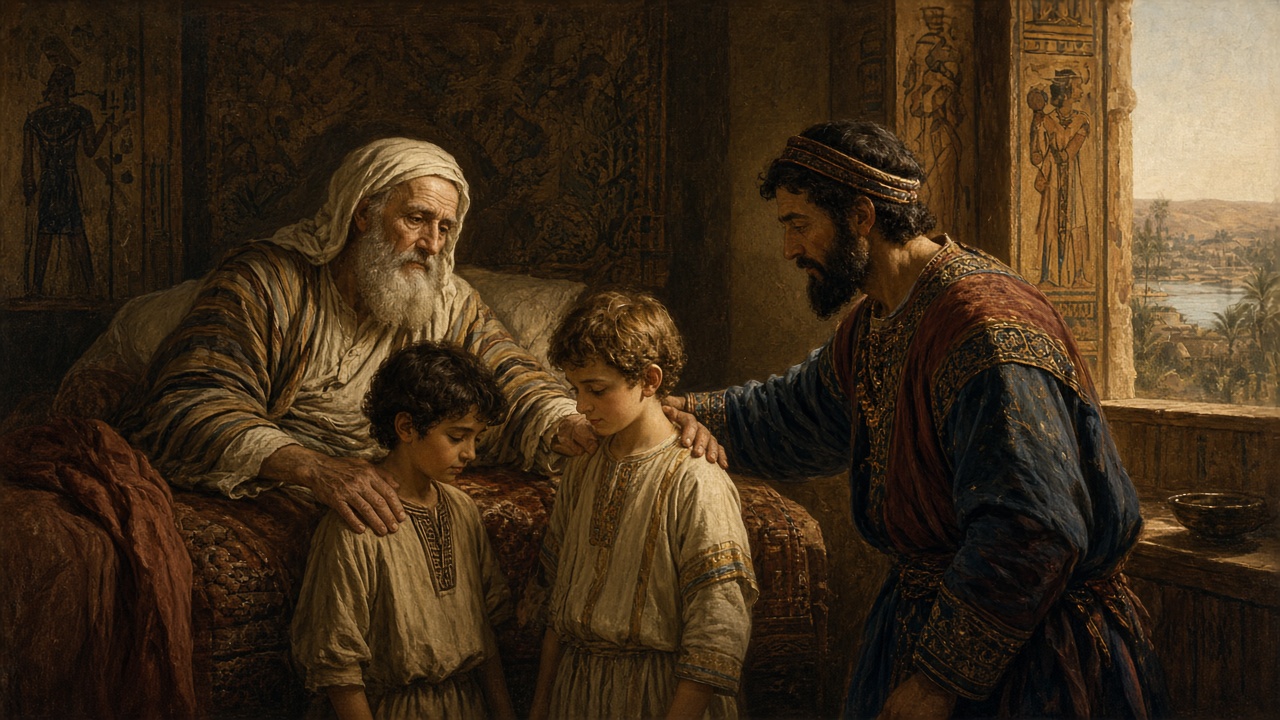
Adoption and Blessing of Ephraim and Manasseh
- Jacob reckons Joseph’s two sons, born to him in Egypt, as his own, on a level with Reuben and Simeon, Leah’s sons. Children born to Joseph after them were to remain Joseph’s, and were to be called by their brothers’ names in the territory they inherited.Sources: the Bible text itself · Manasseh (son of Joseph) · Reuben · Simeon
- Manasseh was the elder son and Ephraim the younger, born in Egypt. The name Ephraim means double fruitfulness, because God had made him fruitful in the land of his affliction. Though Israel could hardly see for age, he crossed his hands, laid his right hand on Ephraim, and insisted that the younger brother would be greater.Sources: the Bible text itself · Ephraim · Manasseh (son of Joseph)
- Jacob recalls that God Almighty appeared to him at Luz in the land of Canaan and blessed him there. Luz was the ancient name of a royal Canaanite city near Bethel, where Jacob halted and received a prophetic vision. He also remembers Rachel, Joseph’s mother, who died to his sorrow on the way back from Paddan—a name found only in this verse, for Padan-aram—and whom he buried beside the road to Ephrath, that is, Bethlehem.Sources: the Bible text itself · Luz · Paddan · Rachel
Notes written with AI assistance from open sources (Theographic Bible Metadata, CC BY-SA 4.0; Easton’s Bible Dictionary, public domain) and reviewed before publishing.
Places in this chapter
- Canaan · 32.767, 35.333 · verses 3, 4, 7, 21
- Luz · Today: Beitin · 31.923, 35.241 · verse 3
- Egypt · 30.129, 31.308 · verses 5, 9
- Bethlehem · 31.704, 35.208 · verse 7
- Ephrath · Today: Bethlehem · 31.704, 35.208 · verse 7
Only places identified with high confidence are shown (90% or more according to the scholarly sources compiled by OpenBible). Period map: DARE (Digital Atlas of the Roman Empire), CC BY 4.0; modern map: © OpenStreetMap contributors; places: OpenBible.info (CC BY 4.0).
Credits and license for this translation
Tte Pa̱'a̱li̱ Me' Skëköl tö Se' a̱
New Testament and Shorter Old Testament in Bribri (CS:bzd:Bribri)
copyright © 2010 Wycliffe Bible Translators, Inc.
Language: Bribri
Translation by: Wycliffe Bible Translators, Inc.
Bribri
bzd
Costa Rica
Copyright Information
© 2010, Wycliffe Bible Translators, Inc. All rights reserved.
This translation text is made available to you under the
terms of the Creative Commons License: Attribution-Noncommercial-No Derivative Works.
( http://creativecommons.org/licenses/by-nc-nd/3.0/ )
In addition, you have permission to port the text to different file formats, as long as you
do not change any of the text or punctuation of the Bible.
You may share, copy, distribute, transmit, and extract portions
or quotations from this work, provided that you include the above copyright
information:
You must give Attribution to the work.
You do not sell this work for a profit.
You do not make any derivative works that change any of the actual words or punctuation of the Scriptures.
Permissions beyond the scope of this license may be
available if you contact
us with your request.
The New Testament and Shorter Old Testament
in Bribri
© 2010, Wycliffe Bible Translators, Inc. All rights reserved.
This translation is made available to you under the terms of the
Creative Commons Attribution-Noncommercial-No Derivatives license 4.0.
You may share and redistribute this Bible translation or extracts from it in any format, provided that:
You include the above copyright and source information.
You do not sell this work for a profit.
You do not change any of the words or punctuation of the Scriptures.
Pictures included with Scriptures and other documents on this site are licensed just for use with those Scriptures and documents.
For other uses, please contact the respective copyright owners.
2014-04-22
Source: http://ebible.org/bzdNTpo/ · eBible.org