Genesis 31
Tte Pa̱'a̱li̱ Me' Skëköl tö Se' a̱ · Tap a verse to see its cross-references.
Jacob tkakshkar Labán yöki̱
1Erë Jacob tö ittsé tö Labán ala'r dulakölpa tö icheke: “Jacob tö se' yë́ íyi ko̱s e' klö'wé̱wa̱, e' wa ie' e̱' blu'wé̱ tai̱ë.” 2Ñies ie' tö isué̱ tö Labán kë̀ tö ie' suè̱ia̱ buaë we̱s ke̱net es. 3Eta̱ Jehová tö ie' a̱ iché: “Be' yúne be' yë́pa ka̱ska' wé̱ be' yamipa tso' ee̱. Ye' michoë be' ta̱ be' kkö'nuk.”
4Jacob tö Raquel ena Lía tsu̱k patké dö̀ wé̱ ie' tso' obeja wëttsë ee̱ 5ta̱ ichéitö ia̱:
—Ye' wa̱ ijche̱newa̱ tö a' yë́ kë̀ ki̱ ye' kianeia̱ we̱s ke̱net es. Erë ye' yë́ e' Këköl tso' ye' ta̱ ke̱kraë ye' ki̱muk. 6A' wa̱ ijche̱r buaë tö ye' kaneblé a' yë́ a̱ moki̱. 7Erë ie' tö ye' ki̱tö'wé̱ ke̱kraë ye' kanè ské wa. Erë Skëköl kë̀ wa̱ ie' a̱ iké̱wö mène a̱s ì sulu wamblö̀itö ye' ki̱. 8Mik ie' tö ye' a̱ iché: “Ye' be' patue̱ke iyiwak wöaule shkitshkit ese wa”, eta̱ iyiwak ulitane pa̱ne wöaule shkitshkit ë̀me. Mik ie' tö ye' a̱ iché: “Ye' be' patue̱ke iyiwak wöaule shkëkshëk ese wa”, eta̱ iyiwak ulitane pa̱ne wöaule shkëkshëk ë̀me. 9Es Skëköl tö a' yë́ iyiwak yë'lur mè ye' a̱.
10“Iyiwak wöbatsöke ñì wa e' ké̱wö ska' ta̱ ye' kabsué̱ tö iyiwak wë'ñe wöbatsöke iláki wa, e' ko̱s wák dör wöaule shkëkshëk ena shkitshkit ena u̱la̱u̱la̱. 11Kabsuè̱ e' a̱, Skëköl biyöchökwak ye' chaké ye' kiè wa ta̱ ye' iiu̱té: ‘¿Ì?’ 12Ie' ye' a̱ iché: ‘Isa̱ú̱ bua'ie ta̱ be' isue̱raë tö iyiwak wë'ñe wöbatsöke iláki wa, e' ko̱s dör wöaule shkëkshëk ena shkitshkit ena u̱la̱u̱la̱. Ì sulu ko̱s wamblé Labán tö be' ki̱, e' sué̱yö, e' kue̱ki̱ ye' tö iwé̱ es. 13Ye' dör Këköl dë'bitu̱ be' wörki̱ ká̱ kiè Betel ee̱ e'. Ee̱ be' tö ák du'ka̱a̱t ye' dalöioie. Ee̱ be' tö ka̱wö me' ye' a̱. Be' e̱' kö́ka̱ bet, be' e̱' yö́ttsa̱ ká̱ i' a̱. Be' yúne wé̱ be' ku̱ne ee̱.’”
14Eta̱ Raquel ena Lía e'pa tö iiu̱té:
—Kë̀ sa' a̱ sa' yë́ daliukuö ta̱'ia̱. 15Ñies sa' sué̱ sa' yë́ tö suluë we̱s o̱'ka es. Kí̱ie ta̱ sa' wato̱'ttsa̱itö be' a̱, sa' ské klöo̱'itö buaë e' e̱wé̱waitö yës. 16E̱'ma ko̱s Skëköl tö íyi yë'lur sa' yë́ ulà a̱, e' dör sa' icha ena sa' ala'r icha. E' kue̱ki̱ ì ko̱s ché Skëköl tö be' a̱ e' iu̱tö́.
Jacob e̱' yéttsa̱ Padán-aram
17E' ukuöki̱ ta̱ Jacob tö ila'r ena ilakölpa e'pa ké e̱' tkökka̱ kameio ki̱. Ie' iyiwak ko̱s ena ie' íyi ko̱s dë' ie' ulà a̱ Padán-aram ikanè skéie, e' patkémiitö ke̱weie ie' yöki̱. Eta̱ ie' e̱' yéttsa̱ micho iyë́ Isaac ska' Canaán. 19Labán mía̱ ká̱ bánet ioveja köyök tök, e' dalewa ie' wa̱ íyi diököl tso' dalöiè e' ko̱s bléwa̱mi Raquel tö. 20Jacob kë̀ wa̱ iyëne Labán a̱ tö ie' mi'kea̱. Es ie' tö iki̱té buaë. 21Ie' tkashkar. Íyi tso' ie' wa̱ e' ko̱s wëttsë. Bet ta̱ ie' tkattsa̱ di' kiè Éufrates, e' wi̱she̱t. Ee̱ ta̱ ie' micho ká̱ kiè Galaad e' ká̱ köwö ki̱.
Labán tö Jacob tötié̱
22Jacob bakshkar e' ki̱ ká̱ de mañat, eta̱ Labán wa̱ ijche̱newa̱ tö ie' bakshkar. 23Eta̱ ie' mía̱ itöki̱ iyamipa ta̱. Ká̱ de kul ta̱ ie' tö ikué̱ Galaad ká̱ köwö ki̱. 24E' nañewe Labán kabsué̱ tö Skëköl de ie' wörki̱ ta̱ ichéitö ia̱: “Ye' ttö̀ ttsö́. Kë̀ be' kàne ttök Jacob ta̱ kësik wa.”
25Ie' de wé̱ Jacob úla tulur Galaad ká̱ köwö ki̱ ee̱. Ee̱ ie' ena iyamipa, e'pa tö iúla tuléka̱ kapowa̱ie ñies. Jacob yamipa úla tuléka̱ kapowa̱ie.|src="HK00223b.tif" size="span" ref="Génesis 31.25" 26Ie' tö iché Jacob a̱:
—¿Ì wamblé be' tö i' es? ¿Iö́k be' tö ye' ki̱tö'wé̱ i' es? Be' wa̱ ye' alà busipa bite̱tse̱r we̱s ñippökwakpa tö s'tsè̱mi es. 27¿Ì kue̱ki̱ be' ye' ki̱tö'wé̱? Be' tkashkar akir ye' yöki̱. Be' e̱' biyö́ chö́pa ye' a̱, e̱'ma ka̱wö buaë tkö'wé̱ ye' tö a' wëttsë ttsëne buaë wa, ma'ma kicha ta̱' ese wa ena sabak blar buaë ese wa. 28Kë̀ be' wa̱ ka̱wö méne ye' a̱ ena ye' ala'r busipa ena ye' duöchkepa e'pa a̱ a̱s sa' e̱' chö̀a̱t ñì a̱. Be' tö iwamblé we̱s pë' suluë es. 29Ye' wa̱ diché tso' a' ulitane tsa̱ioie buaë, erë e̱nia̱ nañewe be' yë́ e' Këköl tö ye' a̱ iché: ‘Ye' ttö̀ ttsö́. Kë̀ be' kàne ttök Jacob ta̱ kësik wa.’ 30Be' mitkene be' yë́ u a̱ we̱s be' ki̱ ikiane tai̱ë es, eta̱ ¿Ìie be' tö ye' wa̱ íyi diököl tso' dalöiè e' ekiblé?
31Eta̱ Jacob tö iiu̱té:
—Ye' suane be' yöki̱. Ye' ibikeits dö' be' ye' yöki̱ be' ala'r busipa yèttsa̱ne e̱r sulu wa. 32Yi wa̱ be' íyi diököl tso' dalöiè e' tso', e' ta̱ a̱s e' wák duö̀wa̱. Se' yamipa ko̱s tso' í̱e̱ se' sa̱u̱k, e'pa wörki̱ be' yú be' íyi yulök. E' kué̱bö, e' ta̱ itsú̱mi.
Erë ie' kë̀ wa̱ ijche̱r tö Raquel tö iyë́ íyi diököl e' blë'wa̱bitu̱.
33Eta̱ Labán tkawa̱ Jacob úla a̱ ie' íyi yulök. E' ukuöki̱ ta̱ ie' tkawa̱ Lía úla a̱. Ñies Lía ena Raquel kanè mésopa böl e'pa úla shu̱yuléitö. Erë kë̀ ie' wa̱ iku̱ne. Ie' e̱' yéttsa̱ Lía úla a̱ mía̱ Raquel úla shu̱yulök. 34E' dalewa Raquel tö iyë́ íyi diököl bléwa̱ kameio tsi̱kkuö diki̱a̱ ta̱ ie' wák e̱' tkéka̱ ibata ki̱. Labán tö ie' úla ulitane shu̱yulé erë kë̀ iwa̱ iku̱ne yës. 35Raquel tö iché ia̱:
—A yë́wö, kë̀ be' ulunuk ye' ki̱. Ye' e̱' kö̀ka̱mi be' wörki̱, erë ye' duöke sik duè wa̱.
Labán tö ie' íyi diököl yulé tai̱ë. Erë kë̀ ie' wa̱ iku̱ne. 36E' kue̱ki̱ Jacob uluneka̱ tai̱ë ta̱ ichéitö Labán a̱:
—¿Ì sulu wambléyö be' ki̱, e' kue̱ki̱ be' ye' tötié̱ dö̀ í̱e̱? 37Be' tö ye' íyi ko̱s e' shu̱yulé ta̱ ¿be', ì kué̱bö? E' tulö́ í̱e̱ se' yamipa wörki̱ a̱s ie'pa tö ichö̀ tö yi ttè dör moki̱ë, be' ö ye'. 38Ye' kaneblë' be' a̱ duas döka̱ dabom böyök (20), e' dalewa ta̱ be' chibo ena be' obeja e' ko̱s tskirke bua'buaë. Be' iyiwak bobokpa kë̀ tkëulettsa̱ yës. Ñies kë̀ ye' wa̱ be' obeja pupula ë̀ kataulewa. 39Namu tö be' iyiwak ttéwa̱, e' ta̱ kë̀ ye' wa̱ inú dë'bitu̱. E' nuí̱ pato̱' ye' tö be' a̱. Ñiwe ö nañewe be' iyiwak ekiblélur akblökwakpa tö, e' patau̱k be' tö ye' ka'. 40Ñiwe ye' tteke ka̱ba tö. Nañewe ta̱ ye' tteke ka̱se̱ tö. Kë̀ ye' kapowa̱ buaë. 41Ye' kaneblë' be' a̱ duas dabom böyök (20) eta̱ es ye' bak weinuk ke̱kraë. Ye' kaneblë' duas dabom eyök ki̱ tkël (14) be' alà busipa dalërmik. E' ukuöki̱ ta̱ ye' skà kaneblë' duas teröl be' iyiwak kue̱ki̱, erë be' bak ye' ki̱tö'u̱k ke̱kraë ye' kanè ské wa. 42Abraham ena ye' yë́ Isaac e'pa Këköl kë̀ kú̱pa ye' ta̱, e̱'ma be' ye' patkë'bitu̱ ulà wöchka. Erë Skëköl tö isué̱ tö ye' sia̱rla, e' kaneblë' tai̱ë, e' kue̱ki̱ ie' tö be' wöuñé e̱nia̱ nañewe.
Jacob ena Labán e'pa ka̱wö mé ñì a̱
43Eta̱ Labán tö Jacob iu̱té:
—Be' alakölpa dör ye' alà busipa. Be' ala'r dör ye' duöchkepa. Obeja ko̱s e' dör ye' icha. Ì ko̱s sué̱bö í̱e̱, e' dör ye' icha ë̀. ¿We̱s ye' a̱ ye' alà busipa ena ye' duöchkepa e'pa o̱rmi? 44E' kue̱ki̱ be' shkö́. Mishka ka̱wö muk ñì a̱. Es se' wa̱ ijche̱rdaë tö we̱s se' ka̱wöta̱ ñì dalöiök.
45Ee̱ ta̱ Jacob tö ák duéka̱ ek ie'pa ka̱wö muke ñì a̱ e' wà kkachoie. 46Ie' tö iché iyamipa a̱:
—Ák dapa'ú̱ í̱e̱.
Ie'pa ulitane tö ák dapa'wé̱ ta̱ ichkérak ák dapaule e' o̱'mik. 47Eta̱ Labán tö ká̱ e' kiè méka̱ iwák ttö̀ wa “Jegar Sahadutá”. Ñies Jacob tö ikiè méka̱ iwák ttö̀ wa “Galaad.” 48Labán tö iché:
—I̱'ñe ák ikkë dapa'wé̱a̱tsö ka̱wö mésö ñì a̱ e' wà kkachoie.
E' kue̱ki̱ Jacob tö ká̱ e' kiè méka̱ es. 49Ká̱ e' kine ñies Mispá, wà dör tö Labán tö iché:
—Mik kë̀ se' ñì su̱neia̱, eta̱ a̱s Jehová tö se' sa̱ú̱ tö we̱s se' ñì wamblöke. 50Be' tö ye' ala'r busipa we'iké ö be' se̱néwa̱ alakölpa kua̱'ki̱ ta̱, e' ta̱ e' sue̱raë Skëköl tö. Erë́ kë̀ yi ku̱' e' sa̱u̱k chène ye' a̱, erë Skëköl wák tö isue̱raë.
51Eta̱ Labán tö ikí̱ ché Jacob a̱:
—Ák dur i' ena ák dapaule i' e' dapa'wé̱yö se' böl shu̱sha̱ë. 52Ák dur i' ena ák dapaule i' e' dör se' böl a̱ iwà kkachoie tö í̱e̱ ë̀ se' ka̱wöta̱ dökwa̱. Kë̀ ye' tkö̀pami be' kke̱r ñippök be' ta̱. Ñies kë̀ be' tkö̀pami ye' kke̱r ñippök ye' ta̱. 53Abraham dör be' duöchke ena Nahor dör ye' duöchke, e'pa Këköl eköl ë̀, a̱s e' tö se' shu̱lö̀.
Eta̱ Jacob tö ka̱wö mé moki̱ë Labán a̱ Skëköl dalöieke iyë́ Isaac tö e' wörki̱. 54E' ukuöki̱ ta̱ ie' tö iyiwak jché ña'wé̱ Skëköl dalöioie ee̱. Ie' tö iyamipa kié chkök. Ie'pa ulitane chké ta̱ ikaperö ee̱.
55Bule es bla'mi ta̱ Labán tö iduöchkepa ena ila'r busipa e'pa wöalattsé e̱' choa̱t ie'pa a̱. Ie' tö iché ia̱rak: a' mú ka̱wö tkö̀ buaë ke̱kraë. E' ukuöki̱ ta̱ imichone ika̱ska'.
Did you know?
Parting at the Heap of Witness
- Laban called the stone heap Jegar-sahadutha, an Aramaic name, and Jacob called it Galeed, Hebrew for “heap of witness.” A Bible dictionary suggests that Nahor’s family originally spoke Aramaic, while Abraham and his descendants learned Hebrew, a kindred dialect, in Canaan.Sources: Galeed · the Bible text itself
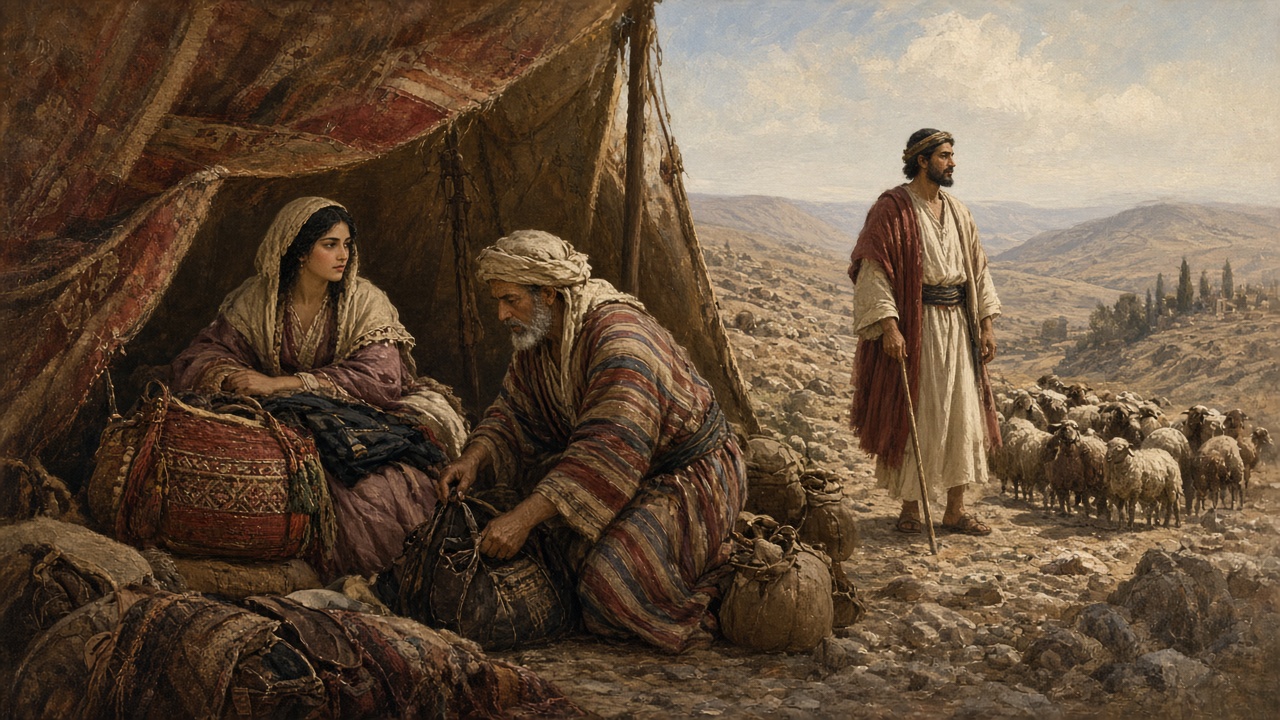
- As they left, Rachel took her father’s household idols, the teraphim, hid them in her camel’s saddlebag, and sat on them while Laban searched the tents. Jacob did not know she had stolen them, though he had declared that anyone found with the idols would not live.Sources: Rachel · the Bible text itself
- Jacob left Paddan-aram, the plain of Aram, commonly regarded as the Mesopotamian district around Haran, crossed the Euphrates, and was overtaken in the hill country of Gilead after a pursuit of seven days. Gilead is described as a “hill of testimony,” a mountainous region east of the Jordan. A dictionary notes that, when Jacob fled from Haran, contact between Abraham’s family in Canaan and the relatives who had remained there came to an end.Sources: Paddan-aram · Gilead · Nahor (brother of Abraham) · the Bible text itself
Notes written with AI assistance from open sources (Theographic Bible Metadata, CC BY-SA 4.0; Easton’s Bible Dictionary, public domain) and reviewed before publishing.
Places in this chapter
- Canaan · 32.767, 35.333 · verse 18
- Euphrates · Today: Euphrates River · 31.004, 47.442 · verse 21
- Gilead · Today: Gilead 1 · 32.187, 35.692 · verses 21, 23, 25
Only places identified with high confidence are shown (90% or more according to the scholarly sources compiled by OpenBible). Period map: DARE (Digital Atlas of the Roman Empire), CC BY 4.0; modern map: © OpenStreetMap contributors; places: OpenBible.info (CC BY 4.0).
Credits and license for this translation
Tte Pa̱'a̱li̱ Me' Skëköl tö Se' a̱
New Testament and Shorter Old Testament in Bribri (CS:bzd:Bribri)
copyright © 2010 Wycliffe Bible Translators, Inc.
Language: Bribri
Translation by: Wycliffe Bible Translators, Inc.
Bribri
bzd
Costa Rica
Copyright Information
© 2010, Wycliffe Bible Translators, Inc. All rights reserved.
This translation text is made available to you under the
terms of the Creative Commons License: Attribution-Noncommercial-No Derivative Works.
( http://creativecommons.org/licenses/by-nc-nd/3.0/ )
In addition, you have permission to port the text to different file formats, as long as you
do not change any of the text or punctuation of the Bible.
You may share, copy, distribute, transmit, and extract portions
or quotations from this work, provided that you include the above copyright
information:
You must give Attribution to the work.
You do not sell this work for a profit.
You do not make any derivative works that change any of the actual words or punctuation of the Scriptures.
Permissions beyond the scope of this license may be
available if you contact
us with your request.
The New Testament and Shorter Old Testament
in Bribri
© 2010, Wycliffe Bible Translators, Inc. All rights reserved.
This translation is made available to you under the terms of the
Creative Commons Attribution-Noncommercial-No Derivatives license 4.0.
You may share and redistribute this Bible translation or extracts from it in any format, provided that:
You include the above copyright and source information.
You do not sell this work for a profit.
You do not change any of the words or punctuation of the Scriptures.
Pictures included with Scriptures and other documents on this site are licensed just for use with those Scriptures and documents.
For other uses, please contact the respective copyright owners.
2014-04-22
Source: http://ebible.org/bzdNTpo/ · eBible.org