Nehemiah 8
Buka Tabuna Tefadi · Tap a verse to see its cross-references.

About this book
About Nehemiah
- Easton's Bible Dictionary (1897) presents Nehemiah as the author of the book, pointing to first-person writing in chapters 1–7, 12:27–47, and 13, and to third-person sections in chapters 8–10 that some suppose Ezra wrote, though it says there is no distinct evidence of that. The same entry dates the book to about 431–430 B.C., after Nehemiah returned a second time to Jerusalem from Persia, and excepts 12:11, 22, and 23 from his hand.Sources: Easton: Nehemiah, Book of
- Nehemiah, son of Hachaliah and probably of the tribe of Judah, belonged to a family of Jerusalem and was one of the Jews of the dispersion. In his youth he served as royal cup-bearer at the palace of Shushan under Artaxerxes Longimanus, and through his brother Hanani he learned that the holy city lay mournful and desolate.Sources: Nehemiah
- The scribe Ezra had led a second company of exiles from Babylon to Jerusalem in 459 B.C., and Easton's dictionary treats Nehemiah as a historical continuation of Ezra. When Nehemiah went up to rebuild the ruined walls, Sanballat, who held some place of authority in Samaria, tried to hinder the work, and Tobiah the Ammonite joined the opposition and sent letters to put him in fear.Sources: Ezra · Easton: Nehemiah, Book of · Sanballat · Tobiah
- Easton's Bible Dictionary (1897) divides the book into four parts: the rebuilding of Jerusalem's wall and the register of those who had returned from Babylon (chapters 1–7); the state of religion among the Jews (8–10); the growth of Jerusalem's population, a census of adult men, and lists of chiefs, priests, and Levites (11 through 12:1–26); and the dedication of the wall, the ordering of temple officers, and Nehemiah's reforms (12:27–13).Sources: Easton: Nehemiah, Book of
- While Nehemiah was away, the priest Eliashib prepared a chamber in the courts of the house of God for Tobiah; on his return Nehemiah cast out all of Tobiah's household goods. Easton's dictionary also notes that the book closes the history of the Old Testament and that the prophet Malachi was contemporary with Nehemiah.Sources: Tobiah · Easton: Nehemiah, Book of
Notes written with AI assistance from open sources (Theographic Bible Metadata, CC BY-SA 4.0; Easton’s Bible Dictionary, public domain) and reviewed before publishing.
Esela Laugagayo ya Fatili Dodoga Lebedi yai
1Dodoga mahudoꞌidi sa faꞌoigogo esegama dobidobi yai, Hoꞌowa Edaꞌedana Hafohafona yai. Laugagayo tau lau faꞌataenna Esela sa faliba bena Mose ena Laugagayo Bukana ya fakalamahanoyama.
2Nawalahi fafaligigi-luwagana yai na lahai bwaꞌibwaꞌina mate tau antalasam, Esela, Laugagayo Bukana ya leyama tatau, wawahin yo tau atahi lobahina mahudoꞌidi lebedi. 3Dobidobi yai, Hoꞌowa Edaꞌedana Hafohafona yai mate Esela Laugagayo Bukana ya fatili falaꞌi tatau, wawahin yo tau atahi lobahina hahaisa lebedi yai. Ya ifi tatatali mate ya fatubu ya fatili ee–, lahai laꞌi.
4Faꞌoigogo fatafatana lofalofa sa ginauli mate hewana yai laugagayo tau lau faꞌataenna, Esela ya mwaito. Nima sibana yai sa mwaito mate: Matitaiya, Sema, Anaiya, Ulaiya, Hilikaiya yo Maseiya. Na seuseulina yai mate: Pedaiya, Miseli, Malikiya, Hasum, Hasibadana, Sekalaiya yo Mesulam.
5Laugagayo Bukana ya soꞌe mate dodoga mahudoꞌidi sa itaꞌita hasa be sa ita, paꞌana in hewa yai. Maihalana, Laugagayo Bukana ya kalasi, mahudoꞌidi sa obiyo.
6Esela iye,
Guyau hesana E lau hitin! In Yaubada Adiꞌadidilina!
Dodoga mahudoꞌidi nimadi sa lau hitindi tiyen,
“Moꞌisa! Wananaha!”
Habahim sa hoba lidi tanohi yai na Guyau sa fadebasae.
7Sulu Lewi Laugagayo Bukana tau liba faneganegana hesadi mate: Diyesuwa, Bani, Selebiya, Diyamin, Akubu, Sabetai, Hodaiya, Maseiya, Kelita, Asiliya, Diyosabada, Hanan yo Pelaiya. Na dodoga edi aba obiꞌobiyo yai sa ataꞌatahi. 8Somo ya fatifatili, aniyona sa liba famahata be dodoga sa nuwatuhu lobahi.
9Fuyana dodoga, laugagayo libadi ni sa atahi mate, sa tan, be Gawana Nehemaiya, yo Esela, (in tau antalasam yo laugagayo tau lau faꞌataenna) yo Sulu Lewi, iti laugagayo tau liba fanegadi, mahudoꞌidi sa falibadi tiyen,
“ Guyau, emi Yaubada matana yai lahai te, mate tabuna. Be tabu au tan!”
10Na Nehemaiya iye,
Au lau be anꞌan loholohodi ami au an, yo nomnom amꞌamnadi ami au nomdi. Na salumadi hige somo adi ti nonohai mate adi au feledi. Lahai te, Guyau ena lahai fafatabuna. Guyau ena kwade mate emi adidili be tabu nuwamiu ti heyaya.
Did you know?
The Reading of the Law and the Feast of Booths
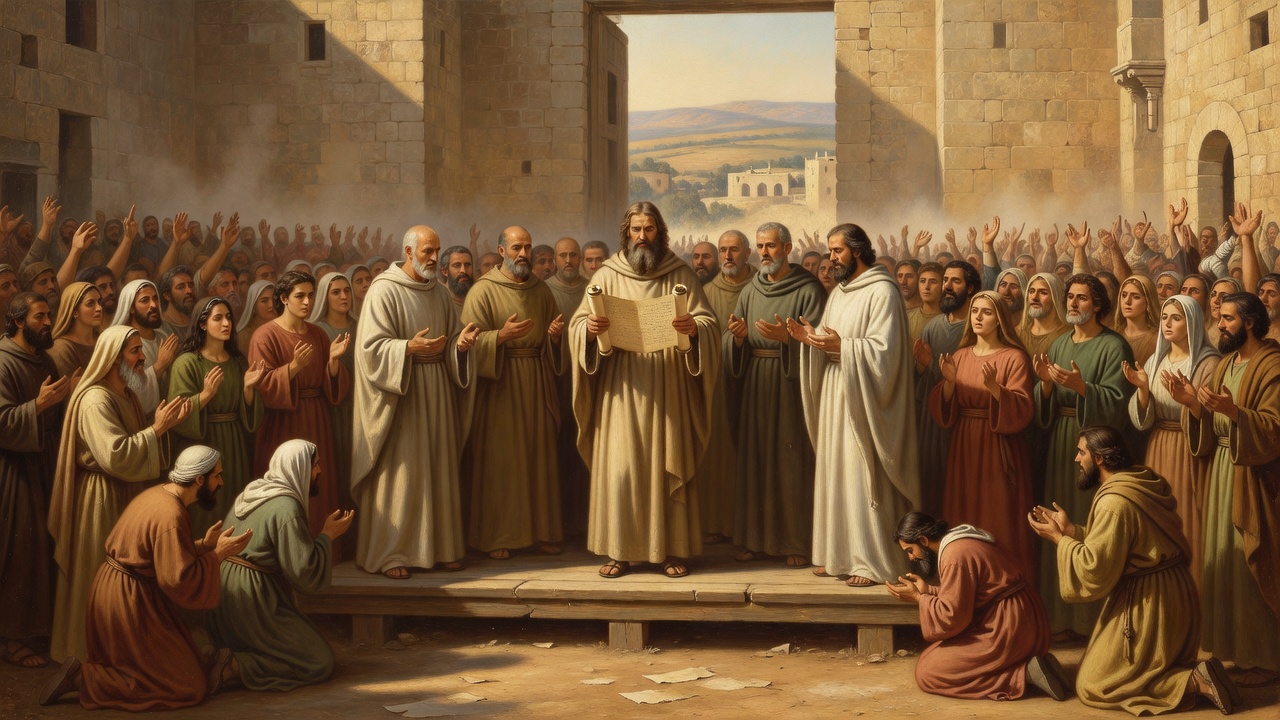
- Ezra the scribe, a priest descended from Aaron who had led exiles back from Babylon, read the Book of the Law of Moses from daybreak until noon to the assembly in Jerusalem. Standing on a high wooden platform in the square before the Water Gate, he read while Levites explained the text so the entire crowd could understand.Sources: the Bible text itself · Ezra · Water Gate · Jerusalem
- When the people wept upon hearing the Law read, Nehemiah the governor, Ezra, and the Levites instructed them not to grieve on a holy day. The people were told to celebrate with rich food and sweet drinks, share portions with those who had nothing prepared, and take comfort in the joy of the Lord.Sources: the Bible text itself
- After discovering the command in the Law to live in booths during the seventh month, the returned exiles gathered palm, olive, and myrtle branches to build shelters across Jerusalem's rooftops, courts, and squares by the Water Gate and the Gate of Ephraim. The text notes that the Israelites had not celebrated this feast in such a manner since the time of Joshua son of Nun.Sources: the Bible text itself · Water Gate · Gate of Ephraim
Notes written with AI assistance from open sources (Theographic Bible Metadata, CC BY-SA 4.0; Easton’s Bible Dictionary, public domain) and reviewed before publishing.
Places in this chapter
- Water Gate · Today: in Jerusalem · 31.777, 35.234 · verses 1, 3, 16
- Jerusalem · 31.777, 35.234 · verse 15
- Ephraim Gate · Today: in Jerusalem · 31.777, 35.234 · verse 16
Only places identified with high confidence are shown (90% or more according to the scholarly sources compiled by OpenBible). Period map: DARE (Digital Atlas of the Roman Empire), CC BY 4.0; modern map: © OpenStreetMap contributors; places: OpenBible.info (CC BY 4.0).
Credits and license for this translation
Buka Tabuna Tefadi
Mark, Acts, and selected excerpts of the Old Testament in the Buhutu language of Papua New Guinea
Buk Baibel long tokples Buhutu long Niugini
copyright © 2015 Wycliffe Bible Translators, Inc.
Language: Buhutu
Translation by: Wycliffe Bible Translators
This translation is made available to you under the terms of the
Creative Commons Attribution-Noncommercial-No Derivatives license 4.0.
You may share and redistribute this Bible translation or extracts from it in any format, provided that:
You include the above copyright and source information.
You do not sell this work for a profit.
You do not change any of the words or punctuation of the Scriptures.
Pictures included with Scriptures and other documents on this site are licensed just for use with those Scriptures and documents.
For other uses, please contact the respective copyright owners.
2015-10-06
Source: http://png.bible/bxh/ · eBible.org